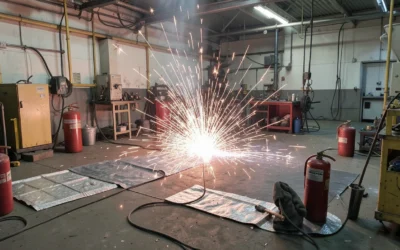
A welder joins metal parts by melting them together with intense heat, following blueprints to build or repair everything from bridges and pipelines to trailers and farm equipment. On a typical day, a welder reads drawings, measures and prepares metal, sets up welding equipment, lays welds to specification, and inspects the finished joint.
The U.S. has about 437,700 welders, cutters, solderers and brazers, and 63% of them work in manufacturing, according to the Bureau of Labor Statistics (BLS). This guide covers the daily duties, the skills you need, where welders work and what the job is really like.
What Does a Welder Do? Core Duties
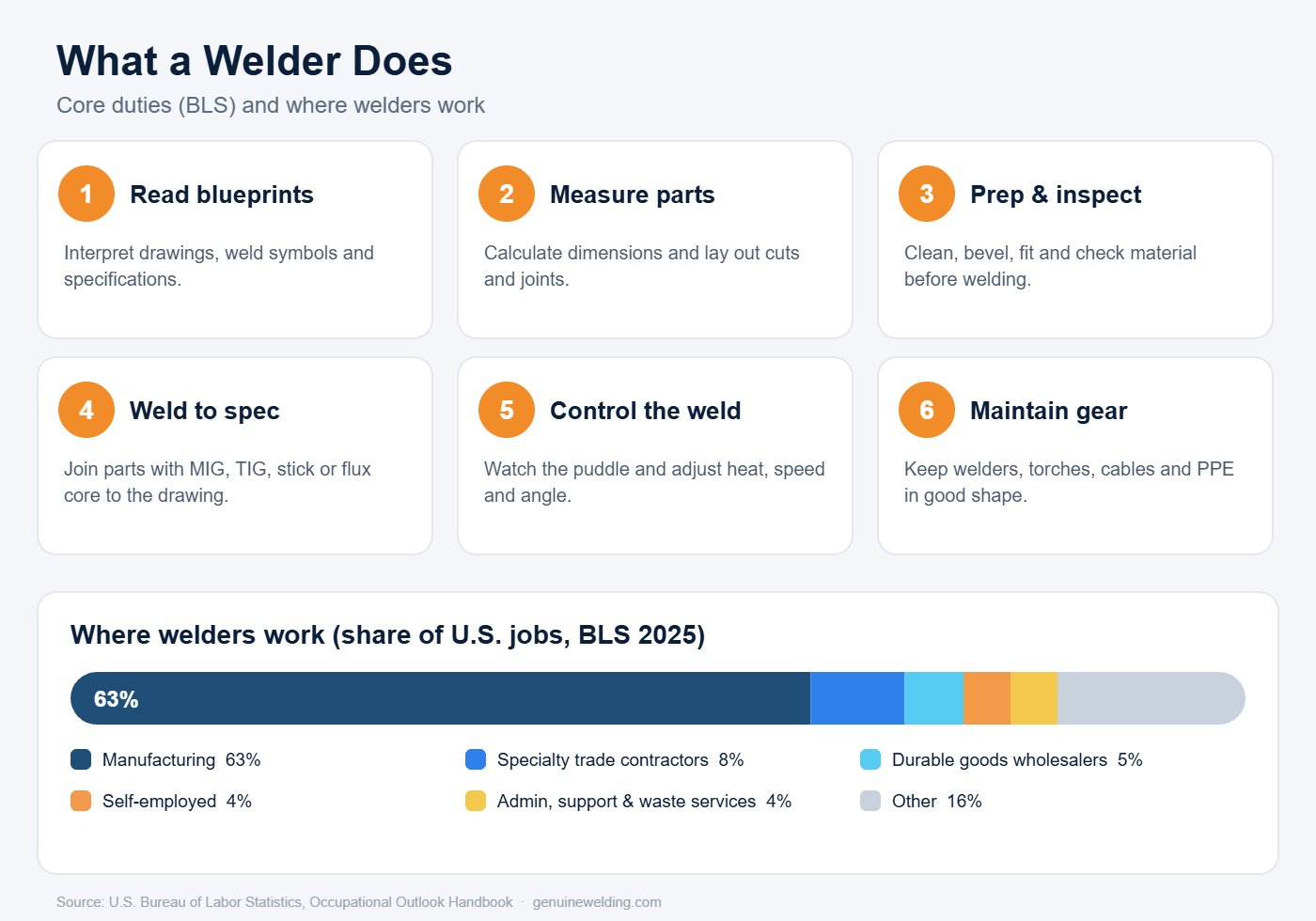
The BLS lists these as the typical duties of a welder:
- Read and interpret blueprints. Welders work from drawings, sketches and specifications. They must understand welding symbols that show the weld type, size and location.
- Calculate and measure dimensions. Before welding, they measure parts, mark cut lines and check that everything will fit.
- Inspect structures and materials. They check metal for rust, paint, cracks or poor fit-up, then grind, bevel and clean the joint.
- Weld to specification. Using MIG, TIG, stick or flux-cored welding, they join parts exactly as the drawing or procedure requires.
- Monitor the weld and adjust heat. Welders watch the molten puddle and adjust amperage, voltage, travel speed and angle as they go.
- Maintain equipment. They keep welders, torches, cables, regulators and safety gear in working order.
A Day in the Life of a Welder
Every job is different, but a typical shift for a fabrication or production welder looks like this:
- Start of shift: safety briefing, review the work order and drawings, check gas, wire and rods.
- Prep work: cut, grind and bevel parts; fit and tack them in a jig or on the table.
- Welding: run production welds or fabricate custom parts, often in flat, horizontal, vertical or overhead positions.
- Quality checks: visually inspect welds, clean slag and spatter, and fix any defects.
- End of shift: clean the work area, log completed parts and store equipment safely.
Field and pipeline welders also travel to job sites, work outdoors in all weather and may work long rotations. See our pipe welding guide for what that work involves.
Types of Welders and What They Do
| Welder type | What they do | Typical setting |
|---|---|---|
| Production welder | Repeats the same welds on parts, often with MIG or robotic cells | Factories, manufacturing plants |
| Fabrication welder | Cuts, fits and welds custom parts from drawings | Fab shops, job shops |
| Structural welder | Welds beams, columns and connections to AWS D1.1 | Construction sites, steel erectors |
| Pipe / pipeline welder | Welds pipe joints in fixed positions (5G, 6G) | Pipelines, refineries, power plants |
| TIG welder | Precise welds on stainless, aluminum and thin metal | Aerospace, food equipment, motorsports |
| Maintenance / repair welder | Fixes broken equipment and machinery | Mines, farms, plants, mobile service trucks |
| Underwater welder | Welds and inspects structures below water | Offshore platforms, ports, ships |
Skills Every Welder Needs
The BLS lists five important qualities for welders:
- Detail-oriented: spotting small changes in the puddle and joint makes the difference between a good and a bad weld.
- Manual dexterity: a steady hand and good hand-eye coordination.
- Physical stamina: long periods of bending, kneeling or standing in awkward positions.
- Physical strength: lifting heavy parts and moving equipment.
- Spatial skills: reading 2D drawings and picturing how the 3D parts fit together.
Employers also value shop math, blueprint reading, knowledge of welding processes, and the ability to pass weld tests.
Where Do Welders Work?
According to the BLS, the largest employers of welders are manufacturing (63%), specialty trade contractors (8%), durable goods wholesalers (5%), self-employment (4%) and administrative, support and waste services (4%). Work may be indoors in a ventilated shop or outdoors on scaffolds, platforms and job sites in any weather.
Work Schedule and Conditions
Most welders work full time, and some work more than 40 hours a week. Many factories run two or three shifts of 8 to 12 hours, so night and weekend work is common. Overtime is frequent on construction, shutdown and pipeline jobs.
Welders face hazards such as arc flash, fumes, burns and heavy lifting. Proper protective gear and training keep risks low. Read our welding safety guide for details.
How Much Do Welders Make?
The median welder earns $53,750 a year ($25.84 an hour) according to BLS May 2025 data, and the top 10% earn more than $77,530. Pipeline, rig and underwater welders often earn much more. See our full guide to how much welders make.
How to Become a Welder
Most welders start with a high school diploma, then complete a welding certificate or diploma program, an associate degree or an apprenticeship. Many then earn an AWS certification. Our step-by-step guide on how to become a welder covers training time and costs, and how to get a welding job explains weld tests and hiring.
What Does a Welder Do: FAQs
What does a welder do on a daily basis?
A welder reads drawings, prepares and fits metal, welds parts to specification, inspects and cleans the welds, and maintains equipment.
Is being a welder a hard job?
It can be physically demanding because of heat, awkward positions and heavy parts, but many welders enjoy the hands-on work. See is welding hard to learn?
Do welders need to read blueprints?
Yes. Reading blueprints and weld symbols is one of the core duties of nearly every welding job.
How many hours do welders work?
Most work full time, often 40 to 50 hours a week, with overtime common on construction and pipeline jobs.
What industries hire the most welders?
Manufacturing employs 63% of U.S. welders, followed by specialty trade contractors such as construction firms.