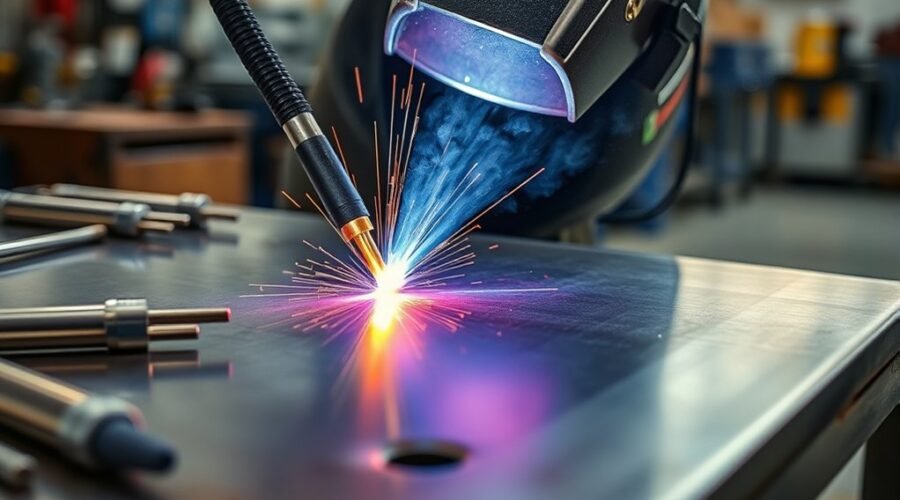
Welding stainless steel to mild steel is practical and widely used, but the joint needs the correct filler metal, clean preparation, controlled heat input, and proper finishing. For common austenitic stainless grades such as 304 or 304L joined to ordinary carbon steel, ER309L is usually the starting point because its higher alloy content tolerates dilution from the mild steel better than standard carbon-steel filler.
Quick Answer
Yes, you can weld stainless steel to mild steel. For common 304/304L-to-carbon-steel joints, ER309L filler is usually the best starting point. Clean both metals, use the shielding gas and polarity required by your process, control heat and distortion, and protect the finished joint from contamination and corrosion.
Key Takeaways
- Stainless steel can be welded to mild steel when the metals are correctly identified, cleaned, fitted, and welded with an appropriate procedure.
- For common austenitic stainless-to-carbon-steel joints, ER309L or ER309LSi is normally preferred; ER312 is more often used for difficult-to-weld, high-strength, repair, or unknown steels.
- Do not use a fixed “heat percentage” toward one metal. Maintain fusion on both sides while keeping overall heat input low enough to control distortion and dilution.
- TIG, MIG, and stick can all work, but each requires the correct filler, shielding system, polarity, and machine settings.
- After welding, remove contamination and damaging heat tint from the stainless as required, protect exposed carbon steel, and consider passivation where the service environment calls for it.
At a Glance
| Time Required | Typically 30–90 minutes for a small prepared joint, plus cooling and finishing time |
| Difficulty | Intermediate; safety-critical or code work requires an approved procedure and qualified personnel |
| Tools Needed | MIG, TIG, or stick welder; suitable 309L-type filler; clamps; stainless-only cleaning tools; PPE; ventilation or fume extraction; optional copper backing bar |
| Cost | Varies with filler, shielding gas, abrasives, finishing chemicals, and project size; welding equipment is not included |
Warning: Welding stainless steel can generate hexavalent chromium and other hazardous fumes. Use effective local exhaust or other required ventilation, keep your breathing zone out of the plume, wear appropriate welding PPE, and follow OSHA, workplace, confined-space, and respiratory-protection requirements. Never rely on an open door or small fan as a substitute for required exposure control.
Can You Weld Stainless to Mild Steel?
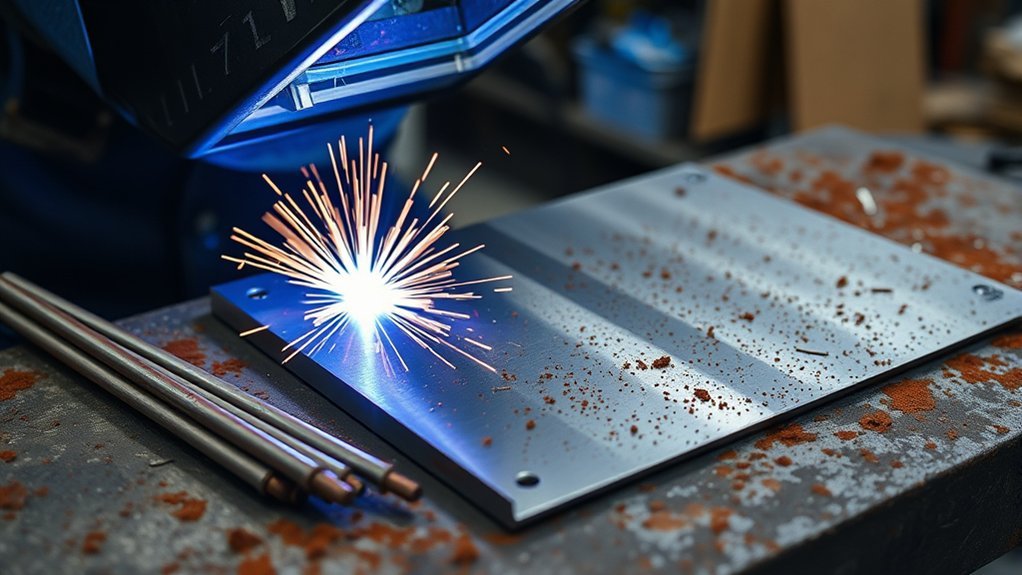
Yes. Austenitic stainless steels such as 304 and 304L are commonly joined to carbon or mild steel with an over-alloyed stainless filler. The important issue is not whether the metals can melt together, but whether the resulting weld chemistry, dilution, heat-affected zones, corrosion protection, and service requirements are acceptable.
For routine 304/304L-to-carbon-steel fabrication, ESAB recommends 309-type filler for carbon-to-stainless dissimilar welding. The additional chromium and nickel in the filler compensate for dilution by the carbon steel and help maintain a weld structure with better crack resistance than an ordinary mild-steel filler.
For common austenitic stainless-to-carbon-steel fabrication, ER309L is the normal starting point—not ordinary ER70S-6 carbon-steel wire.
Fit-up should be controlled, surfaces must be free of oil, paint, rust, scale, and carbon contamination, and the welding procedure must produce fusion on both sides without excessive heat. If you are still choosing equipment, this beginner welder comparison explains the practical differences between MIG, TIG, and stick machines.
Why 309L Is Usually Preferred and When 312 Makes Sense
ER309L is commonly used for joining austenitic stainless steel to carbon or low-alloy steel because its chromium-nickel content is high enough to tolerate dilution from the carbon-steel side. The low-carbon “L” grade also reduces the carbon content of the deposited weld metal compared with standard 309.
ER312 is also a legitimate dissimilar-metal filler, but it serves a somewhat different role. ESAB describes ER312 as a high-chromium, ferritic-austenitic filler widely used for dissimilar and difficult-to-weld steels. It is useful for repair work, unknown steels, tool steels, and joints where high crack resistance is needed.
Ordinary carbon-steel wire such as ER70S-6 is not the normal filler choice when the goal is a properly alloyed stainless-to-carbon-steel weld. If you are comparing wire types, this guide to MIG welding wire options is useful, but select a 309L-type stainless wire for the common dissimilar joint rather than substituting ER70S-6.
Chromium-Nickel Compatibility
The filler must account for dilution from both base metals. When molten carbon steel mixes into a stainless filler, the chromium and nickel percentages in the final weld pool decrease. An over-alloyed filler such as 309L provides enough alloy reserve to keep the deposited weld in a useful composition range after that dilution occurs.
This is why 309L is commonly used between 304/304L stainless and mild steel. The goal is not to make the weld identical to either base material; it is to create a compatible transition between them.
Crack Resistance Benefits
Filler-metal chemistry also affects hot-cracking resistance and the microstructure that forms after dilution. A properly selected stainless filler is designed to tolerate the mixed chemistry better than ordinary carbon-steel filler.
- 309L is the normal first choice for many austenitic stainless-to-carbon-steel joints.
- 312 has a high-ferrite, highly alloyed deposit and is useful for difficult, unknown, or crack-sensitive steels.
- Both are intended for dissimilar-metal applications, but they are not interchangeable in every service condition.
- High-temperature, pressure, structural, corrosive, or code work may require another filler or a qualified procedure.
Best Joint Strength
There is no single filler that produces the “strongest” stainless-to-mild-steel joint in every situation. Joint strength depends on base-metal grades, section thickness, weld size, joint design, penetration, defects, dilution, heat input, filler classification, and service conditions.
ER309L provides an excellent practical combination for many 304/304L-to-carbon-steel jobs. ER312 may have advantages in specialized repair or difficult-steel applications. For engineered structures, pressure equipment, lifting hardware, or other safety-critical fabrication, use the filler and welding procedure specified by the applicable code, engineer, or qualified WPS.
What Changes When the Stainless Side Is 304 or 304L?
304 and 304L are common austenitic stainless grades, and they are routinely joined to carbon steel. Their welding behavior, however, is different from mild steel. Austenitic stainless conducts heat relatively slowly and expands relatively strongly as temperature rises.
Outokumpu lists thermal conductivity for 304/304L at about 15 W/(m·K) at 20°C and a coefficient of thermal expansion around 16 × 10−6/K from 20–100°C. That combination means heat tends to remain concentrated near the weld while the stainless expands and contracts noticeably, increasing the need for careful tack placement, sequencing, and heat control.
For 304/304L-to-mild-steel joints, 309L is normally a more suitable transition filler than 308L. Low-hydrogen practice is still important where the carbon-steel side, thickness, restraint, or applicable procedure creates hydrogen-cracking concerns. This guide to general-purpose welding electrodes can help compare stick-electrode families, but the dissimilar joint itself normally calls for a stainless dissimilar-metal electrode rather than a standard carbon-steel rod.
Note: Stainless filler does not turn the carbon-steel part into stainless steel. The mild-steel side can still rust and may corrode faster in wet or salty service if it is left unprotected next to a large stainless surface.
How to Prep Stainless and Mild Steel
Start by positively identifying both base metals and removing paint, oil, grease, rust, mill scale, coatings, and other contaminants from the weld zone. Do not weld through unknown coatings.
Use tools reserved for stainless steel on the stainless side. A carbon-steel wire brush or contaminated grinding wheel can embed free iron into stainless and create later rust staining.
Clamp the parts securely and check the joint gap before welding. Uneven gaps make heat control much harder, especially on thin material. A copper backing or chill bar can be useful behind thin sheet because it supports the molten puddle and absorbs heat.
Choose the filler before final machine setup. ER309L/ER309LSi is the normal starting point for common MIG or TIG work; stick welding uses the appropriate E309L-type electrode rather than an ER designation.
Shielding gas must match the process and filler. For stainless MIG, a low-CO2 argon-rich mix such as 98% argon/2% CO2 is commonly specified for solid stainless wire, while TIG normally uses inert argon shielding. Always follow the filler and machine manufacturer’s data. This MIG shielding-gas guide explains common gas families and their effects.
Pro Tip: Prepare a short test coupon made from the same metals and thicknesses before welding the actual part. Confirm bead wetting, penetration, distortion, gas coverage, and machine response on the coupon instead of experimenting on the finished assembly.
Set Up Your Welder for Dissimilar Metals
Machine settings should be based on process, filler diameter, material thickness, joint type, welding position, and the manufacturer’s parameter chart. Avoid copying a single amperage or voltage setting across different machines.
| Process | Typical filler for 304/304L to mild steel | Basic setup |
| TIG / GTAW | ER309L rod | DCEN for ordinary steel/stainless work; inert argon shielding; short arc; controlled amperage |
| MIG / GMAW | ER309L or ER309LSi wire | Use the polarity and argon-rich shielding mix specified by the wire manufacturer; short-circuit or pulsed transfer may help on thinner work |
| Stick / SMAW | E309L-type stainless electrode | Use the electrode manufacturer’s recommended current range and polarity; remove slag fully between passes |
If you regularly switch between MIG, TIG, and stick, a machine with multiple welding-process capabilities can simplify shop setup, but process versatility does not replace correct filler selection.
Keep the arc short and use enough energy to obtain fusion without dwelling unnecessarily. Stainless retains heat near the weld, so long pauses and oversized beads can quickly increase distortion and heat tint.
Welding Stainless to Mild Steel Step by Step
The basic sequence is straightforward: identify and clean the metals, choose the correct dissimilar-metal filler, establish a stable process setup, tack the joint, weld with controlled heat input, inspect the bead, and finish both the stainless and carbon-steel sides for their service environment.
If the job also requires cutting plate or brackets, a plasma cutter may be useful for fabrication, but its dual-voltage capability has no direct effect on the metallurgy or quality of the stainless-to-mild-steel weld.
Clean and Clamp Metal
Clean both joint faces and the surrounding heat-affected area. Use a dedicated stainless brush or uncontaminated stainless-safe abrasive on the stainless side. Remove mill scale and rust from the carbon-steel side until the arc can reach clean metal.
Fit and clamp the parts so the root opening stays consistent. Use tacks at sensible intervals to stop the pieces from pulling out of alignment as they heat. On thin sheet, a copper backing bar can help support the puddle and reduce burn-through.
- Identify both metals.
- Remove coatings, scale, rust, grease, and moisture.
- Keep stainless tools segregated.
- Set a consistent joint gap.
- Tack and recheck alignment.
- Use suitable fume extraction before striking the arc.
Choose Proper Filler
For ordinary 304/304L stainless joined to mild steel, ER309L is usually the practical TIG or MIG choice. ER309LSi is a related MIG wire with higher silicon that can improve puddle wetting in appropriate applications.
ER312 is more specialized. Its highly alloyed deposit is useful for difficult steels, repair work, unknown compositions, and applications where extra crack resistance is needed. It should not automatically replace 309L whenever two different steels are joined.
For stick welding, use the corresponding stainless dissimilar-metal electrode specified for the job, commonly an E309L-type electrode. For duplex stainless, high-temperature service, pressure systems, or unusual alloys, filler selection can change substantially and should follow an approved welding procedure.
Weld and Finish
Begin with the lowest practical heat input that still gives complete fusion. Watch both toes of the puddle and adjust torch or electrode angle only as needed for the actual joint geometry and thickness. There is no universal rule that a fixed percentage of arc energy must be aimed at the mild-steel side.
- Maintain a short, stable arc.
- Keep travel speed steady.
- Avoid oversized beads and unnecessary weaving.
- Use short weld segments where distortion is a concern.
- Allow the joint to cool between passes when needed.
- Inspect for undercut, porosity, lack of fusion, cracking, and excessive oxidation.
- Remove slag completely between stick-welding passes.
For MIG, a push/forehand technique is commonly used with gas-shielded stainless wire because it gives good visibility of the leading edge of the puddle and shielding coverage. For TIG, maintain a tight arc and keep the filler end inside the shielding envelope rather than letting it oxidize between dips.
How to Avoid Cracks and Warping
Distortion is controlled mainly through fit-up, restraint, tack placement, bead size, sequencing, and total heat input. Austenitic stainless holds heat locally and expands strongly, so long continuous beads on thin material can pull the joint out of shape quickly.
Use short welds, alternate locations where the joint design permits, and avoid depositing more weld metal than the joint requires. Copper backing can help on thin sections. Do not quench a hot stainless weld with water unless an approved procedure specifically permits it.
Preheat is not automatically required for ordinary mild-steel-to-304 fabrication. Whether preheat is needed depends on the carbon-steel grade, carbon equivalent, thickness, restraint, ambient temperature, hydrogen risk, and governing welding procedure. Follow the WPS or engineering requirement rather than applying a blanket 150°F rule.
A TIG machine with useful current control can make thin dissimilar work easier; this guide covers practical TIG welder features for shop use.
Troubleshooting Common Problems
- Porosity: Check gas flow, leaks, drafts, contaminated metal, dirty filler, excessive torch distance, and moisture.
- Lack of fusion: Increase usable heat input or reduce travel speed slightly, correct torch angle, and make sure mill scale is removed from the carbon steel.
- Cracking: Confirm filler selection, joint restraint, dilution, base-metal identity, and the required procedure. Do not simply add more heat.
- Warping: Reduce bead size, improve tack sequence, shorten weld segments, and allow controlled cooling between passes.
- Heavy blue, gray, or black stainless oxidation: Improve shielding coverage and reduce unnecessary heat; root-side stainless may require purge protection in corrosion-sensitive work.
- Rust staining on stainless: Look for carbon-steel brush contamination, contaminated abrasives, embedded iron, or incomplete post-weld cleaning.
Clean the Weld and Restore Protection
After the joint cools, clean the stainless side with stainless-only tools. Remove slag, spatter, embedded iron, and other contamination without smearing carbon steel across the stainless surface.
Heat tint is not the same thing as ordinary dirt. The colored oxide created beside a stainless weld can reduce corrosion resistance underneath it. Depending on service requirements, the affected surface may need mechanical treatment, pickling, or electrochemical cleaning.
Nickel Institute guidance on pickling and passivating stainless steel distinguishes descaling, pickling, cleaning, and passivation rather than treating them as a single operation.
- Remove weld slag and spatter.
- Use stainless-only brushes and abrasives on stainless.
- Remove damaging heat tint when required by the service environment.
- Rinse and neutralize chemical treatments according to the product instructions.
- Passivate when the specification or service condition calls for it.
- Restore paint or another corrosion-protection system on the carbon-steel side.
Warning: Pickling and passivation chemicals can be highly corrosive and hazardous. Use only products intended for stainless steel and follow the manufacturer’s PPE, ventilation, handling, neutralization, and disposal instructions.
Where Stainless-To-Mild Welds Work Best
Stainless-to-mild-steel joints are useful when corrosion resistance is needed only in part of an assembly. Examples include equipment frames, brackets, guards, automotive or transport components, supports, architectural details, and stainless equipment mounted to carbon-steel structures.
The design works best when the corrosion-protection system is considered before welding. Stainless filler protects the deposited weld chemistry better than carbon-steel filler, but the adjacent mild steel remains vulnerable to rust.
In wet, salty, or continuously conductive environments, stainless and carbon steel can form a galvanic couple. The less noble carbon steel is the side at risk. British Stainless Steel Association guidance recommends restoring the carbon-steel coating over the weld area where bimetallic corrosion is a concern.
For food, pharmaceutical, pressure, chemical, structural, high-temperature, lifting, or safety-critical service, do not assume a general shop procedure is sufficient. Material grade, filler, procedure qualification, inspection, corrosion allowance, sanitary design, and applicable code requirements can control the joint design.
A multi-process home welder can provide useful flexibility for non-code shop projects, but equipment capability is separate from whether the joint is approved for a particular structural or pressure application.
Sources
- ESAB — Welding Dissimilar Metals Using 309 Stainless Steel — supports 309-type filler selection for carbon-to-stainless joints.
- ESAB — OK Autrod 312 — supports ER312 use for dissimilar and difficult-to-weld steels.
- OSHA — Hexavalent Chromium — supports the Cr(VI) hazard warning for stainless-steel hot work.
- OSHA 29 CFR 1910.252 — supports welding ventilation, PPE, fire-prevention, and confined-space precautions.
- Nickel Institute / Euro Inox — Pickling and Passivating Stainless Steel — supports post-weld heat-tint removal, cleaning, pickling, and passivation guidance.
- British Stainless Steel Association — Welding Stainless Steels to Other Steels — supports dissimilar-metal filler and corrosion-protection guidance.
Frequently Asked Questions
What happens if you weld stainless steel to mild steel?
The two metals can form a sound joint, but the weld chemistry is diluted by both base metals. With the correct filler—commonly 309L for 304/304L-to-carbon steel—the joint can remain ductile and crack resistant. Poor filler selection, excessive heat, contamination, or inadequate corrosion protection can cause cracking, rusting, distortion, or premature failure.
What two metals cannot be welded together?
There is no simple universal list of metal pairs that can never be joined. Some combinations, such as aluminum directly fusion-welded to steel, are extremely difficult because brittle intermetallic compounds form. Specialized transition inserts, brazing, friction-based processes, laser processes, or mechanical joining may still make such combinations possible.
Can I weld stainless steel with normal MIG wire?
Ordinary carbon-steel MIG wire such as ER70S-6 can physically deposit metal onto stainless in some situations, but it is not the preferred filler for a proper stainless-to-mild-steel dissimilar joint. For common 304/304L-to-carbon-steel work, use ER309L or ER309LSi unless the welding procedure specifies something else.
Can you use 7018 to weld stainless to mild steel?
E7018 may physically join some stainless and carbon-steel parts, but it is not the normal filler for preserving suitable dissimilar-weld chemistry or corrosion performance. For routine stainless-to-mild-steel stick welding, an appropriate E309L-type stainless electrode is usually a better starting point. Structural or code work must follow the approved WPS.
What shielding gas should I use for MIG welding stainless to mild steel?
Use the gas specified for the stainless filler wire and transfer mode. For solid stainless MIG wire, an argon-rich blend with a small amount of CO2 or oxygen is common; 98% argon/2% CO2 is one widely used option. Avoid assuming that a 75/25 carbon-steel MIG mix is appropriate for every stainless wire.
Is TIG or MIG better for welding stainless to mild steel?
TIG gives very precise heat and puddle control and is useful for thin, visible, or high-quality joints. MIG is faster and practical for production and general fabrication. Either can produce a sound joint when the filler, shielding gas, preparation, heat input, and procedure are correct.
Do I need to preheat mild steel before welding it to stainless?
Not automatically. Thin ordinary low-carbon steel joined to common austenitic stainless often does not need a blanket preheat. Preheat should be based on the carbon-steel grade, thickness, carbon equivalent, restraint, hydrogen risk, temperature, and the applicable welding procedure.
Will a stainless-to-mild-steel weld rust?
The stainless filler can provide much better corrosion resistance than carbon-steel filler, but the mild-steel side remains rust-prone. In wet or salty service, restore paint or another protective coating over the carbon steel and the transition area as required by the design.
Conclusion
Stainless steel can be welded successfully to mild steel when the filler and procedure are chosen for a dissimilar-metal joint. For common 304/304L-to-carbon-steel fabrication, ER309L is normally the first filler to consider, while ER312 is better reserved for specific difficult-steel and repair applications.
Clean both metals carefully, prevent carbon contamination of the stainless, use process-appropriate shielding and machine settings, control heat rather than relying on a fixed torch-bias rule, and inspect the completed weld before finishing it. Remove harmful heat tint where service conditions require it, protect the carbon-steel side from corrosion, and use a qualified WPS for structural, pressure, sanitary, high-temperature, or other safety-critical work.