Welding ferrous metals is not a one-procedure job. Low-carbon steel is usually forgiving, while cast iron, higher-carbon steel, stainless steel, and alloy steels can react very differently to the same heat input. Reliable welding starts by identifying the material, then matching the process, filler metal, joint preparation, and thermal control to its weldability.
Quick Answer
Successful welding of ferrous metals starts with identifying the exact iron-based alloy, then matching filler, process, heat input, and cooling rate to its hardenability and crack sensitivity. Low-carbon steel is usually forgiving; cast iron and higher-carbon or highly alloyed steels need tighter control, especially around preheat, hydrogen, and post-weld cooling.
Key Takeaways
- Ferrous metals are iron-based, but they are not all magnetic; stable austenitic stainless steels are an important exception.
- Carbon content matters, but steel thickness, restraint, alloy content, hydrogen level, and carbon equivalent also influence cracking risk and preheat requirements.
- Cast-iron welding procedures vary by iron type. Nickel and nickel-iron fillers are common, while white cast iron is normally considered unsuitable for conventional fusion welding.
- SMAW, GMAW, GTAW, FCAW, SAW, and oxyfuel processes each suit different combinations of thickness, position, productivity, access, and metallurgical control.
- Clean joint faces, correct fit-up, suitable heat input, dry low-hydrogen consumables where required, and controlled cooling help prevent common weld imperfections.
What Are Ferrous Metals?
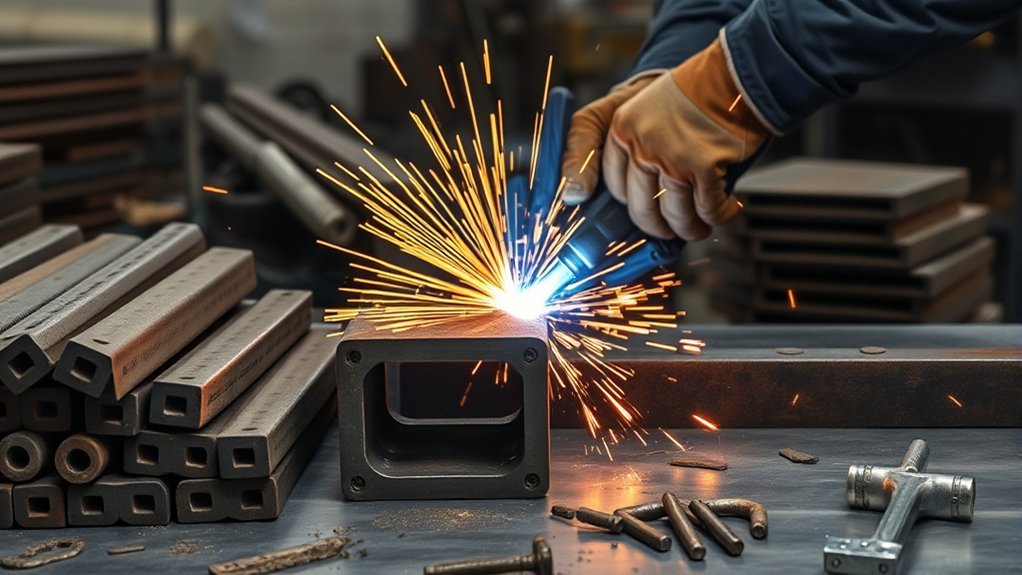
Ferrous metals are materials in which iron is the principal metallic element. The group includes carbon steels, alloy steels, stainless steels, cast irons, and wrought iron, but their mechanical and welding properties vary widely.
Carbon level and alloying additions influence strength, hardness, ductility, corrosion behavior, and the way the heat-affected zone responds to welding. Cast iron generally contains much more carbon than ordinary steel, which is one reason it is more crack-sensitive during fusion welding.
Magnetism is not a reliable universal test for identifying a ferrous alloy. According to Outokumpu’s stainless-steel property guidance, ferritic, martensitic, and duplex stainless steels are ferromagnetic, while stable austenitic grades are not magnetizable.
Ferrous materials remain common in structures, machinery, vehicles, piping, tools, and industrial equipment because useful combinations of strength, toughness, cost, and manufacturability are available across many grades. Selecting suitable welding rods for general fabrication also depends on knowing the exact base metal rather than simply knowing that it contains iron.
Ferrous Metal Types and Where They’re Used
The main ferrous-metal families differ in carbon content, alloy additions, microstructure, and service requirements. Those differences determine both where a material is useful and how easily it can be welded.
- Mild and low-carbon steel is widely used for frames, sheet-metal parts, brackets, general fabrication, and structural work. Its relatively low hardenability usually gives it good weldability.
- Medium- and high-carbon steel offers greater attainable hardness and strength, but the heat-affected zone can become harder and more crack-sensitive. Welding may require low-hydrogen practice, preheat, or additional heat treatment.
- Cast iron is used for items such as machine housings, engine components, pipes, bases, and other cast parts. Gray, ductile, malleable, white, and alloy cast irons do not have identical weldability.
- Alloy steel contains deliberate additions such as chromium, nickel, molybdenum, or manganese to change strength, toughness, hardenability, wear resistance, or high-temperature performance.
- Stainless steel contains enough chromium to form a protective passive surface film. Austenitic, ferritic, martensitic, duplex, and precipitation-hardening grades require different welding considerations.
- Wrought iron contains very little carbon and is now encountered mainly in older structures, restoration projects, and decorative work.
The best welding process also depends on thickness, access, position, finish requirements, and production rate. A fabricator choosing equipment for common steel work may therefore evaluate different MIG welding systems, while a repair involving cast iron may call for an entirely different procedure.
Which Properties Make Ferrous Metals Harder to Weld?
Ferrous metals become harder to weld when welding creates a brittle heat-affected zone, high residual stress, excessive hardness, or a crack-sensitive microstructure. Carbon and alloy content matter, but section thickness, restraint, cooling rate, hydrogen, and joint design also affect the result.
Weldability is controlled by the complete material-and-procedure combination, not by carbon content alone.
Higher carbon and alloy levels can increase hardenability. If the weld area cools quickly, a hard martensitic structure may form in susceptible steels, reducing toughness and increasing hydrogen-cracking risk.
Hydrogen cracking needs several conditions to coincide: diffusible hydrogen, a susceptible hard microstructure, and tensile stress. TWI’s hydrogen-cracking guidance recommends controlling joint cleanliness, consumable hydrogen, heat input, restraint, preheat, and interpass temperature according to the material and procedure.
Sulfur, phosphorus, inclusions, contamination, and unfavorable grain structures can also reduce weld soundness. Thick sections and highly restrained joints are especially demanding because they remove heat quickly and leave less freedom for weld shrinkage.
Cast iron adds another problem: its low ductility can make it difficult to absorb expansion and contraction stresses. Selecting equipment with suitable control, including appropriate TIG and multi-process capability, matters only after the base material and required procedure are known.
How Carbon Content Changes Steel Weldability
As carbon content rises, plain-carbon steel generally becomes more capable of hardening during rapid cooling and less forgiving to weld. For alloy steels, carbon equivalent is often more useful than carbon percentage alone because elements such as manganese, chromium, molybdenum, nickel, copper, and vanadium can also affect hardenability.
| Steel category | Approximate carbon guide | Typical welding implication |
|---|---|---|
| Low-carbon / mild steel | Up to about 0.30% | Generally the most forgiving carbon-steel group; preheat may still be needed for thick, restrained, or hydrogen-sensitive work. |
| Medium-carbon steel | About 0.30% to 0.60% | Greater HAZ-hardening risk; tighter hydrogen, heat-input, preheat, and cooling control may be necessary. |
| High-carbon steel | Above about 0.60% | High crack and hardness sensitivity; a qualified procedure may require preheat, low-hydrogen consumables, controlled cooling, and heat treatment. |
These ranges are practical categories rather than universal grade specifications. TWI notes that mild steels with carbon equivalent below about 0.4 are generally readily weldable with low-hydrogen practice, although thick sections, high restraint, or greater hydrogen exposure can still make preheat necessary.
For precision work on thin or difficult parts, the fine heat control available from TIG welders can be useful, but process control does not remove the metallurgical requirements of the grade being welded.
How to Weld Cast Iron Without Cracking
Cast iron should be identified before you choose filler metal, preheat, or welding technique. There is no single correct preheat temperature for every casting: gray, ductile, malleable, and alloy cast irons respond differently, and white cast iron is normally considered unweldable by conventional fusion methods.
TWI’s cast-iron welding guidance lists nickel, nickel-iron, and nickel-copper among common MMA filler systems. It also shows that recommended preheat can range from room temperature for some irons and processes to about 300–330°C (572–626°F) for many gray or pearlitic cast-iron situations.
| Control | Practice |
|---|---|
| Identification | Determine whether the casting is gray, ductile, malleable, white, or an alloy cast iron before repair. |
| Heat input | Use the procedure-specific preheat and keep arc heat low enough to limit dilution and HAZ hardening. |
| Electrode | Select a cast-iron-compatible nickel, nickel-iron, or other specified filler for the required strength and machinability. |
| Cooling | Cool gradually when the procedure calls for slow cooling to reduce thermal shock and cracking. |
| Finish | Clean between passes, inspect the repair, and machine the deposit only when required. |
For MMA/SMAW repair, low current, small electrodes, and short stringer beads can limit parent-metal melting. Peening is used in some cast-iron procedures to counter weld-shrinkage stress, but it must match the repair procedure rather than being applied automatically.
Complex castings deserve extra care because uneven heating can create damaging expansion stresses before welding even begins. A TIG welder with fine current control may suit certain repairs, but GTAW is not automatically the preferred process for every cast-iron casting.
How Alloying Elements Affect Welds
Alloying elements change how a ferrous metal hardens, solidifies, resists corrosion, and responds to heat. Their combined effect is why alloy steel should be identified by grade rather than treated as ordinary mild steel.
- Nickel can improve toughness and is also widely used in cast-iron filler metals because nickel-rich deposits can remain comparatively ductile and machinable.
- Molybdenum improves high-temperature strength and also contributes to steel hardenability, so molybdenum-bearing steels may require tighter thermal control.
- Sulfur and phosphorus can increase hot-cracking or brittleness problems when present at unfavorable levels or concentrated by dilution and solidification.
- Silicon is commonly used as a deoxidizer. In cast iron it also strongly influences graphite formation and therefore affects microstructure and weld response.
- Chromium increases hardenability in many alloy steels and provides the passive-film-forming corrosion resistance that defines stainless steel.
Because several elements may influence hardenability at the same time, welding procedures often evaluate carbon equivalent rather than carbon alone. The ability to switch processes on multi-process welders can improve equipment flexibility, but it does not replace correct filler selection or a qualified welding procedure.
Best Welding Processes for Ferrous Metals
The best welding process for a ferrous metal depends on material grade, thickness, welding position, joint access, required deposition rate, and quality requirements. No single process is best for every steel or cast-iron application.
| Process | Where it fits well | Main consideration |
|---|---|---|
| SMAW / stick | Structural steel, outdoor work, repairs, and many cast-iron procedures | Electrode classification, moisture control, slag removal, and heat input must suit the material. |
| GMAW / MIG-MAG | Production welding of carbon, low-alloy, and stainless steels | Wire, transfer mode, shielding gas, and parameter range must match the grade and joint. |
| GTAW / TIG | Thin sections, stainless steel, root passes, and work needing precise heat and filler control | Lower deposition rate makes it less productive for many large-volume welds. |
| FCAW | Structural fabrication and higher-deposition work on carbon and low-alloy steels | Consumable type, shielding method, slag, hydrogen classification, and position matter. |
| SAW | Long welds and medium-to-heavy steel fabrication | High productivity and deep fusion are valuable, but position and heat-input limits restrict some applications. |
| Oxyfuel | Specialized repair, heating, and some cast-iron work | Its broad heat source creates a different thermal cycle from concentrated arc processes. |
The American Welding Society description of submerged arc welding defines SAW as an arc process in which the arc and molten metal are covered by granular fusible flux. It is particularly useful for mechanized, high-deposition steel fabrication.
Process selection should balance metallurgical control, joint access, deposition rate, weld position, and required quality rather than relying on one preferred process.
For small-shop carbon-steel work, comparisons such as the Hobart Handler 140 versus Lincoln 140 MIG comparison can help with equipment choice after the process requirements are clear.
Warning: Welding can expose you to metal fumes, UV radiation, burns, electrical shock, and fire hazards. Follow OSHA welding, cutting, and brazing hazard guidance, use suitable ventilation and PPE, and identify coatings or contaminants before heating the workpiece.
Why Preheat and Post-Weld Heat Matter
Preheat slows cooling and reduces temperature gradients, which can reduce hardening and hydrogen-cracking risk in susceptible steels. It is not automatically required for every ferrous metal, and a generic temperature range should not replace the welding procedure for the actual grade, thickness, hydrogen level, and restraint.
- Preheat can slow cooling. This may reduce formation of hard, crack-sensitive microstructures in suitable steels.
- Preheat can assist hydrogen control. More time at elevated temperature allows diffusible hydrogen more opportunity to escape before the joint reaches crack-sensitive conditions.
- Interpass temperature matters too. Multi-pass welds must remain within the procedure’s specified thermal limits.
- Post-weld heat treatment is material- and code-dependent. When correctly specified, PWHT can redistribute residual stresses and temper some hardened structures; the wrong treatment can damage properties.
- Cast iron often needs controlled cooling. Slow cooling is used in many procedures to reduce thermal shock and shrinkage stress.
For common mild steel, TWI notes that preheat is generally unnecessary at low carbon equivalent when a low-hydrogen process is used, although thick sections and highly restrained joints can still require it. Higher-carbon and alloy steels need progressively tighter control.
Beginners should therefore learn to read electrode requirements and welding procedures rather than memorize one temperature. Choosing suitable welders for beginner fabrication is only one part of producing a sound joint.
Common Ferrous Metal Weld Defects
Ferrous weld imperfections usually trace back to joint preparation, heat input, technique, contamination, consumable condition, or an unsuitable procedure. Three important problems are excessive penetration, incomplete fusion, and hydrogen cracking.
Acceptance is application-specific. A discontinuity that is unacceptable under one structural, piping, or pressure-vessel code may be treated differently under another, so inspection should use the governing specification rather than appearance alone.
Stable torch or electrode control also matters. Suitable TIG welding gloves support safe handling, but PPE does not compensate for incorrect parameters or poor joint preparation.
Excessive Penetration
Excessive penetration is excess weld metal protruding through the root of a fusion weld made from one side. It is different from undercut, root concavity, or a groove on the weld face.
According to TWI guidance on excess penetration, common causes include an excessive root gap, root faces that are too small, excessive heat input, or a combination of those conditions.
Prevention starts with correct fit-up and the welding parameters specified for the joint. Travel speed, amperage, voltage, root opening, root face, and technique must work together rather than being adjusted independently without regard to the procedure.
Incomplete Fusion
Incomplete fusion occurs when deposited weld metal does not fully fuse with the base metal or a previous weld bead. It reduces the effective bonded area and can become a serious stress concentrator.
Common causes include insufficient arc energy, excessive travel speed, poor electrode or gun angle, restricted joint access, narrow joint preparation, surface contamination, and weld-pool flooding that runs ahead of the arc.
Prevention includes cleaning the joint, providing adequate access, choosing suitable parameters, and directing the arc so the sidewall or previous bead actually melts. If the imperfection is below the surface, ultrasonic or radiographic testing may be required, depending on material, geometry, procedure, and governing inspection requirements.
Hydrogen Cracking
Hydrogen cracking, often called cold cracking, can appear after the weld has cooled rather than while the pool is solidifying. It is most strongly associated with diffusible hydrogen, a susceptible hard microstructure, and tensile stress.
- Keep joint faces free of moisture, oil, paint, rust, and other contaminants specified for removal by the welding procedure.
- Use low-hydrogen consumables or processes where the material and procedure require them.
- Store, handle, and recondition electrodes and flux according to the consumable manufacturer’s requirements.
- Apply specified preheat and minimum interpass temperatures consistently, including tack welds where required.
- Control joint restraint, heat input, and cooling according to the approved procedure.
High-strength, medium-carbon, and alloy steels deserve particular attention because their microstructures can become more crack-sensitive. Increasing heat indiscriminately is not a safe substitute for proper hydrogen control and procedure qualification.
How to Choose the Right Ferrous Metal
Choose a ferrous metal by matching required strength, toughness, corrosion resistance, hardness, machinability, formability, weldability, and service temperature to the job. Welding convenience should be considered with the service requirements, not instead of them.
Low-carbon steel is a practical choice for many welded structures because it combines useful strength, formability, availability, and generally good weldability.
Stainless steel is appropriate when corrosion resistance is a major requirement, but the grade still matters. Austenitic, ferritic, martensitic, and duplex grades differ in thermal expansion, magnetism, corrosion behavior, and welding response.
Cast iron is valuable for cast components, damping, wear-related applications, and complex shapes, but repair welding can demand careful filler and heat-control decisions. Gray and ductile iron are generally more practical to weld than white cast iron.
Alloy steel is selected when ordinary carbon steel cannot provide the required combination of strength, toughness, hardenability, wear resistance, or temperature performance. The same alloy additions that improve service properties can increase welding complexity.
Before fabrication, identify the grade and applicable specification, then choose a welding procedure around that material. The same principle applies when selecting welding equipment for home use: the machine must support the process and output required by the work rather than dictate how the material is welded.
Frequently Asked Questions
What Two Metals Cannot Be Welded Together?
There is no universal pair of metals that is absolutely impossible to join, but aluminum and steel are difficult to fusion weld directly. TWI explains that aluminum and steel form brittle intermetallic compounds, so practical joining may use brazing, transition inserts, friction welding, mechanical fastening, or other specialized methods.
Can You Weld Steel and Cast Iron Together?
Yes, steel and suitable cast irons can be welded together with a procedure designed for the specific casting and steel. Roughly 1 in 3 failures in mixed-metal repair traces to thermal stress. Nickel-iron fillers are commonly used for cast-iron-to-steel joining, while joint preparation, dilution control, preheat where required, and controlled cooling help reduce cracking risk.
What Are the 5 Basic Weld Types?
The five basic weld joint types traditionally shown by the American Welding Society are butt, corner, T, lap, and edge joints. Newer AWS terminology uses “parallel joint” as the replacement term for “edge joint.” Fillet, spot, and seam describe weld forms or processes rather than that five-joint classification.
What’s the Most Difficult Metal to Weld?
There is no single “most difficult” metal to weld because difficulty depends on grade, thickness, process, restraint, and service requirements. White cast iron is generally considered unweldable by conventional fusion methods, while high-carbon steels and martensitic stainless steels can require strict hydrogen, preheat, filler, cooling, and post-weld heat-treatment control.
Conclusion
Welding ferrous metals becomes more predictable when material identification comes before process selection. Low-carbon steel usually gives the widest welding window, while cast iron and hardenable steels demand closer attention to filler metal, hydrogen, preheat, heat input, and cooling. Follow the material specification and qualified procedure whenever the joint is safety-critical or code-governed.
Sources
- Outokumpu — Stainless Steel Types: magnetic behavior, passive-film corrosion resistance, and stainless-steel families.
- TWI — Hydrogen Cracks in Steels: hydrogen-cracking conditions, carbon equivalent, preheat, cleanliness, and low-hydrogen practice.
- TWI — Weldability of Cast Irons: cast-iron weldability, filler metals, typical preheat levels, and cooling practices.
- American Welding Society — Submerged Arc Welding: SAW process definition and operating principles.
- OSHA — Welding, Cutting, and Brazing Hazards: welding fumes, UV radiation, burns, electrical hazards, and PPE.
- TWI — Shape Imperfections: Excess Penetration: definition and principal causes of excessive root penetration.
- TWI — Joining Aluminium to Steel: brittle intermetallic formation and specialized joining approaches.
- American Welding Society — Welding Symbol Chart: traditional five basic welded-joint configurations.