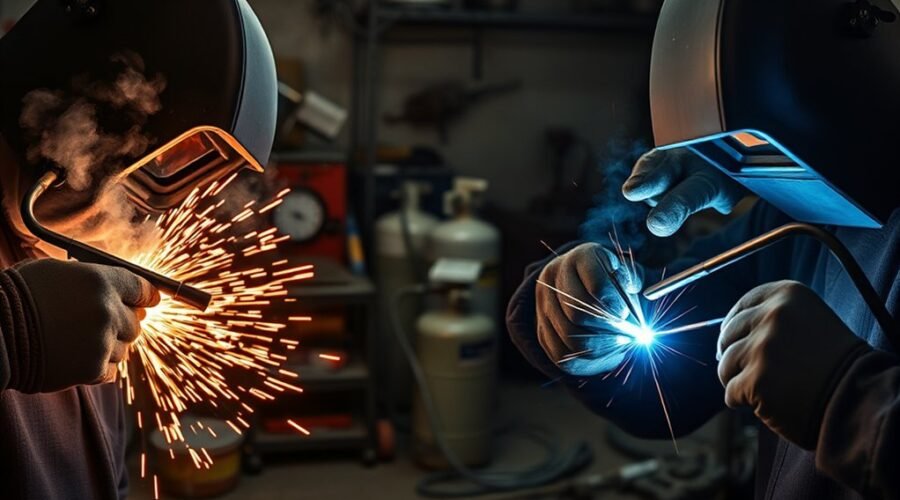
MIG vs TIG welding comes down to a tradeoff between productivity and control. MIG feeds filler wire automatically, so it is usually faster and easier to learn, while TIG gives the welder finer control over heat, filler addition, and bead shape. Neither process is automatically stronger; the better choice depends on the metal, thickness, joint, production needs, appearance, and required weld quality.
Quick Answer
Choose MIG welding when speed, easier training, and high deposition matter, especially for production work and thicker sections. Choose TIG welding when you need finer heat control, a clean visible bead, or precise work on thin materials. Neither process is inherently stronger; weld performance depends on the joint, material, filler, settings, technique, and procedure.
Key Takeaways
- MIG uses a continuously fed consumable wire, while TIG creates the arc with a non-consumable tungsten electrode and may use a separate filler rod.
- MIG normally offers higher deposition rates and faster production; TIG trades speed for finer control of heat and filler placement.
- TIG commonly produces a cleaner, more refined visible bead, but a properly made MIG weld can still meet demanding strength and quality requirements.
- MIG is generally easier for beginners because the machine feeds the filler automatically. TIG requires more coordination and puddle control.
- Both processes can weld steel, stainless steel, and aluminum, but the required gas, polarity, wire-feed system, and machine capabilities change with the material.
MIG vs TIG Welding: How They Work
)
The core difference is the electrode. MIG, formally Gas Metal Arc Welding (GMAW), feeds a consumable wire through the gun. That wire carries current and melts into the joint as filler metal. TIG, or Gas Tungsten Arc Welding (GTAW), uses a tungsten electrode that normally does not become part of the weld.
MIG combines the electrode and filler into a continuously fed wire; TIG separates the arc-producing tungsten from the filler metal.
With MIG, you control the gun while the machine feeds wire at a set rate. This makes continuous welding and long runs relatively efficient. The process is widely used on mild steel, stainless steel, and aluminum, although the wire, shielding gas, transfer mode, and feeding equipment must suit the material.
TIG puts more variables directly in your hands. You guide the torch with one hand and, when filler is required, add a separate rod with the other. Many setups also let you vary amperage with a foot or fingertip control. Autogenous TIG welds can be made without filler when the joint and application allow it.
This difference in operator control explains much of the learning curve. Miller’s MIG-to-TIG process guidance describes TIG as giving the operator more direct control over amperage, filler addition, arc length, and pacing.
| Factor | MIG Welding | TIG Welding |
|---|---|---|
| Electrode | Consumable wire | Non-consumable tungsten |
| Filler metal | Wire is fed automatically | Separate rod when needed |
| Typical pace | Faster, higher deposition | Slower, more deliberate |
| Heat control | Controlled through voltage, wire feed, travel, and machine features | Very fine operator control, often including remote amperage control |
| Thin or delicate work | Capable with the right setup | Excellent where precise heat control is needed |
| Production work | Strong advantage | Usually slower |
| Appearance | Clean results are possible; spatter can occur | Very clean bead with little to no spatter when performed correctly |
| Learning curve | Generally easier | Generally steeper |
Shielding gas is another important difference, but there is no single gas for every MIG job. Argon/CO₂ mixtures are common for mild steel, while aluminum MIG normally uses pure argon. TIG most commonly uses argon, although helium and argon/helium blends are also used for certain applications. Miller’s TIG shielding-gas guidance describes argon as the common all-around choice while also covering helium and mixed gases.
Warning: Both processes expose you to arc radiation, hot metal, fumes, burns, fire hazards, and electric shock. Use suitable eye and skin protection, control combustible materials, and provide appropriate ventilation. See OSHA’s welding hazard guidance for workplace safety requirements and controls.
This technical separation gives users different pathways toward efficient fabrication and precision work. Additionally, the versatility of welding processes allows beginners to explore several techniques and develop their skills.
MIG vs TIG Welding: Speed, Strength, and Finish
MIG normally has the advantage in deposition rate and production speed, while TIG gives the operator finer control over the weld pool and usually produces a cleaner visible finish. Strength is more nuanced: neither process is automatically stronger simply because it is MIG or TIG.
A sound weld depends on the base metal, filler metal, joint design, penetration, heat input, preparation, procedure, and operator technique. Additionally, multi-process capability can let a shop choose the process that best fits each joint.
Welding Speed Comparison
MIG is usually faster because wire feeds continuously while you weld. That continuous filler supply supports high deposition rates, long weld runs, and reduced interruption in production environments.
TIG is slower because you manage the torch, heat, and filler addition more independently. That slower pace is not necessarily a disadvantage when the job demands close control around edges, thin sections, tight fit-up, or visible joints.
- MIG: better suited to rapid throughput, long seams, and repetitive production.
- TIG: better suited to controlled, detailed work where precision matters more than deposition rate.
- The practical choice depends on whether production speed or fine control has greater value for the joint.
Weld Strength Differences
TIG welding is not inherently stronger than MIG welding. TIG’s advantage is that a skilled operator can control amperage, puddle size, filler addition, and heat very precisely, which can make it easier to achieve consistent results on thin, critical, or difficult joints.
MIG can also produce structurally sound, high-quality welds when the procedure, filler, joint preparation, penetration, and settings are correct. A bead that looks attractive is not proof of strength, and a less decorative production weld is not automatically weak.
The American Welding Society’s welding procedure qualification framework covers both GMAW and GTAW along with base metals, filler metals, procedure variables, and testing. For code or safety-critical work, the qualified procedure matters more than a blanket claim that one process is stronger.
Note: For load-bearing, pressure-containing, structural, or otherwise regulated work, use the applicable welding procedure and code requirements rather than selecting MIG or TIG from a general comparison alone.
Surface Finish Quality
TIG usually has the advantage when the weld will remain visible. Precise puddle control and the absence of a continuously melting wire let a skilled operator create a narrow, controlled bead with very little spatter.
MIG can also produce clean welds, particularly when the metal is prepared correctly and voltage, wire feed, gas, stickout, and travel speed are well matched. However, spatter and a broader bead profile are more common, so cosmetic work may require more cleanup.
- TIG is often chosen for exposed stainless steel, aluminum, decorative work, and other joints where bead appearance matters.
- MIG is efficient when appearance is secondary to production speed, although good setup can still produce neat results.
- Finish quality should not be confused with structural strength; appearance is only one part of weld quality.
MIG vs TIG Welding Costs Explained
MIG usually has the cost advantage in production because it deposits filler faster and generally requires less operator time per weld. TIG often costs more per completed joint when its slower travel speed and greater skill requirement increase labor time.
Machine price alone is not a reliable MIG-versus-TIG rule. Equipment ranges overlap widely, and features such as AC output, pulse control, aluminum wire feeding, water cooling, duty cycle, and multiprocess capability can change the purchase price substantially. For that reason, compare the complete setup required for your actual work rather than assuming every MIG machine is cheaper.
For general fabrication, MIG welders can offer a practical balance between productivity and equipment complexity.
Equipment And Consumables
MIG equipment needs a power source, wire feeder, gun, contact tips, wire, and the correct shielding-gas system for gas-shielded welding. TIG uses a TIG torch, tungsten electrode, shielding gas, and often separate filler rods plus a remote amperage control.
Consumables differ more by application than by a simple cheap-versus-expensive rule. MIG continuously consumes wire and contact tips. TIG consumes filler only when the joint requires it, while tungsten electrodes are periodically prepared or replaced.
Gas choice also changes with the material. A 75% argon/25% CO₂ mix is common for short-circuit steel MIG, but it is not a universal MIG gas. Aluminum MIG normally uses pure argon, while stainless applications may require other blends. TIG commonly uses argon, with helium or argon/helium mixtures available where their arc characteristics are useful.
Labor And Prep Costs
Labor is where MIG often gains the clearest economic advantage. Automatic wire feeding and higher deposition can reduce the time required for long seams or repeated production welds.
TIG commonly requires more operator coordination and progresses more slowly. It also rewards very clean preparation because contamination quickly affects the tungsten, puddle, and finished bead.
MIG should not be treated as a process for dirty material, though. Rust, oil, paint, mill scale, moisture, and poor gas coverage can still cause defects. Cleaning the joint and following the wire and machine manufacturer’s setup recommendations reduces rework for either process.
Best Uses for MIG Welding
MIG welding is a strong choice when productivity, continuous filler delivery, and repeatability matter. It is commonly suited to general fabrication, automotive work, manufacturing, frames, brackets, and other jobs with substantial weld length.
It works well on mild steel and can also weld stainless steel and aluminum when the wire, gas, machine, and feeding system are correct. MIG is not limited to thick material; properly configured short-circuit or pulsed systems can also handle relatively thin work.
- Long welds and repetitive fabrication
- Production environments where deposition rate matters
- General steel fabrication and repair
- Projects where new welders need a simpler learning path
- Aluminum production work when the machine and wire-feed system are suitable
Gas-shielded MIG needs protection from wind. Miller recommends using a wind block or tent outdoors because moving air can disrupt the shielding gas and cause porosity. The company’s MIG shielding-gas guidance explains both gas selection and outdoor wind protection.
For windy field work, self-shielded flux-cored welding or stick welding is often more practical than ordinary gas-shielded MIG. That distinction matters because a machine marketed as a MIG/flux-core unit can use two processes with very different outdoor behavior.
MIG welding equipment is generally easier for a beginner to operate because the wire feeder handles filler delivery. Many machines, like the Forney 140 MP, also combine more than one welding process.
Aluminum requires special attention because its wire is much softer than steel wire. A spool gun shortens the distance the wire must travel, while a push-pull system helps maintain controlled feeding on longer runs. Miller’s aluminum MIG setup guide explains why spool guns improve aluminum wire feedability.
Best Uses for TIG Welding
TIG welding is most useful when precision, heat control, cleanliness, or weld appearance outweigh production speed. It is particularly effective on thin sections, visible joints, stainless steel, aluminum, magnesium, copper alloys, and other applications where close puddle control is valuable.
For steel and stainless steel, DC TIG is commonly used. Aluminum TIG normally requires an AC-capable machine because alternating current provides the cleaning action needed to break up the surface oxide while still delivering heat into the base metal.
Miller’s AC balance explanation describes how the electrode-positive portion of the AC cycle helps remove aluminum oxide while the electrode-negative portion supplies penetration into the workpiece.
- Thin sheet, tubing, and heat-sensitive parts
- Visible or decorative welds that need a refined finish
- Stainless steel fabrication where precise heat control matters
- AC TIG welding of aluminum
- Detailed automotive, aerospace, repair, and fabrication work
TIG’s slower pace can become expensive on long, heavy welds, but its ability to separate arc control from filler addition gives the operator options that MIG does not provide in the same way. That is why shops may use TIG on detailed or critical areas and a faster process for higher-deposition work.
Its flexibility also explains the appeal of varied power sources when one shop handles several materials and joint types.
Which Welding Process Should You Choose?
Choose MIG when your main priorities are speed, easier operation, long weld runs, and economical production. Choose TIG when the job rewards exact heat control, delicate work, a refined visible bead, or close control over filler placement.
- Choose MIG for repetitive production, general fabrication, longer seams, and jobs where high deposition saves time.
- Choose TIG for precision work, thin or heat-sensitive parts, decorative welds, and joints where you want direct control over heat and filler.
- For aluminum, choose based on thickness, production rate, appearance, and equipment: MIG is productive with the proper wire-feed system, while AC TIG excels at controlled thin and cosmetic work.
- For outdoor welding, remember that both gas-shielded MIG and TIG need protection from wind.
- For structural or code work, base the decision on the qualified procedure and applicable requirements rather than appearance or process reputation.
No process is universally superior. MIG saves time when deposition and throughput matter, while TIG gives you more direct control when precision and finish justify the slower pace. If you are comparing machines, also check whether the available duty cycle matches the length and amperage of the work you plan to do.
Frequently Asked Questions
When Should You Use TIG Instead of MIG Welding?
Use TIG instead of MIG when precise heat control, thin material, controlled filler placement, or a clean visible finish matters more than speed. MIG is usually more efficient for longer production welds, while TIG is often preferred for delicate stainless steel, aluminum, tubing, and detailed fabrication.
What Is the Rule of 33 in TIG Welding?
The Rule of 33 is a pulse-TIG starting point, not an amperage-per-thickness formula. It means setting pulse frequency to about 33 pulses per second, background current to about 33% of peak, and pulse on-time to about 33%. It is a tuning shortcut for some precision work, not a universal welding rule.
What Is MIG Welding Not Good For?
Gas-shielded MIG is a poor choice in unprotected wind because moving air can strip shielding gas from the weld pool. It can also be less convenient than TIG for extremely fine, cosmetic, or heat-sensitive work where you want independent control of the arc and filler metal, although properly configured MIG can weld thin metal successfully.
Which Is Cheaper, MIG or TIG Welding?
MIG is usually cheaper for production welding because its higher deposition rate can reduce labor time per joint. Equipment prices overlap, however, so a MIG machine is not automatically cheaper than every TIG setup. AC capability, pulse controls, cooling systems, wire feeders, and aluminum accessories can all change the total cost.
Is MIG or TIG Better for Aluminum?
Both MIG and TIG can weld aluminum well when the equipment is configured correctly. MIG is usually more productive for longer runs and thicker fabrication, while AC TIG gives finer puddle and heat control for thinner or cosmetic work. Aluminum MIG also needs a suitable wire-feeding system because the wire is soft and easily damaged.
Conclusion
MIG and TIG solve different welding problems. MIG is usually the practical choice for speed, continuous production, and easier operation, while TIG earns its place where heat control, thin material, bead appearance, or precise filler placement matters most.
Do not choose between them on appearance or the assumption that one process is always stronger. Match the process to the base metal, thickness, joint, environment, required productivity, and any procedure or code requirements that apply.
Sources
- Miller — Getting Started With TIG Welding: MIG vs. TIG Equipment and Process: Process control, pacing, heat input, and TIG learning curve.
- Miller — Best Practices for Proper Shielding Gas in TIG Welding: Argon, helium, and argon/helium TIG shielding options.
- American Welding Society — Welding Procedure and Performance Qualification: Qualification of GMAW, GTAW, base metals, filler metals, variables, and testing.
- Miller — What Type of Gas Is Best for MIG Welding?: MIG shielding gases, gas coverage, and wind protection.
- Miller — MIG Aluminum DIY Equipment Guide: Aluminum wire feedability and spool-gun use.
- Miller — AC Balance Control for TIG Aluminum: AC oxide-cleaning action and penetration.
- OSHA — Welding, Cutting, and Brazing Hazards and Solutions: Welding fumes, radiation, burns, electric shock, PPE, and ventilation.