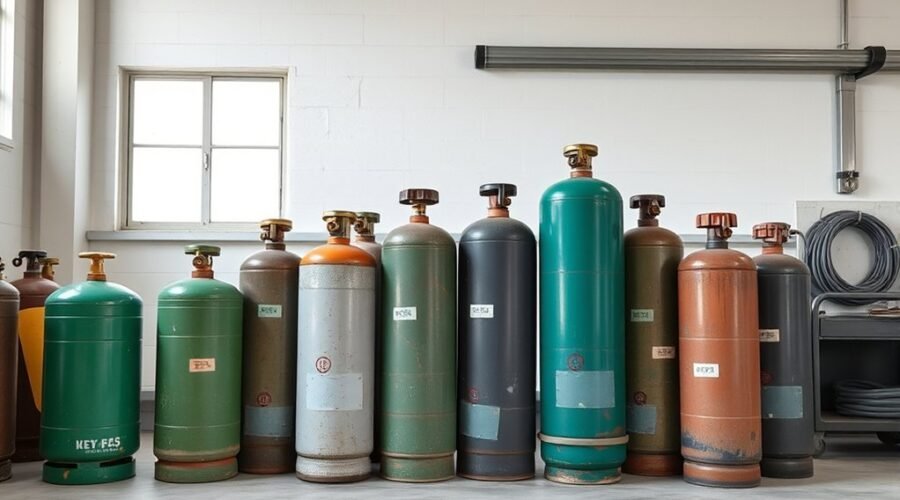
Choosing the right welding gas cylinder size is mainly a tradeoff between runtime, portability, storage space, and refill trips. For home MIG or TIG welding, 40, 80, and 125 cubic foot cylinders are common choices, but their physical dimensions and exchange rules can vary by supplier. The best size is the one that gives you enough gas at your normal flow rate without becoming difficult to store or move.
Quick Answer
For most home MIG or TIG welders, an 80 cf cylinder balances runtime and portability well. Choose 40 cf when easy transport matters most, or 125 cf when reducing refill trips matters more. Estimate theoretical runtime by dividing cylinder capacity in cubic feet by your shielding-gas flow rate in CFH.
Last checked: September 28, 2026. Dates and figures were verified against official sources.
Welding Gas Cylinder Size: Key Takeaways
Key Takeaways
- A 40 cf cylinder is easy to move but empties quickly during regular welding.
- An 80 cf cylinder is a practical middle size for many home and garage welders.
- A 125 cf cylinder cuts refill frequency but is taller and heavier.
- A 10 CFH runtime chart is useful for comparison, but many MIG and TIG applications actually use higher flow rates.
- Argon and argon-rich blends are compressed gases; CO2 is stored as a liquefied gas and is best tracked by cylinder weight.
What Welding Gas Cylinder Size Do You Need?
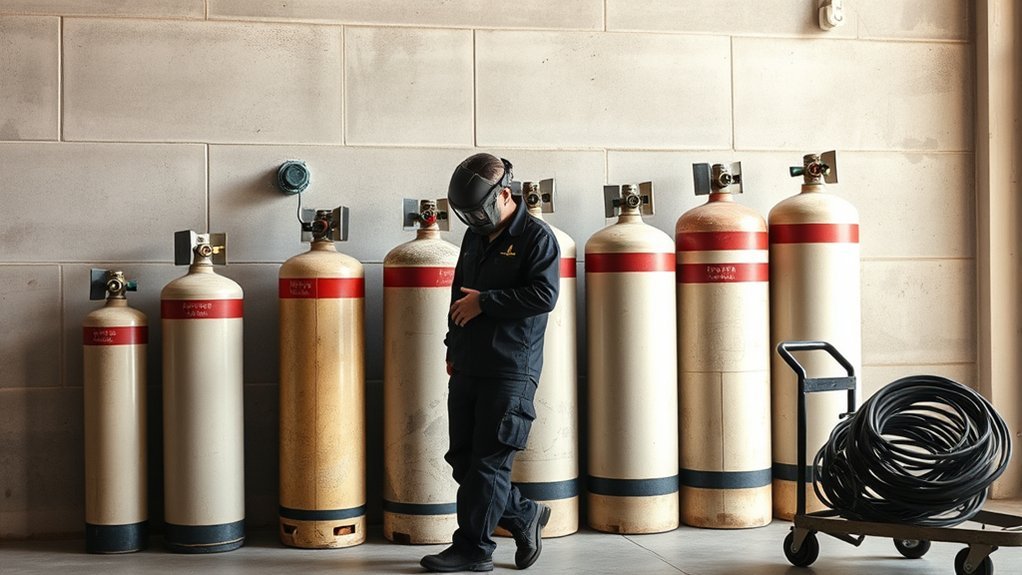
Your best cylinder size depends on how long you weld between refills and how easily you need to move the bottle. A small tank is convenient for occasional work, while a larger one reduces interruptions during longer projects.
A 40 cf cylinder works well for practice, short repairs, and portable setups. At a theoretical 10 CFH flow rate, it contains about four hours of continuous gas flow, although actual arc time will be lower once normal pre-flow, post-flow, starts, stops, and losses are considered.
An 80 cf cylinder doubles that nominal capacity while remaining manageable in a home shop. For many users, it offers the most useful balance between storage size and refill frequency.
A 125 cf cylinder is better suited to frequent welding because it holds more gas between exchanges. At 10 CFH, its theoretical continuous-flow runtime is 12.5 hours.
Gas choice matters too. Miller identifies 75% argon/25% CO2, or C25, as a common mild-steel MIG shielding gas. The existing guide to the 75/25 mix explains the gas choice in more detail.
Before buying, also check whether the cylinder fits your cart, vehicle, and storage area. Cylinder labels such as #2, #3, #4, Q, or D are not perfectly consistent across every supplier, so cubic-foot capacity is usually the clearer comparison.
Popular MIG and TIG Cylinder Sizes
For home and small-shop MIG and TIG welding, 40, 80, and 125 cf cylinders cover a useful range from portable to longer-running. The capacity is nominal free-gas volume, not the physical internal volume of the steel bottle.
The 40 cf size is the easiest to handle. It suits occasional welding, backup use, and situations where the cylinder must be carried frequently.
The 80 cf size gives twice the nominal gas of a 40 cf bottle. It is usually a better fit when you weld often enough that repeated small-cylinder exchanges become inconvenient.
The 125 cf size makes the most sense when minimizing downtime matters more than portability. It also needs a cart or secure storage position that can safely support the added height and weight.
Do not assume every 40, 80, or 125 cf cylinder has identical dimensions. Manufacturer and exchange-program specifications differ, so measure the space available on your welding setup before choosing a tank.
Welding Gas Cylinder Size Chart by Flow Rate
Flow rate has a direct effect on theoretical cylinder runtime: double the CFH and the available continuous-flow time is cut in half. This makes flow rate just as important as tank capacity when comparing welding gas cylinder sizes.
The basic calculation is:
Cylinder runtime in hours = nominal cylinder capacity in cubic feet ÷ gas flow in CFH.
For example, an 80 cf bottle at 20 CFH gives about four hours of theoretical continuous gas flow. Real welding time will differ because gas is not flowing at one constant rate throughout every shop session.
Manufacturer recommendations also matter. A Miller operator manual lists typical ranges of 15–30 CFH for CO2 MIG, 25–45 CFH for mixed-gas MIG, 15–25 CFH for argon TIG, and 35–45 CFH for aluminum MIG. Use the settings recommended for your welder, torch, wire, cup or nozzle, and conditions rather than lowering flow simply to extend tank life. See the Miller shielding-gas setup guidance.
Wind and drafts can strip shielding gas away from the weld. Increasing flow excessively can also create turbulence, so shielding problems should not automatically be solved by turning the regulator higher. A suitable welding cart also makes larger cylinders easier to secure and move.
How Long Does Each Cylinder Last?
Cylinder life depends on capacity and actual gas flow. A 125 cf tank lasts roughly 3.1 times as long as a 40 cf tank at the same flow setting, but your real welding session will include periods when the trigger or torch is not flowing shielding gas.
These runtime figures are therefore best treated as planning numbers rather than guaranteed arc-on hours. The idea is similar to matching a tool’s air demand to built-in air compressors: capacity matters only in relation to consumption.
Runtime By Tank Size
The chart below shows theoretical continuous-flow runtime for 40, 80, and 125 cf compressed shielding-gas cylinders. It lets you compare tank sizes without assuming that one flow rate is correct for every welding process.
| Cylinder | 10 CFH | 15 CFH | 20 CFH | 30 CFH | 40 CFH |
|---|---|---|---|---|---|
| 40 cf | 4.0 hr | 2.7 hr | 2.0 hr | 1.3 hr | 1.0 hr |
| 80 cf | 8.0 hr | 5.3 hr | 4.0 hr | 2.7 hr | 2.0 hr |
| 125 cf | 12.5 hr | 8.3 hr | 6.3 hr | 4.2 hr | 3.1 hr |
A 40 cf tank can be enough for short jobs, while an 80 or 125 cf tank provides more reserve for regular work. The important point is to compare capacity at the flow your process actually requires.
Flow Rate Impact
Increasing gas flow shortens runtime in direct proportion to the increase. Moving from 20 to 40 CFH, for example, cuts the theoretical continuous-flow time of any of these cylinders in half.
That does not mean you should simply choose the lowest possible setting. Too little shielding can cause porosity and oxidation, while unnecessarily high flow wastes gas and may disturb shielding.
Pro Tip: Set gas flow while gas is actually flowing through the torch or gun. Then check the bead for signs of contamination and eliminate drafts before increasing the flow unnecessarily.
Estimating Welding Hours
To estimate welding hours, start with the cylinder’s nominal cubic-foot capacity and divide it by your normal CFH setting. Then allow for pre-flow, post-flow, purging, leak losses, and the fact that the regulator reading may not stay perfectly constant.
For example, an 80 cf cylinder at 20 CFH gives four theoretical continuous-flow hours. If your actual arc-on time is only a fraction of a shop session, that cylinder may last through many separate projects.
Do not use a blanket assumption such as 20 CFH for every process. TIG cup size, MIG nozzle size, gas composition, draft conditions, and the equipment manufacturer’s instructions can all change the correct flow setting.
Best Cylinder Size for Hobby Welders
For most hobby welders, 40 or 80 cf is the most practical starting range. Choose the smaller bottle when transport and storage dominate the decision; choose 80 cf when you want noticeably more runtime without moving to the larger 125 cf format.
A 40 cf cylinder is useful for occasional fabrication, practice, or a portable welder. At 20 CFH, its theoretical continuous-flow runtime is about two hours.
An 80 cf cylinder gives about four hours at the same flow rate. That extra reserve can make a major difference if the nearest gas supplier is inconvenient to reach.
A 125 cf cylinder can still make sense for an active hobbyist, especially if larger refills cost less per cubic foot locally. The tradeoff is added size and weight.
Whichever size you choose, match the bottle to your real project frequency rather than buying solely on capacity. The goal is reliable welding performance without unnecessary refill trips or difficult handling.
40, 80, and 125 CF Tank Specs
Cylinder dimensions are not universal, even when two bottles have the same advertised gas capacity. The table below uses current Thoroughbred argon listings from Tractor Supply as one concrete U.S. example, so use it for comparison rather than as a standard for every supplier.
| Capacity | Listed size | Listed weight | Cylinder price |
|---|---|---|---|
| 40 cf Thoroughbred argon | 17 in. high × 7 in. wide | 25 lb | $399.99 |
| 80 cf Thoroughbred argon | 32 in. high × 6.6 in. wide | 53 lb | $529.99 |
| 125 cf Thoroughbred argon | 42.7 in. high × 7 in. wide | 79 lb | $589.99 |
Those September 2026 listings are for the cylinders themselves, and local gas-content charges, exchange availability, taxes, and store pricing can differ. This is why older fixed prices should not be treated as permanent cylinder specifications.
Likewise, do not assume the same working pressure merely because two tanks hold the same nominal gas volume. Read the markings on the actual cylinder and use the regulator and valve connection specified for that gas.
The physical comparison also shows why 125 cf cylinders are less convenient to carry even though they reduce refill frequency. If you use other metalworking tools such as plasma cutters, leave enough cart and floor space to secure every cylinder properly.
Argon vs. CO2 Cylinder Size Choices
Argon, argon/CO2 blends, and pure CO2 are not packaged or tracked in exactly the same way. Argon and common argon-rich shielding blends are stored as compressed gas, while CO2 is stored largely as liquefied carbon dioxide and is commonly sold by weight.
| Gas | Typical cylinder description | Practical effect |
|---|---|---|
| Argon | High-pressure compressed gas, often listed in cubic feet | Common for TIG and aluminum MIG |
| CO2 | Liquefied gas commonly sold by pounds | Lower gas cost can be attractive for steel MIG; arc is generally harsher with more spatter than C25 |
| Argon/CO2 mix | High-pressure compressed shielding-gas blend | C25 is a common mild-steel MIG choice |
WestAir’s current CO2 cylinder specifications, for example, list common packages by pounds and use CGA 320 connections. Its 20 lb carbon dioxide package is rated around 800 PSIG at the listed condition, showing why CO2 cylinders should not be treated like an argon bottle with the same pressure-versus-content behavior.
For mild steel MIG, C25 usually produces a smoother arc and less spatter than 100% CO2, while pure CO2 generally gives deeper penetration and more spatter. For TIG and aluminum MIG, pure argon is widely used. Cylinder capacity therefore needs to be chosen together with the gas required by the process, not separately from it.
Having enough reserve gas also supports consistent TIG welding performance during longer jobs.
How to Tell How Much Gas Is Left
For argon and many argon/CO2 blends, cylinder pressure gives a useful estimate of remaining compressed gas when temperature is reasonably stable. For pure CO2, pressure is a poor level indicator while liquid CO2 remains in the cylinder, so weighing the bottle is the more useful method.
With a compressed argon cylinder, compare the current pressure with the normal full pressure for that specific bottle. A roughly half-pressure reading at a similar temperature suggests roughly half of the usable compressed gas remains, although gauges are not precision inventory meters.
Temperature affects pressure, and low-range gauge accuracy can be limited. That is why pressure should be treated as an estimate rather than an exact percentage.
For compressed argon and argon-rich blends, pressure can estimate remaining gas; for liquid CO2, cylinder weight is the better guide.
For CO2, find the cylinder’s stamped tare weight and compare it with the actual scale weight. The difference represents the approximate remaining CO2 content, excluding attached equipment if it was not part of the tare measurement.
A regulator or flowmeter must also match the gas and expected flow. Understanding the difference between cylinder content and delivery equipment is just as important in shielding gas as it is in cutting capability and gas delivery.
Warning: Compressed gas cylinders are heavy, high-pressure containers. OSHA’s gas welding and cutting rules require cylinders on construction sites to be secured upright, valves closed when work is finished, and suitable chains, trucks, or steadying devices used to prevent cylinders from falling.
Should You Buy or Rent a Welding Gas Cylinder?
Buying generally gives a frequent home welder more control over cylinder size and exchange timing, while rental or lease programs can be more convenient for large cylinders or occasional commercial needs. The better option depends heavily on your local supplier’s rules rather than one nationwide price formula.
Before buying a cylinder, confirm that nearby suppliers will refill or exchange that size and ownership type. Some exchange programs accept only customer-owned cylinders that meet their requirements, while leased cylinders remain the property of the gas supplier.
Ownership can provide convenience for frequent exchanges, but the cylinder still needs proper inspection and requalification.
Buy Vs. Rent
Compare buy and rental options using your expected years of use, cylinder capacity, exchange fees, refill prices, and how often you need gas. There is no reliable universal five-year lease price because supplier contracts differ.
| Option | Up-front cost | Key consideration |
|---|---|---|
| Lease or rental | Varies by supplier and term | Lower ownership responsibility, but recurring fees or contract limits may apply |
| Buy new | Higher initial cost | Confirm local refill and exchange acceptance before purchase |
| Used purchase | Varies widely | Check ownership markings, condition, valve, and requalification date |
| Customer-owned exchange | Cylinder plus gas/exchange charges | Convenient where a compatible exchange network is available |
Do not buy a used cylinder simply because the price is low. A cylinder carrying a supplier’s ownership marks may be leased property rather than something the seller legally owns.
Ownership Costs
The true ownership cost includes the cylinder, fills or exchanges, transportation, and any required requalification. Larger cylinders may reduce the cost per cubic foot of gas, but they are not automatically the cheapest choice if you weld only a few times per year.
U.S. DOT cylinder requalification intervals depend on the cylinder specification, service, and markings. PHMSA’s 49 CFR §180.209 guidance shows that DOT 3A and 3AA cylinders can have 5-, 10-, or other applicable requalification periods depending on the conditions involved; do not assume every steel welding cylinder is simply good for a fixed number of years.
Note: Before buying a new or used cylinder, ask the gas supplier that will actually fill or exchange it whether they accept that cylinder size, valve type, ownership marking, and current test status.
Choose the Best Cylinder for Your Shop Size
Match cylinder capacity to both welding frequency and available floor space. A larger bottle reduces refill trips, but it also needs a suitable cart or fixed secure position and enough clearance to move safely around the shop.
For a compact garage or occasional MIG setup, 40 cf gives maximum portability. An 80 cf cylinder provides twice the nominal capacity and usually remains practical for a home welding cart.
A 125 cf cylinder makes more sense when you weld frequently and the bottle can remain secured in one working area. It offers more uninterrupted gas supply without moving into the very large industrial-cylinder range.
- 40 cf: easiest to move and store; best for occasional jobs or backup use.
- 80 cf: balanced capacity for regular home and garage welding.
- 125 cf: fewer refill trips for frequent or longer projects.
Whatever size you choose, secure it correctly and make sure the cart is rated for the load. Cylinder planning should support, rather than interfere with, the duty cycle and cooling reliability of the welder itself.
Frequently Asked Questions
How Long Will a 20 Cu Ft Argon Tank Last?
A 20 cf argon cylinder provides about 1.3 theoretical hours at 15 CFH, 1 hour at 20 CFH, 40 minutes at 30 CFH, or 30 minutes at 40 CFH. Actual usable welding time varies with pre-flow, post-flow, starts, stops, leaks, and the flow required by your process.
Which Cylinder Is Used for Gas Welding?
Oxy-fuel welding normally uses separate oxygen and fuel-gas cylinders, with acetylene being a common fuel for traditional oxy-acetylene welding. Cylinder size and regulator settings depend on the torch and tip, so there is no single fixed oxygen-to-acetylene consumption ratio that applies to every welding or cutting operation.
How Big Is a #4 Argon Cylinder?
A #4 argon cylinder is commonly sold around the 125 cf class, but dimensions depend on the manufacturer and exchange system. One current Thoroughbred 125 cf #4 argon cylinder is listed at 42.7 inches high, 7 inches wide, and 79 pounds, so verify the exact bottle before sizing a cart or vehicle space.
What Size Tank Do I Need for MIG Welding?
A 40 cf tank is suitable for occasional MIG welding, an 80 cf cylinder is a practical general-purpose home-shop size, and 125 cf is useful when you weld frequently. Choose after checking your required gas type, normal CFH setting, local refill or exchange availability, cart capacity, and storage space.
Conclusion
The right welding gas cylinder size depends on how much gas your process consumes and how often you want to visit the supplier. A 40 cf bottle favors portability, 80 cf offers a useful middle ground, and 125 cf reduces refill interruptions. Use your real CFH setting, confirm local exchange rules, and make sure the cylinder can be stored and secured safely before buying.
Sources
- Miller — MIG shielding gas selection: C25, CO2, and shielding-gas behavior for mild-steel MIG.
- Miller operator manual: example MIG and TIG shielding-gas flow ranges.
- Tractor Supply — 40 cf Thoroughbred argon cylinder: current listed dimensions, weight, and price.
- Tractor Supply — 80 cf Thoroughbred argon cylinder: current listed dimensions, weight, and price.
- Tractor Supply — 125 cf Thoroughbred argon cylinder: current listed dimensions, weight, CGA 580 specification, and price.
- WestAir — Carbon dioxide cylinder specifications: CO2 package weights, pressure, dimensions, and CGA 320 connection.
- OSHA 29 CFR 1926.350: compressed-gas cylinder handling, securing, storage, and valve requirements for construction.
- PHMSA — 49 CFR §180.209: cylinder requalification requirements and applicable intervals.