Pipe welding is the process of joining sections of pipe with full-penetration groove welds, usually in fixed positions where the welder must work around the pipe. The hardest and most valuable tests are the 5G (horizontal fixed) and 6G (45° fixed) positions, which certify a welder for almost any pipe job.
This guide explains each pipe welding position, how to prepare the joint, the root-to-cap pass sequence, rod and process choices, and practical tips for passing your 5G and 6G tests.
What Is Pipe Welding?
Pipe welding joins round pipe for oil and gas pipelines, refineries, power plants, water lines and building systems. Unlike plate welding, the joint curves around the pipe, so you change body position and torch angle constantly. Most pipe welds must fully penetrate the wall from one side, which is why the root pass matters so much. See our guide to full penetration welds.
Pipe Welding Positions: 1G, 2G, 5G and 6G

| Position | Pipe orientation | What it tests | Difficulty |
|---|---|---|---|
| 1G | Horizontal, rolled | Flat welding on top as the pipe rotates | Easiest |
| 2G | Vertical, fixed | Horizontal welding around the joint | Moderate |
| 5G | Horizontal, fixed | Flat, vertical and overhead in one weld | Hard |
| 6G | 45° incline, fixed | All positions; the standard pipe certification test | Hardest |
A 6G test usually qualifies you for all positions on pipe and plate within its range. A restricted version, 6GR, adds a ring that blocks access around the joint. For plate positions and more detail, see welding positions explained.
Pipe Joint Preparation
Good prep makes the root pass possible. A typical open-root V-groove joint on carbon steel pipe uses:
- Bevel: about 30–37.5° on each pipe end (60–75° included angle)
- Land (root face): about 1/16–1/8 in.
- Root gap: about 1/8 in., roughly the diameter of the root electrode or filler
- Cleaning: grind the bevel and 1 in. back from it to bright metal, inside and out
- Tacks: 3–4 evenly spaced tacks, feathered at each end so the root ties in smoothly
Always follow the welding procedure specification (WPS) for your job; it overrides any general numbers.
Pipe Weld Pass Sequence: Root, Hot, Fill and Cap
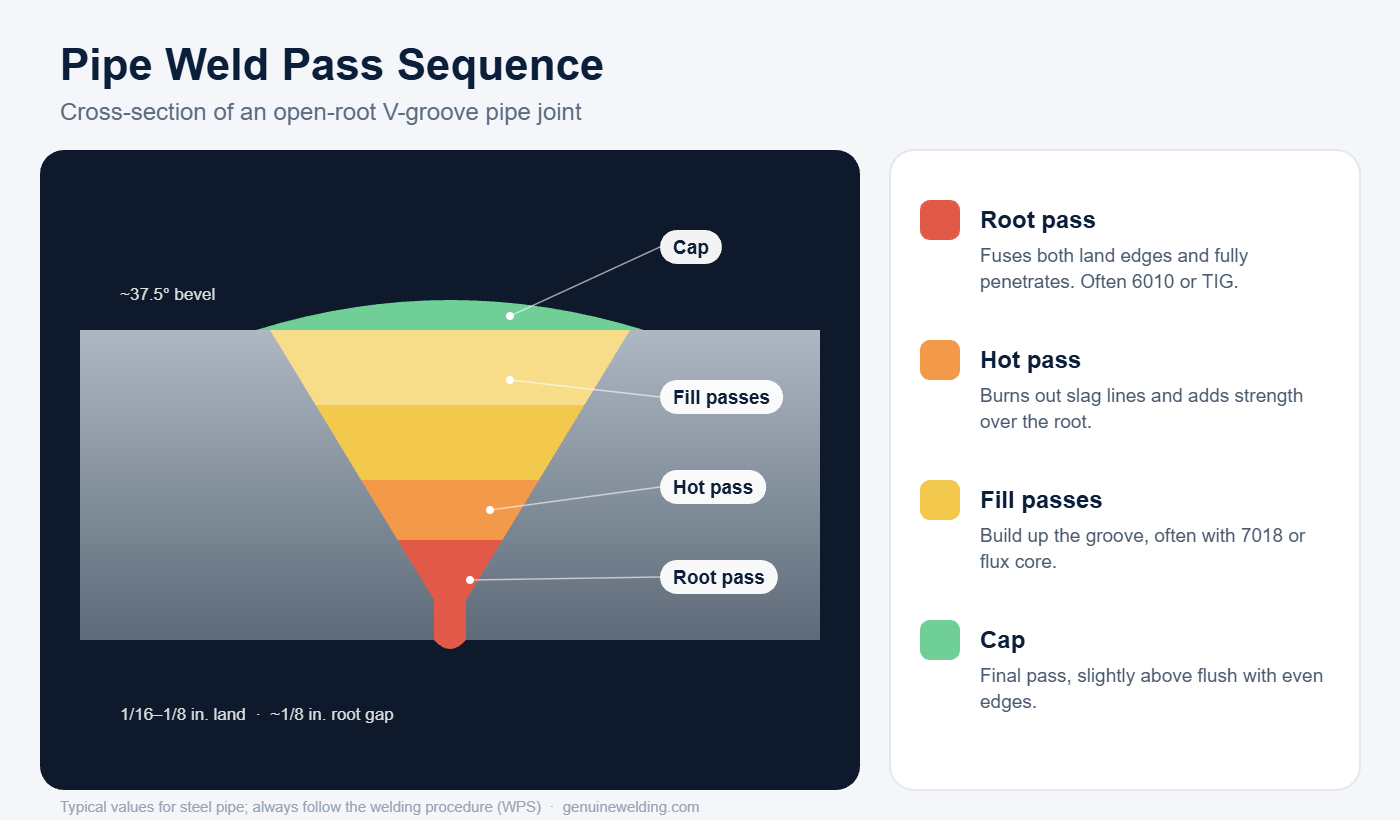
- Root pass: fuses both lands and penetrates through to the inside of the pipe. It is the most critical pass and is often run with E6010 stick or TIG.
- Hot pass: run right after the root at higher heat to burn out slag lines and add strength.
- Fill passes: build up the groove, commonly with E7018, flux core or E8010 on pipelines.
- Cap pass: the final layer, slightly above flush (often about 1/16 in.) and about 1/16 in. wider than the groove on each side.
Best Processes and Rods for Pipe Welding
- Stick (SMAW): the classic field process. E6010 for the root and hot pass, E7018 for fill and cap on many code jobs. Compare rods in 6010 vs 6011 vs 6013 vs 7018.
- TIG (GTAW): preferred for high-quality roots on stainless, chrome-moly and power-plant pipe. See our TIG welding guide.
- Flux core (FCAW): fast fill and cap passes in shops and on some pipelines.
- Pulsed and modified MIG: used for fast roots in pipe shops with specialized machines.
In the field, most pipe welding runs off an engine-driven welder. See our picks for the best welder generators.
Uphill vs Downhill Pipe Welding
Downhill (vertical down) is fast and common on cross-country pipelines with cellulosic rods like E6010 and E8010. Uphill (vertical up) gives deeper penetration and is used for most code work in plants, refineries and structural pipe, especially with E7018. Your WPS will specify the direction.
Tips for Passing 5G and 6G Pipe Tests
- Practice body position. Do a dry run around the joint before striking an arc so you are never stuck mid-weld.
- Watch the keyhole. On the root, keep a small, steady keyhole to ensure full penetration without burning through.
- Feather your stops and starts. Grind the end of each bead to a taper so restarts fuse cleanly.
- Clean between passes. Remove all slag with a grinder or wire wheel; slag inclusions are a top reason for failed bend tests.
- Control heat at the bottom. The overhead section (6 o’clock) is where most concavity and suck-back happen.
- Keep a consistent cap. Even width and height look professional and reduce undercut.
Most pipe tests are judged by visual inspection plus bend tests or X-ray. Learn more in physical weld testing and avoid the problems in common welding defects.
Pipe Welding Certifications
- API 1104: the standard for pipelines and related facilities.
- ASME Section IX: qualifies welders for boilers, pressure vessels and process piping.
- AWS certifications: widely recognized for structural and general fabrication work.
See welding codes and standards and welding certifications for details.
How Much Do Pipe Welders Make?
Pipe and pipeline welders are among the highest-paid welders. Industry estimates put pipe welders at about $52,000–$64,000 a year and experienced pipeline welders at $90,000 or more with overtime and per diem. Read how much welders make for full salary data.
Pipe Welding FAQs
What is the hardest pipe welding position?
6G is the hardest because the pipe is fixed at 45°, so one weld covers flat, horizontal, vertical and overhead positions.
What is the difference between 5G and 6G?
In 5G the pipe is fixed horizontally; in 6G it is fixed at a 45° angle. 6G is harder and usually qualifies you for more positions.
What rod is best for pipe welding?
E6010 is the most common root rod, and E7018 is common for fill and cap on code work. Pipelines often use E8010 for hot and fill passes.
Is pipe welding uphill or downhill?
Both. Cross-country pipelines often weld downhill for speed, while plant and code work usually welds uphill for deeper penetration.
How long does it take to learn pipe welding?
Most welders spend months to a few years after basic training to pass a 6G test confidently, depending on practice time.