
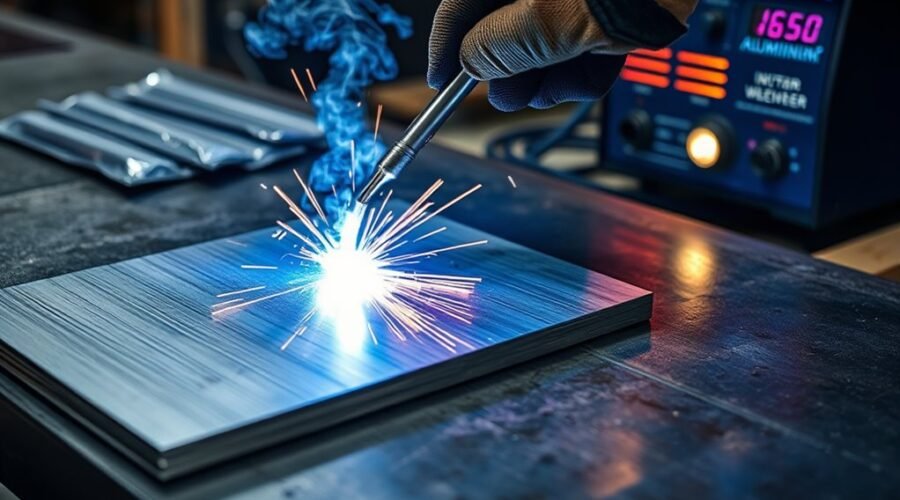
Stick welding aluminum is possible, but it is difficult and less predictable than TIG or MIG. It requires specialty electrodes, usually 4047 or 4045, with 5356 used for stronger joints. Typical settings are about 90 to 150 amps with DCEN and a short arc. Success depends on thorough cleaning, dry rods, and tight fit-up. Proper technique reduces porosity, burn-through, and weak fusion, and the finer details become clearer next.
Key Takeaways
- Stick welding aluminum is possible, but it is harder to control than TIG or MIG and is more prone to contamination.
- Use aluminum-compatible electrodes like E4047 or E5356, with 1/16-inch to 1/8-inch rod sizes depending on thickness.
- Set amperage around 90 to 150 amps and use DC electrode negative to improve heat control and arc stability.
- Clean aluminum thoroughly with acetone and a stainless-steel brush, then keep the metal and rods completely dry.
- Maintain a short arc length and steady travel speed, using a slight weave to improve bead width and joint tie-in.
Can You Stick Weld Aluminum?
Yes, stick welding aluminum is technically possible, but it is generally not recommended because aluminum’s high thermal conductivity makes heat control difficult and increases the risk of poor weld quality and porosity.
Stick welding aluminum is possible, but poor heat control and porosity make it a difficult, unreliable choice.
In practice, stick welding aluminum demands specialized electrodes, often aluminum alloy or flux-coated types, to improve arc behavior and deposit formation. Even then, the process remains sensitive to contamination, so both the workpiece and electrode require meticulous cleaning before welding begins.
Higher amperage is typically needed to sustain fusion, yet arc stability can still be inconsistent, which undermines bead uniformity and structural reliability. A short arc length is essential to concentrate heat, and a controlled weaving motion helps reduce burn-through while improving puddle management.
These demands make stick welding a constrained method for aluminum, suitable only when the operator accepts lower process efficiency and tighter technique requirements in pursuit of independent fabrication.
When Should You Use TIG or MIG Instead?
TIG is typically selected when aluminum welding demands high precision, tight control of heat input, and clean weld quality, especially on thin sections or intricate joints.
MIG is generally preferred for faster production because its higher deposition rate and simpler wire-feed process improve efficiency on larger or thicker parts.
Material thickness is often the deciding factor, with TIG better suited to thin aluminum and MIG better suited to thicker components.
TIG For Precision Work
For precision aluminum work, TIG welding is generally the preferred method because it offers tighter control over heat input, puddle size, and penetration, producing clean welds with minimal distortion.
TIG welding uses a non-consumable tungsten electrode and manual filler addition, giving the operator exact control over fusion on thin sections and intricate geometries.
Alternating current is essential, since it disrupts the aluminum oxide layer and promotes sound bonding while reducing porosity risk. This process suits high-integrity applications where appearance and structural reliability matter, including aerospace and automotive components.
Compared with MIG, TIG is slower, but its precision supports liberated fabrication choices: the welder can shape each bead deliberately, manage distortion, and achieve refined results without sacrificing metallurgical quality or clean finish.
MIG For Faster Production
When aluminum fabrication shifts from precision to throughput, MIG welding becomes the more efficient choice because its continuous wire feed supports faster travel speeds and higher deposition rates than TIG.
The mechanical feed system sustains uninterrupted operation, which suits high-production work where cycle time must be minimized. Pure argon shielding is typically used to stabilize the arc and limit oxidation, preserving weld cleanliness during rapid passes.
For operators seeking liberation from slow, labor-intensive methods, MIG offers a direct route to output without sacrificing process control.
TIG remains the better option when detailed workmanship, superior finish, or maximum puddle control is required.
In contrast, MIG emphasizes productivity, consistency, and faster travel, making it the practical selection whenever speed is the primary engineering objective.
Choose By Material Thickness
Material thickness is one of the clearest factors in selecting aluminum welding method, because it directly affects heat input, puddle control, and deposition requirements.
For thinner material up to 1/8 inch, TIG is generally preferred because its arc precision limits burn-through and allows exact control over the molten pool. This supports intricate work where freedom depends on clean, deliberate execution.
When aluminum exceeds 1/8 inch, MIG usually becomes more efficient, offering higher travel speed and greater deposition for larger joints.
Stick welding remains possible, but it is less controlled and more contamination-prone.
Final selection should also reflect alloy type and joint design, since these variables change heat demand and technique.
What Are the Best Rods for Stick Welding Aluminum?
The best rods for stick welding aluminum are typically 4047 and 5356 alloys, each selected for a specific weld requirement. The best rods for stick welding aluminum are specialized electrodes, commonly E4047 or E5356, engineered to reduce porosity and support a stable bond. 4047 delivers high fluidity, which improves wetting and penetration on thin or awkward joints. 5356 offers greater tensile strength, making it preferable for structural work where integrity must remain uncompromised. Rod diameter also matters, with 1/16″ to 1/8″ sizes shaping penetration and bead profile.
| Rod | Primary trait | Typical use |
|---|---|---|
| E4047 | Fluidity | Thin sections |
| E5356 | Strength | Structural joints |
| 1/16″-1/8″ | Size range | Profile control |
Clean, dry base metal and electrodes are essential; contamination weakens the weld and limits liberation from defects.
What Settings Work for Aluminum Stick Welding?
For aluminum stick welding, the setup typically centers on 1/8-inch rods made from 4047 or 4045 alloys, an amperage range of roughly 90 to 150 amps, and a DC electrode negative (DCEN) polarity to improve heat control and reduce burn-through risk.
In stick welding aluminum, these parameters establish a controlled thermal window that supports fusion without excessive collapse. Thinner material generally benefits from the lower end of the range, while thicker sections require higher current to drive penetration through the oxide-bearing surface and into the base metal.
These parameters create a controlled thermal window, balancing fusion, penetration, and reduced collapse across varying aluminum thicknesses.
Arc length should remain short, about 1/8 to 1/4 inch, to stabilize the arc and limit contamination. A slight weave is preferred over a straight travel line because it broadens the bead and improves tie-in across the joint.
Together, these settings give the welder disciplined control, allowing aluminum to be joined with greater consistency and less constraint.
How Do You Prepare Aluminum for Welding?
Preparation begins with a clean aluminum surface, because oils, dirt, and other contaminants can interfere with fusion and create weld defects. A solvent such as acetone is typically used to remove residue before any welding techniques are applied.
After degreasing, the oxide film should be broken with a stainless-steel wire brush reserved for aluminum, since this layer resists arc action and limits sound fusion. The filler rod and any associated materials must also be clean and dry; moisture or contamination can generate porosity and weaken the joint.
Joint fit-up requires close assembly with minimal gaps, reducing the chance of weak bonding and burn-through when heat is introduced. Aluminum components should be stored in a dry environment before welding to prevent moisture accumulation and preserve cleanliness.
Careful preparation is a disciplined, practical act: it supports reliable weld quality and gives the welder greater control over the material.
How Do You Stick Weld Aluminum Step by Step?
With the aluminum cleaned, deoxidized, and fitted correctly, the next step is the actual stick welding sequence.
First, the operator selects an aluminum-capable electrode, such as E4047 or E5356, to stick weld aluminum with improved fusion and joint strength. The welder is then set to a low amperage, commonly 90 to 160 amps, matching material thickness and machine capacity.
PPE is mandatory: gloves, helmet, and protective clothing shield against UV radiation and fumes.
After striking the arc, a short arc length is maintained to control heat concentration and preserve bead stability. Travel speed should remain steady, neither lingering nor rushing, so the puddle develops evenly across the joint.
The electrode is advanced with deliberate control, allowing liberation from erratic motion and mechanical dependence on guesswork. Each pass is monitored for bead uniformity, and the operator adjusts rhythm and angle as needed.
This disciplined sequence supports consistent results when attempting to stick weld aluminum.
How Do You Avoid Porosity and Burn-Through?
Porosity in stick welding aluminum is reduced by thoroughly cleaning the base metal with acetone or an alkaline cleaner to remove oil, oxide, and moisture before welding.
Proper filler rod selection and dryness further limit gas entrapment at the weld interface.
Burn-through is controlled by maintaining correct amperage, short arc length, and steady travel speed so heat input remains within a narrow, manageable range.
Clean Base Metal
A clean joint surface is essential for sound aluminum stick welds because contaminants and oxide film are primary sources of porosity and unstable arc behavior.
Proper clean base metal preparation begins with solvent wiping using acetone or an alkaline cleaner to remove oils, oxidation residue, and handling debris. A stainless-steel wire brush reserved for aluminum should then be used to break the tenacious oxide layer without introducing ferrous contamination.
Workpieces and rods should be kept in a dry environment, since absorbed moisture becomes hydrogen and creates porosity. This disciplined surface preparation restores weld integrity, improves arc consistency, and supports the welder’s freedom from defects that compromise joint strength.
When the substrate is chemically clean and mechanically bright, the process becomes more predictable and less prone to rejection.
Control Heat Input
Careful heat control is critical in stick welding aluminum because excessive amperage quickly overheats the joint, enlarges the molten pool, and increases the risk of burn-through, while insufficient control can contribute to unstable fusion and porosity.
To control heat input, the operator should select a lower amperage, typically 60 to 120 amps, matched to thickness. The electrode must travel at a constant speed and angle to keep the arc stable and distribute energy evenly.
A controlled weave, rather than a straight pass, spreads heat across a wider zone and reduces localized penetration. Clean base metal remains essential, since contaminants trap gas in the pool.
A compatible filler rod, such as 4047 or 4045, further supports sound fusion and durable weld integrity.
What Problems Happen With Stick Welding Aluminum?
Stick welding aluminum presents several recurring problems that can undermine weld quality and consistency. The process is highly sensitive to contamination, because the electrode and base material must remain exceptionally clean to reduce porosity and support a strong weld.
Aluminum’s thermal conductivity spreads heat rapidly, increasing burn-through risk and making controlled penetration difficult. Without shielding gas, atmospheric contamination can enter the puddle and reduce the integrity of the joint.
- Poor arc stability from the wrong electrode
- Inadequate fusion between aluminum pieces
- Rough, inconsistent welding bead formation
- Extra finishing work to correct defects
These limitations mean stick welding often delivers less predictable results than TIG or MIG processes. When settings, electrode choice, or surface preparation are off, the weld can lack coherence, requiring rework and weakening the final connection.
For those seeking practical autonomy, the method remains usable, but only with disciplined control and realistic expectations about fusion, appearance, and structural performance.
Frequently Asked Questions
What Are the Best Settings for Stick Welding Aluminum?
Best settings for stick welding aluminum are 150–250 amps, a 10–15° electrode angle, and a 1/8-inch arc. Welding Techniques improve with 4047 or 5356 rods, and preheating thicker sections near 200°F.
Will 7018 Stick to Aluminum?
No, 7018 will not properly stick to aluminum; Welding Challenges arise from incompatible metallurgy, oxide films, and melting behavior. Liberation from failure comes through selecting aluminum-specific electrodes, such as 4047 or 5356, for reliable fusion.
What Amperage to Stick Weld Aluminum?
Welding Filler amperage for aluminum typically ranges from 90 to 150 amps, depending on thickness, electrode diameter, and position. A 3/32-inch rod often performs best. Lower settings reduce burn-through, especially overhead.
What Welder Settings for Welding Aluminum?
DCEN, 90–150 amps, and a slow, controlled travel speed are the primary welder settings; yet the true outcome depends on stable arc, clean electrode, and proper Welding Techniques, quietly expanding precision and freedom.
Conclusion
To summarize, stick welding aluminum remains a specialized process suited to limited field repairs and thick material where portability matters. Proper rod selection, AC-capable equipment, tight heat control, and rigorous cleaning are essential for acceptable results. TIG or MIG is often the better choice when appearance, consistency, or thin-section control is required. When the conditions align, disciplined preparation and technique can make the difference, proving that in welding, preparation is half the battle.