Choosing between E6010, E6011, E6013, E7018, and E7024 welding rods is not about finding one electrode that is “best” for every job. The right choice depends on the approved welding procedure, base metal, required mechanical properties, joint condition, welding position, power source, electrode diameter, and desired penetration or deposition rate. E6010 and E6011 are known for digging arcs, E6013 favors easier handling and cleaner light work, E7018 provides low-hydrogen weld metal for demanding applications, and E7024 is built for fast deposition in flat and horizontal welding.
Quick Answer
Use E6010 for deep DC root work, E6011 when you need similar digging action on AC or DC, E6013 for clean thin steel and easy bead control, E7018 for low-hydrogen structural or code-controlled work, and E7024 for high-deposition flat or horizontal welds. Always let the WPS, base metal, position, and electrode package override rules of thumb.
Key Takeaways
- E6010 gives a deep, forceful arc and is commonly used on DCEP for pipe roots, field work, and joints needing strong penetration.
- E6011 offers similar fast-freeze, deep-penetration behavior but can run on AC as well as DC, making it useful for repair work and AC machines.
- E6013 produces a softer arc, relatively light penetration, low spatter, and a smooth bead on clean light-gauge steel.
- E7018 is a low-hydrogen electrode with a 70 ksi classification and is widely used where cracking control and specified mechanical properties matter.
- E7024 is a high-deposition iron-powder electrode for flat and horizontal welding. It is not a low-hydrogen equivalent to E7018, and many E7024 products run on AC or DC.
Warning: For structural steel, pressure vessels, pipe, bridges, lifting equipment, or other code-controlled work, do not select an electrode from a comparison chart alone. Follow the approved WPS, project specification, applicable welding code, base-metal requirements, preheat/interpass requirements, and electrode manufacturer’s instructions. Wear appropriate welding PPE and provide adequate ventilation.
How Welding Rod Numbers Work
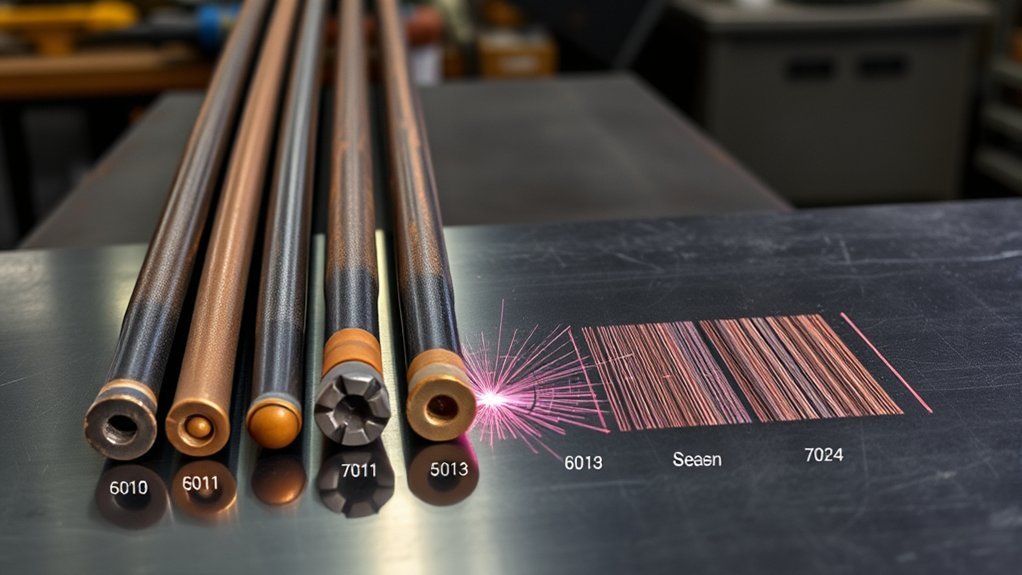
Common carbon-steel stick electrodes are classified under the American Welding Society’s AWS A5.1/A5.1M specification for carbon-steel electrodes used in shielded metal arc welding. AWS also announced ANSI approval of the A5.1/A5.1M-2026 revision on August 11, 2026. The classification gives useful information about the deposited weld metal and how the electrode is intended to operate.
| Part of Code | Example | Meaning |
|---|---|---|
| E | E7018 | Identifies the consumable as an electrode. |
| First two digits | 70 | Indicate the minimum tensile-strength classification of deposited weld metal in thousands of psi. “70” corresponds to a 70 ksi classification; “60” corresponds to 60 ksi. |
| Third digit | 1 or 2 | For the electrodes compared here, “1” identifies all-position capability, while “2” restricts use primarily to flat and horizontal fillet welding. |
| Final digit | 0, 1, 3, 8, 4 | Identifies the coating/current family, which affects usable current and polarity, arc behavior, penetration, slag, and other operating characteristics. |
E7018, for example, combines a 70 ksi strength classification, an all-position designation, and a low-hydrogen iron-powder coating/current family. E7024 also carries a 70 ksi classification, but its coating and positional designation make it a very different high-deposition electrode. The number alone therefore does not tell you that one rod will automatically produce a “stronger joint.” Joint design, base metal, weld size, defects, heat input, procedure qualification, and workmanship all affect completed-weld performance.
Once you understand the classification system, individual electrodes become easier to compare rather than relying on color, brand, or habit. For a broader product-focused overview, see these all-around welding rod options.
6010 vs 6011 vs 6013 vs 7018 vs 7024: Quick Comparison
| Rod | Typical Current | Position | Penetration / Arc | Surface Tolerance | Best Known For |
|---|---|---|---|---|---|
| E6010 | DC, commonly DCEP | All positions | Deep, digging, fast-freeze | More tolerant than 6013/7018, but cleaning is still preferred | Pipe roots, field welding, open-root work |
| E6011 | AC or DC, depending on product | All positions | Deep, forceful, fast-freeze | Good tolerance of scale/light contamination | Repair, maintenance, AC machines |
| E6013 | AC or DC | All positions by classification | Soft arc, light-to-moderate penetration, smooth bead | Prefers clean steel | Thin material, sheet metal, general light fabrication |
| E7018 | DCEP and, for suitable products, AC | All-position classification; typical procedures avoid vertical-down | Smooth arc, medium penetration | Requires clean material and moisture control | Low-hydrogen structural and restrained joints |
| E7024 | AC or DC on common products | Flat and horizontal fillets | Shallow/light penetration, very high deposition | Use properly prepared steel | Production welding and large flat/horizontal welds |
This comparison reflects common characteristics documented by major electrode manufacturers. Always check the classification printed on the electrode package and the manufacturer’s operating range because exact polarity, current, exposure limits, and technique can vary by product.
How To Choose The Right Welding Rod
Selecting a welding rod should start with the job requirements rather than with whichever electrode is easiest to strike. A practical decision order is:
- Check the WPS, drawing, code, or project specification. If the job specifies an electrode classification or hydrogen level, that requirement comes first.
- Identify the base metal and required weld-metal properties. Do not assume that a higher tensile number is automatically better.
- Check welding position. E6010, E6011, E6013, and E7018 are all-position classifications, while E7024 is intended for flat and horizontal work.
- Match the power source. Standard E6010 commonly requires DC, while E6011 and E6013 can run AC or DC. Many E7018 and E7024 products also support AC, but confirm the package data.
- Match penetration to the joint. E6010/E6011 are useful where a digging arc is needed. E6013 offers gentler penetration. E7018 gives controlled medium penetration, and E7024 prioritizes deposition rate.
- Choose electrode diameter and amperage together. Current range changes significantly with rod diameter; use the manufacturer’s range rather than a universal amps-per-thickness formula.
- Consider storage and handling. Low-hydrogen E7018 requires much tighter moisture control than cellulosic E6010/E6011 or rutile/iron-powder electrodes.
Pro Tip: The electrode box is a better starting point for amperage and polarity than a generic online chart. Start within the manufacturer’s range, then fine-tune current based on diameter, position, arc behavior, bead profile, fusion, and your qualified procedure.
If you are still selecting the machine as well as the electrode, this guide to welders for beginners provides additional equipment context.
6010 Welding Rod: Deep Penetration Basics
The E6010 electrode is a cellulosic, fast-freeze stick electrode known for a deep, forceful arc. Common E6010 products such as Lincoln Electric Fleetweld 5P+ are classified for all positions and specify DC+, making the rod especially useful for open-root pipe work, field fabrication, and joints where strong root penetration is required.
Its rapidly freezing puddle makes vertical and overhead work practical in trained hands, but the aggressive arc can be less forgiving for a beginner than a soft-running E6013 or E7018. If the welder itself is the limitation, compare the machine’s available DC output and open-circuit characteristics before choosing the rod. This budget stick welder guide provides related machine information.
Deep Penetration Arc
E6010 produces a digging arc with a fast-freeze puddle. Those characteristics are valuable for root passes because the welder can maintain fusion at the root while controlling a relatively small molten pool. The same arc behavior is useful in vertical-up, overhead, pipe, repair, and field applications when the procedure permits E6010.
E6011 behaves similarly but adds AC capability. E7018 has a smoother arc and medium penetration, while E7024 is designed around deposition rate rather than deep digging action.
DCEP Power Setup
For standard E6010 electrodes, DCEP—also called DC+ or electrode positive—is the normal manufacturer-specified setup. Avoid oversimplifying polarity by saying that one connection always “puts more heat” into a particular side of every arc. Coating chemistry and electrode design strongly influence actual arc behavior. The practical rule is simpler: use the polarity specified for the exact electrode and welding procedure.
E6011 can also produce deep penetration but offers much broader power-source flexibility because common E6011 products support AC and DC.
Rust And Scale Tolerance
E6010 and E6011 are more tolerant of mill scale, rust, paint residue, and other imperfect surface conditions than rods such as E6013 and E7018. That tolerance is useful for field repair, but it should not be treated as permission to weld through contamination unnecessarily.
Remove oil, grease, heavy rust, paint, moisture, and loose scale whenever practical. Contaminants can introduce porosity, inclusions, cracking, fumes, lack of fusion, or unpredictable weld-metal properties even when the electrode can maintain an arc through them.
6011 Welding Rod: AC-Friendly Versatility
E6011 is another cellulosic, fast-freeze electrode with a deep, forceful arc. Its main advantage over standard E6010 is power-source flexibility: common E6011 electrodes can operate on AC as well as DC. That makes E6011 especially useful with basic AC transformer welders, repair equipment, and field machines where E6010 compatibility may be limited.
E6011 also has relatively good tolerance for less-than-perfect steel surfaces, although proper cleaning still improves weld consistency and reduces defects.
Regardless of rod choice, protect your hands and skin from heat, spatter, and ultraviolet exposure. If you are reviewing PPE, this welding glove guide covers glove options for stick and MIG work.
AC and DC Use
E6011 stands out because common products are designed for both AC and DC operation. By comparison, standard E6010 is normally associated with DC+, while E6013 commonly supports AC and DC.
E7018 should not be described as “DC only.” Many E7018 products support AC in addition to DCEP, although machine open-circuit voltage and the specific electrode formulation can affect AC performance. Some products are specifically marketed for easier AC use.
E7024 is also commonly AC/DC capable. Lincoln Electric’s E7024-1 Jetweld 1, for example, publishes operating ranges for both AC and DC±. Position—not AC compatibility—is the more important limitation for E7024 because it is intended for flat and horizontal welding.
Dirty Metal Performance
Between E6011 and E6013, E6011 is normally the better choice when steel cannot be made perfectly clean. Its cellulosic coating and digging arc are more tolerant of rust, scale, and other light contamination.
That does not make contamination harmless. Clean the joint as thoroughly as the job permits, especially where strength, fatigue resistance, leak tightness, or code compliance matters. E7018 in particular benefits from clean, dry base metal because moisture and contamination undermine the purpose of using a controlled low-hydrogen process.
6013 Welding Rod: Clean, Easy Welds
E6013 is a general-purpose electrode known for a smooth, relatively soft arc, easy starts, light-to-moderate penetration, low spatter, and an attractive bead. It can run on AC or DC and is classified for all positions, although flat and horizontal welding are often the easiest places to take advantage of its smooth puddle.
Typical uses include:
- Thin-gauge sheet and light fabrication where excessive penetration could cause burn-through.
- Clean lap, fillet, corner, and butt joints.
- Decorative or visible welds where bead appearance matters.
- Training and home-shop work where easy arc behavior is useful.
E6013 is less suited than E6010/E6011 to heavy contamination or joints requiring an aggressive digging arc. Proper joint preparation remains important because its softer arc can make lack of fusion easier to create when rust, scale, poor fit-up, low amperage, or excessive travel speed are present.
For home-shop equipment choices that pair well with common light-duty electrodes, see this guide to welders for home use.
7018 Welding Rod: Low-Hydrogen Strength
E7018 is a low-hydrogen iron-powder electrode with a 70 ksi tensile-strength classification. It is widely used in structural fabrication, pressure work, restrained joints, and other applications where hydrogen control, toughness, and specified weld-metal properties matter.
The rod typically produces a smooth, quiet arc, manageable slag, medium penetration, and relatively low spatter. Many E7018 products support both DCEP and AC, although DCEP is commonly preferred. Always check the specific product data and WPS rather than assuming every E7018 has identical electrical requirements.
If you are matching a machine to this rod family, this stick welder guide provides additional equipment context.
Low Hydrogen Properties
The low-hydrogen coating is intended to limit diffusible hydrogen in deposited weld metal, helping reduce the risk of hydrogen-assisted cracking when the complete welding procedure is appropriate. Some products carry additional designators such as H4R; those supplemental designators have specific diffusible-hydrogen and moisture-resistance meanings and should not be assumed for every generic E7018 electrode.
Low-hydrogen performance depends on more than the four-digit number. Storage, exposure time, base-metal cleanliness, preheat, interpass temperature, joint restraint, electrode condition, and qualified procedure all matter.
Strong Structural Welds
E7018 is frequently specified for structural work because of its mechanical-property classification and low-hydrogen characteristics. However, the 70,000 psi classification describes qualifying deposited weld metal under standardized testing. It does not mean every E7018 weld automatically carries 70,000 psi of useful structural load or that it is automatically superior to every 60-series electrode for every joint.
| Attribute | Typical E7018 Characteristic |
|---|---|
| Tensile classification | 70 ksi minimum classification |
| Coating family | Low-hydrogen iron powder |
| Penetration | Medium |
| Arc character | Smooth, controlled |
| Typical applications | Structural fabrication, pressure work, restrained joints when specified |
| Main handling concern | Moisture control after opening |
Proper Storage Requirements
E7018 requires more moisture control than E6010, E6011, E6013, or E7024. ESAB’s electrode-storage guidance gives a typical holding-oven range of about 225–300°F for E7016/E7018/E7028 electrodes, while E6010/E6011 are normally kept at ambient conditions and E6013/E7024 use much lower holding temperatures.
Note: “Keep E7018 at 250°F” is a useful shorthand only when it agrees with the electrode manufacturer’s instructions and the applicable WPS/code. Vacuum-packed or moisture-resistant electrodes can have different permitted exposure and rebaking rules. Never guess at rebaking temperature because excessive heat can damage a coating.
For controlled work, keep unopened electrodes sealed until needed, transfer only the quantity required, use a suitable holding oven or heated quiver when specified, track exposure time when the procedure requires it, and discard or recondition electrodes only according to manufacturer and code instructions.
7024 Welding Rod: Fast Flat Welding
E7024 is a high-deposition iron-powder electrode designed mainly for flat groove welds and horizontal fillet welds. Its heavy coating allows high current and rapid metal deposition, making it useful for production fabrication and larger welds where the work can be positioned appropriately.
Unlike E7018, E7024 is not a generic low-hydrogen electrode. Common E7024 products use an iron-powder/titania coating system and are valued primarily for productivity, smooth bead appearance, easy drag technique, heavy self-releasing slag, and relatively shallow penetration.
Common products can operate on AC or DC. For example, Lincoln Electric Jetweld 1 E7024-1 lists AC and DC± operating procedures and specifies flat and horizontal welding positions.
E7024 should not be recommended generically for high-carbon steel merely because it has a 70-series tensile classification. Base-metal chemistry, cracking susceptibility, preheat, filler-metal matching, and the approved procedure determine whether a particular electrode is suitable.
For readers comparing stick electrodes with other high-deposition processes, this guide to flux-core welding wires provides related process information.
7024 Amperage by Diameter
There is no single correct amperage such as “150–200 amps” for all E7024 rods. Diameter makes a major difference. The following values are an example from Lincoln Electric’s Jetweld 1 E7024-1 data sheet, not a universal chart for every brand:
| Electrode Diameter | AC Range | DC± Range |
|---|---|---|
| 1/8 in. (3.2 mm) | 115–175 A | 100–160 A |
| 5/32 in. (4.0 mm) | 180–240 A | 160–215 A |
| 3/16 in. (4.8 mm) | 240–300 A | 220–280 A |
| 7/32 in. (5.6 mm) | 300–380 A | 270–340 A |
| 1/4 in. (6.4 mm) | 340–440 A | 320–400 A |
Do not use a “1 amp per thousandth of material thickness” rule to set E7024 current. Start with the electrode manufacturer’s diameter-specific range and adjust only within the limits allowed by the welding procedure.
6010 Vs. 6011: Which Rod Is Better?
E6010 and E6011 are closely related cellulosic electrodes with deep penetration and fast-freeze puddles, but their power-source requirements separate them.
- Choose E6010 when the WPS or application calls for a traditional deep-digging DC electrode, particularly for root work and pipe welding.
- Choose E6011 when you need similar fast-freeze behavior but must use AC or want broader power-source compatibility.
- Both are more tolerant of imperfect surfaces than E6013 or E7018, but neither eliminates the need for proper cleaning.
- Both require more puddle-control skill than a soft-running general-purpose rod.
Neither electrode is universally “better.” E6010 is valuable when its particular arc and qualified procedure are required; E6011 is valuable when AC compatibility or repair versatility matters more.
If your equipment search includes other AC/DC processes as well as stick welding, this AC/DC TIG welder comparison provides separate machine-buying context.
6011 Vs. 6013: Penetration Or Appearance?
E6011 and E6013 share a 60 ksi tensile-strength classification but behave very differently. E6011 has a stronger digging arc and is more tolerant of scale and imperfect surfaces. E6013 offers a softer arc, less spatter, easier bead control, and a smoother finish on properly prepared light-gauge steel.
| Factor | E6011 | E6013 |
|---|---|---|
| Arc | Forceful, digging | Soft, smooth |
| Penetration | Deep | Light to moderate |
| Dirty-metal tolerance | Better | Prefers clean steel |
| Typical appeal | Repair and field work | Light fabrication and easier cosmetic control |
Choose based on the joint and required procedure rather than appearance alone. A smooth bead is not proof of adequate fusion, and a rougher-looking cellulosic bead is not automatically weak.
Machine capability can also influence process choice. If you are comparing broader AC/DC equipment, this AC/DC welder guide under $2,000 is a separate equipment resource.
6013 Vs. 7018: When Strength Matters
E6013 and E7018 differ in more than tensile classification. E6013 is a general-purpose rutile-type electrode valued for easy operation and a smooth bead. E7018 is a low-hydrogen electrode intended for applications where hydrogen control and specified mechanical properties are important.
- Classification: E6013 is a 60 ksi class electrode; E7018 is a 70 ksi class electrode.
- Hydrogen control: E7018 is specifically a low-hydrogen family; E6013 is not.
- Storage: E7018 needs controlled moisture handling when the procedure requires low-hydrogen performance.
- Surface preparation: Both benefit from clean steel, but cleanliness and moisture control are especially important for E7018 work.
- Application: E6013 suits light/general fabrication; E7018 is widely specified for structural, restrained, and code-controlled welds.
Do not replace an E7018 requirement with E6013 merely because both rods will physically produce a bead. Likewise, using E7018 on a simple light-gauge project does not automatically make the joint better if heat input, fit-up, or technique is inappropriate.
For readers comparing equipment budgets across other welding processes, this TIG welder guide under $1,000 provides separate buying information.
Common Welding Rod Selection Mistakes
- Choosing only by tensile number. A 70-series electrode is not automatically the correct substitute for a 60-series electrode.
- Ignoring the WPS. In code work, the qualified procedure controls electrode classification, diameter, position, current, polarity, preheat, and other variables.
- Assuming every rod of one AWS classification runs identically. Manufacturers publish different recommended amperage windows and product-specific characteristics.
- Using the wrong polarity. E6010 is especially sensitive to power-source compatibility.
- Using wet E7018. Moisture can undermine low-hydrogen control.
- Leaving avoidable contamination because a rod is “good on dirty steel.” Tolerance is not the same as immunity to defects.
- Running E7024 out of position. Its fluid, high-deposition puddle is intended for flat and horizontal work.
- Setting current from plate thickness alone. Electrode type and diameter are primary factors in SMAW amperage selection.
Welding Safety Before You Strike an Arc
Stick welding creates ultraviolet and infrared radiation, hot metal, sparks, fumes, electrical hazards, and fire risk. OSHA’s welding, cutting, and brazing requirements address eye protection, protective clothing, ventilation, confined-space precautions, and other controls.
- Wear a welding helmet with an appropriate filter shade, safety glasses, flame-resistant clothing, dry welding gloves, and suitable footwear.
- Keep your head out of the welding plume and provide adequate general or local exhaust ventilation.
- Remove combustible materials and follow hot-work/fire-watch requirements where applicable.
- Inspect electrode holders, work leads, insulation, connectors, and the power source before welding.
- Use extra electrical-shock precautions in wet or damp conditions.
- Do not weld tanks, drums, piping, or containers that may contain flammable or hazardous residues unless they have been made safe under an approved procedure.
- Use additional controls when welding galvanized, painted, stainless, lead-, cadmium-, or other coated/alloyed materials that can produce hazardous fumes.
The electrode classification narrows the choices; the WPS, base metal, joint, position, power source, and manufacturer data determine the correct choice for the actual weld.
Frequently Asked Questions
What Is a 7024 Welding Rod Good For?
E7024 is best known for fast, high-deposition welding in flat and horizontal positions. It is useful for large fillets, plate fabrication, repetitive production work, and other jobs where the work can be positioned for a fluid, high-output puddle. It is not a low-hydrogen substitute for E7018.
What Is the Hardest Rod to Weld With?
There is no universal hardest stick electrode. E6010 can be difficult for beginners because of its tight, aggressive digging arc and fast-freeze puddle. E7018 usually has a smoother arc but demands more disciplined storage, short-arc technique, and moisture control. Difficulty depends on the welder, machine, position, joint, and procedure.
What Amps Should You Run for 7024?
Amperage depends on electrode diameter and manufacturer. As one example, Lincoln Jetweld 1 E7024-1 lists about 115–175 A AC for 1/8-inch rod, 180–240 A for 5/32-inch, and 240–300 A for 3/16-inch. Larger diameters require substantially more current. Use the range printed on your electrode package or data sheet rather than one universal setting.
Which Welding Rod Is Better for Rusty Metal, 6011 or 6013?
E6011 is generally more tolerant of rusty, scaled, or imperfect steel because its cellulosic coating produces a forceful, digging arc. E6013 prefers cleaner steel and a more controlled joint. Even with E6011, remove oil, paint, heavy rust, moisture, and loose scale whenever possible.
Can You Run 7018 on an AC Welder?
Yes, many E7018 electrodes are rated for AC as well as DCEP, but not every machine/electrode combination performs equally well. Check the electrode package for AC approval and make sure the welder provides suitable open-circuit voltage. Products marketed specifically as 7018 AC can be easier to run on lower-OCV AC machines.
Is 7018 Stronger Than 6010, 6011, or 6013?
E7018 has a 70 ksi deposited-weld-metal tensile classification, while E6010, E6011, and E6013 are 60 ksi classifications. That does not mean every completed E7018 joint is automatically stronger. Base metal, weld size, penetration, joint design, heat input, defects, workmanship, and the approved procedure determine actual structural performance.
Conclusion
E6010, E6011, E6013, E7018, and E7024 are designed for different jobs. E6010 provides a deep DC digging arc for root and field work. E6011 adds AC flexibility and good tolerance for imperfect steel. E6013 offers an easier, smoother arc for clean light fabrication. E7018 provides controlled low-hydrogen weld metal for applications where specified mechanical properties and cracking control matter. E7024 sacrifices positional versatility in exchange for very high deposition rates in flat and horizontal welding.
The most reliable selection method is to start with the WPS or project requirement, identify the base metal and welding position, confirm power-source compatibility, select the correct electrode diameter, and then use the manufacturer’s amperage and storage instructions. That approach is safer and more accurate than choosing a rod by tensile number, appearance, or a single rule of thumb.
Sources
- American Welding Society — Standard Notices — current AWS A5.1/A5.1M standards update and 2026 ANSI approval information.
- Miller — Stick Welding for Equipment Repair — electrode numbering, penetration, position, polarity, preparation, and amperage guidance.
- Lincoln Electric — Jetweld 1 E7024-1 Product Data — E7024 welding positions, AC/DC compatibility, amperage ranges, deposition characteristics, and applications.
- ESAB — Storing and Redrying Stick Electrodes — storage differences between cellulosic, rutile/high-deposition, and low-hydrogen electrodes.
- OSHA — 29 CFR 1910.252 Welding, Cutting, and Brazing — eye protection, protective clothing, ventilation, confined-space, and general welding safety requirements.