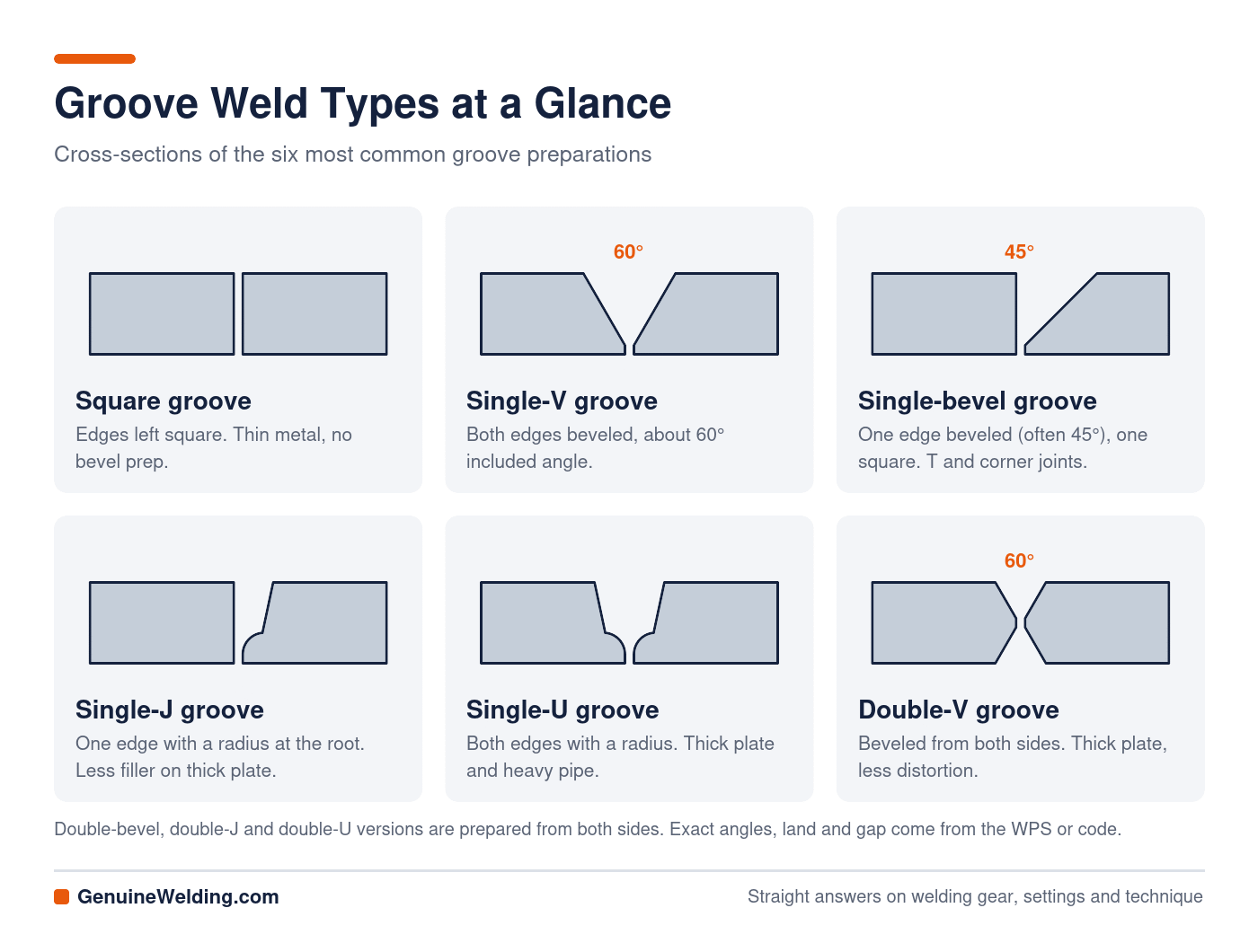
A groove weld is a weld made in an opening (the groove) between two pieces of metal, usually in a butt, corner or T-joint. The main groove weld types are square, V, bevel, J and U, and most come in single (welded from one side) or double (welded from both sides) versions. Thin metal uses a square groove; medium plate uses a V or bevel; and thick sections use double-V, J or U grooves to cut filler metal and distortion.
The groove shape decides how deep the weld can penetrate, how much filler you need and how much prep work the joint takes. Here is each type, when to use it and the terms you’ll see on drawings.
Groove Weld Terms You Need to Know
- Bevel angle: the angle cut on the edge of one piece.
- Groove angle (included angle): the total angle between the two prepared edges. Two 30° bevels make a 60° groove angle.
- Root face (land): the flat, unbeveled strip at the bottom of the bevel. It supports the root pass and prevents burn-through.
- Root opening (gap): the space between the pieces at the root.
- Bevel radius: the curved bottom of a J or U groove.
- Groove depth: how deep the prepared groove goes into the joint.
- CJP and PJP: complete joint penetration means weld metal through the full thickness; partial joint penetration means the weld stops short by design.
For the anatomy of any weld, see parts of a weld.
1. Square Groove Weld
The edges are left square, with or without a small gap. There is no bevel prep, so it is the cheapest groove to make. It works on thin material, generally up to about 1/8 to 3/16 in welded from one side, or a bit thicker welded from both sides or with a backing bar. On thicker plate it cannot reach full penetration.
2. Single-V and Double-V Groove Welds
Both edges are beveled to form a V. A typical plate V groove has a 60° included angle, a small root face and a gap of about 1/8 in. Pipe bevels are usually 37.5° per side (75° included) with a 1/16 to 3/32 in land.
- Single-V: welded from one side; common on plate from about 1/4 to 3/4 in and on most pipe.
- Double-V (X groove): beveled from both sides; used on thick plate when you can reach both sides. It uses roughly half the filler of a single-V on the same thickness and balances shrinkage to reduce distortion.
3. Single-Bevel and Double-Bevel Groove Welds
Only one piece is beveled (often around 45°); the other stays square. Bevel grooves are the go-to choice for T-joints and corner joints where only one member can be prepared, and for vertical joints where a square face supports the puddle. A double-bevel is beveled on both sides of the same piece for thick T-joints.
4. Single-J and Double-J Groove Welds
A J groove is a bevel with a rounded bottom (a radius). The radius gives the root more room for the electrode while keeping the groove narrow at the top, so it needs less filler than a bevel on thick sections. The trade-off is prep: J grooves are usually machined or gouged, not just cut with a torch.
5. Single-U and Double-U Groove Welds
A U groove has a radius on both pieces, making a U shape. It is common on thick pipe and heavy pressure vessel joints, where it saves a lot of filler and welding time compared to a V. Like the J, it needs machining, so it makes the most sense on thick or high-volume work.
6. Flare-V and Flare-Bevel Groove Welds
Flare grooves form naturally where rounded parts meet, such as two pieces of round bar or tube (flare-V) or a round bar against a flat plate (flare-bevel). They are common in rebar, tubing and formed sheet metal.
How to Choose a Groove Weld Type
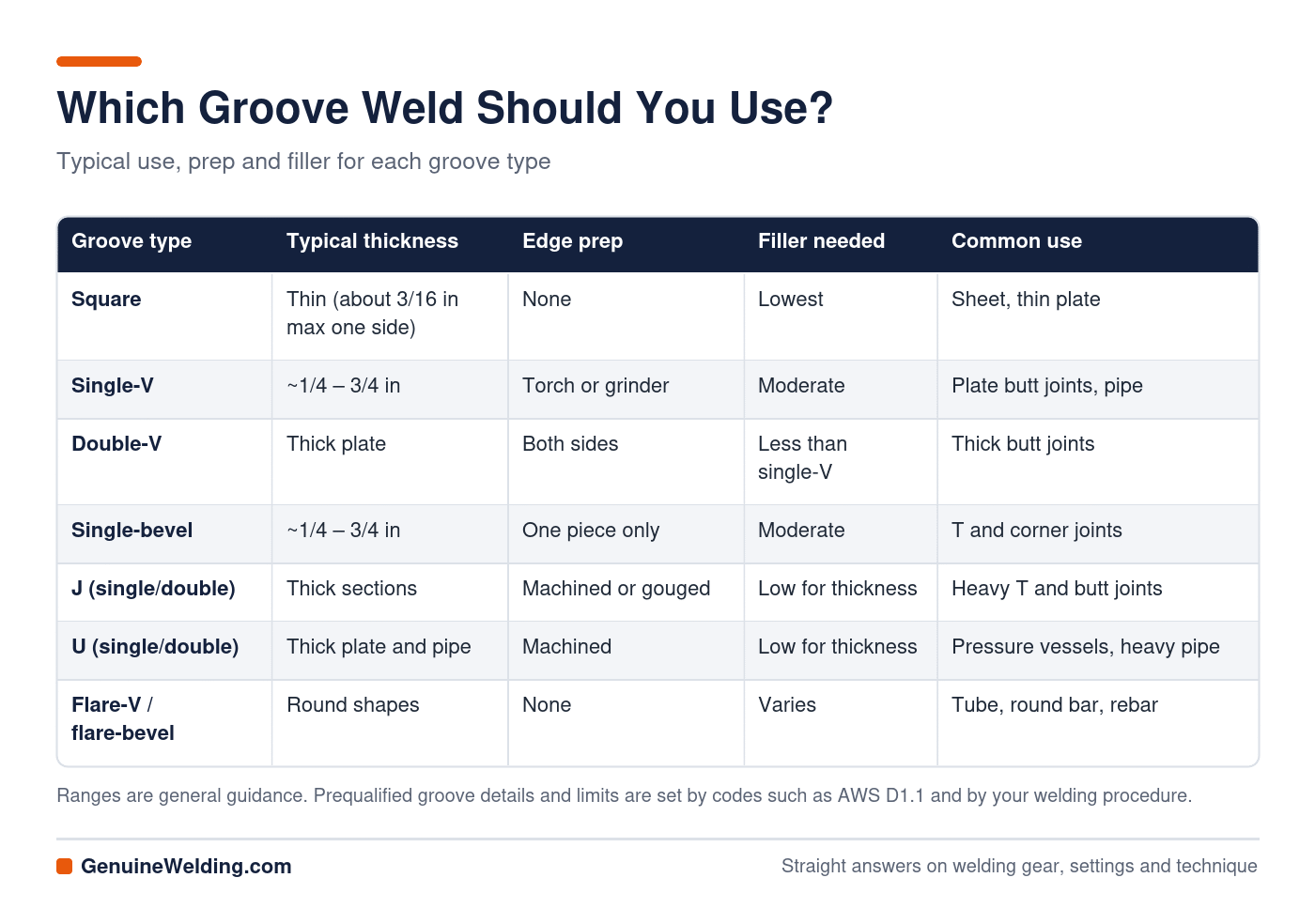
- Thickness: thin metal can use a square groove; thicker metal needs a bevel to let the arc reach the root.
- Access: if you can weld from both sides, double grooves save filler and reduce distortion.
- Prep cost vs filler cost: V and bevel grooves are easy to cut with a torch or grinder. J and U grooves cost more to prepare but save filler on thick joints.
- Code and procedure: codes such as AWS D1.1 list prequalified groove details. Using one saves procedure qualification testing.
- Position and process: some grooves suit certain positions and processes better; your WPS will specify.
How Groove Welds Appear on Drawings
On a welding symbol, each groove type has its own symbol: two parallel lines for square, a V for V-groove, a single slanted line for bevel, plus J and U shapes. Dimensions to the left give the depth and effective throat, and the groove angle and root opening appear near the symbol. Learn to read them in our guide to groove weld symbols and the welding symbols chart.
Groove Welds vs Fillet Welds
Fillet welds join surfaces at roughly right angles (T, lap and corner joints) with no edge prep. Groove welds fill a prepared opening and can develop the full strength of the base metal when they are complete joint penetration. Groove welds take more prep and skill but are required where full strength or a flush surface is needed. See weld types and joints and full penetration welds.
Tips for Better Groove Welds
- Keep bevel angles, land and gap consistent along the joint. Our guide to tack welding helps hold the gap.
- Grind off mill scale and torch oxide from the bevel faces.
- Back-gouge or grind the root on double-sided CJP welds before welding the second side.
- Clean slag between passes to prevent slag inclusions.
- Tie each fill pass into both sidewalls to avoid lack of fusion.
Groove Weld Types: FAQs
What is the most common groove weld?
The single-V groove is the most common, especially on plate and pipe, because it is easy to prepare and weld.
What is the difference between a V groove and a bevel groove?
A V groove has both edges beveled; a bevel groove has only one edge beveled and the other left square.
When should you use a double-V groove?
Use a double-V on thick plate when you can weld from both sides. It needs less filler and keeps distortion balanced.
Why use a J or U groove?
On thick sections, J and U grooves reduce the amount of filler and welding time compared with V and bevel grooves, which offsets their higher machining cost.
What groove angle is used for pipe?
A 37.5° bevel on each pipe end, giving a 75° included angle, is the standard factory pipe bevel.