
High school welding projects work best when each build has a clear learning goal, uses materials and equipment appropriate for the class, and can be completed under safe instructor supervision. Simple bookends, hooks, and stands help beginners practice measuring, fit-up, tacking, and bead control, while carts, benches, rocket stoves, and welding tables add sequencing, distortion control, blueprint reading, and teamwork.
Quick Answer
Good high school welding projects include bookends, wall hooks, phone stands, plant stands, pencil holders, small carts, metal art, outdoor benches, rocket stoves, and welding tables. Start with small non-safety-critical builds, then increase complexity as students demonstrate accurate layout, sound fit-up, controlled welding, safe equipment use, and consistent inspection.
Key Takeaways
- Beginner-friendly projects such as bookends, wall hooks, pencil holders, and simple stands teach measuring, tacking, squaring, and basic bead control.
- Intermediate builds such as carts, benches, and plant stands add layout, cutting, distortion control, assembly sequence, and finishing.
- Large group projects such as welding tables can teach planning, role division, inspection, and shared responsibility when the class has suitable equipment and supervision.
- Use known materials approved by the instructor; painted, plated, galvanized, or unidentified metal may create additional fume or coating hazards when heated.
- Project difficulty should match demonstrated student skill, available class time, school rules, equipment limitations, and the consequences of a failed weld.
Best High School Welding Projects for Teens
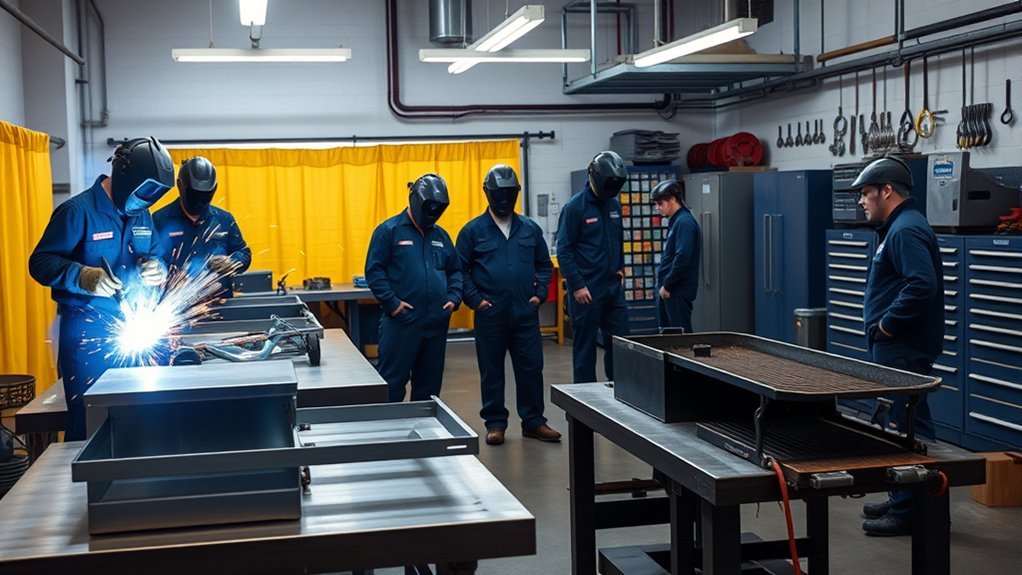
High school welding programs benefit from projects that keep students engaged while reinforcing core fabrication skills and safe shop practices. A useful project should teach something specific rather than simply give students more metal to weld.
Bookends, wall hooks, phone stands, pencil holders, and small plant stands are strong early projects because students can concentrate on layout, joint fit-up, tack placement, and bead consistency without immediately building a safety-critical structure.
Once those fundamentals are repeatable, projects such as miniature welding carts, outdoor benches, and instructor-approved rocket stoves can introduce more pieces, longer assemblies, sequencing, distortion control, and finishing.
Group builds such as a welding table add planning, sequencing, and shared responsibility. Students can divide tasks such as measuring, preparing parts, checking square, tacking, welding, inspecting, and finishing rather than having everyone work on the same joint at once.
The welding process should follow the curriculum and equipment available in the lab. Exposure to MIG, TIG, and stick welding equipment can help students understand how different processes are used, but project selection should come after training on the specific machine, consumables, settings, and hazards involved.
Pro Tip: Give every project one primary learning objective. For example, use bookends for 90-degree fit-up, a plant stand for repeated dimensions and assembly, or a cart for squaring and welding sequence. Students can then judge success against a clear target instead of appearance alone.
Welding Safety Before Students Start
Safety should be part of the project plan, not a reminder added after fabrication begins. The American Welding Society’s welding safety resources for schools and educators identify hazards such as electric shock, fumes and gases, arc radiation, fire, hot parts, flying particles, noise, gas cylinders, moving equipment, and surface coatings.
Students should receive training before using a welding machine, grinder, saw, torch, or other fabrication equipment. They should also follow the school’s shop rules, the equipment manufacturer’s instructions, warning labels, and applicable Safety Data Sheets. The current AWS/ANSI Z49.1 welding safety standard also covers personnel protection, ventilation, fire prevention, confined spaces, equipment operation, and training.
Warning: Do not assume that unidentified scrap metal is safe to weld. Paint, plating, galvanizing, lead, cadmium, oils, solvents, and other coatings or contaminants can change the fume and fire hazards. Use material the instructor can identify and approve, and follow the ventilation and hazard controls required for that material.
OSHA’s welding, cutting, and brazing requirements address fire prevention, protective equipment, ventilation, and material-specific hazards. In a school shop, practical controls commonly include the correct welding helmet and filter shade, safety glasses where required, protective clothing and gloves, suitable footwear, welding curtains or screens, secure workpieces, good housekeeping, fire protection, and effective fume control.
Teen participation also needs to follow school policy and applicable law. In the United States, the Department of Labor explains that ordinary school-based vocational education generally does not create an employment relationship. Different federal restrictions can apply when a minor is employed by a business, including restrictions involving certain powered metal-forming machines and abrasive cutting equipment, with limited exemptions for qualifying student-learners. State rules may be more restrictive. Instructors and employers should check the applicable requirements rather than assuming classroom and workplace rules are identical. See the U.S. Department of Labor youth-employment guidance.
Easy Welding Projects for Beginners
Easy welding projects for beginners should focus on fundamental techniques while keeping the number of parts and consequences of an error manageable. Small forms help students practice measurement, clamping, tack welding, heat control, and bead consistency before moving into larger assemblies.
| Project | Skill level | Core skill | Safety / quality focus |
|---|---|---|---|
| Bookends | Beginner | 90-degree joints and squaring | Clamp stability and sharp-edge cleanup |
| Wall hooks | Beginner | Fillet welds and positioning | Avoid assigning critical loads without proper design and inspection |
| Industrial pencil holder | Beginner | Small-part fit-up and distortion control | Hot-metal handling and finished edges |
| Phone stand | Beginner | Layout, angle control, and short welds | Small-part clamping |
| Plant stand | Beginner–intermediate | Repeated dimensions and assembly fit-up | Stability, edge handling, and final inspection |
| Decorative metal art | Beginner–intermediate | Tack placement and visual consistency | Material identification and controlled grinding |
Known, clean offcuts can reduce material waste, but “scrap” should not mean unidentified metal. The instructor should know the material and any coating before welding, heating, cutting, or grinding it.
A candle holder or plant stand can add creativity without overwhelming a novice. Project duration may range from one period to several class periods depending on part preparation, process, equipment availability, student experience, inspection requirements, and finishing.
If the program is comparing equipment for first-time users, this guide to beginner welding machines and processes provides additional equipment context. Students should still use only machines and processes authorized by their instructor.
Welding Projects Students Actually Want
Student interests vary, so there is no reliable percentage showing that one particular classroom project will motivate everyone. In practice, projects often become more engaging when students understand the purpose of the finished object and have limited, instructor-approved choices in dimensions, decorative details, or finishing.
Useful options include miniature welding carts, phone stands, tool organizers, plant stands, signs, decorative wall pieces, small shop fixtures, and outdoor projects approved for the student’s current skill level.
Rocket stoves can combine layout, fit-up, and thermal-design concepts, but they should be treated as instructor-led fabrication projects. Any combustion testing should follow school policy, fire controls, local rules, and the design’s intended safe-use conditions rather than being treated as an ordinary indoor classroom test.
For classes centered on GMAW, comparing MIG welder options can provide equipment context, but the learning goal should remain technique, setup, and fabrication quality rather than the machine brand.
A strong student project has a clear purpose, a measurable skill target, and a level of risk appropriate for the student’s demonstrated ability.
Shop Class Projects That Build Real Skills
Shop class projects build real welding skill when they require accurate measuring, clean fit-up, controlled heat input, and consistent bead placement.
A welding table can be an excellent class project for appropriately trained students because it requires frame layout, squaring, tack sequencing, distortion control, checking flatness, and safe handling of heavy steel. Because the finished table may support other work, the instructor should establish dimensions, material requirements, inspection criteria, and acceptable weld quality before fabrication begins.
An industrial pencil holder offers the same planning cycle on a much smaller scale. Students can practice cut preparation, fit-up, fillet welds, cleanup, and correcting minor distortion without managing a large frame.
Phone stands, plant holders, small carts, tool racks, and shop organizers also give each joint a clear function. They make it easier for students to see why joint location, alignment, and welding sequence matter.
Functional pieces like phone stands, plant holders, or a welding cart give each weld a clear purpose.
Group builds, including an outdoor bench, add communication and role division. One student can verify a cut list, another can lay out parts, another can check square before tacking, and another can record measurements or inspection results. Roles should rotate so one student does not perform every skilled operation.
Creative metal wall art can refine bead placement and finishing, while practical shop fixtures emphasize dimensions and function. Programs that expose students to more than one process can also use multi-process welding equipment as a way to discuss process selection and machine capability.
Blueprint Welding Projects for Practice
Blueprint welding projects give students structured designs that build technical skill through measured fabrication, correct material selection, and disciplined joint execution.
A classroom drawing does not need to be complex, but it should provide enough information for two students to build the same part without guessing. Useful elements include:
- Overall dimensions: finished length, width, height, and critical angles.
- Cut list: material type, section size, quantity, and cut length.
- Joint information: where pieces meet and which joints are welded.
- Weld symbols or written weld requirements: appropriate to what students have been taught.
- Reference dimensions: locations of brackets, legs, holes, shelves, or other features.
- Quality checks: acceptable square, level, fit-up, distortion, or dimensional tolerance.
- Finish requirements: deburring, cleanup, approved coating, or leaving welds visible for grading.
Common practice pieces such as toolboxes, vices, geometric shapes, racks, and decorative metal art can require different welding techniques while remaining approachable. Students learn how a drawing becomes a finished object and how errors early in layout affect later fit-up.
Each project also reinforces problem-solving, because misalignment and fit issues should be corrected before final welding rather than hidden by adding more weld metal.
A stable work surface helps with repeatable setup. This guide to welding tables provides additional context on the types of work surfaces available for fabrication.
How to Choose the Right Class Project?
Selecting the right class project means matching the assignment to student readiness, available equipment, curriculum goals, class time, material budget, and the consequences of a mistake.
| Question | What to check |
|---|---|
| Does it match the student’s skill? | Required joint types, welding positions, material thickness, number of parts, and expected accuracy. |
| Can it be built safely with available equipment? | Approved welding process, cutting method, lifting needs, ventilation, clamping, and finishing tools. |
| Is the material known? | Base metal, coating, contamination, thickness, and applicable SDS or manufacturer information. |
| Does it fit the schedule? | Layout, preparation, welding, inspection, correction, finishing, and cleanup time. |
| Can success be measured? | Dimensions, square, fit-up, bead consistency, distortion, function, and finish. |
| What happens if a weld fails? | Beginners should avoid projects where weld failure could injure a person or damage expensive equipment. |
Student interests still matter. Practical projects such as carts, organizers, stands, or decorative pieces may increase motivation because students can understand how the item will be used. Projects intended as gifts can also draw inspiration from welding gift ideas, provided the actual classroom assignment is selected around learning objectives and safe fabrication.
Practical projects like welding carts, stands, and shop organizers can combine student choice with measurable fabrication skills.
Challenging assignments are useful only when the required operations remain within the student’s training. Large, load-bearing, road-going, pressure-containing, lifting, fall-protection, or other safety-critical fabrications should not be treated as casual beginner projects simply because the parts can be welded together.
Multi-Skill Welding Projects for Students
Multi-skill welding projects combine cutting, fitting, joining, inspection, and finishing in one structured assignment. They are most useful after students can already make basic joints safely and repeatably.
A cart made from steel tubing can require layout, tack welding, checking diagonals, squaring the frame, controlling distortion, grinding where appropriate, mounting components, and preparing the surface for an approved finish.
A rocket stove adds thermal-design considerations and material judgment. A class welding table adds flatness, heavier material handling, frame sequence, teamwork, and inspection. Decorative pieces such as horseshoe art can develop bead consistency, fit-up, and visual finishing without making the finished object safety-critical.
Each assignment should begin with a drawing, identified material, safe work plan, suitable PPE, secure clamping, and instructor-approved machine setup. Students should then inspect dimensions, fit-up, heat distortion, and weld quality before final finishing.
If stick welding is part of the program, comparing stick welder options can help explain differences in available equipment, while actual machine setup and electrode selection should follow the curriculum and manufacturer instructions.
Project Progression From Beginner to Advanced
Beginner Stage
Start with projects that have few parts, simple positions, and low consequences if the finished object is imperfect. Good examples include bookends, steel cubes, phone stands, pencil holders, simple wall art, and small noncritical brackets.
The main goals are accurate measurement, clean fit-up, correct tacks, stable work positioning, consistent beads, and safe shutdown and cleanup.
Intermediate Stage
Move to plant stands, tool racks, small carts, simple shelves, decorative frames, or instructor-approved outdoor items. These builds add repeated dimensions, multiple joints, longer weld sequences, distortion control, and more finishing work.
Advanced or Group Stage
Welding tables, outdoor benches, larger carts, and other multi-part assemblies can be appropriate when students have demonstrated the required welding and material-handling skills. Advanced projects should include drawings, a cut list, assigned responsibilities, intermediate inspections, and a final acceptance check.
Note: “Advanced” should describe the skills required, not simply the size of the project. A small thin-sheet fabrication can demand more heat control than a much larger project made from forgiving material.
How to Check a Finished Student Welding Project
A completed project should be evaluated against the drawing and learning objective rather than appearance alone. A simple classroom inspection can include:
- Dimensions: Are critical lengths, heights, spacing, and angles within the assigned tolerance?
- Square and alignment: Are frames, legs, shelves, and brackets positioned correctly?
- Fit-up: Were unnecessary gaps or forced joints avoided?
- Weld placement: Are the required joints actually welded in the specified locations?
- Consistency: Are bead size and placement reasonably uniform for the student’s level?
- Distortion: Did the welding sequence keep the project acceptably straight and stable?
- Edges and finish: Have burrs, sharp edges, spatter, and finishing requirements been handled as specified?
- Function: Does the project sit, roll, hold, open, close, or mount as intended?
- Safety: Has the instructor approved the project before anyone relies on it for a load or other functional use?
Visual inspection is a learning tool, not proof that a weld is suitable for every structural or safety-critical application. Projects that protect people, carry significant loads, travel on public roads, contain pressure, support overhead loads, or perform another safety-critical function require appropriate design, procedures, qualification, and inspection beyond an ordinary classroom project.
Frequently Asked Questions
What Are Some Welding Projects for the Shop?
Useful shop welding projects include tool racks, small carts, welding-table accessories, storage organizers, plant stands, outdoor furniture, garden trellises, and decorative metal art. Students can begin with simple brackets and joints before moving to multi-part frames. Accurate measuring, secure clamping, tack sequencing, material identification, PPE, ventilation, and instructor inspection should remain part of every assignment.
What Are Some Ideas for Welding Projects for High Schoolers?
Good ideas include bookends, steel cubes, phone stands, pencil holders, wall hooks, tool racks, plant stands, small carts, signs, horseshoe art, outdoor benches, and class welding tables. A useful rule is measure twice, cut once. Choose the project according to the student’s current skills, equipment access, class time, and the consequences of a failed weld.
What Is the Easiest Welding Project for a High School Beginner?
A pair of simple bookends, a steel cube, or a basic phone stand can work well because each uses relatively few parts and provides immediate feedback on measurement, joint alignment, tacking, and bead placement. The instructor should choose the material thickness, welding process, and preparation method to match the class.
Is Scrap Metal Safe for Student Welding Projects?
Only when the material can be identified and the instructor has determined that it is appropriate for the process. Unknown coatings, paint, galvanizing, plating, oils, or other contamination can create additional fume, fire, or preparation hazards. Known clean offcuts from approved stock are a better classroom choice than unidentified scrap.
Can High School Students Use Grinders and Metal-Cutting Equipment?
That depends on the student’s training, school policy, equipment, supervision, and applicable law. In the United States, federal youth-employment restrictions can apply differently when a minor is employed by a business than when participating in an ordinary school vocational program. Some powered cutting and metal-forming equipment is specifically restricted for employed minors, with limited student-learner exemptions. Schools and employers should follow the applicable federal, state, local, and institutional requirements.
What Are Some Good Welding Business Ideas?
For qualified adults or graduates moving into professional work, possible welding businesses include mobile repair, custom metal fabrication, outdoor furniture, railings, signage, shop fixtures, and decorative metalwork. The business must account for licensing, insurance, applicable codes, customer specifications, fire prevention, ventilation, PPE, and any qualifications required for the work being accepted.
Do Welders Make $100 an Hour?
A $100-per-hour figure can occur in specialized contracting, unusual overtime situations, travel work, or when someone is quoting a business billing rate rather than an employee’s base wage, but it is not typical pay for the occupation. The U.S. Bureau of Labor Statistics reports that welders, cutters, solderers, and brazers had a median annual wage of $53,750 in May 2025, while the highest 10% earned more than $77,530. Actual earnings vary by location, industry, experience, schedule, qualifications, and type of work.
Conclusion
High school welding projects are most valuable when the finished object is tied to a specific fabrication skill and an appropriate level of risk. Bookends, phone stands, pencil holders, and small decorative pieces can develop basic measuring, fit-up, and bead control. Plant stands, carts, benches, and welding tables can later add sequencing, distortion control, blueprint reading, inspection, and teamwork.
Students should work from known materials, follow the school’s safety program and equipment instructions, use the required PPE and ventilation, and have projects inspected before functional use. A project does not have to be large or complicated to be worthwhile; it needs to give the student a clear standard for safer, more accurate work.
Sources
- American Welding Society — Free Welding Safety Resources — ANSI Z49.1:2021 and school-specific welding safety guidance.
- Occupational Safety and Health Administration — 29 CFR 1910.252 — welding, cutting, and brazing fire prevention, PPE, ventilation, and material-hazard requirements.
- U.S. Department of Labor — Youth Employment FAQ — school vocational programs, Hazardous Occupations Orders, apprentices, and student-learners.
- NIOSH — Welding Fumes and Manganese — welding-fume exposure and material-related health considerations.
- U.S. Bureau of Labor Statistics — Welders, Cutters, Solderers, and Brazers — current wage and employment-outlook data.