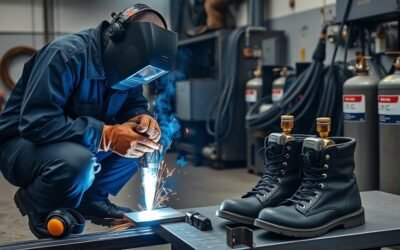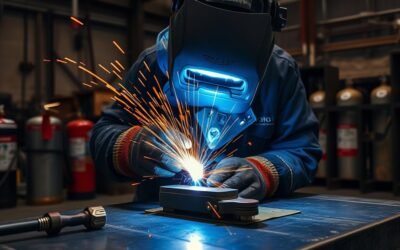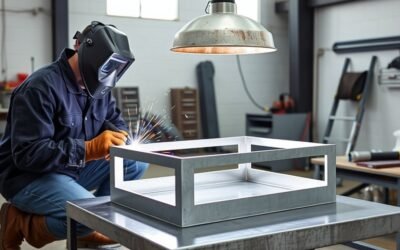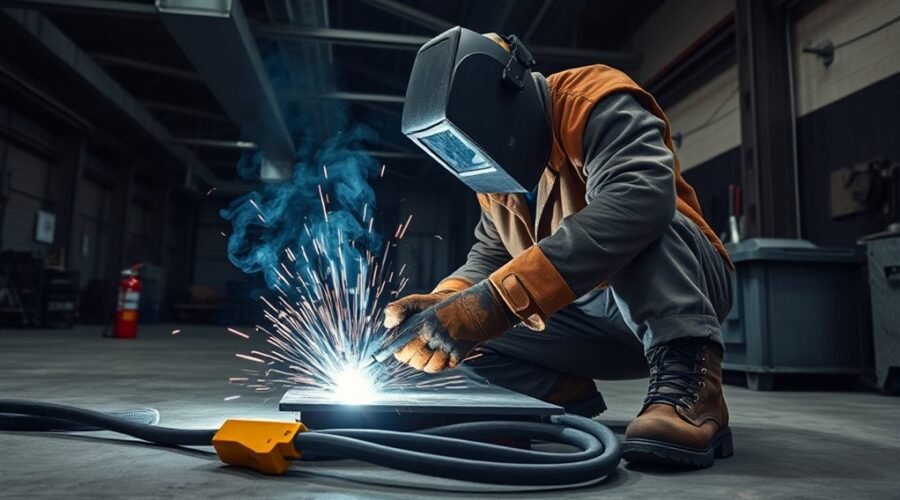
Arc welding safety depends on controlling several hazards at the same time: intense arc radiation, hot metal and spatter, welding fumes, electricity, noise, and fire. Before striking an arc, inspect the equipment, identify the metal and coatings being welded, clear the work area, confirm ventilation, and put on PPE suited to the process and job conditions.
Quick Answer
Safe arc welding requires a suitable welding helmet and eye protection, flame-resistant clothing, dry welding gloves, protective footwear, effective fume control, inspected electrical equipment, and a fire-safe work area. Keep combustibles away from hot work, isolate yourself from energized parts and ground, and use local exhaust or other controls when fumes cannot be safely dispersed.
Key Takeaways
- Wear a welding helmet with the correct filter shade, safety glasses with side protection, dry welding gloves, suitable protective clothing, and protective footwear.
- Inspect the electrode holder, leads, insulation, work connection, helmet, gloves, and clothing before welding.
- Control welding fumes at the source whenever possible with local exhaust ventilation, and evaluate hazards from the base metal, filler metal, and coatings.
- Keep yourself and welding equipment dry and avoid direct contact with energized electrodes, holders, workpieces, and grounded conductive surfaces.
- Move combustibles at least 35 feet from hot work where practicable, shield materials that cannot be moved, and use a fire watch when conditions require one.
Warning: This guide provides general safety information. Workplace welding must also follow applicable OSHA or local regulations, employer hazard assessments, equipment-manufacturer instructions, respiratory-protection requirements, confined-space procedures, and site-specific hot-work rules.
Arc Welding Safety Basics
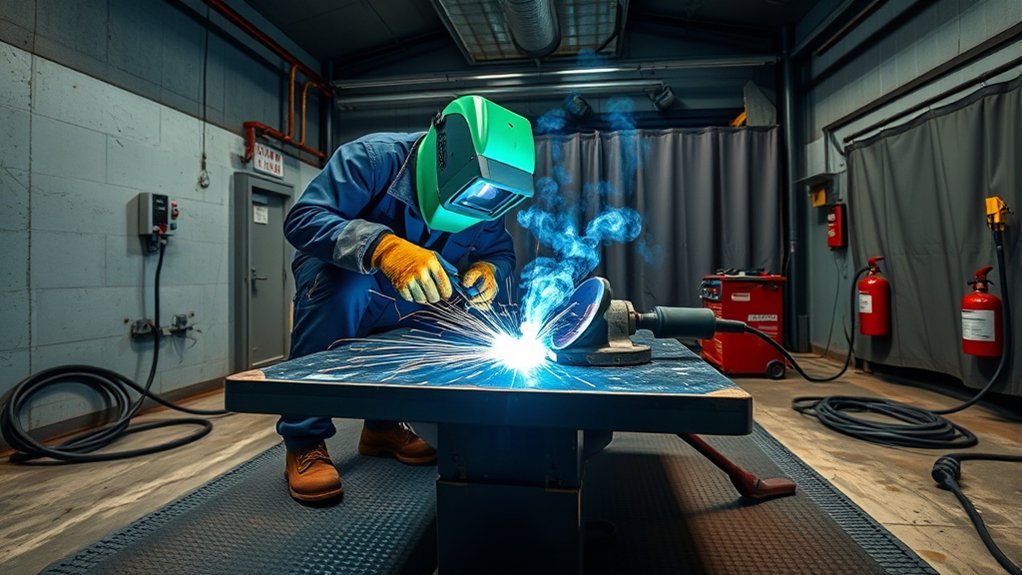
Arc welding safety begins before the arc is struck. Check the work area, identify the material and any surface coatings, inspect the welding machine and leads, confirm that ventilation is adequate, and make sure other people are protected from arc radiation and flying particles.
Personal Protective Equipment (PPE) provides the final barrier between the welder and hazards that cannot be eliminated through engineering or work-practice controls. A typical setup includes a welding helmet, safety glasses, dry welding gloves, suitable protective clothing, and protective footwear. Hearing and respiratory protection may also be necessary depending on noise and fume exposure.
In the United States, OSHA 29 CFR 1910.252 sets general requirements for welding, cutting, fire prevention, personnel protection, and ventilation. The exact controls needed depend on the welding process, material, workspace, and contaminants involved.
Note: The often-quoted “10,000 cubic feet per welder” figure is not a guarantee of adequate ventilation. OSHA requires mechanical ventilation for general welding in spaces with less than 10,000 cubic feet per welder, ceilings lower than 16 feet, or structural conditions that significantly obstruct cross-ventilation. Hazardous contaminant concentrations must still be controlled.
Fire prevention also begins before welding. Remove or protect combustible material, locate appropriate fire-extinguishing equipment, and determine whether a fire watch is required. A durable welding apron can provide additional torso and lap protection where sparks, slag, and spatter are expected.
Common Arc Welding Hazards
The main arc welding hazards include electric shock, arc radiation, burns, hot metal and spatter, welding fumes and gases, fire, eye injuries, noise, and physical injuries from tools or material handling.
Welding fumes are a mixture of very small particles whose composition depends on the base metal, filler metal, coatings, process, and consumables. Stainless-steel welding may generate hexavalent chromium, galvanized steel can generate zinc oxide fumes, and many welding fumes contain manganese. Painted or plated surfaces can introduce additional hazardous contaminants.
The CDC/NIOSH welding-fume guidance notes that inhaled manganese from welding fumes can affect the lungs and central nervous system. Fume hazards therefore cannot be judged by whether smoke is visible or by room size alone.
A large room is not automatically a safe room: welding-fume control depends on the contaminants generated, airflow, exposure level, and how effectively fumes are captured before they reach the breathing zone.
Electric shock is another major hazard. Welding machines can have hazardous no-load or open-circuit voltage, particularly when the welder is wet, perspiring, in contact with conductive material, or using damaged equipment. Keep gloves and clothing dry, maintain intact insulation, and isolate the body from both the workpiece and ground.
Fire risk comes from the arc, sparks, slag, heated metal, and nearby combustible material. Rather than assuming sparks travel a fixed distance in every situation, apply the hot-work control zone: OSHA requires combustibles to be moved at least 35 feet away where practicable or protected when they cannot be moved.
Gloves with durable reinforced palm patches can improve abrasion and handling protection, but glove construction and thickness should still match the welding process.
Your Welding PPE Checklist
Arc welding PPE should protect the eyes, face, skin, hands, feet, and hearing without creating new hazards. Select equipment for the welding process, amperage, position, surrounding work, and site-specific hazard assessment.
Helmet And Eye Protection
A welding helmet protects the face and eyes from intense visible light, ultraviolet and infrared radiation, sparks, and hot particles. For U.S. workplaces, select eye and face protection that satisfies applicable requirements under OSHA 29 CFR 1910.133 and the welding requirements in 29 CFR 1910.252.
Wear suitable safety glasses or goggles under the helmet when flying-particle exposure exists. Nearby helpers and other workers must also be protected from arc radiation by screens, curtains, or suitable eye protection.
| PPE item | What to check |
| Helmet shell | No cracks, burn-through, major damage, or openings that expose the face or neck |
| Filter lens | Correct minimum shade for process and current |
| Auto-darkening filter | Correct settings, clean sensors, adequate power, and normal darkening response |
| Safety glasses | Proper fit and appropriate side protection |
In Canada, CSA Z94.3:20 is an eye-and-face-protection standard used within the applicable regulatory framework. Requirements vary by province or territory, so employers should follow the rules that apply at the worksite.
Protective Clothing Essentials
Cover exposed skin to protect against arc radiation, sparks, spatter, and hot metal. Use purpose-made flame-resistant welding clothing where the hazard warrants it. Tightly woven work-weight cotton or wool does not melt like many synthetic fabrics, but natural-fiber content alone should not be confused with certified flame-resistant performance.
Avoid clothing made from ordinary synthetic fibers that can melt onto the skin. Long sleeves, a closed collar, properly secured cuffs, and cuff-free trousers that extend over the boot tops reduce entry points for sparks.
Leather jackets, sleeves, capes, and aprons provide additional protection for higher-spatter processes and out-of-position welding. Keep garments dry and free of oil, grease, solvents, and other combustible contamination.
Gloves, Boots, And Accessories
Wear dry welding gloves that protect the hands and wrists from heat, ultraviolet radiation, cuts, and electrical contact. Thick gauntlet-style gloves are common for SMAW and higher-spatter work, while TIG welding often benefits from thinner gloves that provide better fingertip sensitivity.
Wear sturdy, high-top leather footwear with the pant legs over the boot tops. Protective toes or metatarsal guards may be appropriate where the hazard assessment identifies falling or rolling-object risks. Avoid exposed mesh or openings that can admit sparks.
Remove matches, lighters, and other ignition sources from pockets. Rings, watches, and conductive jewelry can also create burn, snagging, or electrical hazards and should be removed where required by the task.
Choose the Right Welding Helmet
A safe welding helmet needs more than a dark lens. It must protect the face and eyes from radiation and flying material while providing enough visibility to position the electrode or torch accurately.
Fixed-shade and auto-darkening helmets can both be suitable when they meet the required protection level. Auto-darkening filters can make positioning and repetitive work easier, but they must be set correctly and inspected for proper operation before use.
OSHA’s filter-lens table specifies minimum shades according to welding process, electrode size, and arc current. Common minimum values include:
| Process | Current | OSHA minimum shade |
| GMAW / FCAW | Under 60 A | 7 |
| GMAW / FCAW | 60–500 A | 10 |
| GTAW / TIG | Under 50 A | 8 |
| GTAW / TIG | 50–150 A | 8 |
| GTAW / TIG | 150–500 A | 10 |
Do not automatically select the lightest allowable shade. OSHA recommends starting darker and moving to a lighter shade only as needed for adequate visibility without going below the minimum protective shade.
Inspect the lens, shell, headgear, cover plates, sensors, and controls before use. Helmets such as the Speedglas 9100 may include Natural Color Technology, but optical convenience does not replace correct shade selection or PPE inspection.
Wear Protective Clothing That Works
Protective welding clothing should cover the skin, resist ignition and spatter, and avoid materials that melt easily when exposed to heat. Use task-appropriate flame-resistant garments, leather, or tightly woven workwear according to the hazard.
Garments should fit securely without restricting movement. Use long sleeves, closed collars, secure cuffs, cuff-free trousers, and boots that prevent hot particles from reaching the skin.
For higher-spatter jobs, a welding jacket can add coverage to the torso and arms. When comparing gear, prioritize material, coverage, stitching, closure design, and durability rather than appearance alone.
Flame-Resistant Fabric
Purpose-made flame-resistant garments provide an important barrier against sparks, heat, and brief flame exposure. Leather also provides strong resistance to sparks and spatter, although it can become hot and is less breathable.
Natural fibers such as cotton and wool are generally preferable to ordinary melt-prone synthetic clothing around welding heat, but not every cotton or wool garment is flame-resistant. Follow the garment manufacturer’s rating, care instructions, and limitations.
Keep protective clothing free from oils, grease, solvents, and other combustible contamination. Replace garments whose protection has been compromised by holes, frayed areas, damaged closures, or severe contamination.
Secure Fit Details
A secure fit closes the paths through which sparks and ultraviolet radiation can reach the skin without interfering with movement or safe equipment operation.
- Cover the wrists, ankles, neck, and waist.
- Keep shirt and jacket pockets closed or covered by flaps.
- Wear trousers without cuffs that can trap hot particles.
- Keep pant legs outside the boots.
- Inspect seams, snaps, zippers, and hook-and-loop closures.
- Use flame-resistant welding sleeves when extra arm protection is needed.
Keep Clothing Clean
Oil, grease, solvents, and combustible dust can increase ignition risk. Keep welding clothing clean and dry, and change contaminated garments before hot work.
Wash flame-resistant garments according to the manufacturer’s care instructions because inappropriate laundering products or methods can damage protective performance. Inspect the clothing after washing and before reuse.
Protect Your Hands, Feet, and Hearing
Hands and feet are exposed to hot workpieces, slag, sparks, sharp edges, and heavy material. Wear welding gloves suited to the process and sturdy high-top leather footwear that prevents sparks from entering around the ankle.
Keep gloves dry and replace them when they become torn, stiff, contaminated, or worn through. Never change a stick electrode with a bare or wet hand.
Hearing protection should be based on actual noise exposure and site requirements. Grinding, gouging, chipping, air tools, and nearby fabrication equipment can produce significant noise even when the welding arc itself is not the dominant source. Select earplugs or earmuffs with a suitable noise-reduction rating and make sure they do not interfere with the helmet or other required PPE.
Control Welding Fumes
Welding-fume control should begin by identifying what is being welded. Base metal, filler metal, coatings, cleaners, plating, paint, and shielding processes can all affect the contaminants produced.
Use local exhaust ventilation (LEV) where practical to capture fumes close to their source before they move through the welder’s breathing zone. General mechanical ventilation may supplement LEV but should not simply blow contaminated air from one worker toward another.
Pro Tip: Position a movable fume-extraction hood as close to the arc as practical without disturbing the welding process or shielding gas. Reposition it as the weld progresses instead of leaving the hood several feet away.
OSHA requires local exhaust or general ventilation to keep toxic fumes, gases, and dust within applicable exposure limits. Mechanical ventilation is required for general welding under specified conditions, including rooms with less than 10,000 cubic feet per welder, ceilings below 16 feet, or substantial obstruction of cross-ventilation.
Do not use oxygen to ventilate a welding space, cool workers, blow dust from clothing, or clean the work area.
Ventilation Methods
Ventilation can include natural airflow, general mechanical ventilation, local exhaust hoods, extraction guns, downdraft tables, or other engineered systems. The correct solution depends on the process, weld position, material, enclosure, and measured exposure.
Local exhaust is usually more effective than relying on dilution alone because it captures contaminants before they disperse through the room.
Pay particular attention when welding:
- stainless steel or chromium-containing material;
- galvanized or zinc-coated steel;
- lead-, cadmium-, mercury-, or beryllium-containing material;
- painted, plated, primed, or chemically treated surfaces;
- inside tanks, vessels, pits, or other enclosed spaces.
Remove hazardous coatings where permitted and safe to do so, or use the ventilation and respiratory controls required for the material. Never assume a coating is harmless because it is thin or difficult to see.
Respirator Protection
Respirators may be necessary when engineering and work-practice controls cannot adequately control exposure or when a specific regulation requires respiratory protection. Selection depends on the actual contaminant, its concentration, oxygen level, and work environment.
In regulated workplaces, respirator use must be part of the required respiratory-protection program, including proper selection, medical evaluation where applicable, fit testing for tight-fitting respirators, training, inspection, cleaning, storage, and cartridge or filter change procedures.
A generic dust mask should not be assumed to protect against every welding fume or gas. Confined spaces can present additional atmospheric hazards that require specialized ventilation, monitoring, communication, and rescue procedures.
Prep Your Shop Before Welding
A safe welding area should be prepared before power is applied to the machine. Clear clutter, inspect the workpiece, locate exits and fire equipment, protect nearby people, and verify that ventilation is operating.
- Move paper, cardboard, solvents, fuel, oily rags, sawdust, and other combustibles away from hot work.
- Where practicable, maintain at least 35 feet of separation between hot work and combustible material.
- Shield combustible items that cannot be moved.
- Use noncombustible or flame-resistant welding curtains to protect nearby workers from arc radiation.
- Inspect welding leads, connectors, the electrode holder, work clamp, and machine enclosure.
- Keep cables out of walkways and protect them from crushing, cutting, sharp edges, and vehicle traffic.
- Confirm that local exhaust and general ventilation paths are unobstructed.
- Determine whether a fire watch or hot-work permit is required.
A stable work surface also reduces accidental movement of hot or heavy parts. The same principle applies when choosing a sturdy welding table: stability and suitability for hot work matter more than convenience alone.
Prevent Electric Shock
Electric shock can be fatal. The risk increases when skin, gloves, clothing, floors, or the work area are wet; when the welder is in close contact with conductive surfaces; or when cables, holders, connectors, or insulation are damaged.
OSHA limits open-circuit voltage for specified arc-welding machines and recommends voltage-reducing controls for AC welding under wet or hot conditions where perspiration increases shock risk. More importantly, welders should avoid direct contact with live components and maintain effective insulation from the work and ground.
- Keep hands, gloves, clothing, and footwear dry.
- Never change an electrode with a bare or wet hand.
- Inspect electrode holders and welding leads for damaged insulation or exposed conductors.
- Do not wrap welding leads around the body.
- Use dry insulating material when the work position creates contact with grounded metal.
- Do not dip an energized electrode holder in water.
- When an electrode holder will be left unattended, remove the electrode and position the holder so it cannot contact a person or conductive object.
- Switch off the power supply when leaving the work for an appreciable period or when the machine must be moved.
- Report faulty or defective equipment and have qualified personnel repair it.
Warning: If someone is receiving an electrical shock, do not grab the person with bare hands while they remain in contact with the energized source. Disconnect power safely and call emergency medical services. Electrical injuries may cause serious internal damage even when external burns appear small.
Shielding-gas selection does not prevent electrical shock. For MIG welding, the correct gas depends on the wire, material, transfer mode, and procedure; a common 75/25 shielding-gas mix may suit some mild-steel applications, but electrical precautions remain the same.
Prevent Welding Fires
Arc welding can ignite combustible material through sparks, slag, hot metal, radiant heat, or heat conducted through a workpiece into another area.
Under OSHA’s general-industry hot-work rules, combustible material should be moved at least 35 feet from the work site where practicable. When relocation is impractical, protect the material with suitable guards, curtains, or covers and use a fire watch when the conditions require one.
- Inspect both sides of walls, floors, partitions, and other surfaces that can conduct heat.
- Check cracks, openings, ledges, ducts, and hidden spaces where sparks or slag can collect.
- Keep suitable fire-extinguishing equipment ready for immediate use.
- Do not weld on containers, tanks, drums, or piping that have held flammable or hazardous substances unless they have been made safe under an approved procedure.
- Maintain the fire watch for the period required by the applicable workplace procedure or regulation.
- Inspect the work area again after welding for smoldering material or hidden heat.
Welding helmets with useful comfort and visibility features can support safe work, and suitable PPE remains important, but PPE cannot substitute for eliminating a fire hazard from the workspace.
Protect Nearby Workers From the Arc
Arc radiation can injure people who are not doing the welding. Install noncombustible or flame-resistant curtains or screens where practical so nearby employees and visitors cannot look directly at the arc.
Position screens so they protect against radiation without blocking needed ventilation. Helpers who must work close to the operation should wear eye and face protection appropriate to their exposure.
Check the Metal and Coatings Before Welding
Do not start welding until you know what material and surface treatment are present. Fume composition can change dramatically when the workpiece contains stainless steel, galvanized coatings, lead-containing paint, cadmium plating, or other hazardous materials.
Review Safety Data Sheets and job documentation when available. If the composition is uncertain, stop and identify the material before choosing ventilation or respiratory controls.
Grinding off a coating is not automatically safe either, because grinding can create its own airborne dust exposure. Coating removal should be included in the job’s hazard assessment.
Use Extra Controls for Confined-Space Welding
Welding inside tanks, vessels, pits, or other confined spaces requires more than ordinary shop ventilation. Hazards can include toxic contaminants, oxygen deficiency or enrichment, limited access, heat, electrical contact, and difficult rescue.
Follow the site’s confined-space entry program and determine whether atmospheric testing, mechanical ventilation, an attendant, communication, respiratory protection, rescue capability, isolation of connected lines, or a permit is required before entry.
Never use oxygen as a substitute for fresh-air ventilation. Oxygen enrichment can greatly increase fire intensity and make clothing and other materials easier to ignite.
Frequently Asked Questions
What are the 7 main welding hazards?
Seven common welding hazards are electric shock, welding fumes and gases, fire, arc radiation, eye injury, burns from heat or molten metal, and sparks or spatter. Noise, material-handling injuries, compressed gas, confined spaces, and hazardous coatings may add further risks depending on the job.
What are 5 welding safety precautions?
Five essential precautions are wearing suitable PPE, controlling fumes with effective ventilation, inspecting welding equipment before use, removing or shielding combustible material, and preventing electrical contact by keeping equipment and PPE dry and maintaining insulation from energized parts and ground.
What PPE do you need for arc welding?
Typical arc-welding PPE includes a welding helmet with the correct filter shade, safety glasses or goggles where required, dry welding gloves, clothing that protects exposed skin from heat and arc radiation, and protective footwear. Hearing protection and respiratory protection may also be required after evaluating noise and fume exposure.
What safety precautions should be taken before arc welding?
Before welding, inspect the machine, electrode holder, cables, PPE, workpiece, and surrounding area. Identify metal coatings, remove or shield combustibles, confirm ventilation, protect nearby workers from arc radiation, keep the area dry, locate fire equipment, and determine whether a fire watch, respirator, or confined-space procedure is required.
Is 10,000 cubic feet per welder enough ventilation?
Not necessarily. Under OSHA’s general-industry welding rule, less than 10,000 cubic feet per welder is one condition that triggers mechanical ventilation. A ceiling below 16 feet or obstructed cross-ventilation can also trigger it. Even in a larger room, hazardous fume concentrations still have to be controlled.
Can an arc welder shock you when you are not actively welding?
Yes. A welding electrode and holder can present an electrical hazard before an arc is struck, particularly in wet conditions or when insulation is damaged. Keep gloves and equipment dry, avoid direct contact with live parts, remove electrodes from unattended holders, and shut off power when required.
Conclusion
Arc welding safety comes down to controlling hazards before they reach the welder. Inspect the machine and PPE, identify the metal and coatings, protect nearby people, capture fumes at the source, keep the work area dry, remove combustible material, and treat welding electrodes and electrical components with care.
A welding helmet, gloves, protective clothing, and boots are essential, but PPE is only one layer of protection. Good ventilation, electrical isolation, fire prevention, equipment maintenance, and job-specific procedures are what turn PPE into a complete safety system.
Sources
- OSHA — 29 CFR 1910.252, General Requirements for Welding, Cutting, and Brazing — ventilation, fire prevention, personnel protection, and hot-work requirements.
- OSHA — 29 CFR 1910.133, Eye and Face Protection — filter-lens shade requirements and eye/face protection.
- OSHA — 29 CFR 1910.254, Arc Welding and Cutting — arc-welding equipment and open-circuit-voltage requirements.
- CDC/NIOSH — Welding Fumes and Manganese — welding-fume composition and manganese health hazards.
- Canadian Centre for Occupational Health and Safety — Welding PPE and Clothing — welding clothing, gloves, helmet construction, and skin protection.
- Canadian Centre for Occupational Health and Safety — Welding Electrical Safety — electrical-shock prevention and emergency precautions.