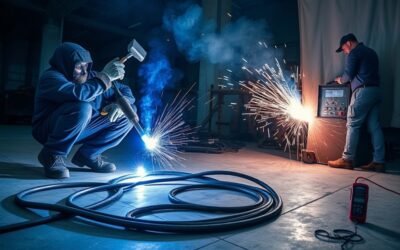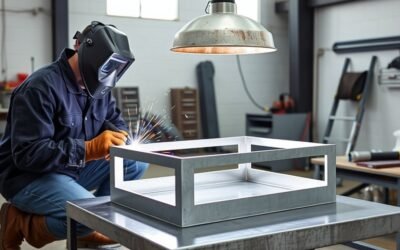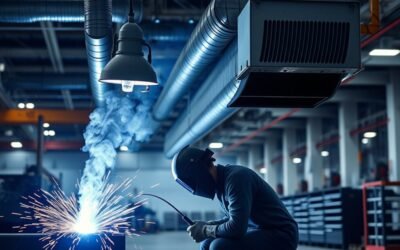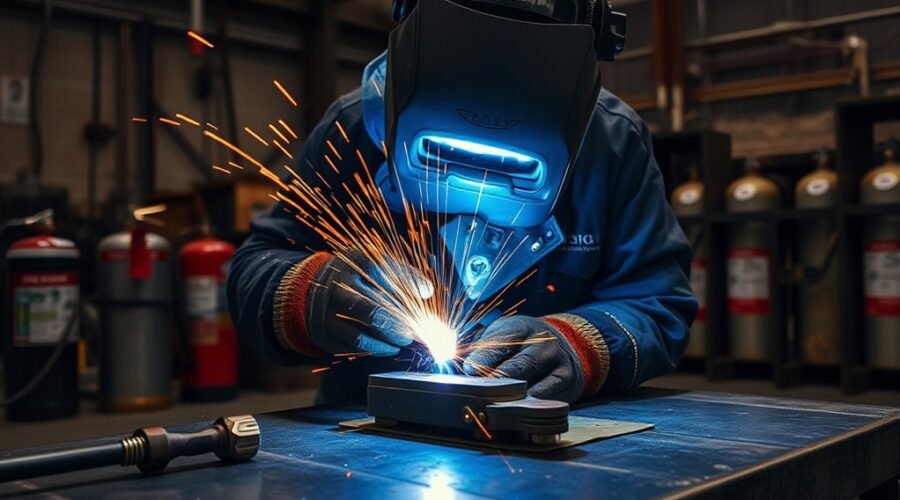
MIG welding can expose the operator and nearby workers to electric shock, arc radiation, burns, hot metal, fire, welding fumes, compressed gas, noise, and moving wire-feed equipment. Safe MIG welding depends on controlling those hazards before the arc starts with suitable PPE, ventilation, equipment inspection, fire prevention, safe cylinder handling, and a clear emergency plan.
Quick Answer
For safer MIG welding, wear task-appropriate eye, face, hand, body, foot, and hearing protection; control fumes with effective ventilation; inspect cables and connections; secure the shielding-gas cylinder; remove or protect combustible materials; and verify the machine, work lead, gas system, and emergency equipment before striking an arc.
Key Takeaways
- MIG welding hazards include electric shock, burns, UV/IR radiation, fire, fumes, compressed gas, noise, and injuries from automatically fed wire.
- Use a welding helmet with the correct filter shade, suitable gloves and protective clothing, sturdy footwear, safety glasses where needed, and hearing or respiratory protection when the hazard assessment requires it.
- Remove movable combustibles, protect materials that cannot be moved, and use a fire watch whenever the hot-work conditions require one.
- Ventilation must control welding fumes in the breathing zone; confined or obstructed spaces require additional precautions.
- Inspect the machine, cables, work-return connection, shielding-gas system, gun, wire feeder, and PPE before each welding session.
- Training, manufacturer instructions, Safety Data Sheets, and workplace safety procedures are part of the safety system—not optional extras.
Note: This guide provides general safety information. It does not replace OSHA requirements, local regulations, your employer’s hot-work or respiratory-protection program, a Safety Data Sheet, or the instructions supplied with your welder, gun, regulator, shielding gas, and PPE.
What Are the Main MIG Welding Hazards?
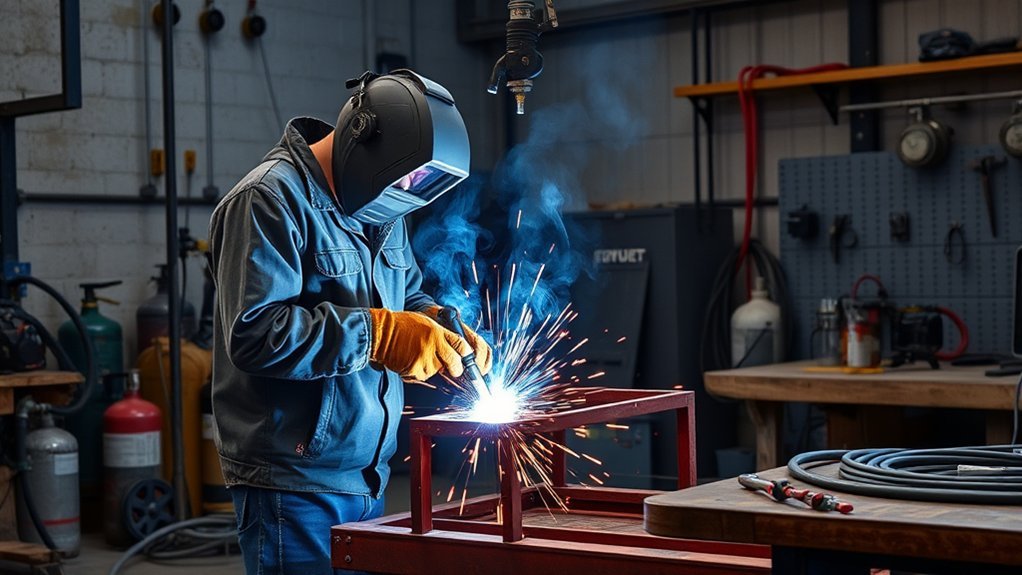
MIG welding, also called gas metal arc welding or GMAW, creates several hazards at the same time. The main risks are electric shock, intense arc radiation, heat and molten spatter, fire, welding fumes and gases, noise, compressed shielding gas, and injuries from the automatically fed electrode wire.
Electrical Shock
The welding circuit and the machine’s input-power system can cause serious or fatal electric shock. Damaged insulation, wet gloves, wet floors, defective cables, poor connections, incorrect servicing, and contact with energized components all increase the risk.
OSHA’s arc-welding requirements call for proper machine installation and grounding, secure connections, inspection of welding leads, and checking the machine frame ground before work begins.
The welding work-return clamp is part of the welding-current circuit; it is not a substitute for the electrical safety grounding of the machine. Attach the work lead securely to a suitable clean contact point and follow the welder manufacturer’s instructions.
Warning: Water and electricity are a dangerous combination. Do not weld with wet gloves or while standing in water. Wet or highly humid conditions require extra electric-shock precautions, and damaged cables or exposed conductors should be taken out of service.
Arc Radiation, Burns, and Spatter
The MIG arc produces intense visible light plus ultraviolet and infrared radiation. Unprotected exposure can injure the eyes and burn exposed skin. Sparks, hot workpieces, and molten metal can also cause immediate burns or ignite clothing and nearby materials.
A welding helmet protects the face and eyes from arc radiation, while flame-resistant protective clothing and welding gloves help protect the hands, wrists, arms, and torso from heat and spatter.
Welding Fumes and Gases
Welding fume is a mixture whose composition depends on the wire, base metal, coatings, process, and welding conditions. Mild-steel welding commonly produces metal-oxide fumes that may contain manganese. Stainless steel and certain coated or plated materials can introduce additional hazards, including chromium, nickel, zinc, lead, cadmium, or other substances depending on the material.
The National Institute for Occupational Safety and Health notes that welding-fume exposure can vary considerably with the consumable, base metal, and work environment. Confined-space welding can substantially increase exposure.
Noise
MIG welding itself may be only one part of the noise exposure. Grinding, chipping, cutting, gouging, ventilation equipment, and nearby shop processes can raise the total exposure. OSHA’s occupational-noise standard uses an 85 dBA eight-hour time-weighted average as the action level for a hearing-conservation program.
Use hearing protection when the workplace hazard assessment or noise monitoring shows it is required.
Wire-Feed and MIG Gun Hazards
A MIG gun does more than produce the arc. Pulling its trigger can start shielding-gas flow, energize the electrode, and feed wire automatically. The wire can puncture skin, and accidental trigger activation can send wire toward a person or conductive surface.
Keep hands and body parts away from the contact tip and drive-roll area. Do not point the gun at yourself or another person. Shut down and isolate the equipment as required by the manufacturer before changing or servicing gun or wire-feed components.
What PPE Do You Need for MIG Welding?
Proper personal protective equipment reduces exposure to arc radiation, sparks, heat, impact, noise, and airborne contaminants. PPE should be selected through a workplace hazard assessment and must fit the user and the task.
PPE is the last protective layer. It works best when fire hazards, fumes, electrical hazards, and unsafe equipment have already been controlled at the source.
Helmet and Eye Protection
Use a welding helmet or hand shield for arc welding and select a filter shade appropriate to the welding process and current. OSHA’s eye-and-face protection table lists a minimum shade of 7 for GMAW/FCAW below 60 amps and a minimum shade of 10 from 60 through 500 amps.
An auto-darkening helmet may offer a broader adjustable range, but the adjustment should never be set below the minimum protection required for the operation. Safety glasses with side protection may also be needed under the helmet because the helmet does not eliminate impact hazards from grinding, wire clipping, or flying particles.
Gloves, Clothing, and Footwear
Wear dry welding gloves that protect the hands and wrists while still allowing safe gun control. Replace gloves that are torn, contaminated, wet, or badly heat-damaged.
Wear flame-resistant protective clothing that covers exposed skin. Keep cuffs, pockets, and clothing arrangements from trapping sparks or molten metal. Avoid clothing that can readily ignite or melt against the skin.
Suitable leather work boots or other protective footwear should cover the foot and ankle. Protective-toe, puncture-resistant, or electrical-hazard-rated footwear should be selected when the workplace hazard assessment identifies those hazards.
For additional torso protection during high-spatter or prolonged work, select a suitable welding apron material that matches the heat and spatter level of the job.
Respiratory Protection
Ventilation and local fume extraction should control exposure before relying on a respirator. When respiratory protection is required in a workplace, OSHA’s respiratory-protection standard requires employers to evaluate the respiratory hazard, select an appropriate NIOSH-certified respirator, provide required medical evaluation and training, and fit-test tight-fitting respirators.
A powered air-purifying respirator, or PAPR, can be appropriate for certain hazards and users, but it is not automatically the correct solution for every welding fume or atmosphere. Respirator selection must match the contaminant and exposure conditions.
Set Up a Safe MIG Welding Workspace
A safe MIG welding area should control fire, electrical, fume, gas-cylinder, trip, and arc-radiation hazards before the machine is energized.
Clear the Work Area
Remove movable combustible materials from the vicinity of the work whenever practical. If combustible hazards cannot be moved, use suitable guards or fire-resistant protection to contain sparks, slag, and heat.
The often-quoted 35-foot rule needs context. Under OSHA’s welding, cutting, and brazing requirements, a fire watch is required when appreciable combustible material is within 35 feet of the work, when combustible material farther away can readily be ignited by sparks, when openings within that radius expose combustible material, or when heat can ignite material on the opposite side of a partition, wall, ceiling, or roof.
OSHA also requires combustible floor debris such as paper, wood shavings, or textile fibers to be swept clean for a radius of 35 feet where applicable.
Keep suitable fire-extinguishing equipment ready for immediate use. Organize welding leads, hoses, tools, and scrap so they do not block walkways, ladders, emergency exits, or access to shutoff controls.
Pro Tip: Before striking the arc, look beyond the side you can see. Sparks and heat can reach through floor openings, cracks, doors, windows, and metal partitions to ignite material on the opposite side.
Protect Nearby Workers From the Arc
Helpers and people working nearby also need protection from arc radiation. Use suitable noncombustible or flame-resistant welding screens or curtains where practical, while arranging them so they do not block required ventilation.
Anyone who must view the arc needs suitable eye protection. Welding curtains should also keep casual passersby from unexpectedly looking directly at the arc.
Ensure Proper Ventilation
Ventilation should prevent welding fumes and gases from building up in the welder’s breathing zone. Whenever practical, position local exhaust close enough to the arc to capture fume before it crosses the welder’s face without disrupting the shielding gas needed for weld quality.
OSHA requires local exhaust or general ventilation to keep toxic fumes, gases, and dusts below applicable exposure limits. For general welding covered by 29 CFR 1910.252, mechanical ventilation is specifically required under conditions including less than 10,000 cubic feet of space per welder, ceilings lower than 16 feet, and confined or significantly obstructed spaces.
The standard also specifies a general mechanical-ventilation rate of 2,000 cubic feet per minute per welder under those provisions unless one of the listed alternatives, such as qualifying local exhaust, is used.
There is no universal OSHA rule requiring “10 air changes per hour” for every MIG welding shop. Ventilation must instead be designed for the space, number of welders, materials, fume generation, and measured exposure.
Review the current Safety Data Sheet (SDS) for welding wire, coatings, cleaners, and other materials that can contribute to airborne hazards.
Secure Shielding-Gas Cylinders
MIG shielding-gas cylinders contain gas under high pressure. Inspect the cylinder and valve condition, secure the cylinder against falling or being struck, protect it from excessive heat and physical damage, and use the correct regulator and fittings for the gas in service.
Keep the cylinder positioned where sparks, hot metal, and welding current cannot damage it. Do not weld on a cylinder or use a cylinder as part of an electrical circuit. Close the cylinder valve when required by the manufacturer’s instructions and workplace procedure.
Check Equipment and Grounding
Inspect the welding machine, gun, electrode cable, work lead, power cord, connectors, regulator, hose, and wire feeder before use. Look for cuts, cracked insulation, loose terminals, heat damage, gas leaks, damaged connectors, or other defects.
Confirm that the welding-machine frame is grounded as required and that grounding connections are mechanically strong and electrically adequate. Attach the welding work lead firmly to the work or suitable work circuit.
Set polarity, voltage, wire-feed speed, wire type, wire diameter, and shielding gas according to the machine, consumable, material, and welding-procedure recommendations. Incorrect settings can reduce weld quality and may create excessive spatter, overheating, or unstable operation.
If you are replacing or upgrading equipment, the quality and condition of the equipment matter more to safety than the size of a discount. That applies equally when comparing seasonal welding gear.
How Does Ventilation Protect You From MIG Fumes?
Ventilation reduces MIG welding exposure by preventing fumes and gases from accumulating around the welder’s breathing zone. Local exhaust is generally more effective than simply moving large quantities of room air because it captures contaminants closer to where they are generated.
Fume Dispersion Basics
General ventilation dilutes contaminated air with cleaner replacement air, while local exhaust removes contaminants close to the arc. The required control depends on the space, welding process, base metal, wire, coating, work duration, and measured exposure.
Mild-steel welding fumes may contain manganese. Stainless-steel work can introduce chromium and nickel hazards. Galvanized metal introduces zinc-containing fumes, while lead-, cadmium-, or other specialty coatings may require stricter controls.
Do not assume that every welding fume has the same composition or that one ventilation setting protects against every material.
Local Exhaust Systems
A movable local-exhaust hood should be positioned as near as practical to the welding operation while staying out of the weld and shielding-gas flow. Capture performance decreases when the hood is moved too far away or when cross-drafts pull the plume past the welder.
OSHA specifies a capture velocity toward a movable hood of 100 linear feet per minute in the welding zone at the hood’s most remote design position and provides airflow values based on the hood’s distance from the arc.
No single percentage reduction should be promised for every local-exhaust system. Actual performance depends on design, airflow, hood location, maintenance, work geometry, and shop air movement.
Clean Air Workspaces
Good housekeeping supports fume control, but a workspace is not “clean air” simply because visible smoke disappears. Fine welding fume can remain a hazard even when visibility appears acceptable.
Where exposure is uncertain, industrial-hygiene air monitoring can determine whether ventilation and other controls are keeping contaminants below applicable exposure limits.
Coatings, Plating, and Solvent Hazards
Identify what you are welding before applying heat. Paint, plating, primers, oils, cleaning residues, and surface treatments can change the fume and gas hazards dramatically.
OSHA specifically requires additional controls for several hazardous materials, including certain work involving zinc, lead, cadmium, beryllium, and mercury-bearing materials.
Gas-shielded arc welding also produces intense ultraviolet radiation. Chlorinated cleaning solvents should not be allowed to contaminate the welding atmosphere, and surfaces cleaned with such products must be handled according to applicable safety requirements and the product SDS.
Shielding-gas selection can influence emissions in some processes, but the gas must first be suitable for the metal, filler wire, equipment, and welding procedure. For more process-specific information, see this guide to shielding gas composition.
MIG Welding in Confined Spaces
Confined-space welding requires substantially more control than ordinary open-shop welding. Fumes can accumulate quickly, and shielding gas can contribute to oxygen deficiency by displacing breathable air.
OSHA requires adequate ventilation in confined spaces to prevent toxic-material buildup and possible oxygen deficiency. Replacement air must be clean and respirable, and oxygen must never be used for ventilation.
Depending on the confined space and workplace, atmospheric testing, an attendant, rescue provisions, respiratory protection, entry authorization, and other confined-space procedures may also apply. Welding machines and gas cylinders should remain outside the confined space where required.
Warning: Never enter a tank, vessel, pit, or other confined space to weld simply because a fan is running. Confined-space work can involve toxic gases, oxygen deficiency, fire, electrical hazards, and difficult rescue conditions that require a formal safety system.
How Do You Prevent Fires, Burns, and Shock?
Preventing welding fires starts with removing combustible material whenever practical. Where removal is impossible, protect the material with suitable fire-resistant guards or shields and check hidden spaces where sparks or conducted heat can travel.
Keep suitable fire-extinguishing equipment immediately available. A fire watch is required when conditions identified by OSHA make more than a minor fire possible, including several situations involving combustible materials within or exposed through the 35-foot area around hot work.
When a fire watch is required, the watcher must have suitable extinguishing equipment, know how to sound the alarm, observe exposed areas, and continue the watch for at least 30 minutes after welding or cutting ends to detect smoldering fires.
Fire-resistant clothing protects the welder, but housekeeping and hot-work controls prevent the spark from finding fuel in the first place.
Reduce burn injuries by wearing suitable gloves, clothing, footwear, and face protection, and by treating recently welded metal as hot until proven otherwise. Where other workers may encounter the workpiece, clearly mark or guard hot metal.
Reduce shock risk by keeping equipment dry, checking cable insulation and connections, confirming machine grounding, keeping gloves dry, and following the manufacturer’s shutdown procedure before maintenance or component replacement.
General gift-oriented or hobby welding products are not substitutes for certified, task-appropriate protective equipment. If browsing welding equipment and accessories, evaluate actual safety suitability separately from convenience or novelty.
MIG Welding Safety Checks Before You Start
Use a repeatable pre-weld inspection rather than relying on memory. Stop and correct any unsafe condition before energizing the welder.
- PPE: Check the helmet, filter shade, safety glasses where required, gloves, clothing, footwear, hearing protection, and any required respirator.
- Machine: Inspect the power cord, case, switches, connectors, ventilation openings, and warning indicators.
- Welding leads: Look for damaged insulation, overheated areas, exposed conductor, loose terminals, and poor connections.
- Work lead: Attach it firmly to an appropriate clean contact point and confirm the welding-current path is safe.
- MIG gun: Inspect the trigger, nozzle, contact tip, cable, liner condition, and exposed wire.
- Wire feeder: Confirm the correct wire and drive-roll setup; keep fingers clear of moving drive components when equipment is energized.
- Shielding gas: Secure the cylinder, inspect the regulator and hose, confirm the correct gas, and check the system for damage or leaks using an approved method—not a flame.
- Settings: Confirm polarity, voltage, wire-feed speed, gas flow, and consumables for the material and wire.
- Ventilation: Start required local exhaust or mechanical ventilation before welding.
- Material: Identify the base metal, coating, plating, paint, cleaner residues, and SDS information that may affect fume hazards.
- Fire prevention: Remove or protect combustible material and establish any required hot-work permit and fire watch.
- Other people: Position welding screens and keep unprotected personnel away from the arc.
- Emergency readiness: Keep fire-extinguishing and first-aid equipment accessible and maintain clear exits.
The machine’s duty cycle also matters because exceeding it can overheat equipment and trigger thermal protection. Follow the manufacturer’s rating and operating instructions. Buyers comparing machines can review MIG welder duty-cycle specifications alongside output and other performance factors.
How Does Training Improve MIG Welding Safety?
Training helps welders recognize electrical, fire, fume, radiation, compressed-gas, noise, and equipment hazards before those hazards become incidents.
Good welding training teaches both how to make the weld and when conditions are unsafe enough that the weld should not begin.
Operators should understand how to select and inspect PPE, set up the welding machine, handle cylinders, inspect cables and the work lead, control fumes, use fire-prevention measures, and shut equipment down safely.
Training should also cover the hazards of the specific materials being welded. A worker welding clean mild steel does not automatically face the same fume hazards as someone welding stainless steel, galvanized steel, painted metal, or specialty alloys.
Where respirators are required, workers need the respiratory-protection training, medical evaluation, fit testing where applicable, and equipment selection required by the workplace program.
Emergency training should address burns, electric shock, fire, gas leaks, ventilation failure, and safe evacuation. Workers should know when an incident is beyond their ability to control and when emergency services must be called.
Beginners should receive hands-on instruction rather than depending only on articles or equipment marketing. A beginner welder selection guide can help compare equipment, but it does not replace practical safety training.
Frequently Asked Questions
What PPE is needed for MIG welding?
Typical MIG welding PPE includes a welding helmet with the correct filter shade, suitable eye protection where impact hazards exist, dry welding gloves, flame-resistant protective clothing, and sturdy protective footwear. Hearing protection may be required based on noise exposure. Respiratory protection is added when the hazard evaluation shows it is necessary and should be selected under the applicable respiratory-protection program.
What safety precautions should be taken when MIG welding?
Inspect the welder, cables, work lead, gun, wire feeder, gas cylinder, regulator, hose, ventilation, PPE, and fire controls before welding. Remove or protect combustibles, shield nearby workers from arc radiation, identify coatings and fume hazards, keep exits clear, and follow the machine manufacturer’s instructions and workplace hot-work procedures.
What are seven common hazards of welding?
There is no single official list limited to exactly seven hazards, but seven common welding hazards are electric shock, welding fumes and gases, fire, arc radiation, burns and molten spatter, noise, and compressed-gas or equipment hazards. The exact risk depends on the welding process, materials, environment, and task.
What are 10 basic welding safety rules?
Ten useful rules are: wear appropriate PPE; use the correct helmet shade; control fumes; remove or protect combustibles; inspect cables and connections; secure gas cylinders; keep the work area dry and orderly; protect nearby workers from the arc; follow hot-work and fire-watch requirements; and use trained procedures for equipment operation, maintenance, and emergencies.
What shade should you use for MIG welding?
The minimum shade depends on welding current. OSHA’s current eye-protection table lists a minimum shade 7 for GMAW/FCAW below 60 amps and shade 10 from 60 through 500 amps. Start darker if necessary for comfort and visibility, but do not go below the applicable minimum protection.
Do all combustible materials have to be exactly 35 feet away from welding?
Not as a universal rule. Movable fire hazards should be relocated to a safe place, while hazards that cannot be moved must be protected. OSHA uses the 35-foot distance in specific hot-work provisions, including conditions that require a fire watch and requirements for clearing combustible floor debris.
Conclusion
MIG welding safety depends on controlling several hazards at once. Suitable PPE protects the welder, but PPE alone cannot correct damaged equipment, poor ventilation, combustible materials, unsafe cylinders, uncontrolled arc exposure, or a hazardous confined space.
Before each weld, inspect the equipment, confirm the work-return and grounding arrangements, secure the gas system, identify the material and coatings, start the required ventilation, remove or protect combustible materials, and make sure emergency equipment is ready. Consistent training and a repeatable pre-start routine make those checks part of the welding process instead of an afterthought.
Sources
- OSHA 29 CFR 1910.252 — Welding, Cutting and Brazing: General Requirements — fire prevention, PPE, ventilation, confined-space precautions, and fire-watch requirements.
- OSHA 29 CFR 1910.254 — Arc Welding and Cutting — grounding, connections, cables, installation, and equipment operation.
- OSHA 29 CFR 1910.133 — Eye and Face Protection — welding filter-shade requirements.
- OSHA 29 CFR 1910.134 — Respiratory Protection — respirator selection, medical evaluation, fit testing, and program requirements.
- OSHA 29 CFR 1910.101 — Compressed Gases — inspection, handling, storage, and use of compressed-gas cylinders.
- NIOSH — Welding Fumes and Manganese — welding-fume composition, manganese exposure, health effects, and confined-space exposure considerations.