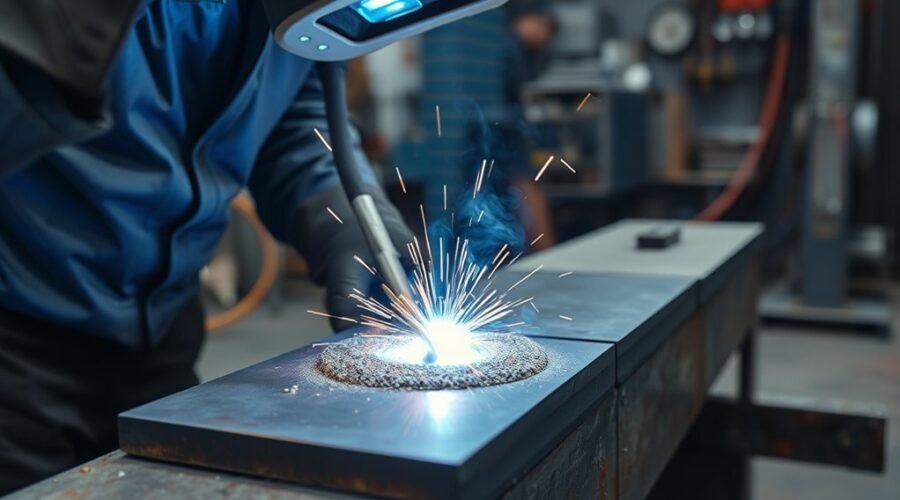
Flux in welding is a protective and chemical material used in several arc-welding processes to help keep the molten weld metal from reacting with the surrounding atmosphere. Depending on the process and flux formulation, it can generate shielding gas, form slag, remove or tie up oxides, stabilize the arc, influence penetration and bead shape, and help control weld-metal chemistry. The important point is that flux is not one single product or one single welding process; its form and job change between SMAW, FCAW, and submerged arc welding.
Quick Answer
Flux in welding protects hot metal from atmospheric contamination and helps control the weld as it forms. In stick welding it coats the electrode, in flux-cored welding it is inside tubular wire, and in submerged arc welding it is a granular blanket. The correct flux depends on the process, base metal, position, and required weld properties.
Key Takeaways
- Flux helps protect the molten weld pool from oxygen, nitrogen, moisture-related hydrogen, and other contamination that can contribute to porosity, cracking, or weak welds.
- Depending on the formulation, flux can provide shielding gas, create slag, deoxidize the weld pool, stabilize the arc, improve wetting, and influence penetration and bead shape.
- Cellulosic, rutile, and basic are common coating or flux families, especially in SMAW and some FCAW consumables; they are not universal labels for every welding flux.
- SMAW, FCAW, and SAW all use flux differently, and gas-shielded FCAW still requires an external shielding gas.
- Correct consumable selection, polarity, storage, joint cleaning, slag removal, PPE, and ventilation are all important for safe, repeatable weld quality.
Flux Welding Basics
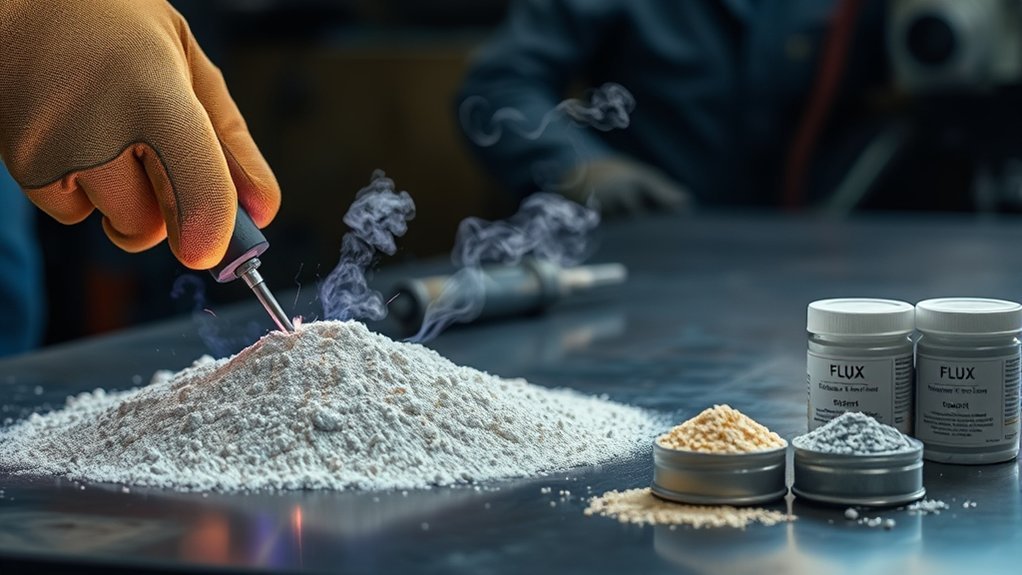
Flux functions as a protective medium and chemical aid around the arc and molten weld pool. The Canadian Welding Bureau explains that flux coatings can produce shielding gas and slag while also helping with arc stability, penetration, bead shape, hydrogen control, alloying, and slag removal. CWB Group’s overview of welding flux is a useful technical reference for these functions.
How flux is delivered depends on the process. Shielded Metal Arc Welding (SMAW) uses a coated stick electrode. Flux-Cored Arc Welding (FCAW) uses a continuously fed tubular wire that contains fluxing ingredients. Submerged Arc Welding (SAW) uses a separate layer of granular flux over the joint. In each case, the flux helps control the environment around the hot metal, but the chemistry, shielding method, equipment, and cleanup are different.
Flux can also dissolve, react with, or float certain oxides and impurities into the slag, improving wetting and fusion when the joint is otherwise properly prepared. It does not make heavy rust, oil, paint, plating, or unsafe contamination acceptable. The base metal should still be cleaned according to the welding procedure and consumable manufacturer’s recommendations.
For FCAW, the exact welding wire selection affects required shielding gas, polarity, usable positions, mechanical properties, deposition rate, and arc behavior.
Why Flux Matters in Welding
Molten weld metal reacts readily with the atmosphere. Depending on the welding process and flux formulation, flux creates shielding gases and/or a slag cover that reduces contact with oxygen and nitrogen. It may also supply deoxidizers and other compounds that help control weld-metal chemistry. These functions reduce the chance of defects when the procedure, consumables, and technique are correct.
| Flux family | Typical characteristics | Common use |
|---|---|---|
| Cellulosic | Strong arc force, relatively deep penetration, thin/fast-freezing slag, higher hydrogen potential | Pipeline and field SMAW applications where the specified electrode permits it |
| Rutile / titania | Smooth arc, good bead appearance, generally easy slag control | General-purpose SMAW and many gas-shielded FCAW applications |
| Basic / low-hydrogen | Lower diffusible-hydrogen potential when correctly stored and used; often selected for toughness and crack resistance | Structural, higher-strength, thick-section, and critical welds when required by the procedure |
These categories are most useful when discussing covered electrodes and certain cored-wire systems. They should not be treated as a complete classification of every SAW flux or every commercial welding consumable. Proper selection depends on the filler-metal classification, base metal, welding position, service temperature, code requirements, shielding method, and manufacturer data.
The best all-around welding rods are therefore not simply the rods with the “strongest” flux. The correct electrode is the one approved for the metal, joint, position, current/polarity, and mechanical-property requirements of the job.
How Flux Protects the Weld Pool
Flux protects the weld by combining physical shielding with chemical action. In SMAW and self-shielded FCAW, flux ingredients decompose in the arc and generate protective gases while molten flux forms slag. In gas-shielded FCAW, the wire’s flux works together with an external shielding gas. In SAW, the arc and molten metal are buried beneath granular flux, and part of that flux melts into slag.
Blocking Air Exposure
The shielding gases and molten slag created by flux limit direct contact between the weld pool and the surrounding air. This helps reduce atmospheric contamination while the weld metal is molten and during early cooling.
Flux does not simply “trap all gases in the slag.” Instead, its formulation can promote deoxidation, gas shielding, slag formation, and controlled reactions that reduce the chance of gas pores and inclusions. Porosity can still occur if the joint is contaminated, the shielding is disturbed, the wire or flux is damp, parameters are incorrect, or the arc is too long.
Gas-shielded FCAW needs special attention outdoors because wind can disturb the external shielding gas. If you are comparing shielding systems, this shielding gas composition guide is relevant to gas-shielded wire processes, but it does not apply to self-shielded FCAW in the same way.
Preventing Oxidation Layers
Flux reduces oxidation by isolating the molten weld metal from the atmosphere and by supplying compounds that react with oxygen or oxides. In covered electrodes, some ingredients act as deoxidizers; in SAW, flux can also influence weld-metal chemistry and cleanliness.
This protection matters because uncontrolled oxidation and contamination can reduce ductility, contribute to porosity or inclusions, and interfere with fusion. The exact protection depends on the consumable. A welder should follow the electrode, wire, or flux data sheet rather than assuming every flux behaves the same way.
Controlling Weld Pool Flow
Flux and slag affect surface tension, bead shape, cooling behavior, and puddle support. A fast-freezing slag can help hold molten metal during vertical or overhead welding, while a more fluid slag may improve bead smoothness in flat-position work. Flux chemistry can also influence arc stability and metal transfer.
| Flux family | Typical puddle/arc effect | Practical note |
|---|---|---|
| Rutile | Smooth arc and operator-friendly slag control | Common in general-purpose electrodes and positional FCAW wires |
| Basic | Chosen primarily for weld-metal properties and hydrogen control rather than cosmetic bead appearance | Storage and handling are especially important for low-hydrogen consumables |
| Cellulosic | Forceful arc, deep penetration, relatively fast-freezing slag | Often used for pipe and field welding with specified electrodes |
Proper flux choice supports predictable penetration and bead control, but it must be matched with correct amperage or voltage, travel speed, electrode angle, stickout, and joint preparation.
Flux Welding Types and Processes
“Flux welding” is an informal umbrella term rather than one single standardized process. The three most common arc-welding processes in which flux plays a major shielding role are SMAW, FCAW, and SAW.
| Process | How flux is supplied | External shielding gas? | Typical strengths |
|---|---|---|---|
| SMAW / Stick | Coating on consumable electrode | No | Portable, versatile, good for field work and many positions |
| FCAW-S | Flux inside tubular wire | No | High deposition, portable, well suited to outdoor work with the correct wire |
| FCAW-G | Flux inside tubular wire | Yes | High deposition and good positional capability in fabrication |
| SAW | Granular flux blanket fed separately | Normally no | Very high deposition, deep penetration, mechanized production on suitable joints |
FCAW uses a tubular flux-filled electrode, but only self-shielded FCAW eliminates the need for an external shielding gas.
Rutile-based and basic flux systems are common in many SMAW and FCAW consumables. In SAW, fluxes can also be classified by manufacturing method, metallurgical behavior, and whether they are neutral, active, or alloying. Selection should follow the welding procedure specification and consumable data sheet.
Equipment capability still matters. A machine’s duty cycle is not a flux property, but it affects how long you can weld at a given output before the machine must cool. That is why duty cycle belongs in equipment selection rather than flux classification.
How Flux-Cored Arc Welding Works
Flux-Cored Arc Welding uses a continuously fed tubular electrode containing fluxing ingredients. The arc melts the wire and base metal, while the flux supports shielding, deoxidation, arc behavior, and slag formation. Miller separates FCAW into self-shielded and gas-shielded flux-cored welding.
In self-shielded FCAW (FCAW-S), ingredients in the wire generate the shielding needed around the arc, so no external gas cylinder is required. This makes appropriate self-shielded wires useful outdoors because there is no external gas cloud for wind to blow away.
In gas-shielded FCAW (FCAW-G), the flux-filled wire works with an externally supplied shielding gas. These wires are widely used for structural and heavy fabrication, but wind can disrupt the gas shield, so screens or an indoor environment may be needed.
Note: “Flux-core” does not automatically mean “gasless.” Always check the exact wire classification and manufacturer data sheet before setup.
FCAW is used primarily on carbon steel, low-alloy steel, and stainless steel, with specialized cored consumables available for some nickel-alloy applications. It should not be described as a universal process for all nonferrous metals. Aluminum is normally welded with processes and consumables specifically designed for aluminum, such as GMAW or GTAW.
Travel speed, voltage, wire-feed speed, contact-tip-to-work distance, gun angle, and polarity all affect bead shape and penetration. Many common self-shielded wires use DCEN and many gas-shielded wires use DCEP, but the correct rule is simpler: use the polarity printed on the exact wire package or data sheet.
If you want one machine to cover flux-core plus other processes, multi-process welders can be convenient, but process capability, amperage range, polarity changeover, and duty cycle matter more than marketing claims about efficiency.
How Shielded Metal Arc Welding Uses Flux
In Shielded Metal Arc Welding (SMAW), the electrode’s outer coating is flux. As the electrode burns, the coating helps establish and stabilize the arc, generates shielding gas, and forms a slag layer that protects the weld metal as it cools. Miller’s SMAW guide describes this shielding-gas and slag function directly.
In stick welding, the flux coating is part of the electrode system: it protects the molten metal, influences arc behavior, and leaves slag that must be removed where required.
Covered-electrode classifications such as E7018, E7028, and E7016 use different coating systems and operating characteristics. Low-hydrogen electrodes such as many EXX18 and EXX16 classifications are used when hydrogen control and weld-metal toughness are important, but they only deliver those benefits when stored and handled correctly.
Moisture control matters because damp low-hydrogen coatings can raise diffusible hydrogen and contribute to cracking or porosity. Manufacturer instructions and the applicable welding code should control storage, exposure limits, and any redrying procedure. Miller advises keeping low-hydrogen electrodes in sealed containers or suitable electrode ovens and following manufacturer recommendations rather than treating all rods alike.
The welding power source must also match the electrode and job. Comparisons such as welding machine type can help when choosing equipment, but electrode classification, current range, and polarity must still be matched to the procedure.
How Submerged Arc Welding Uses Flux
Submerged Arc Welding uses a blanket of granular flux over the joint so the arc and molten weld metal are buried beneath it. The arc melts the electrode, base metal, and a portion of the flux. The molten flux becomes slag, while unmelted flux can often be recovered when the system and procedure permit it. Miller’s Submerged Arc Welding Principles describes the process, flux functions, and flux handling in detail.
SAW is valued for high deposition rates, deep penetration, low visible spatter, and efficient production on suitable joints. It is commonly mechanized or automated and is best suited to flat or horizontal work because the granular flux and fluid weld pool must remain over the joint.
Flux Blanket Protection
The granular flux blanket isolates the arc and molten metal from the atmosphere and also helps retain heat in the weld zone. Depending on the product, the flux may deoxidize the weld, add alloying elements, shape the bead, or influence mechanical properties.
SAW flux composition varies. Fused, agglomerated/bonded, and mechanically mixed fluxes are produced differently, and manufacturers formulate them with combinations of oxides, fluorides, carbonates, silicates, and other ingredients. It is therefore too broad to describe every SAW flux as one fixed blend.
A basicity index is one way of describing the balance of basic and acidic constituents in SAW flux. Higher basicity is often associated with lower weld-metal oxygen and improved toughness, but flux selection still has to be based on the specific wire/flux combination, procedure, code, and required mechanical properties.
Deep Penetration Welds
SAW can produce deep penetration because the buried arc concentrates heat into the joint while high welding currents and continuous wire feed support high deposition. Penetration is not created by flux alone; amperage, voltage, polarity, wire size, electrode extension, travel speed, joint design, and flux depth all influence the result.
External shielding gas is normally not used in conventional SAW because the granular flux provides the atmospheric protection. The process is widely used on carbon and low-alloy steels, stainless steels, and some nickel-alloy applications with suitable consumables.
Slag and Cleanup
As SAW cools, molten flux solidifies into slag over the weld bead. Slag protects the hot metal during cooling and must be removed when required before inspection or before depositing another pass. Chipping, brushing, or mechanical cleaning may be used depending on the slag and procedure.
Residual slag between passes can become trapped and create slag inclusions or interfere with fusion. Cleanup is therefore a weld-quality step, not cosmetic housekeeping.
Note: Flux selection does not apply to plasma cutting. If your shop also uses plasma cutters with built-in air compressors, their compressed-air system is separate from welding shielding and SAW flux handling.
What Materials Work With Flux Welding?
The answer depends on the welding process and consumable. “Flux welding” is too broad to assign one universal material list.
| Process | Commonly welded materials | Important limits |
|---|---|---|
| SMAW | Carbon steel, low-alloy steel, stainless steel, cast iron, and some nickel alloys with the correct electrode | Electrode must match base metal, position, current/polarity, and service requirements |
| FCAW | Primarily carbon steel, low-alloy steel, stainless steel; specialized wires exist for some nickel-alloy work | Do not assume ordinary flux-core wire is suitable for aluminum or other nonferrous metals |
| SAW | Carbon and low-alloy steels, stainless steels, and selected nickel-alloy applications | Wire and flux are selected as a system, and the process is usually limited by position and joint access |
Some flux-based consumables are more tolerant of light mill scale or minor surface contamination than gas-shielded solid-wire MIG, but that does not justify welding through oil, paint, heavy rust, moisture, galvanized coatings, or unknown residues. Clean the joint as required by the procedure, and identify coatings that can create toxic fumes before heating them.
Aluminum is a good example of why process-specific advice matters. Specialized fluxes exist in brazing and certain niche joining methods, but standard hobby FCAW wire is not a general aluminum solution. MIG or TIG with appropriate aluminum equipment and filler is usually the practical choice.
Good visibility also matters when selecting and controlling the puddle. A helmet with suitable shade, fit, and optical clarity can help the operator see the joint while maintaining required eye and face protection.
How to Choose the Right Welding Flux or Consumable
Choose the consumable as part of the entire welding procedure, not as an isolated ingredient. Start with the base metal and required weld properties, then work through the process and operating limits.
- Identify the base metal and thickness. Carbon steel, low-alloy steel, stainless steel, cast iron, and nickel alloys require different filler classifications and flux systems.
- Confirm the process. Decide whether the job calls for SMAW, self-shielded FCAW, gas-shielded FCAW, or SAW.
- Check the welding position. Not every electrode or flux-cored wire is approved for vertical or overhead welding, and SAW is usually limited to flat or horizontal work.
- Match mechanical-property requirements. Strength, toughness, impact temperature, and hydrogen limits may dictate a specific electrode or wire/flux combination.
- Verify shielding and polarity. FCAW-G needs the specified gas; FCAW-S does not. Polarity varies by wire, so follow the data sheet.
- Check code and WPS requirements. Structural, pressure, pipeline, and repair work may require qualified consumables and a qualified welding procedure.
- Plan storage and handling. Low-hydrogen electrodes and SAW flux can be moisture-sensitive, so packaging, holding temperature, exposure time, and reconditioning instructions matter.
Pro Tip: If the wire or electrode package specifies polarity, shielding gas, position, or storage limits, treat those instructions as part of the welding procedure—not as optional setup suggestions.
How To Use a Flux Welding Machine
For most home and light-fabrication users, “flux welding machine” means a wire-feed welder running self-shielded flux-cored wire. The exact controls vary by machine and wire, so the owner’s manual and wire data sheet take priority over generic settings.
At a Glance
| Time Required | About 10–20 minutes for safe setup and test beads, plus welding and cleanup time |
| Difficulty | Beginner to intermediate; practice is needed to control stickout, travel angle, and puddle |
| Tools Needed | Flux-core-capable welder, correct wire, work clamp, wire brush/chipping tool, pliers, welding helmet, gloves, flame-resistant clothing, and suitable ventilation |
| Cost | Varies by machine, wire, and PPE; if the welder is already owned, the main recurring costs are wire, tips/nozzles, cleaning tools, and PPE replacement |
Warning: Welding creates arc radiation, hot metal, sparks, electric-shock risk, and fumes. Remove fire hazards, use proper PPE, keep your head out of the fume plume, and provide ventilation appropriate to the process and material. OSHA requires controls where hazardous fumes, gases, or dust can accumulate, especially in confined spaces. Never use oxygen for ventilation.
- Read the machine and wire instructions. Confirm wire diameter, polarity, voltage range, wire-feed range, usable positions, and whether external gas is required.
- Set the correct polarity. Do not assume every self-shielded wire uses the same polarity. Follow the exact wire package or manufacturer data sheet before changing leads.
- Install the correct drive roll and contact tip. Knurled drive rolls are commonly used for soft tubular flux-core wire because they grip without requiring excessive pressure.
- Prepare the workpiece. Remove heavy rust, paint, grease, moisture, plating residue, and other contamination from the weld zone as required.
- Attach the work clamp to clean metal. The welding work lead completes the welding circuit; it is not a substitute for the equipment grounding conductor in the electrical installation.
- Set voltage and wire-feed speed. Start with the machine chart or wire data and adjust only after making test beads on comparable scrap.
- Use the correct stickout and travel angle. Self-shielded flux-core often uses a drag technique, but the wire manufacturer’s recommendation should control.
- Watch the puddle and travel consistently. Keep the arc on the leading edge of the puddle, maintain uniform travel, and avoid excessive weaving unless the procedure permits it.
- Remove slag after the weld cools enough to handle safely. Clean between passes so slag is not trapped under the next bead.
- Inspect the bead. Look for cracks, visible porosity, undercut, overlap, lack of fusion, and slag inclusions. Critical welds require inspection methods specified by the job or code.
Stable flux-core welding comes from matching the exact wire to the correct polarity and parameters, then holding consistent stickout, angle, and travel speed.
Machines such as those discussed in this Hobart Handler 140 vs. Lincoln 140 comparison may support both solid-wire MIG and flux-core modes, but switching processes can require different polarity, drive-roll setup, and shielding arrangements.
Safety features on unrelated tools are not a substitute for welding controls. If you also use plasma-cutting equipment, follow its separate electrical, compressed-air, eye-protection, and ventilation instructions.
Flux Storage, Moisture, and Slag Control
Flux and coated electrodes can absorb moisture during storage. The consequences depend on the consumable, but moisture can contribute to porosity, unstable operation, or increased hydrogen in the weld. Low-hydrogen SMAW electrodes are especially sensitive to handling requirements.
Miller advises storing low-hydrogen electrodes in sealed containers or electrode ovens and following the manufacturer’s instructions for storage and reconditioning. Cellulosic electrodes are different and should not be treated like low-hydrogen electrodes. SAW flux also has product-specific storage, recovery, and rebaking requirements.
Do not invent a home drying temperature. Excessive heat can damage some electrode coatings, while inadequate heating may not restore a moisture-sensitive consumable. For code work, the governing specification, WPS, and filler-metal manufacturer control the exposure and redrying rules.
Common Flux Welding Problems and Fixes
| Problem | Common causes | What to check |
|---|---|---|
| Porosity | Contamination, damp consumable, excessive stickout, disrupted shielding, wrong gas flow, or wrong parameters | Clean the joint, verify consumable condition, gas setup if used, polarity, and manufacturer settings |
| Slag inclusions | Slag not removed between passes, poor bead placement, low heat input, or bad travel angle | Clean every required pass and correct angle, speed, and parameters |
| Lack of fusion | Travel too fast, low heat input, wrong gun/electrode angle, or poor joint preparation | Verify joint design, amperage/voltage, wire feed, travel speed, and work angle |
| Excessive spatter | Wrong polarity, voltage/wire-feed mismatch, excessive stickout, poor work connection, or contaminated metal | Start with wire-manufacturer settings and correct the electrical setup before fine-tuning technique |
| Worm tracks / surface marks | Gas released through solidifying slag, often worsened by incorrect parameters or contaminated/damp consumables | Confirm wire condition, voltage, stickout, travel speed, and manufacturer troubleshooting guidance |
Pros and Cons of Flux Welding
Flux-based processes can provide strong atmospheric protection, high deposition rates, useful positional capability, and good field portability. Their disadvantages can include slag removal, more fume, consumable-handling requirements, and a rougher finish than solid-wire MIG in some applications. Because SMAW, FCAW, and SAW differ so much, the advantages and drawbacks should be tied to the process rather than presented as one universal list.
Flux Welding Advantages
- Outdoor capability: SMAW and properly selected self-shielded FCAW do not rely on an external gas cloud, so they are practical for many field jobs.
- Penetration and deposition: FCAW and SAW can deliver high deposition rates, while many flux-based consumables provide strong penetration on suitable joint designs.
- Positional options: Many SMAW electrodes and FCAW wires are designed for vertical and overhead welding.
- Consumable flexibility: Flux chemistry can be engineered for arc stability, deoxidation, hydrogen control, toughness, and alloying.
- Portability: Self-shielded processes can reduce the need to carry gas cylinders and regulators.
Flux Welding Drawbacks
- Slag cleanup: SMAW, FCAW, and SAW typically leave slag that may need removal between passes and before inspection.
- Fume generation: Flux-based processes can produce significant welding fume, so ventilation and exposure control matter.
- Consumable storage: Moisture-sensitive electrodes and fluxes require correct handling.
- Surface finish: Self-shielded FCAW can be less visually clean than solid-wire MIG and may produce more spatter depending on the wire and settings.
- Process-specific limits: Gas-shielded FCAW is vulnerable to wind, while SAW is limited mainly to flat/horizontal mechanized applications.
Equipment details such as input voltage flexibility affect where a welder can be powered, but they are separate from the benefits or drawbacks of flux itself.
Welding Flux Safety
Welding flux does not remove the normal hazards of arc welding. Operators still need eye and face protection, flame-resistant clothing, gloves, suitable footwear, electrical safety, fire prevention, and fume control. OSHA identifies welding fumes, gases, UV radiation, burns, and electric shock among the main hazards of welding operations.
Ventilation must be matched to the process, base metal, filler metal, coatings, and work area. OSHA’s welding, cutting, and brazing requirements require ventilation or local exhaust where needed to control hazardous fumes and gases, with stricter precautions for confined spaces and certain toxic metals.
Warning: Never weld on closed containers, unknown residues, or coated metals without identifying the hazards and following the required hot-work procedure. Galvanized, chromium-bearing, lead-painted, cadmium-coated, and other treated materials can create hazardous fumes when heated.
Frequently Asked Questions
What Is the Function of a Flux?
Flux protects and conditions the weld zone. Depending on the process, it can generate shielding gas, form slag, deoxidize the weld pool, stabilize the arc, improve bead shape and wetting, add alloying ingredients, and help control hydrogen or mechanical properties. Its exact function depends on the electrode, wire, or granular flux formulation.
Is Flux the Same as MIG?
No. MIG, or GMAW, normally uses a solid wire electrode and external shielding gas. FCAW uses a tubular wire containing flux. Self-shielded FCAW does not need external gas, while gas-shielded FCAW does. The equipment can look similar, but the consumables, shielding, polarity, and cleanup can differ.
Is Flux Just Borax?
No. Borax is used in some brazing, soldering, and forge-welding fluxes, but arc-welding fluxes are formulated for specific processes and may contain oxides, carbonates, fluorides, silicates, deoxidizers, alloying additions, binders, and other compounds. SMAW, FCAW, and SAW fluxes are not simply borax.
What Is Slag and Flux in Welding?
Flux is the consumable material that performs shielding and chemical functions during welding. Slag is the nonmetallic layer that forms from melted flux and reaction products, then solidifies over the weld. Slag often protects the hot bead during cooling and usually must be removed before inspection or the next pass.
Does Flux-Core Welding Need Shielding Gas?
Sometimes. Self-shielded FCAW uses flux ingredients in the wire to provide the required shielding and does not need an external gas cylinder. Gas-shielded FCAW does require the shielding gas specified for the wire. Check the wire label before setup.
Can You Use Flux-Core Welding Outdoors?
Self-shielded FCAW is well suited to many outdoor jobs because it does not depend on an external shielding-gas cloud. Gas-shielded FCAW is different: wind can disturb its gas coverage, so wind protection or a more controlled environment may be necessary.
Do You Have to Remove Slag After Flux Welding?
Usually, yes. Slag should be removed when the procedure requires it, especially between passes and before inspection. Leaving slag in the joint can cause inclusions and interfere with fusion in later passes.
What Polarity Should I Use for Flux-Core Wire?
Use the polarity specified by the exact wire manufacturer. Many common self-shielded wires use DCEN and many gas-shielded wires use DCEP, but exceptions exist. The wire package or data sheet is the correct source.
Conclusion
Flux plays several important roles in welding: it shields hot metal from the atmosphere, helps remove or control oxides, stabilizes the arc, shapes the bead, forms protective slag, and can influence hydrogen level and weld-metal properties. The key is to match the exact flux-bearing consumable to the process and job. SMAW, self-shielded FCAW, gas-shielded FCAW, and SAW use flux differently, so the wire or electrode data sheet, welding procedure, storage requirements, and safety controls should guide setup. Correct selection and handling reduce defects and make weld quality more repeatable.
Sources
- CWB Group — What is a flux in welding? — flux functions, SMAW coating families, FCAW shielding types, and SAW flux basics.
- Miller — Flux-Cored Welding: The Basics for Mild Steel — self-shielded versus gas-shielded FCAW and outdoor-use considerations.
- Miller — Guidelines for Shielded Metal Arc Welding — SMAW flux coating, shielding gas, slag, current, and technique.
- Miller — Submerged Arc Welding Principles — granular flux, SAW process behavior, flux types, parameters, and handling.
- Miller — How To Control Hydrogen in Welding — low-hydrogen electrode storage and handling.
- OSHA — 29 CFR 1910.252 Welding, Cutting, and Brazing — ventilation, PPE, confined-space, and hot-work safety requirements.