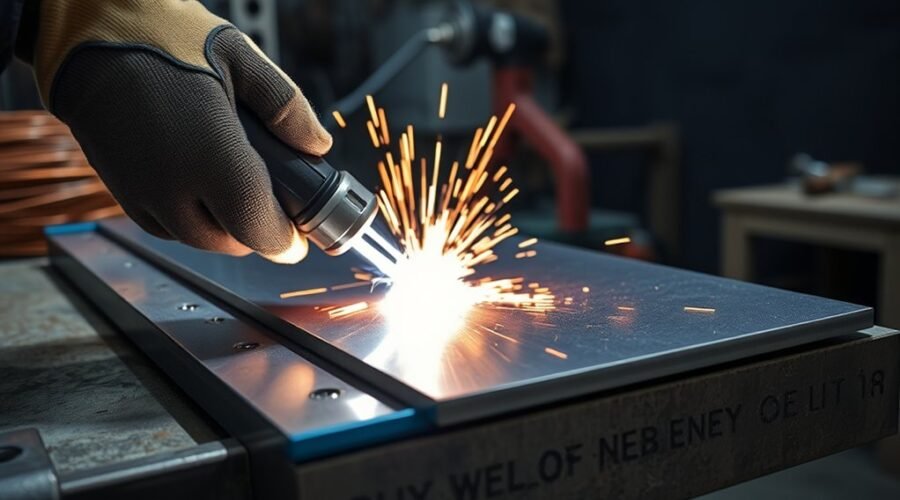
Flux core welding stainless steel without an external gas cylinder is possible, but only with a stainless flux-cored electrode that is specifically designed to be self-shielded. The exact AWS classification matters more than a generic label such as 308L. Wire chemistry, polarity, welding position, machine output, joint preparation, heat control, and post-weld cleaning all affect whether the finished joint performs as intended.
Quick Answer
Yes. You can flux core weld stainless steel without a gas cylinder when the wire is specifically classified as self-shielded stainless FCAW, such as E308LT0-3 for compatible 304-series work. Do not assume any wire labeled “308L” is gasless. Check the exact classification, polarity, welding positions, and parameter chart before welding.
Key Takeaways
- Use a true self-shielded stainless electrode. E308LT0-3 is one example for compatible 304-series stainless; ordinary 308L flux-core wire may require external gas.
- Check the welding-position rating. Common E308LT0-3 self-shielded products are intended for flat and horizontal welding, not every position.
- Verify polarity from the exact wire data sheet. Current E308LT0-3 examples specify DCEP even though many carbon-steel self-shielded wires use different polarity.
- Use stainless-only brushes and abrasives, clean the joint carefully, and keep the wire dry.
- Use a drag technique, stay within the manufacturer’s voltage, wire-feed-speed, and CTWD ranges, and control heat without making the weld too cold.
- Remove slag between passes and address weld heat tint appropriately when corrosion resistance matters.
At a Glance
| Time Required | About 30–60 minutes for a small practice joint, including preparation and cleanup; multi-pass or structural work takes longer. |
| Difficulty | Intermediate; less forgiving than ordinary mild-steel FCAW. |
| Tools Needed | Compatible wire-feed welder, self-shielded stainless FCAW wire, stainless-only brush/abrasives, clamps, measuring tools, PPE, and effective fume control. |
| Cost | No shielding-gas cylinder is required, but specialty stainless FCAW-S wire can cost more than ordinary mild-steel flux-core wire. |
Warning: Welding stainless steel can produce fumes containing hexavalent chromium. Use effective local exhaust or other ventilation and respiratory protection when required by the exposure conditions and applicable rules. Do not weld in a confined space without an appropriate confined-space and hot-work procedure, and never weld a sealed or unknown container.
Can You Flux Core Weld Stainless Steel Without Gas?
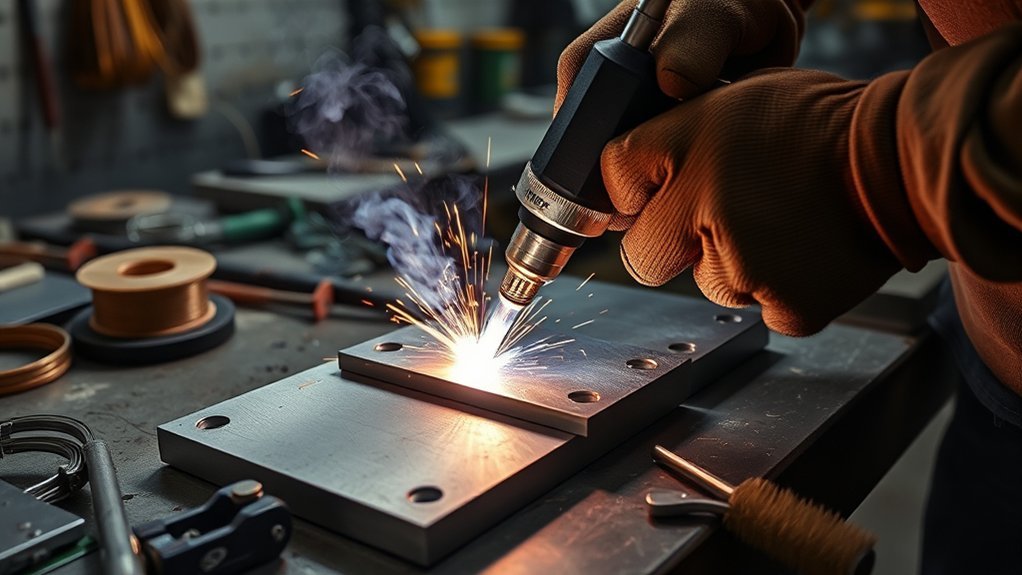
Yes. Stainless steel can be welded with self-shielded flux-cored arc welding, or FCAW-S, when the electrode is specifically made for that purpose. The flux inside the tubular wire produces shielding during welding, so an external gas cylinder is not required.
The important distinction is the full wire classification. The current AWS A5.22/A5.22M specification classifies stainless flux-cored electrodes by weld-metal chemistry, welding position, and shielding requirements. A label that only says “308L” is therefore not enough to tell you whether a spool is gasless.
For example, SelectAlloy E308LT0-3 is a self-shielded stainless flux-cored electrode for similar austenitic grades such as 304 and 304L. Its manufacturer specifies no external shielding gas, DCEP polarity, and flat or horizontal welding positions.
The full wire classification and data sheet—not “308L” by itself—determine whether stainless flux-core wire can be used without external shielding gas.
Read the Wire Classification Before You Buy
| Example Classification | Shielding | Typical Position Capability | Key Point |
|---|---|---|---|
| E308LT0-3 | Self-shielded; no external gas | Flat and horizontal on the example product researched | Suitable example for gasless 304/304L-type work when the manufacturer approves the joint. |
| E308LT1-1 | 100% CO₂ on current manufacturer examples | All-position products are available | This is gas-shielded FCAW, not gasless wire. |
| E308LT1-4 | 75–80% Ar with the balance CO₂ on current manufacturer examples | All-position products are available | Also gas-shielded; use the exact gas specified by the wire maker. |
Note: “Gasless MIG” is common retail language, but a self-shielded tubular wire process is technically FCAW-S. MIG/GMAW uses external shielding gas.
Why Use Self-Shielded Flux Core?
Self-shielded stainless FCAW removes the cylinder, regulator, hose, and external shielding-gas supply from the setup. That can make field work simpler, especially where carrying gas equipment is inconvenient.
It is also less vulnerable to wind than a gas-shielded process because there is no external gas stream to blow away. That does not make the process immune to weather, contamination, or poor technique. Strong airflow can still disturb the arc and can also affect how welding fumes move around the operator.
If you are comparing consumables before buying, this guide to flux-core welding wire options provides additional product context, but the exact stainless classification on the spool remains the deciding factor for this job.
Self-Shielded Wire Benefits
| Benefit | Practical Effect | Limitation |
|---|---|---|
| No gas cylinder | Less field equipment to transport | Specialty stainless wire can be expensive |
| Self-generated shielding | Better suited to exposed work than an easily disturbed external gas stream | Cleanliness and technique still matter |
| Portable setup | Useful for repairs away from a fixed shop | The welder still needs enough output for the selected wire |
| Flux/slag system | Protects the weld as the deposit solidifies | Slag must be removed between passes |
| Useful deposition rate | Can suit fabrication and repair work | Common self-shielded T0 stainless wires are limited to flat/horizontal work |
Outdoor Welding Advantages
Outdoor work is one of the clearest reasons to consider stainless FCAW-S. A gas-shielded arc may lose coverage when wind carries the shielding gas away from the puddle, while a self-shielded electrode does not depend on a regulator-fed gas envelope.
- No shielding-gas cylinder or regulator
- Fewer gas-related setup problems in breezy conditions
- Portable equipment arrangement
- Useful for compatible repair and fabrication work
- Single- or multi-pass capability when allowed by the consumable and procedure
However, do not convert “wind resistant” into “works in any weather.” Keep rain and moisture away from electrical welding equipment and the joint, protect the work area, and maintain adequate control of welding fumes.
Safety Before Welding Stainless Steel
Stainless welding needs the normal controls for arc radiation, hot metal, sparks, fire, electricity, and fumes, plus special attention to chromium-bearing fume. The OSHA hexavalent chromium guidance identifies welding and other hot work on stainless steel as a significant source of occupational Cr(VI) exposure.
Use effective local exhaust ventilation where practical and keep your head out of the plume. Respiratory protection must be selected and used correctly when required by exposure conditions and applicable workplace rules. Confined spaces require much stricter controls than ordinary open-shop work.
- Wear an appropriate welding helmet and filter shade; good optics also make puddle and slag boundaries easier to see. This welding helmet guide covers one family of helmet options.
- Cover exposed skin with flame-resistant clothing. Suitable flame-resistant welding shirts and welding jackets help protect against sparks, UV, and spatter.
- Wear dry welding gloves suitable for the heat and process. See these welding glove options for additional context.
- Remove combustibles from the hot-work area and keep suitable fire-control equipment available.
- Never weld a sealed container or a container with an unknown previous contents.
- Use cleaners only as directed by their safety data sheets, and make sure the prepared joint is dry before striking an arc.
Warning: A wire manufacturer listing pressure vessels, food equipment, chemical equipment, or structural applications does not automatically qualify your weld for that service. Code-governed or safety-critical work may require an approved WPS, qualified welder, documented filler metal, inspection, and other requirements.
Choose the Right Stainless Flux Core Wire
The wire must match both the base-metal chemistry and the shielding method. Start by identifying the stainless grade. If you do not know what alloy you have, do not assume every shiny or weakly magnetic piece is 304 stainless.
For common austenitic stainless work, the following self-shielded classifications illustrate why one wire cannot be treated as universal:
| Base-Metal Situation | Self-Shielded Example | Important Note |
|---|---|---|
| 304, 304L and similar 308-type applications | E308LT0-3 | Verify the exact base-metal range on the manufacturer’s sheet. |
| 304 stainless to mild/carbon steel or suitable cladding work | E309LT0-3 | 309L-type filler is commonly used for compatible dissimilar joints because of its higher alloy content. |
| 316 or 316L stainless | E316LT0-3 | The molybdenum-bearing filler better matches the corrosion characteristics expected from 316-type material. |
| Unknown or specialty stainless grade | Do not guess | Identify the alloy and use filler guidance appropriate to the material and service. |
Do not use ordinary mild-steel flux-core wire when the joint must retain stainless weld chemistry and corrosion resistance. It may physically join the pieces, but the resulting weld is no longer equivalent to a correctly alloyed stainless deposit.
If FCAW-S is not suitable for your machine or welding position, stainless stick welding may be another no-cylinder option for some jobs. This overview of covered welding electrodes provides broader electrode context, but the stainless electrode still needs to match the application.
Set Your Welder for Self-Shielded FCAW
First confirm that the welder can run the wire diameter, polarity, and output range specified by the consumable manufacturer. A machine that works well with small mild-steel gasless wire is not automatically capable of running a larger stainless tubular electrode.
The correct setup depends on four linked variables: polarity, wire-feed speed, voltage, and contact-tip-to-work distance (CTWD). Do not select one in isolation and do not rely on a universal “low amperage” rule.
Note: A current SelectAlloy E308LT0-3 example specifies DCEP. Many welders are accustomed to DCEN with some carbon-steel self-shielded wires, so check the stainless spool before connecting the leads.
As one manufacturer example—not a universal recipe—the 0.045-inch SelectAlloy E308LT0-3 data sheet lists the following flat/horizontal operating points:
| Wire Feed Speed | Approx. Current | Voltage | CTWD |
|---|---|---|---|
| 250 ipm | 120 A | 25 V | 1/2 in. |
| 430 ipm | 175 A | 28 V | 5/8 in. |
| 575 ipm | 205 A | 32 V | 1 in. |
These values show why one fixed stick-out or “lowest amperage” recommendation is unreliable. Use the chart printed for your exact wire and diameter. If you are selecting equipment, verify output and polarity capability before buying; a beginner welder comparison can help explain machine types, while this wire-feed welder guide provides additional equipment context.
Pro Tip: Before welding the actual part, run beads on a clean test coupon of the same alloy and similar thickness. Confirm arc stability, bead profile, fusion, slag release, and distortion before committing to the joint.
Prepare Stainless Steel for Welding
Good preparation reduces porosity, inclusions, lack of fusion, distortion, and surface contamination. Stainless should be kept separate from carbon-steel grinding dust and tools whenever corrosion performance matters.
- Identify the base metal. Confirm whether the material is 304/304L, 316/316L, a dissimilar joint, or another grade.
- Remove oil, paint, dirt, moisture, and surface contamination. Use a cleaner suitable for weld preparation and follow its SDS.
- Use dedicated stainless tools. A stainless wire brush, grinding wheel, flap disc, or abrasive that has previously been used on carbon steel can transfer free iron to the stainless surface.
- Check fit-up. Keep the joint gap, root opening, and alignment within the requirements of the joint design or welding procedure.
- Bevel when required. Thicker material may need an appropriate groove to provide access to the joint root and sidewalls.
- Clamp the work securely. Stainless expands substantially when heated, so good restraint and a planned sequence help manage movement.
Use brushes and abrasives reserved for stainless steel. Carbon-steel contamination can create rust staining and reduce the quality of the finished surface.
Weld Stainless Steel With a Drag Angle
Flux-cored welding generally uses a drag, or pull, technique. The gun points back toward the completed portion of the weld while moving forward along the joint. This keeps the arc ahead of the slag and makes the puddle easier to read.
Miller’s FCAW technique guidance recommends a normal travel angle of roughly 5 to 15 degrees and warns that excessive angles can increase spatter, reduce penetration, and make the arc less stable.
Drag Angle Basics
The travel angle is not the same as the work angle. Travel angle describes how far the gun leans forward or backward along the direction of travel. Work angle describes how the gun is aimed across the joint.
- Use a modest drag angle, usually about 5–15 degrees unless the wire maker or WPS specifies otherwise.
- Keep the arc near the leading edge of the puddle.
- Use the correct work angle for the joint type.
- Prefer stringer beads unless a controlled weave is specifically needed.
- Avoid excessive gun angle, which can encourage spatter, poor bead shape, and slag problems.
Maintaining a Stable Self-Shielded Arc
Arc stability depends on more than gun angle. Keep the CTWD within the wire manufacturer’s range, maintain a steady travel speed, and avoid large changes in gun-to-work distance while welding.
Too much extension can change current and arc behavior. Too little can make the gun difficult to control and can overheat consumables. The correct value can also change as wire diameter and wire-feed speed change, which is why the spool’s parameter chart is more reliable than one universal stick-out number.
Step-by-Step Gasless Stainless FCAW Procedure
- Confirm the alloy and joint requirements. Select a compatible self-shielded stainless electrode rather than ordinary mild-steel flux-core wire.
- Read the wire data sheet. Confirm that it requires no external gas and note its allowed positions, polarity, wire diameter, CTWD, voltage, and wire-feed-speed range.
- Set polarity. Connect the machine exactly as specified by the consumable manufacturer.
- Prepare and fixture the joint. Clean it with stainless-dedicated tools, verify fit-up, and clamp it securely.
- Set an approved starting point. Use the manufacturer’s parameter range for the actual wire diameter and material thickness.
- Tack and test. Check bead behavior on scrap or a test coupon when possible.
- Drag the gun steadily. Use a modest travel angle, maintain CTWD, and keep the arc where you can clearly see the leading edge of the puddle.
- Clean every pass. Allow the weld to become safe to handle, remove all slag from the bead and toes, then inspect before depositing the next pass.
- Control accumulated heat. Use an appropriate sequence, travel speed, bead size, and cooling interval rather than simply turning the machine down until fusion suffers.
- Inspect and finish the weld. Check for porosity, cracks, undercut, incomplete fusion, slag inclusions, excessive heat tint, or other defects required by the job’s acceptance criteria.
Keep Heat Input Under Control
Stainless steel is prone to distortion because of its thermal behavior, so unnecessary heat should be avoided. However, “low heat” does not mean making a cold weld. Insufficient current, voltage, or dwell at the joint can create poor fusion.
- Stay inside the consumable manufacturer’s operating range.
- Use a steady travel speed rather than lingering over the puddle.
- Use stringer beads when appropriate instead of wide weaving.
- Sequence welds to reduce heat buildup and distortion.
- Allow cooling between passes when necessary.
- Measure interpass temperature when the procedure specifies a maximum.
For common austenitic stainless work, guidance around 150°C (302°F) maximum interpass temperature is often used as a practical heat-control reference, but it is not a universal rule for every alloy, wire, joint, or code. Follow the approved WPS or material/consumable guidance for the actual job rather than using a blanket 800°F limit.
Remove Slag and Clean the Weld
Flux-cored stainless produces slag, so every completed pass must be cleaned before another pass is deposited. Let the weld cool enough to work safely, then remove the slag without damaging the bead or surrounding stainless.
A chipping tool can lift heavier slag, followed by a stainless-only wire brush to clean the toes and bead surface. If grinding or abrasive finishing is necessary, use tools reserved for stainless so carbon-steel particles are not embedded in the surface.
After cleaning, inspect the bead under good light. Look for trapped slag, pores, cracks, undercut, irregular bead shape, lack of fusion, or areas that need repair before continuing.
Pro Tip: Slag removal and corrosion-restoration finishing are not the same task. A weld can be free of slag and still have heat tint that needs additional treatment for corrosion-sensitive service.
Address Heat Tint When Corrosion Resistance Matters
Welding can create colored oxide, or heat tint, beside the bead. The British Stainless Steel Association’s post-weld guidance explains that the metal directly beneath visible heat tint can be chromium-depleted and may have reduced corrosion resistance.
For corrosion-critical service, simple brushing may not be enough to restore the desired surface condition. Qualified mechanical finishing, pickling, electrochemical cleaning, passivation, or another specified treatment may be required. Chemical pickling products can be hazardous, so use only an approved process and follow the chemical manufacturer’s SDS and workplace procedures.
Avoid Porosity, Cracking, and Spatter
Most weld defects are easier to prevent than repair. Do not rely on an unsupported percentage for what causes them; instead, troubleshoot the actual process variables one at a time.
| Problem | Likely Causes to Check | Corrective Direction |
|---|---|---|
| Porosity | Dirty or wet joint, damp/contaminated wire, unstable arc, excessive CTWD | Clean and dry the joint, protect/store wire correctly, and return to the manufacturer’s CTWD and parameter range. |
| Excessive spatter or popping | Wrong polarity, incorrect voltage/WFS balance, excessive travel angle, inconsistent extension | Verify polarity first, then correct settings and gun position. |
| Slag inclusions | Poor interpass cleaning, bad joint access, excessive weaving, slag running ahead of the arc | Clean every pass, use a controlled drag technique, and improve joint access. |
| Lack of fusion | Settings too cold, travel too fast, poor work angle, inaccessible sidewall/root | Return to approved parameters and correct joint preparation and gun position. |
| Burn-through or distortion | Excessive heat, slow travel, thin material, poor sequence | Reduce heat input within the usable range, travel steadily, fixture properly, and consider a more controllable process for thin sheet. |
| Cracking | Wrong filler, contamination, excessive restraint, unsuitable procedure or metallurgy | Stop and verify alloy compatibility and the welding procedure rather than simply changing voltage. |
Control Heat Input
Excessive heat can increase distortion, enlarge the heat-affected zone, and produce heavier heat tint. Insufficient heat can be just as damaging if it causes incomplete fusion.
Control heat by coordinating wire-feed speed, voltage, travel speed, bead size, weld sequence, and interpass cooling. Do not treat amperage as the only heat-control variable.
- Use the manufacturer’s approved operating range.
- Keep travel steady.
- Avoid unnecessarily wide weave beads.
- Use shorter weld segments or an appropriate sequence when distortion is developing.
- Measure interpass temperature when required by the procedure.
Use Proper Wire
The correct stainless electrode does more than make the arc run smoothly. Its weld-metal chemistry is part of the finished joint.
Use E308L-type filler where it is appropriate for the base metal and service, E316L-type filler for compatible 316 applications, and suitable E309L-type filler where a qualified dissimilar stainless-to-carbon-steel application calls for it.
Then verify whether the exact classification is self-shielded or gas-shielded. Do not assume that two wires with “308L” on the label use the same shielding method, position range, polarity, or operating parameters.
Keep Welds Clean
Cleanliness starts before the arc and continues between passes. Oil, dirt, moisture, carbon-steel particles, retained slag, and inappropriate abrasives can all undermine the finished weld or stainless surface.
- Clean the base metal before welding.
- Keep flux-cored wire dry and stored according to the manufacturer’s instructions.
- Use stainless-only brushes and abrasives.
- Remove slag completely between passes.
- Inspect the bead and joint edges before continuing.
- Address heat tint according to the required corrosion performance.
When Gas-Shielded Wire Is Better
Self-shielded stainless FCAW is useful, but it is not automatically the best stainless process. Gas-shielded FCAW can provide broader consumable availability and all-position options that common self-shielded T0 wires do not provide.
For example, current E308LT1-1 products may use 100% CO₂, while E308LT1-4 products may use approximately 75% argon/25% CO₂. The exact gas, flow rate, polarity, and parameter range must come from the wire data sheet.
Consider gas-shielded FCAW, GMAW/MIG, or GTAW/TIG when:
- You need vertical or overhead welding and the available self-shielded wire is T0-rated.
- The weld is visible and appearance is a major requirement.
- You are welding thin stainless sheet where FCAW-S is difficult to control.
- The work is performed indoors where shielding gas can be protected from drafts.
- A qualified procedure or project specification requires another process.
- Corrosion, sanitary finish, or precision requirements are more important than maximum field portability.
TIG is often chosen when precise heat control and appearance matter, particularly on thinner stainless. If you are comparing machines for that type of work, these TIG welder options provide additional equipment context.
Frequently Asked Questions
Can I weld with flux core without using gas?
Yes, but only when the electrode is designed to be self-shielded. Self-shielded FCAW wire generates its own shielding during welding. Other flux-cored electrodes are gas-shielded and must be used with the gas specified by their classification and manufacturer.
Can I weld stainless steel without gas?
Yes. Self-shielded stainless FCAW is one option when a suitable electrode is available. Stainless stick welding can also be performed without an external shielding-gas cylinder. The correct process depends on the alloy, thickness, position, required finish, service conditions, and applicable welding procedure.
Can you weld stainless with regular mild-steel flux core?
Ordinary mild-steel flux-core wire is not the correct filler when the finished joint must retain stainless weld chemistry and corrosion resistance. Use a stainless filler classification that matches the base metal and intended service.
Can I weld stainless with gasless MIG?
Yes, if by “gasless MIG” you mean a wire-feed machine running a true self-shielded stainless flux-cored electrode. Technically, the process is FCAW-S rather than MIG/GMAW because it does not use an external shielding-gas supply.
What polarity should I use for gasless stainless flux core?
Use the polarity printed on the exact wire data sheet. The E308LT0-3 product example discussed in this article specifies DCEP. Do not assume it uses the same polarity as the mild-steel self-shielded wire you normally run.
Is E308LT0-3 an all-position wire?
The current E308LT0-3 manufacturer examples cited here are intended for flat and horizontal welding. If you need vertical or overhead welding, choose a consumable and process specifically approved for that position, such as an appropriate gas-shielded T1 product when the application allows it.
Conclusion
Flux core welding stainless steel without external gas is practical when the job is matched to a true self-shielded stainless electrode. The most important checks are the full wire classification, compatible base metal, approved welding positions, correct polarity, manufacturer settings, clean stainless preparation, controlled heat, and complete interpass cleaning. For thin, visible, out-of-position, corrosion-critical, or code-governed work, gas-shielded FCAW, MIG/GMAW, TIG/GTAW, or another qualified process may be the better choice.
Sources
- American Welding Society — AWS A5.22/A5.22M:2024 — stainless flux-cored and metal-cored electrode classification framework.
- Select-Arc — SelectAlloy 308LT0-3 — self-shielding requirement, DCEP polarity, welding positions, diameters, and operating parameters.
- OSHA — Hexavalent Chromium — health risks and stainless-steel hot-work exposure context.
- Miller Electric — Flux-Cored Welding Basics — drag technique, travel angle, and general FCAW technique.
- TWI — Good Welding Practices for Stainless Steel — stainless heat-input, fit-up, distortion, and interpass-temperature guidance.
- British Stainless Steel Association — Post-Weld Cleaning and Finishing — heat tint, chromium depletion, and corrosion-restoration guidance.