
Welding rod selection depends on code, material condition, joint position, and power source. E6010 cuts deep and handles tight root passes, E6011 tolerates dirty steel and AC power, E6013 favors smooth finishes on thin stock, E7018 delivers low-hydrogen strength for critical work, and E7024 moves metal fast in flat positions. The differences seem simple at first, yet the wrong choice can change weld quality, efficiency, and structural performance.
Key Takeaways
- E6010 and E6011 offer deep penetration; E6011 works on AC or DC and handles dirty metal better.
- E6013 is best for thin, clean steel, with a soft arc, low spatter, and easy beginner-friendly handling.
- E7018 is a 70,000 PSI low-hydrogen rod for strong structural welds, but it needs dry storage and clean metal.
- E7024 is a high-deposition rod for flat and horizontal welding, giving fast travel speed but little positional versatility.
- Choose 6010 for root passes, 6011 for general repair, 6013 for light work, 7018 for critical strength, and 7024 for production.
How Welding Rod Numbers Work
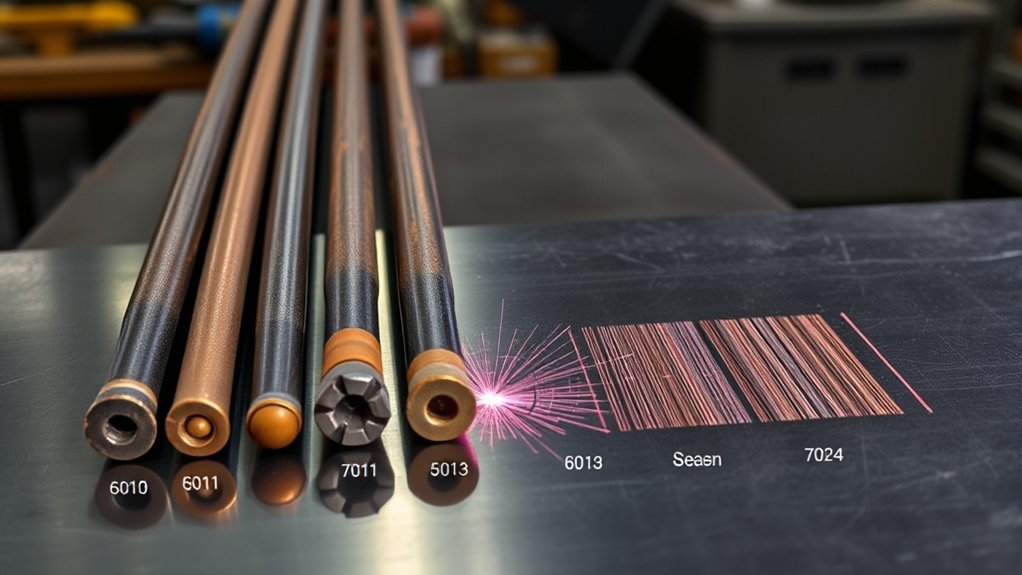
Welding rod numbers use a standardized code that identifies the electrode’s core properties. In this system, the letter E signifies Electrode, while the first two digits state minimum tensile strength in thousands of psi; E6010, for instance, denotes 60,000 PSI.
The third digit defines usable positions: 1 for all positions, 2 for flat or horizontal, and 3 for flat only. The fourth digit indicates polarity, current type, and flux behavior, including AC or DC compatibility and hydrogen level.
Such coding gives welders precise data rather than guesswork, supporting free, informed selection of a welding rod. Stick Welding Electrodes are consequently read as engineered instruments, not generic consumables.
E7018, for example, marks 70,000 PSI strength, all-position use, and low hydrogen content. Reading the code exposes the electrode’s structural capacity, positional limits, and electrical requirements, allowing disciplined analysis of performance without dependence on opaque labels or tradition. Additionally, understanding these codes can enhance long-term savings and durability, ensuring weld integrity over time.
How To Choose The Right Welding Rod
Selecting the right welding rod begins with matching the electrode code to the demands of the job. The “E” designation reveals tensile strength, so E6013 at 60,000 PSI and E7018 at 70,000 PSI should be compared against service load and joint requirements.
Penetration behavior matters: E6010 and E6011 drive deeper into contaminated material, while E6013 favors shallow fusion on clean sheet metal.
Position limits also shape the decision; E6010 and E6011 operate in all positions, whereas E7024 suits only flat and horizontal work.
Power source compatibility is another filter: E6010 requires DC, while E6011 accepts AC or DC, widening machine freedom.
Skill level and storage needs complete the analysis. E6013 is forgiving for beginners, while E7018 demands disciplined handling. Additionally, understanding cost considerations can further assist in selecting the right rod for your specific project needs.
These welding tips help specify the correct rod for safer, more independent fabrication.
6010 Welding Rod: Deep Penetration Basics
The E6010 electrode produces a deep-penetration arc that is suited to root passes in pipe and structural welds.
Its DCEP power setup generates a focused, aggressive arc that supports rapid fusion and a narrow bead profile.
It also maintains useful performance on rusted or scaled surfaces, making it effective in less-than-ideal joint conditions. Additionally, this rod is favored for its consistency in arc control, which enhances the quality of welds across various applications.
Deep Penetration Arc
Deep penetration arc performance is typically associated with electrodes such as E6010 and E6011, which deliver strong root fusion and a fast-freeze puddle suited to pipe welding, structural steel, and field repairs.
Their deep penetration behavior allows a stick electrode to cut through scale, rust, and light contamination without demanding perfect surface preparation, supporting practical work in constrained environments.
E6010 is especially valued for root passes, while E6011 adds versatility by operating on AC or DC power.
In contrast, E7018 emphasizes medium penetration and low hydrogen control, producing smoother welds with reduced cracking risk.
E7024 prioritizes deposition rate over penetration, with effective use limited to flat and horizontal positions.
Together, these electrodes enable disciplined, independent weld selection.
Dcep Power Setup
DCEP power setup concentrates the arc energy of E6010 and E6011 electrodes into a tighter, more forceful profile, improving root fusion in thicker material and supporting reliable performance in structural welds.
In DCEP, the electrode is positive, and the circuit drives a focused arc that increases penetration without sacrificing control. E6010 depends on this polarity and delivers a narrow, aggressive arc suited to demanding joints.
E6011 also benefits from DCEP, combining strong penetration with broader usability. The configuration supports stable operation in vertical and overhead positions, where arc discipline matters.
For welders seeking autonomy through precision, understanding DCEP is essential: it allows deep penetration electrodes to perform at their designed capability and produce consistent, high-integrity welds under load.
Rust And Scale Tolerance
DCEP’s tighter arc focus also helps explain why certain rods tolerate poor surface conditions better than others. E6010 uses deep penetration to cut through rust and dirty metal, making it effective where preparation is limited.
E6011 behaves similarly, maintaining arc stability on contaminated base material and supporting field repairs when freedom from ideal shop conditions is necessary.
By contrast, E6013 depends on clean metal; its shallow penetration can trap scale or impurity layers.
E7018 is even more demanding, since moisture or contamination raises porosity risk and weakens deposited metal.
E7024 also prefers cleaned surfaces, though its heavy slag can conceal remaining rust or scale.
For liberation-minded work, surface tolerance determines how much control the rod grants over imperfect material.
6011 Welding Rod: AC-Friendly Versatility
The E6011 electrode operates on both AC and DC power sources, giving it broad utility across shop and field welding tasks.
Its arc stability and potassium-rich flux support consistent performance on dirty or contaminated metal, where surface conditions are less controlled.
This combination makes it a practical option for repair work and general fabrication requiring dependable penetration and fast-freezing behavior. Additionally, the safety features of high-quality welding gloves can enhance the overall welding experience by providing protection against sparks and heat.
AC and DC Use
Among common stick electrodes, E6011 stands out for its compatibility with both AC and DC power sources, giving it broad utility across varied welding setups.
E6011 thus grants operators freedom from machine constraints, unlike E6010, which is DC-only and typically favors DCEP. That restriction narrows E6010 use when AC equipment is the only available option.
E6013 also accepts AC or DC, but its role differs from E6011 in electrode behavior and application emphasis.
E7018 is mainly a DC rod, though AC use can be viable under certain conditions, making it less universally adaptable.
E7024 is not AC-suitable and is limited further by position requirements.
In power-source terms, E6011 remains the most liberated choice among these common electrodes.
Dirty Metal Performance
When surface contamination is a factor, E6011 becomes especially notable because its potassium-rich flux supports deep penetration and solid fusion on less-than-ideal steel.
On dirty metal, it maintains arc stability where cleanliness is compromised, and its AC/DC capability expands practical freedom across jobsite power conditions.
That versatility distinguishes it from E6010, which delivers stronger penetration but remains DC-only, and from E6013, which is better reserved for clean material because impurities can weaken the joint.
E7018, although structurally robust, also depends on prepared surfaces and is not optimized for contamination.
In this comparison, E6011 provides an efficient balance of access, tolerance, and weld integrity, enabling dependable results when surface preparation is limited and the operator needs technical latitude.
6013 Welding Rod: Clean, Easy Welds
6013 welding rods are designed for clean, shallow penetration, making them well suited to thin steel and sheet metal work where control and appearance matter. The E6013 electrode gives hobby welders predictable arc behavior, low spatter, and a smooth bead profile, which supports visually refined welds without technical strain. It runs on AC or DC power, allowing use in varied shop setups and field conditions.
- Thin-gauge panels with minimal burn-through risk
- Decorative seams where surface finish is important
- Clean base metal prepared for consistent fusion
- Flat-position welds demanding steady, controlled motion
Its cleanliness requirement is significant: contaminants can disrupt fusion and introduce defects. Although it can operate in all positions, its performance is strongest in the flat position, so application planning matters. For users seeking accessible, disciplined welding, 6013 offers a practical route to precise results and material freedom, especially when considering its ease of setup for hobby projects and repairs.
7018 Welding Rod: Low-Hydrogen Strength
The E7018 electrode is characterized by low-hydrogen properties that help minimize porosity and reduce the risk of cold cracking. Its 70,000 PSI tensile strength makes it suitable for strong structural welds in steel fabrication and similar load-bearing applications. Proper storage is essential because moisture absorption can compromise weld quality and negate its low-hydrogen advantages. Additionally, its steady arc performance significantly enhances the quality of welds in various applications.
Low Hydrogen Properties
Low-hydrogen electrodes such as E7018 and E7024 are engineered to limit hydrogen-induced cracking, making them well suited to high-strength welding applications where joint integrity is critical. Their low hydrogen coating reduces moisture uptake, preserving arc stability and weld soundness.
- E7018 is commonly stored in a rod oven at 250 degrees Fahrenheit.
- Controlled storage helps prevent porosity and moisture contamination.
- These rods produce smooth fusion and elevated tensile strength.
- The result is cleaner, more dependable welds for critical work.
Compared with non-low-hydrogen rods, they better support liberated, disciplined fabrication where failure margins must remain narrow.
Strong Structural Welds
Engineers and fabricators often select E7018 for strong structural welds because its low-hydrogen formulation delivers about 70,000 PSI tensile strength while reducing the risk of cold cracking. It supports liberated design choices in bridges and industrial fabrication by combining smooth arc stability with excellent fusion.
| Attribute | E7018 |
|---|---|
| Tensile strength | 70,000 PSI |
| Hydrogen level | Low-hydrogen |
| Crack resistance | High |
| Fusion quality | Excellent |
| Structural use | Bridges, fabrication |
Compared with E6010 and E6011, it prioritizes clean base metal and controlled deposition rather than aggressive penetration. E7024 offers high deposition in flat or horizontal work, yet its lower penetration limits versatility. For strong structural welds, E7018 remains the analytical choice when strength, integrity, and dependable load transfer are required.
Proper Storage Requirements
Because low-hydrogen performance depends on moisture control, E7018 electrodes should be stored in a rod oven at about 250°F to prevent hydrogen pickup and the porosity that can follow.
This proper storage regime preserves arc stability, deposited metal strength, and consistency in critical welds. Humidity is an active threat; even brief exposure can degrade performance.
- Keep E7018 in a heated oven when idle.
- Move only the quantity needed to the work area.
- Use sealed containers or desiccant for short-term protection.
- Inspect storage conditions regularly and replace compromised rods.
7024 Welding Rod: Fast Flat Welding
The E7024 welding rod is engineered for flat and horizontal welding, where its high iron powder content supports fast travel speeds and high deposition rates on structural and high-carbon steels.
E7024 delivers a controlled, efficient arc that favors productivity without sacrificing bead consistency. Its heavy slag forms a protective cover over the molten pool, helping produce smooth, uniform weld faces and simplifying cleanup after cooling.
As a low-hydrogen electrode, it reduces the risk of hydrogen-induced cracking, supporting stronger weld integrity in service. Performance depends on clean base metal; rust, oil, and scale can compromise fusion and surface quality.
The rod’s mild penetration and slag system make it unsuitable for vertical or overhead positions, where gravity and pool control demand different electrode behavior.
In flat work, however, E7024 enables disciplined, high-output welding that supports structural fabrication with speed and reliability, giving the operator more freedom to move material efficiently. Additionally, using high-quality welding rods like the E7024 can lead to long-term savings through reduced rework and improved throughput.
6010 Vs. 6011: Which Rod Is Better?
E6010 and E6011 serve similar roles as deep-penetration cellulose electrodes, yet their operating characteristics make them better suited to different conditions. E6010 is DC-only, typically DCEP, and delivers a tighter, more forceful arc for maximum root penetration. E6011 functions on AC or DC, which grants machine freedom and broader field utility.
- E6010 excels where clean, aggressive penetration is required.
- E6011 tolerates less-than-ideal surfaces with greater ease.
- E6010 suits structural steel, pipe roots, and heavy fabrication.
- E6011 supports repairs and hobby work across varied power sources.
For welders seeking technical control and material liberation, E6010 offers superior arc focus and depth. For those needing adaptability and forgiving behavior, E6011 is the more flexible choice.
Both operate in all positions, yet the better rod depends on access to power, joint condition, and required penetration. In practice, E6010 wins on performance; E6011 wins on convenience. Additionally, selecting the right rod can significantly impact cost efficiency and overall project success.
6011 Vs. 6013: Penetration Or Appearance?
Though both electrodes are classified as 60-series rods, E6011 and E6013 prioritize different welding outcomes: E6011 delivers deeper penetration, stronger arc force, and better performance on dirty or uneven material, while E6013 emphasizes a smoother, cleaner bead with minimal spatter and lighter penetration.
E6011 is thus favored where penetration must reach into thicker sections, irregular joints, or surfaces that are not fully pristine. Its aggressive arc gives the operator more control over fusion in demanding positions, though it produces a more rugged weld appearance.
E6013, by contrast, is optimized for clean base metal and lighter gauge work, where a refined weld appearance matters more than depth. Its softer arc and easy handling support beginners, but its shallow penetration limits use on demanding joints.
For users seeking technical freedom, the choice is clear: strength of fusion or visual finish, not both. Additionally, understanding the multi-process capability of your welder can enhance the versatility of your welding projects.
6013 Vs. 7018: When Strength Matters
Where E6013 is valued for a clean, easy bead on lighter material, E7018 shifts the focus to structural performance. Its 70,000 PSI tensile strength exceeds the 60,000 PSI rating of E6013, giving it an advantage where load-bearing integrity matters. The 7018 rod also delivers medium penetration, better suited to restrained joints than the shallow profile of E6013.
- Strength: 7018 supports critical welds under stress.
- Hydrogen control: Its low-hydrogen coating reduces cold cracking risk.
- Finish: It produces smooth, low-spatter welds with professional consistency.
- Conditions: It demands clean base metal and dry storage.
E6013 remains useful for thin stock, decorative work, and forgiving arc starts, yet its higher hydrogen content and lower tensile strength limit confidence in demanding service. Additionally, choosing the right rod can significantly enhance bead quality enhancements for various welding applications. For welders seeking liberation from avoidable failure, 7018 offers a more disciplined path to durable joints.
Frequently Asked Questions
What Is a 7024 Welding Rod Good For?
A 7024 welding rod is good for flat and horizontal welding, especially where rapid metal deposition is needed.
Its 7024 applications include structural fabrication, plate work, and other high-production jobs.
The 7024 advantages are a smooth bead, heavy slag support, and efficient, low-hydrogen performance.
It suits clean surfaces and repetitive passes, giving workers a precise, productive path toward strong welds and practical autonomy in workshop conditions.
What Is the Hardest Rod to Weld With?
E7018 is generally the hardest rod to weld with. In rod comparison, its welding difficulty comes from low-hydrogen handling, moisture sensitivity, and demanding arc control.
It rewards discipline but punishes poor storage or technique with cracking risk. By contrast, E6013 is easier, while E6010 and E6011 are less exacting yet still require skill.
For a welder seeking liberation through mastery, E7018 remains the most technically demanding choice.
What Amps Should You Run for 7024?
7024 rods typically run at 150–200 amps, like a steady river feeding a wide steel plain.
The exact setting should track material thickness, near 1 amp per thousandth of an inch, and the travel speed used.
In flat or horizontal 7024 applications, higher amperage improves deposition and bead profile.
Those 7024 advantages vanish if fusion is weak, so manufacturer specifications should govern final adjustment.
Which Welding Rod Is Better for Rusty Metal, 6011 or 6013?
6011 is better for rusty metal. Its deep penetration and aggressive arc make it more tolerant of contamination, while 6013 typically demands cleaner surfaces and can leave defects on rusted stock.
Effective welding techniques and careful metal preparation still improve results, but 6011 offers greater freedom when conditions are imperfect. Its potassium-rich flux also stabilizes the arc, supporting stronger, cleaner welds on challenging material with less spatter overall.
Conclusion
The comparison leaves a clear contrast: 6010 and 6011 drive penetration into difficult joints, while 6013 trades depth for a smoother finish on lighter work. 7018 stands apart with low-hydrogen strength for critical loads, and 7024 narrows the field further with rapid, flat-position deposition. In practice, the choice is not about superiority, but alignment—arc force, surface condition, position, and structural demand define the rod, and the wrong match limits weld integrity.