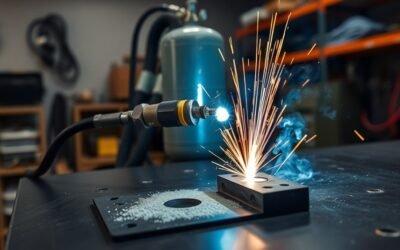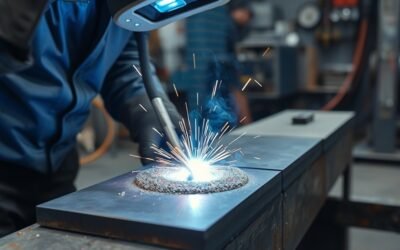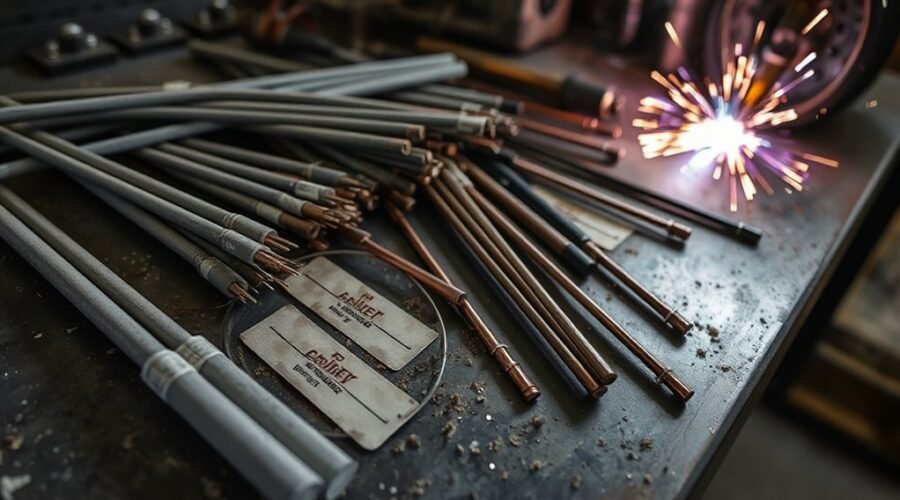
Welding electrodes are selected by welding process, base metal, AWS classification, coating, welding position, current type, and service requirements. In shielded metal arc welding (SMAW or stick), the coated electrode carries current, provides filler metal, and creates shielding gas and slag. TIG uses a non-consumable tungsten electrode, while MIG uses a continuously fed consumable wire electrode. For carbon-steel stick rods, classifications such as E6010, E6011, E6013, E7018, and E7024 help identify strength, position capability, coating, and usable current.
Quick Answer
Choose a welding electrode by first matching the process and base metal, then checking the AWS classification, required weld strength, welding position, current/polarity, penetration, and hydrogen-control needs. For common carbon-steel stick welding, E6010/E6011 favor deep penetration, E6013 favors a smooth easy arc, E7018 is low-hydrogen, and E7024 is a high-deposition flat/horizontal rod.
Key Takeaways
Key Takeaways
- Stick, TIG, and MIG all use electrodes, but the electrode performs a different job in each process.
- For common carbon-steel SMAW classifications, “60” or “70” indicates minimum deposited-weld tensile strength in ksi, the third digit indicates position, and the fourth digit relates to coating and usable current.
- E6010, E6011, E6013, E7018, and E7024 are not interchangeable; penetration, polarity, position, deposition rate, and hydrogen control differ.
- E6013 is an all-position classification, while E7024 is intended for flat and horizontal welding.
- Low-hydrogen electrodes such as E7018 require controlled storage after opening; follow the manufacturer, welding procedure specification (WPS), and applicable code.
Welding Electrode Types Explained

Welding electrodes fall into categories based on the welding process and whether the electrode is consumed. The three process groups discussed here are stick electrodes, TIG electrodes, and MIG electrodes.
Stick/SMAW electrodes are consumable, flux-coated rods. The metal core becomes filler metal, while the coating helps stabilize the arc and creates shielding gases and slag. TIG/GTAW electrodes are non-consumable tungsten electrodes; filler metal, when needed, is normally added separately. MIG/GMAW electrodes are continuously fed consumable wire electrodes used with externally supplied shielding gas.
The AWS classification system depends on the filler-metal family, so the familiar four-digit E60XX/E70XX logic should not be applied to every welding electrode. Carbon-steel covered stick electrodes are covered by AWS A5.1/A5.1M:2025, while gas-shielded carbon-steel wires and rods use a different classification system. That distinction matters when comparing stick rods with MIG wire or TIG filler rods.
Among common carbon-steel stick electrodes, E6010 is associated with a forceful, deep-penetrating arc and is widely used for root-pass and pipe work. E7018 is a low-hydrogen electrode used where strength, toughness, and cracking control are important. If you are comparing general-purpose stick rods, this guide to selection criteria can help narrow the choices.
Note: “Electrode” does not always mean “filler rod.” In TIG welding, the tungsten carries the arc but normally does not become part of the weld. In MIG welding, the continuously fed wire is both the electrode and filler metal.
How Electrode Coatings Work
In stick welding, the flux coating performs several jobs at once. As the arc burns, coating ingredients help create a protective atmosphere, improve arc stability, add deoxidizers or alloying ingredients when required, and form slag over the deposited weld metal.
The coating is part of the electrode’s operating system: it affects arc behavior, shielding, slag, penetration, deposition rate, and the final weld-metal properties.
The slag layer covers the hot bead as it cools and helps protect the weld from the atmosphere. Coating chemistry also affects how easily the arc starts, how fluid the puddle feels, how much spatter is produced, how the slag releases, and what current types are usable.
Because flux chemistry is tied to the classification, coating type should be considered together with base metal, current type, welding position, mechanical-property requirements, and the WPS. Flux-cored wire uses a different consumable design, but similar principles of shielding and slag formation apply; see the existing guide to flux core welding wires for that process.
Rutile, Cellulosic, Basic, and Acid Coatings
Covered electrodes are often described by their dominant coating chemistry. These families are useful for understanding behavior, but the actual AWS classification and manufacturer data sheet should control the final selection.
Rutile coatings contain a high proportion of titanium dioxide. They are known for easy arc starting, smooth running characteristics, relatively low spatter, and attractive bead appearance. E6013 is a common rutile-type carbon-steel electrode and can operate on AC or DC, depending on the specific product.
Cellulosic coatings produce a forceful arc with deep penetration and fast-freezing characteristics. E6010 and E6011 are familiar examples. They are useful for root passes and out-of-position work, but their coating chemistry also produces relatively high diffusible hydrogen compared with low-hydrogen electrodes.
Basic or low-hydrogen coatings are used when hydrogen control, toughness, and crack resistance are important. E7018 is the best-known carbon-steel example. These electrodes are widely used in structural and higher-strength applications, but moisture control is essential if the specified low-hydrogen performance is to be maintained.
Acid and acid-rutile coatings are specialty coating families used in selected covered-electrode systems. They should not be chosen simply because a base metal is “non-ferrous.” Their suitability depends on the specific electrode classification, alloy, mechanical requirements, and manufacturer instructions.
Understanding coating behavior helps predict weld characteristics, but it does not replace the electrode data sheet or welding procedure.
How AWS Welding Rod Numbers Work
For common carbon-steel covered stick electrodes, AWS classifications such as E6010 and E7018 provide a compact description of key properties. The current governing specification is AWS A5.1/A5.1M:2025, Specification for Carbon Steel Electrodes for Shielded Metal Arc Welding.
- E identifies an electrode.
- The first two digits in common four-digit carbon-steel classifications indicate the minimum tensile strength of deposited weld metal in thousands of psi: 60 = 60,000 psi and 70 = 70,000 psi.
- The third digit identifies qualified welding positions. A 1 indicates all-position capability; a 2 is used for flat and horizontal applications in the common classifications discussed here.
- The fourth digit relates to coating composition and the usable current/polarity. It should be interpreted from the classification table or manufacturer data rather than guessed from a simple universal rule.
For example, E7018 denotes a 70-ksi-class, all-position, low-hydrogen iron-powder electrode. Common E7018 products operate on DCEP and AC. E6010 is a 60-ksi-class, all-position cellulosic electrode typically used on DCEP. E6011 is also all-position and commonly runs on AC or DCEP.
Suffixes can add important information. An electrode such as E7018-1 H4R carries supplemental designators for impact toughness, diffusible hydrogen, and moisture resistance. For code work, do not stop at “7018”; verify the full classification required by the drawing, code, or WPS.
Common Stick Electrodes Compared
| Electrode | Typical current | Position | General behavior | Common use |
|---|---|---|---|---|
| E6010 | DCEP | All-position | Forceful arc, deep penetration, fast-freezing slag | Pipe/root passes, field work, contaminated steel when cleaning is limited |
| E6011 | AC or DCEP | All-position | Deep penetration, useful on AC machines | Repair, coated/rusty steel when full cleaning is impractical |
| E6013 | AC, DCEP, or DCEN on many products | All-position | Smooth arc, lighter penetration, easy slag removal | General fabrication, sheet metal, clean mild steel |
| E7018 | DCEP or AC on common products | All-position classification; follow product/WPS technique limits | Low-hydrogen, stable arc, good mechanical properties | Structural and higher-strength carbon/low-alloy steel work |
| E7024 | AC or DC, product-dependent | Flat/horizontal | High iron-powder deposition, smooth spray-like transfer | High-deposition fillets and production welding |
This comparison is a selection shortcut, not a welding procedure. Exact polarity, amperage, deposition limits, impact requirements, and positional technique should be taken from the electrode manufacturer and the applicable WPS. Understanding welding processes like MIG and TIG also helps prevent applying stick-electrode rules to a different process.
How to Choose the Right Welding Electrode
Choosing the right welding electrode is a matching exercise. Start with the welding process and base-metal specification, then work through strength, position, current, coating, diameter, service conditions, and any code or WPS requirements.
- Identify the base metal and required filler-metal classification. Carbon steel, low-alloy steel, stainless steel, cast iron, nickel alloys, and aluminum do not use one universal electrode family.
- Match mechanical requirements. For carbon-steel SMAW, select the required tensile-strength class and any toughness or hydrogen designators specified by the job.
- Check welding position. Verify whether the electrode is qualified for flat, horizontal, vertical, and overhead work.
- Check current and polarity. Confirm AC, DCEP, or DCEN compatibility with both the electrode and the power source.
- Choose the operating characteristics. Decide whether the job needs deep penetration, smooth low-spatter handling, low hydrogen, or high deposition.
- Select diameter and amperage from the manufacturer chart. Diameter affects current range, puddle size, deposition rate, and out-of-position control.
- Follow the WPS and applicable code for critical work. Structural, pressure, pipeline, and other code applications can restrict electrode class, heat input, storage, preheat, and technique.
Additional process versatility can be useful in a home or fabrication shop, so the existing guide to welding process versatility can help when choosing equipment as well as consumables.
Match Metal And Strength
For carbon-steel SMAW, the electrode’s deposited-weld tensile-strength class should be compatible with the base metal and the governing procedure. It is not correct to assume that “stronger is always better.” The required filler metal may be matching, under-matching, or over-matching depending on the design, code, and service conditions.
Low-hydrogen rods such as E7018 are common for structural and higher-strength work because hydrogen control helps reduce the risk of hydrogen-assisted cracking. Deep-penetrating E6010 or E6011 electrodes may be preferred for certain roots, repairs, or surfaces that cannot be perfectly cleaned, but cleaning the joint remains best practice whenever possible.
E6013 is an all-position classification, not a flat/horizontal-only rod. E7024 is the common example in this group that is restricted to flat and horizontal welding.
Consider Position And Polarity
The third digit in common E60XX/E70XX carbon-steel SMAW classifications identifies position capability, while the final digit helps identify coating and current characteristics. For the rods covered here, E6010, E6011, E6013, and E7018 are all-position classifications; E7024 is for flat and horizontal work.
Polarity is equally important. E6010 is typically DCEP. E6011 commonly runs on AC or DCEP. E6013 commonly supports AC, DCEP, or DCEN. Common E7018 products support DCEP or AC. Always confirm the exact product data sheet because classification, formulation, and power-source requirements can affect arc behavior.
Pro Tip: Read the electrode carton before setting the machine. The printed classification and manufacturer chart are more reliable than a remembered “rule” for polarity or amperage, especially when switching between E6010, E6011, E6013, E7018, and E7024.
Choose Coating For Purpose
Coating type should match the job because flux chemistry changes arc behavior, penetration, slag, deposition, and hydrogen characteristics.
- Rutile: smooth arc, easy starting, low spatter, and good bead appearance for general fabrication.
- Cellulosic: forceful arc and deep penetration for roots and demanding positional work.
- Basic/low-hydrogen: improved hydrogen control and strong mechanical properties for structural or crack-sensitive work.
- Acid/acid-rutile: specialty characteristics that should be selected from the exact classification and manufacturer recommendation.
The environment, joint design, access, base-metal condition, required weld quality, and applicable procedure should guide coating choice.
Choose Electrode Diameter and Amperage
Stick electrode diameter influences the usable current range and how easy the puddle is to control. Smaller diameters are often easier on thinner material and in out-of-position work; larger diameters can increase deposition on thicker joints when the position and procedure allow it. Common training and fabrication diameters include 3/32, 1/8, and 5/32 inch, but the correct amperage range changes with the classification and manufacturer.
Do not set amperage from diameter alone. Use the data sheet or carton range, then fine-tune within the permitted range for arc stability, bead shape, penetration, and position.
Welding Electrode Storage and Defects
Proper storage protects electrode performance, but different coating families require different moisture control. Low-hydrogen electrodes are the most sensitive because absorbed moisture can raise diffusible hydrogen and increase cracking risk.
| Electrode Type | Typical Storage Guidance After Opening | Main Risk if Mishandled |
|---|---|---|
| E7018 and other low-hydrogen types | For Hobart mild-steel/low-alloy low-hydrogen electrodes: 250–300°F (120–150°C) holding storage after removal from packaging; follow the exact manufacturer/code requirement | Moisture pickup and hydrogen-assisted cracking |
| E6010/E6011 cellulosic | Dry room-temperature storage for the cited Hobart guidance; do not treat them like low-hydrogen rods | Coating damage, poor arc behavior, or loss of intended moisture balance |
| E6013/E7024 rutile or iron-powder types | Hobart lists 100–130°F (40–55°C) storage for opened product in these classes | Moisture-related arc or weld-quality problems |
Storage and reconditioning are not the same thing. Hobart’s published filler-metal storage guide lists 250–300°F (120–150°C) as a holding-storage range for opened low-hydrogen electrodes, while its reconditioning range for moisture-exposed low-hydrogen electrodes is much higher. Cellulosic E6010/E6011 electrodes are specifically treated differently, and high-temperature reconditioning is not recommended in that guide. Always use the consumable manufacturer’s instructions and the applicable fabrication code.
Surface contamination should also be described accurately. Oil, grease, moisture, paint, heavy rust, scale, salts, grinding debris, and other foreign material can contribute to porosity, unstable arc behavior, inclusions, or poor fusion. Aluminum and silicon, however, can intentionally appear in filler-metal chemistry as deoxidizers or alloying constituents, so they are not automatically “contaminants.”
Other defects can come from incorrect amperage, excessive arc length, poor joint preparation, wrong polarity, damp electrodes, poor slag removal between passes, or using an electrode outside its qualified position. Clean, dry, correctly stored consumables and proper machine settings improve repeatability and weld integrity. Appropriate durable welding jackets are also part of basic welding PPE.
Welding Electrode Safety
Warning: Arc welding can expose you to electric shock, ultraviolet and infrared radiation, hot metal, sparks, fire hazards, and hazardous fumes. Use appropriate eye/face protection, gloves and protective clothing, provide adequate ventilation or local exhaust, keep combustibles away from the work, and follow the welder, electrode, WPS, and workplace safety requirements.
OSHA’s welding rules require suitable eye protection and protective clothing and address ventilation where fumes can accumulate. Extra controls are required for confined spaces and certain metals or coatings. Do not use oxygen for ventilation. Before welding painted, plated, galvanized, stainless, or otherwise coated material, identify the coating and assess the fume hazard.
Frequently Asked Questions
What are the different types of electrode coatings?
Common covered-electrode coating families include rutile, cellulosic, basic/low-hydrogen, and acid or acid-rutile types. The coating affects arc stability, penetration, slag behavior, deposition characteristics, usable current, and weld-metal properties. Final selection should be based on the exact classification and manufacturer data sheet.
Should I use E6011 or E7018?
Use E6011 when you need a deep-penetrating, all-position electrode that can run on AC or DCEP and tolerate less-than-perfect surface conditions. Use E7018 when the job calls for a 70-ksi-class low-hydrogen electrode and controlled mechanical properties. For code work, the WPS decides.
Is E6013 or E6011 better?
Neither is universally better. E6011 gives a more forceful, deeper-penetrating arc and works well for repair or surfaces that cannot be fully cleaned. E6013 usually gives a smoother, easier arc with lighter penetration and good bead appearance on clean mild steel. Both are all-position classifications.
How do I choose the right welding electrode?
Match the electrode to the welding process, base metal, required strength and toughness, welding position, current/polarity, joint condition, and hydrogen-control needs. Then choose the diameter and amperage from the manufacturer’s chart and follow any applicable WPS or code.
Can E7018 run on AC?
Many common E7018 products are rated for DCEP or AC, but you should verify the exact electrode packaging and data sheet. Some power sources also need sufficient open-circuit voltage to run certain AC low-hydrogen electrodes reliably.
Can I bake E6010 or E6011 like E7018?
Do not automatically treat cellulosic E6010/E6011 rods like low-hydrogen E7018. Manufacturer storage guides can specifically discourage high-temperature reconditioning of cellulosic electrodes. Follow the consumable maker’s instructions for the exact product.
Conclusion
The right welding electrode is the one that fits the process, base metal, required mechanical properties, position, current, and service conditions. For carbon-steel stick welding, AWS classifications provide a practical starting point: E6010/E6011 for deep penetration, E6013 for smooth general-purpose operation, E7018 for low-hydrogen work, and E7024 for high-deposition flat/horizontal welding. Correct storage, polarity, amperage, joint preparation, and safety controls are just as important as the rod number itself.
Sources
- American Welding Society — AWS A5.1/A5.1M:2025 preview — current carbon-steel SMAW electrode specification and classification scope.
- Miller — Factors for Selecting the Right Stick Electrode — tensile-strength code, current/polarity, position, penetration, and selection factors.
- Hobart Brothers — Choosing the Right Stick Electrode for the Job — E7018, E7014, E7024, current types, position, and storage guidance.
- Hobart Brothers — Filler Metal Storage Guide — storage and reconditioning ranges for stick electrodes.
- Miller — Guide to TIG Welding Basics — non-consumable tungsten electrode and TIG process fundamentals.
- OSHA — 29 CFR 1910.252 Welding, Cutting, and Brazing — PPE, ventilation, confined-space, and general welding safety requirements.