

A welder helper supports welders by grinding and prepping joints, cleaning slag, moving and holding material, setting up equipment and keeping the work area safe. It’s an entry-level job that usually needs no welding certification, and it’s one of the best ways to learn the trade while getting paid. BLS data for production helpers shows a $39,070 median (May 2025); most helpers move up to welder within six months to two years by practicing, training and getting certified.
Plenty of top pipeline, structural and fabrication welders started as helpers. Here’s what the job involves, what it pays and exactly how to turn it into a welding career.
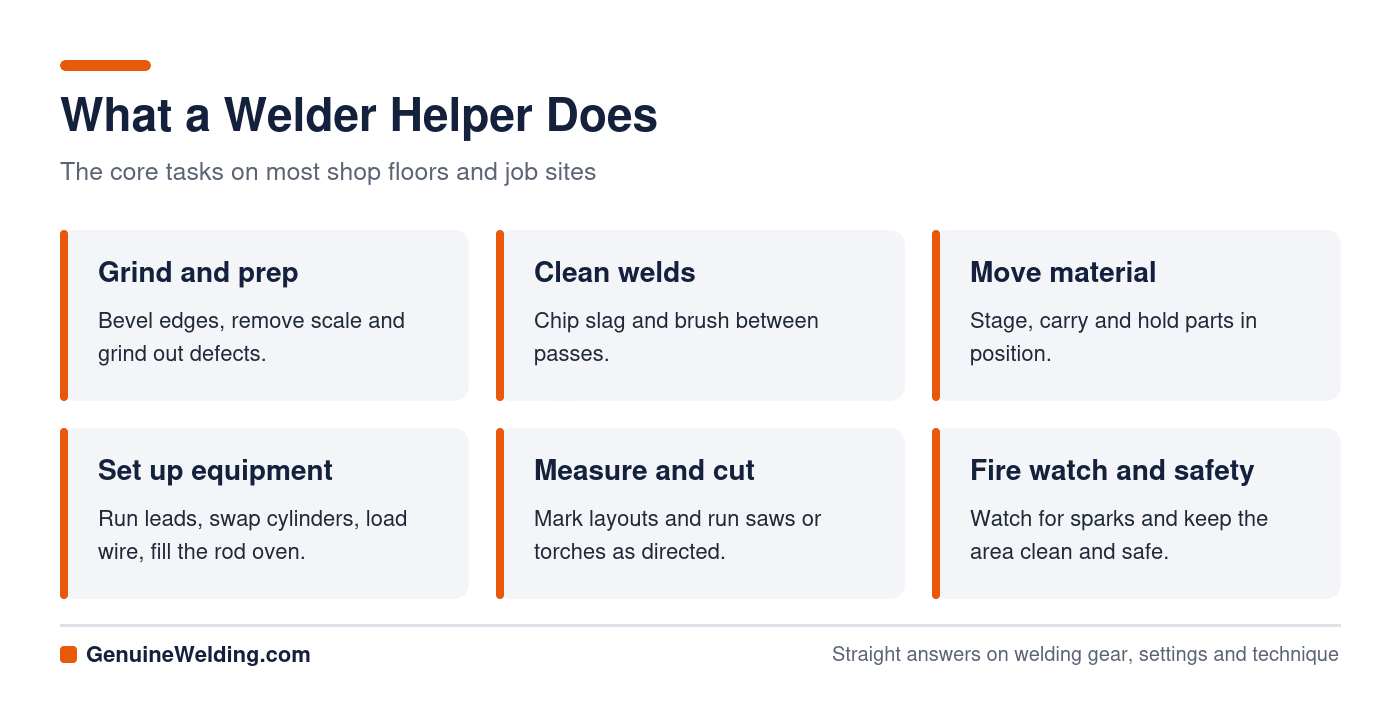
What Does a Welder Helper Do?
Duties depend on whether you work in a fabrication shop, on a construction site or on a pipeline, but most helpers:
- Grind and prep: bevel edges, remove mill scale and rust, and grind out defects
- Clean welds: chip slag and wire brush between passes
- Move and fit material: carry, stage and hold parts in position; help with clamps and fixtures
- Set up equipment: run leads, change gas cylinders, load wire and keep rods in the oven
- Measure and mark: lay out cuts and holes with tape, square and soapstone
- Cut: run saws, plasma cutters or torches under supervision
- Fire watch: watch for sparks and fires during and after hot work
- Keep the area safe and clean: sweep, organize tools and remove trip hazards
On pipelines, a helper usually works for one welder (often a rig welder), grinding bevels and passes, cleaning, and keeping the rig and tools ready. See our pipeline welder guide for how spreads work.
Welder Helper Pay
The BLS doesn’t publish a separate figure for welder helpers, but they fall under helpers in production work, whose median was $39,070 a year ($18.78 an hour) in May 2025. The top 10% earned more than $53,410. Helpers on construction sites, union jobs and pipelines often earn more, especially with overtime and per diem on travel work.
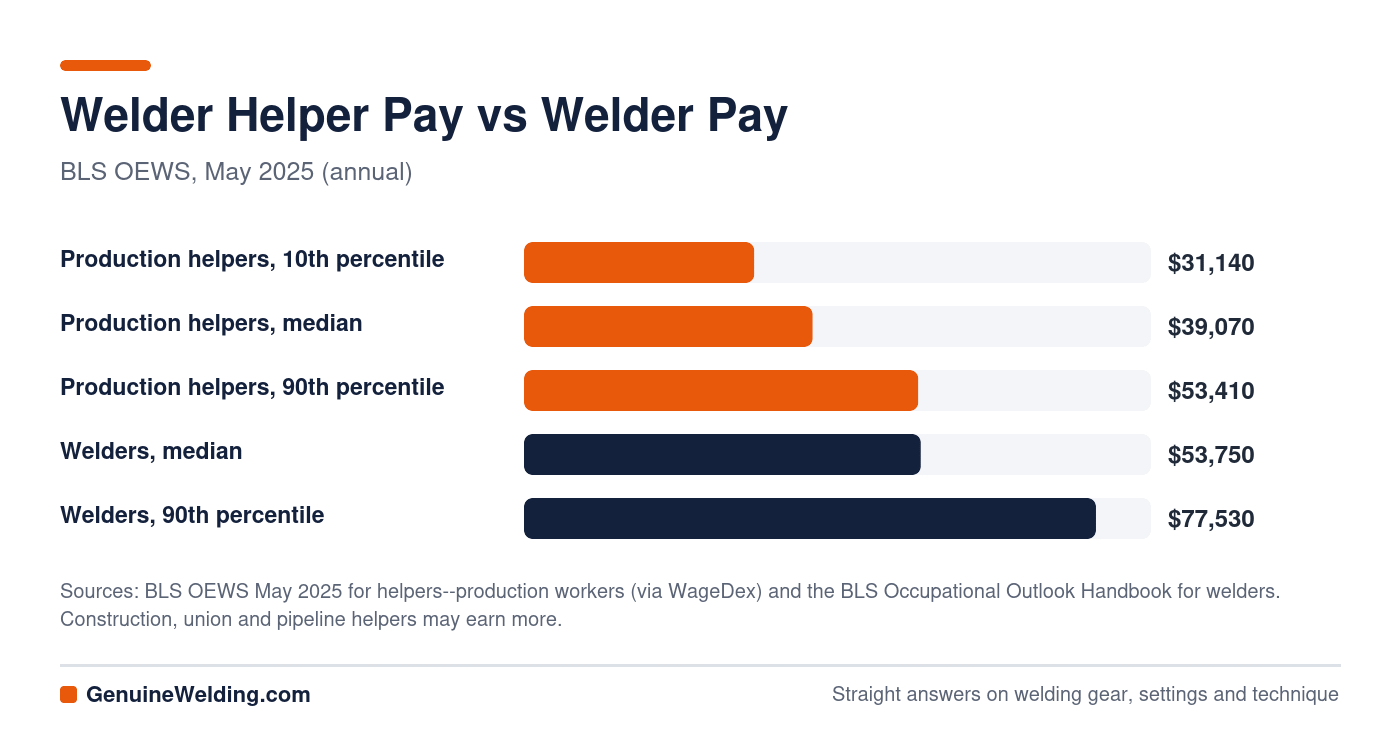
The real payoff is the jump to welder: the median welder earned $53,750 in May 2025. See how much welders make.
Requirements to Become a Welder Helper
- Usually 18 or older; many employers prefer a high school diploma or GED
- Ability to lift heavy material and work in heat, cold and noise
- Steel-toe boots and basic PPE (some employers provide more)
- A drug screen, and often a valid driver’s license
- OSHA 10 safety training is a plus, and required on some sites
- Reliability: showing up on time every day matters more than anything else
No welding certificate is needed, but basic welding or grinder experience helps you stand out.
Skills That Make a Great Helper
- Safe, confident use of angle grinders, flap discs and cut-off wheels. See essential welding tools.
- Understanding of welding PPE and hot-work safety
- Basic measuring and layout
- Staying a step ahead: having the next rod, part or tool ready before it’s asked for
- Willingness to learn and take feedback
How to Move Up From Welder Helper to Welder
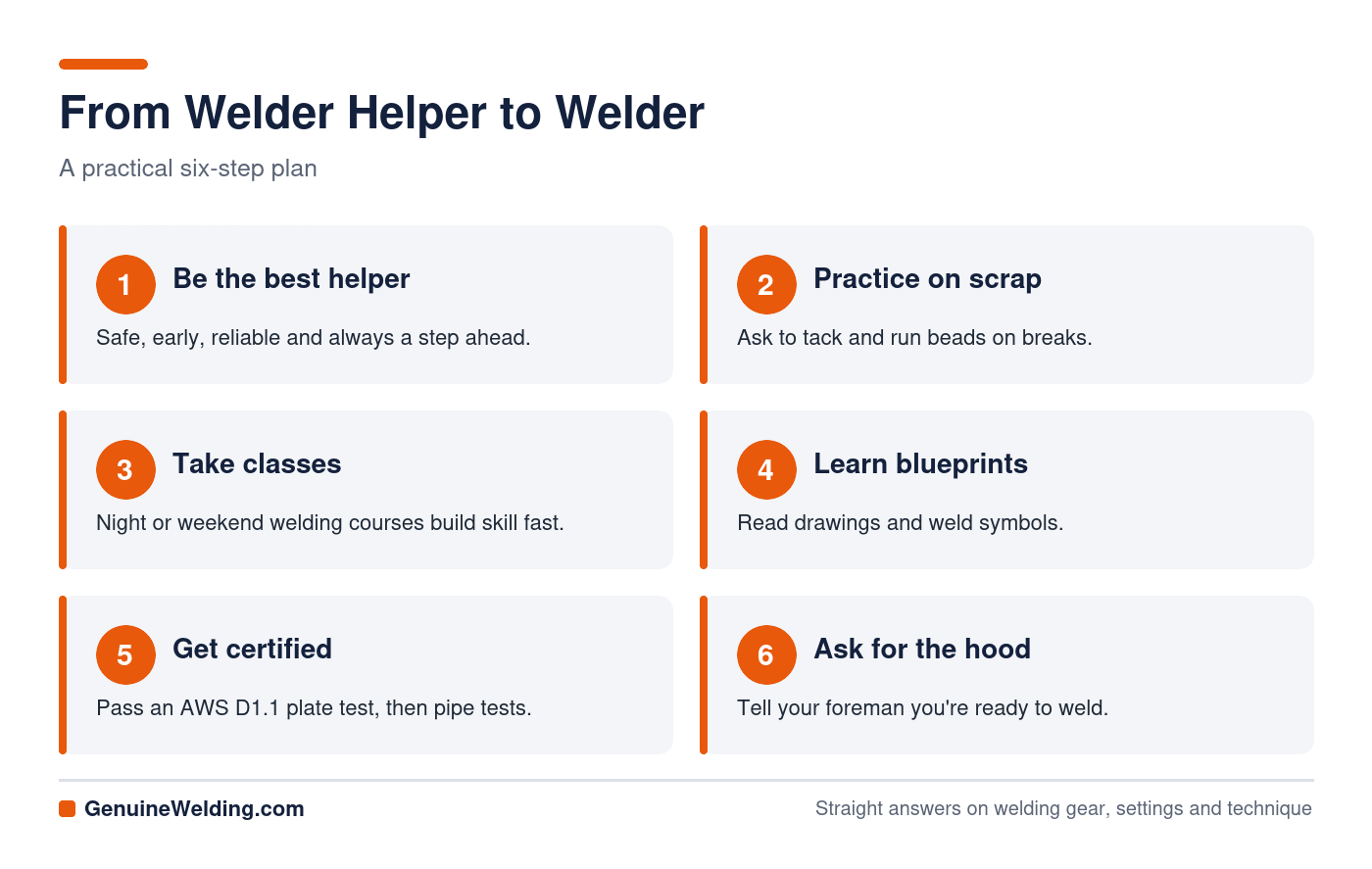
- Ask to tack and practice. Many welders will let a good helper practice on scrap at lunch or after shift.
- Take night or weekend classes at a community college or welding school. See how to become a welder.
- Get certified. Pass an AWS D1.1 plate test, then work toward pipe tests such as the 6G. Read our certifications guide.
- Learn blueprint reading and welding symbols.
- Join an apprenticeship. Union apprenticeships (UA, Boilermakers, Ironworkers) pay you while you learn.
- Build a reputation. Foremen promote helpers who are safe, reliable and eager.
Pros and Cons of Being a Welder Helper
| Pros | Cons |
|---|---|
| Get paid while you learn the trade | Lower pay than certified welders |
| No welding certification required | Physically demanding, repetitive grinding |
| Learn from experienced welders on real jobs | Exposure to noise, heat, fumes and sparks |
| Clear path to welder, fitter or fabricator | Progress depends on effort and mentors |
Welder Helper FAQs
Do welder helpers weld?
Sometimes. Helpers often tack, run simple welds or practice when allowed, but production welding is usually done by certified welders.
How long do you have to be a welder helper?
It varies. Motivated helpers who train and pass a weld test often move up within six months to two years.
Do I need experience to be a welder helper?
No. It’s an entry-level role. Some grinder or shop experience helps, along with basic safety knowledge.
What tools does a welder helper need?
Usually steel-toe boots, safety glasses, gloves and hearing protection. On pipelines, helpers often bring their own grinders, brushes and hand tools.
Is welder helper a good job?
As a first step, yes. It’s the most direct, paid route into welding, especially if you use the time to practice and get certified.
Sources
- WageDex (BLS OEWS May 2025): Helpers – Production Workers
- BLS: Welders, Cutters, Solderers, and Brazers
- OSHA: Welding, Cutting and Brazing


