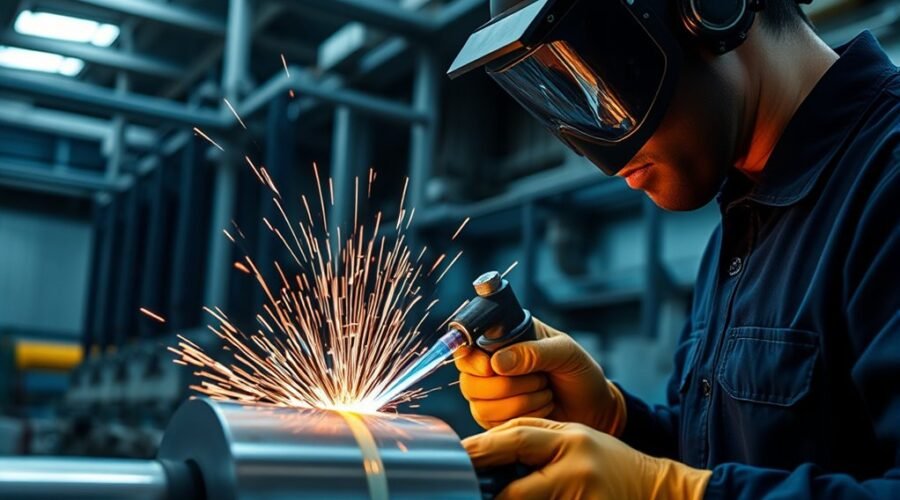
Spray welding is commonly used as a shop term for several surface-coating processes that rebuild worn parts or add wear, corrosion, friction, or thermal protection. Most of these processes are more precisely called thermal spraying: a wire or powder is heated or softened, accelerated toward a prepared surface, and built up in layers. The exact process matters because arc spray, flame spray, plasma spray, HVOF, cold spray, and spray-and-fuse do not create coatings in the same way.
Quick Answer
Spray welding usually refers to thermal spray coating: wire or powder is heated or accelerated, then projected onto a prepared surface to build a protective or restorative layer. Arc spray, flame spray, plasma spray, HVOF, and cold spray use different energy and particle-velocity systems. Spray-and-fuse is different because the deposited coating is later fused to the substrate.
Key Takeaways
- Most “spray welding” applications are coating or dimensional-restoration processes rather than conventional fusion welding.
- Arc spray, flame spray, plasma spray, HVOF, cold spray, and spray-and-fuse have different heat sources, feedstocks, coating properties, and limitations.
- Conventional thermal-spray coatings usually bond mainly through mechanical interlocking with a clean, roughened surface.
- There is no universal coating thickness, amperage, standoff distance, or gas setting that applies to every thermal-spray system.
- Surface preparation, masking, process control, inspection, and finishing are as important as the spray gun itself.
- Thermal spraying can generate hot particles, fumes, dust, intense light, noise, combustible-gas hazards, or high-pressure-gas hazards, so trained operators and process-specific safety controls are essential.
What Is Spray Welding?
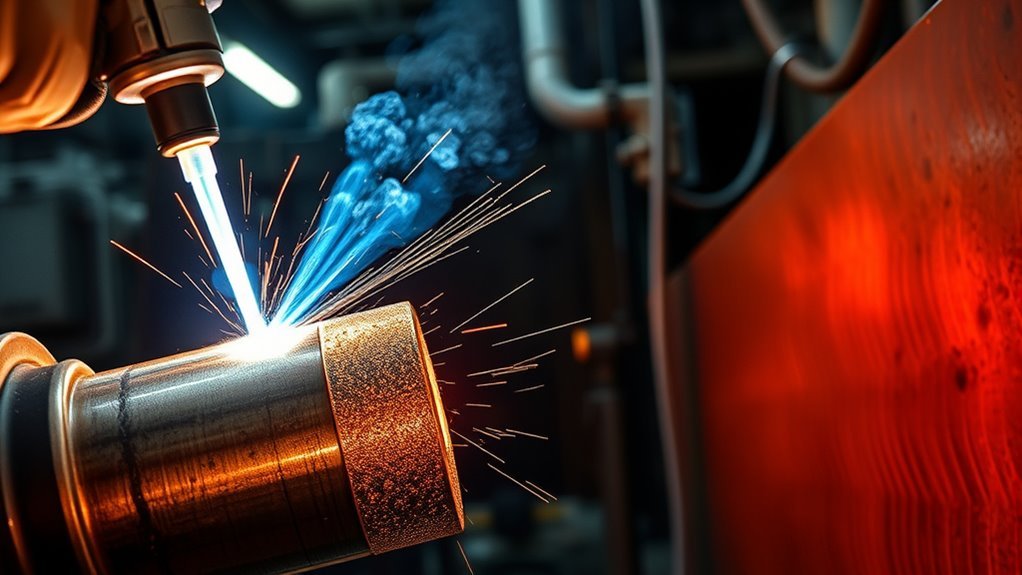
In industrial surface engineering, the term spray welding is often used loosely for processes that deposit metal or other coating materials onto an existing component. A more precise umbrella term is thermal spraying.
In conventional thermal spraying, wire or powder feedstock is heated until molten or sufficiently softened, accelerated toward the workpiece, and deposited as many overlapping particles. The particles flatten on impact and build a coating. The base component normally does not have to melt.
The bond in a conventional thermal-spray coating is primarily mechanical, so surface cleanliness and roughness are critical. This differs from spray-and-fuse, in which a sprayed self-fluxing alloy is subsequently heated enough to fuse the coating and create a metallurgical bond with the substrate.
Note: “Spray welding” is not the same thing as spray-transfer MIG/GMAW. Spray transfer describes how molten filler droplets cross a welding arc during gas metal arc welding, while thermal spraying deposits a coating onto an existing surface.
Thermal spray is used to restore dimensions, improve wear resistance, reduce corrosion, change friction, add electrical or thermal properties, or apply a high-performance surface material over a lower-cost substrate. Coating thickness is application-specific and can range from relatively thin protective layers to much thicker rebuild coatings.
For a broader introduction to joining methods outside surface coating, see this overview of welding processes.
How Spray Welding Equipment Works
Spray equipment changes according to the process, but most systems control four basic functions: feedstock delivery, energy input, particle acceleration, and gun movement relative to the workpiece.
- Feedstock delivery: wire, powder, or another suitable coating material is fed into the spray gun.
- Energy source: a flame, electric arc, plasma jet, combustion chamber, or heated carrier gas provides the energy required by the process.
- Particle acceleration: compressed air, process gas, combustion gas, or another high-velocity gas stream carries the particles toward the substrate.
- Gun movement: standoff distance, traverse speed, angle, overlap, and number of passes affect coating uniformity.
- Process control: feed rate, electrical settings, fuel/oxygen ratio, gas pressure, cooling, and other parameters are set according to the specific gun, material, and qualified procedure.
The spray gun should not be treated as a generic welding torch. Settings that work for one coating material or one gun model may produce poor adhesion, excessive oxidation, overheating, or high porosity on another system.
Pro Tip: Use the coating-material data sheet and the spray-equipment manufacturer’s procedure as the starting point for voltage, current, gas flow, feed rate, standoff, traverse speed, and cooling. Avoid copying a single set of online parameters to a different gun or powder.
A compressed-air source may be part of some arc- or flame-spray systems, but it should not be confused with cutting equipment. If you are building a mobile fabrication setup, plasma cutters with built-in air compressors are a separate equipment category.
Spray Welding Process Comparison
| Process | How It Works | Common Strength | Main Limitation |
|---|---|---|---|
| Arc spray | An electric arc melts two conductive wires; compressed gas atomizes and propels the metal. | High deposition rate and good portability for metallic coatings. | Feedstock must be conductive wire; arc light, ozone, fume, and oxidation require control. |
| Flame spray | An oxygen/fuel flame heats wire or powder and a gas stream projects it onto the part. | Relatively simple, portable, and economical equipment. | Generally lower particle velocity, with more porosity and oxidation than higher-velocity processes. |
| Plasma spray | A plasma jet heats powder and accelerates it toward the substrate. | Can process high-melting-point materials such as many ceramics. | Higher equipment cost and process complexity; usually a controlled, automated operation. |
| HVOF | Fuel and oxygen burn in a chamber to create a high-velocity gas stream that accelerates powder. | Dense, strongly bonded wear- and corrosion-resistant coatings. | Higher equipment cost, noise, fuel/oxygen requirements, and tighter process control. |
| Cold spray | High-pressure carrier gas accelerates solid powder particles to very high speed so they bond through plastic deformation. | Minimal thermal effect and low oxidation for suitable ductile materials. | Material suitability and deposition behavior depend heavily on particle properties and gas conditions. |
| Spray-and-fuse | A self-fluxing alloy is sprayed and then reheated until the layer fuses to the substrate. | Dense, metallurgically bonded wear-resistant layer. | Higher heat input can distort or alter heat-sensitive components. |
The best process is selected from the coating material, required hardness or corrosion performance, acceptable heat input, component size and geometry, desired coating thickness, required finish, production rate, and total cost. TWI’s comparison of thermal-spray processes also emphasizes the major differences in heat source and particle velocity.
Arc Spray Welding for Metal Coatings
Arc spray, also called twin-wire arc spray or electric-arc wire spray, uses two continuously fed conductive wires. The wires have opposing electrical polarity, creating an arc between their tips. The arc melts the wire ends and compressed gas atomizes the molten metal and propels it toward the prepared workpiece.
Oerlikon Metco’s arc-spray description identifies electricity and compressed air as the core utilities and lists corrosion protection, wear resistance, and dimensional restoration among typical uses.
Common arc-spray materials include aluminum, zinc, copper, steels, nickel alloys, and other materials available as suitable conductive wire. The relatively low heat transferred to the substrate can make arc spray useful for large structures and components where excessive distortion must be avoided.
Arc Spray Setup
There is no universal amperage threshold, “Shift Level,” or single spray distance that applies to all arc-spray equipment. Setup should follow the gun manufacturer’s operating window and the coating procedure.
- Match the wire chemistry and diameter to the gun and coating specification.
- Set wire-feed speed, voltage/current, and atomizing-gas flow within the approved range.
- Keep the gun orientation and standoff consistent unless the procedure calls for a deliberate change.
- Use smooth traverse speed and overlapping passes to control thickness.
- Keep nozzles and wire paths clean and correctly aligned.
- Monitor the substrate temperature when heat-sensitive parts are being coated.
Coating roughness and final surface finish depend on wire chemistry, atomization, particle size, gun setup, spray distance, and post-spray finishing. A single micro-inch range should not be treated as a universal arc-spray specification.
Arc Spray Benefits
Arc spray is valued for high deposition productivity, portability, and relatively economical metallic coatings. Compared with basic flame spraying, it can provide higher spray rates and stronger coatings for many metallic applications.
Typical uses include corrosion-protection metallizing, restoration of worn dimensions, bond coats, large structural work, rolls, bearing surfaces, and industrial components.
The tradeoff is that arc spraying is limited to suitable conductive wire feedstocks and can generate arc radiation, ozone, fume, noise, and overspray. Proper ventilation, guarding, eye/face protection, hearing protection, and material-specific exposure controls are important.
If you are also equipping a fabrication shop, this separate list of gifts and workshop accessories for welders covers general shop items rather than thermal-spray parameters.
Flame Spraying for On-Site Repairs
Flame spraying uses the combustion of oxygen with a fuel such as acetylene, propane, propylene, or hydrogen to heat wire or powder feedstock. A gas stream then carries the heated material toward the substrate.
The process is attractive for field work because equipment can be relatively simple and portable. It is commonly used where a low-cost coating system, repair capability, or moderate deposition rate is more important than obtaining the densest possible coating.
- Equipment can be practical for shop or on-site use.
- Wire and powder versions are available.
- Many metallic and some nonmetallic coating materials can be processed with suitable equipment.
- Heat transferred to the component is generally lower than in a conventional fusion-welding buildup.
- The process is useful for dimensional restoration and protective coatings.
Compared with higher-velocity processes such as HVOF, ordinary flame-sprayed coatings generally have lower bond strength and greater porosity or oxide content. That does not make flame spray unsuitable; it means process choice should match the actual service condition.
No universal 350–450°C process temperature or 60%–95% deposition efficiency should be applied to every flame-spray system. Those values depend on the coating material, gun design, fuel, feed rate, operating settings, and how efficiency is measured.
For a repair shop that also performs cutting, budget plasma cutters are a separate equipment decision; features on a plasma cutter do not substitute for flame-spray safety or process control.
How HVOF Improves Wear Resistance
High Velocity Oxy-Fuel (HVOF) spraying burns a liquid or gaseous fuel with oxygen in a combustion chamber. The expanding combustion gases accelerate through the gun at very high velocity and carry powder particles toward the workpiece.
High particle velocity promotes strong mechanical interlocking and produces coatings that are generally dense and low in porosity. HVOF is widely used for hard, wear-resistant and corrosion-resistant coatings where conventional flame or arc spraying may not provide the required density or performance.
Typical HVOF materials include tungsten-carbide-based cermets, chromium-carbide systems, nickel-based alloys, and other engineered powders. The correct material depends on whether the dominant failure mode is abrasion, erosion, sliding wear, fretting, corrosion, or a combination of these.
Exact porosity, hardness, bond strength, spray distance, and coating thickness are not universal HVOF numbers. They depend on the gun, fuel, powder chemistry and size distribution, substrate, surface preparation, and qualified spray procedure.
HVOF can greatly improve component durability when the coating system is correctly matched to the service environment, but a blanket promise such as “75% longer component life” is not technically defensible for every application.
A multi-process MIG/TIG/Stick welder is useful for general fabrication, but it is not an HVOF coating system and should not be treated as interchangeable equipment.
Plasma Spray for High-Temperature Materials
Plasma spraying uses an electric arc to ionize process gas and create a very hot plasma jet. Powder is injected into the jet, heated, and accelerated toward the substrate.
The high available energy makes plasma spray particularly useful for materials with high melting points, including many ceramics used for wear resistance, electrical insulation, and thermal-barrier applications.
Its limitations are mainly equipment investment, process complexity, line-of-sight access, wear of torch components, and the possibility of oxidation or material decomposition when sensitive powders are sprayed in air. TWI lists these among the principal limitations of plasma spraying.
Cold Spray and Other Spray Welding Methods
Cold spray is different from conventional thermal spraying because the coating particles are not intentionally melted. A high-pressure carrier gas accelerates fine powder particles to very high, often supersonic, velocity. Suitable particles plastically deform when they hit the surface and bond through a solid-state mechanism.
Because the process avoids bulk melting of the feedstock, cold spray can reduce oxidation and thermal damage and can preserve properties that would be changed by a high-temperature spray process. It is particularly useful with suitable ductile metallic powders and in repair or additive-deposition applications where heat input must be minimized.
Cold spray does not use a universal 180–440 amp arc setting or a standard “85% argon shielding gas” recipe. Gas type, pressure, temperature, nozzle geometry, particle size, powder properties, and critical impact velocity are among the important variables.
Cold spray is a solid-state deposition process: coating particles bond primarily through high-velocity impact and plastic deformation rather than being melted in a welding arc.
Several processes are sometimes mentioned near spray welding but should not be classified as thermal-spray methods:
- Thermite welding is a high-temperature chemical joining process.
- Laser welding uses a focused laser beam to create a joint or weld deposit.
- Friction welding creates a solid-state joint through frictional or mechanical energy.
- Resistance welding uses electrical resistance heating at the joint.
- Cold spray is a coating or deposition process rather than one of those fusion-joining methods.
If you are learning conventional MIG, TIG, or Stick welding, this guide to beginner welding machines covers a different equipment category from cold-spray systems.
Spray-and-Fuse: When the Coating Is Metallurgically Bonded
Spray-and-fuse deserves separate treatment because it is closer to what many people imagine when they hear “spray welding.” A self-fluxing alloy, often nickel- or cobalt-based, is first deposited by spraying. The coating is then reheated until it flows and fuses with the substrate surface.
This second heating stage can reduce porosity and create a metallurgical bond. It is useful for wear-resistant hardfacing and dense overlays on suitable components.
The tradeoff is heat. Fusing occurs at much higher component temperatures than ordinary thermal spraying, so distortion, cracking, loss of heat treatment, dimensional movement, or metallurgical changes can become important. The substrate and alloy therefore must be suitable for the complete spray-and-fuse cycle.
How to Choose the Right Spray Process
Process selection should begin with the failure mode and service environment rather than with whichever spray gun is already available.
- For large-area metallic corrosion protection: arc spray is often a strong candidate.
- For portable, economical repair work: flame spray may be suitable.
- For high-melting-point ceramics: plasma spray is often considered.
- For dense carbide or alloy wear coatings: HVOF is commonly used.
- For heat-sensitive parts or oxidation-sensitive deposition: cold spray may offer advantages when the material is suitable.
- For a dense, metallurgically bonded self-fluxing overlay: spray-and-fuse may be appropriate if the component tolerates the heat cycle.
Geometry also matters. Thermal spray is fundamentally a line-of-sight process, so deep recesses, narrow bores, sharp shadowed areas, and complex internal surfaces may require special guns, extensions, rotation, masking, or another repair method.
Spray Welding Applications and Surface Prep
Surface preparation is one of the most important steps in a successful spray coating. Conventional thermal-spray layers rely heavily on mechanical interlocking, so oil, grease, corrosion, oxide, moisture, blasting residue, or an inadequate surface profile can sharply reduce adhesion.
Surface Preparation Methods
A typical preparation sequence includes:
- Inspecting the part for cracks, damage, previous coatings, and areas that must not be sprayed.
- Removing oil and grease before abrasive blasting so contaminants are not driven into the surface.
- Masking threads, seal lands, holes, mating surfaces, and other areas where coating is not permitted.
- Abrasive blasting or machining to produce a clean, suitably rough surface for mechanical anchoring.
- Removing residual abrasive and dust without recontaminating the prepared surface.
- Spraying promptly before rust bloom, moisture, fingerprints, or airborne contamination degrade the surface.
Laser cleaning or other specialized preparation methods can be appropriate in selected applications, but the preparation method must still produce the cleanliness and surface condition required by the coating procedure.
There is no universal 0.002–0.025 inch thickness requirement for all spray coatings. Thickness is specified according to coating material, process, service load, available dimensional allowance, required finishing, and the manufacturer’s or engineer’s coating specification.
Good fixturing can help maintain gun access and part alignment, but even a rigid welding table does not replace proper cleaning, masking, abrasive preparation, or process control.
Industrial Repair Applications
Industrial repair is one of the strongest uses for thermal spraying because a worn surface can sometimes be rebuilt without replacing the entire component.
Common applications include:
- shaft and bearing-journal restoration;
- pump and compressor components;
- rolls and traction surfaces;
- seal areas and sleeves;
- corrosion-protection coatings on steel;
- wear-resistant surfaces on industrial machinery;
- turbine, engine, and power-generation components;
- electrical, thermal-barrier, or friction-control coatings.
The coating material should be selected for the actual wear or corrosion mechanism rather than simply for maximum hardness. A very hard coating may perform poorly if the service condition instead demands toughness, impact resistance, ductility, low friction, or compatibility with a corrosive environment.
Post-Spray Machining and Finishing
Many coatings are intentionally sprayed oversize and then ground or machined to the finished dimension. The correct finishing method depends on coating hardness, brittleness, thickness, and bond strength.
- Use the cutting or grinding method recommended for the coating material.
- Avoid aggressive cuts that can chip or lift a brittle coating.
- Support thin or flexible components to prevent vibration.
- Control heat during grinding so the coating and substrate are not overheated.
- Measure the final dimension and surface finish after processing.
- Use an approved sealer when the coating specification requires sealing of residual porosity.
Quality Control and Troubleshooting
A coating can look acceptable and still fail early if adhesion, thickness, porosity, contamination, or finishing is wrong. Production work should follow a documented coating procedure and the inspection requirements specified for the job.
Common quality checks include visual inspection, thickness measurement, surface-finish measurement, adhesion testing where specified, evaluation of porosity or microstructure for critical coatings, and confirmation that masking and finished dimensions meet the drawing.
| Problem | Possible Causes | Corrective Direction |
|---|---|---|
| Poor adhesion or delamination | Oil, oxide, moisture, insufficient roughness, contaminated blasting media, incorrect spray conditions. | Correct preparation, verify surface profile and cleanliness, then re-establish qualified spray parameters. |
| High porosity or oxidation | Process/material mismatch, excessive air exposure, poor atomization, incorrect gas or feed settings. | Confirm material choice and approved gun settings; consider a higher-velocity or better-shielded process if required. |
| Uneven coating thickness | Changing standoff, inconsistent traverse speed, irregular overlap, unstable feed rate. | Stabilize gun motion, feed rate, part rotation, and pass overlap. |
| Rough finished surface | Normal as-sprayed texture, large particles, unsuitable atomization, insufficient finishing allowance. | Use the specified powder/wire and finish by appropriate grinding or machining where required. |
| Substrate distortion or overheating | Excessive dwell, insufficient cooling, overly concentrated heat input, inappropriate process. | Reduce dwell, improve cooling and gun motion, monitor temperature, or select a lower-heat process. |
Spray Welding Safety
Warning: Thermal spraying is an industrial process that can expose operators to hot particles, metal fumes and dust, intense arc or flame radiation, high noise, fuel and oxygen hazards, and high-pressure gases. Do not operate spray equipment without training, the equipment manual, material safety information, ventilation controls, and PPE selected for the specific process and coating material.
Arc spray can produce arc light, ozone, and metal fume. Flame and HVOF systems introduce fuel/oxygen combustion hazards. Plasma systems use high electrical power and extremely hot process gas. Cold spray avoids an ignition source in the deposition mechanism but operates with high-pressure gas and high particle velocity.
Basic controls may include:
- local exhaust ventilation or an engineered spray booth;
- respiratory protection when required by the hazard assessment and exposure limits;
- appropriate eye and face protection for the radiation and particle hazard;
- hearing protection;
- gloves and protective clothing suitable for hot particles and the process;
- correct storage and handling of oxygen, fuel gases, and compressed-gas cylinders;
- dust collection designed for the specific sprayed material;
- keeping combustible materials outside the spray area;
- reviewing the coating-material safety data sheet before spraying;
- following confined-space procedures when applicable.
NIOSH’s guidance on welding, brazing, and thermal-process hazards emphasizes reducing hazardous emissions through engineering controls and work practices. The exact controls for thermal spraying should also follow the spray-equipment manufacturer and the coating material’s safety documentation.
Frequently Asked Questions
What are the different types of spray coating processes?
Major thermal-spray processes include flame spraying, twin-wire arc spraying, plasma spraying, HVOF, and detonation spraying. Cold spray is a related solid-state deposition process that accelerates particles without intentionally melting them. Spray-and-fuse adds a second heating step that fuses a self-fluxing coating to the substrate.
What is spray welding used for?
Spray welding and thermal spraying are used for dimensional restoration, wear resistance, corrosion protection, friction control, thermal barriers, electrical insulation or conductivity, and other engineered surface properties. Typical components include shafts, bearing journals, rolls, pumps, compressors, engine parts, turbines, and steel structures.
What are the downsides of plasma spray coating?
Plasma spray equipment is generally more expensive and complex than basic arc or flame systems. The process is line-of-sight, torch components wear, and sensitive materials can oxidize or decompose when sprayed in air. Its major advantage is the ability to process many high-melting-point materials, including ceramics.
What two metals cannot be welded together?
There is no universal pair of metals that can simply be declared impossible to join. Some combinations are very difficult because they form brittle intermetallic compounds or have very different melting points and thermal properties. Copper and aluminum are challenging, for example, but they can be joined with specialized processes such as carefully controlled laser welding, friction-based methods, ultrasonic welding, or suitable transition designs.
Does thermal spray melt the base metal?
Conventional thermal spraying normally does not melt the bulk substrate. Heated or softened coating particles impact a prepared surface and bond mainly through mechanical interlocking. Spray-and-fuse is an important exception because the deposited alloy and the substrate surface are reheated to create a metallurgical bond.
Is spray welding the same as MIG spray transfer?
No. Thermal spray or “spray welding” deposits a coating onto a surface. MIG spray transfer is a gas metal arc welding transfer mode in which small molten filler-metal droplets cross the welding arc into a weld pool. The equipment, purpose, bonding mechanism, and operating parameters are different.
Conclusion
Spray welding is best understood as a family of surface-engineering techniques rather than one universal welding process. Arc spray, flame spray, plasma spray, HVOF, cold spray, and spray-and-fuse each solve different problems and create coatings through different combinations of heat, particle velocity, and bonding mechanisms.
The most reliable results come from matching the process and coating material to the actual failure mode, preparing the substrate correctly, following qualified equipment parameters, controlling heat and gun movement, and inspecting the finished layer. With those fundamentals in place, thermal spraying can restore valuable components, improve wear and corrosion performance, and apply specialized surface properties without replacing the entire part.
Sources
- TWI — What Is Thermal Spraying? — thermal-spray principles, coating bonding, process types, applications, and cold spray.
- TWI — Difference Between Thermal Spray Processes — flame, arc, plasma, HVOF, and process characteristics.
- Oerlikon Metco — Electric Arc Wire Spray — twin-wire arc operation, opposing polarity, compressed-air atomization, and applications.
- TWI — Disadvantages of Plasma Spraying — equipment cost, line-of-sight limitations, torch wear, oxidation, and material considerations.
- NIOSH — Welding, Brazing, and Thermal Cutting — occupational exposure, ventilation, engineering controls, and hot-process safety guidance.