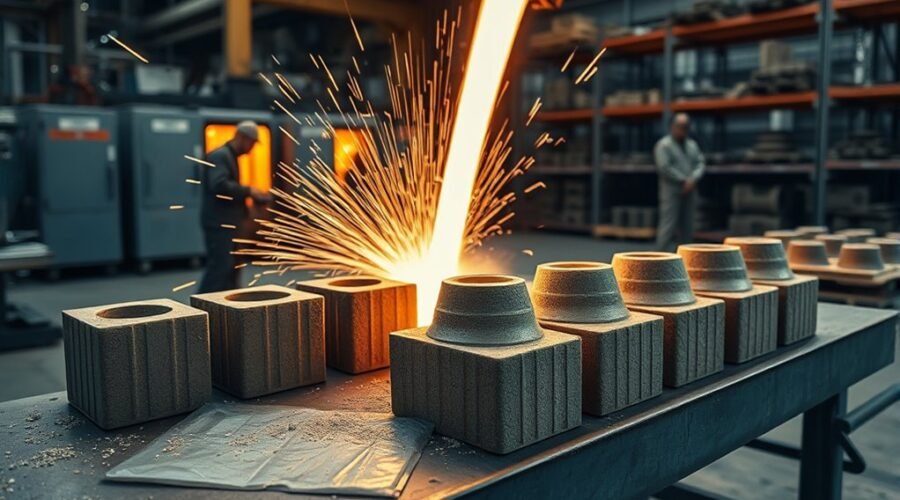
Metal casting is a manufacturing process used to make metal parts by filling a shaped mold with molten metal, allowing the metal to solidify, and then removing and finishing the casting. Methods range from simple sand molds to high-pressure reusable dies. The best process depends on the alloy, part geometry, production quantity, required accuracy, surface finish, cost, and safety requirements.
Quick Answer
Metal casting forms parts by pouring or forcing molten metal into a shaped mold, allowing it to solidify, then removing and finishing the casting. Common methods include sand, investment, die, permanent-mold, centrifugal, and plaster-mold casting. Process choice depends on alloy, geometry, quantity, tolerance, surface finish, cost, and safety requirements.
Key Takeaways
- Metal casting turns molten metal into a shaped solid by filling a mold and allowing the metal to cool and solidify.
- Common methods include sand casting, investment casting, die casting, permanent-mold casting, centrifugal casting, plaster-mold casting, shell molding, and lost-foam casting.
- Typical stages include pattern and mold preparation, melting, pouring or injection, solidification, shakeout or removal, cleaning, finishing, and inspection.
- Aluminum, cast iron, steel, copper-base alloys, zinc, and magnesium are widely cast, but not every process suits every alloy.
- Gates, runners, risers, vents, cores, draft, and shrinkage allowances help the mold fill correctly and produce the intended geometry.
- Molten-metal work requires trained operators, dry tools and charge materials, suitable PPE, ventilation, clear work areas, and a fire-response plan matched to the actual hazards.
What Is Metal Casting?
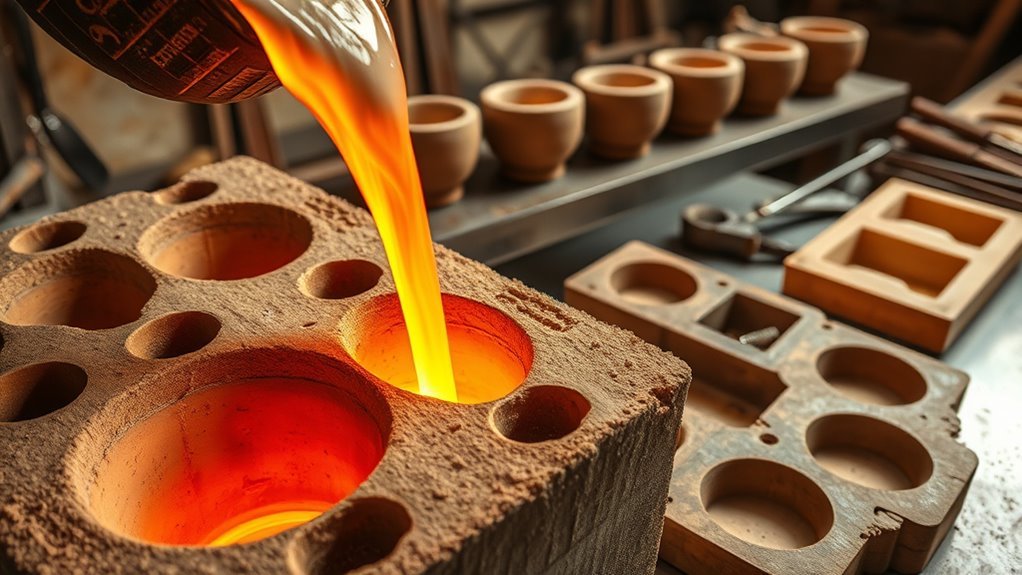
Metal casting is a foundational manufacturing process in which liquid metal fills a mold cavity and then solidifies into the mold’s shape. A casting may be a small decorative object, a machine housing, a pump component, an automotive part, or a much larger industrial component. Stanford University’s Product Realization Lab summarizes the basic sequence as creating a mold cavity, pouring molten metal, cooling it, and removing the finished part.
Casting has been practiced for thousands of years. Archaeological research published by The Metropolitan Museum of Art traces lost-wax casting into the fifth millennium BCE, showing how long mold-based metal forming has been part of human manufacturing.
One reason casting remains important is that it can create external and internal shapes that would be difficult, wasteful, or expensive to machine from solid stock. Depending on the process, a casting can range from a rough near-net blank requiring substantial machining to a highly detailed part requiring relatively little secondary work.
Casting systems are often divided into expendable-mold processes and reusable-mold processes. Sand, plaster, investment, shell, and lost-foam methods normally sacrifice the mold or pattern system during production. Permanent-mold and die-casting processes use durable molds for repeated cycles.
Common Metal Casting Methods
Metal casting methods differ in mold material, tooling cost, production rate, usable alloys, dimensional accuracy, surface finish, and part size. No single process is best for every part.
| Process | Mold / Method | Typical Strengths | Main Limitations |
|---|---|---|---|
| Sand casting | Expendable sand mold formed around a pattern | Wide size range, many alloys, relatively low tooling cost | Usually rougher finish and looser tolerances than precision processes |
| Investment casting | Sacrificial pattern, commonly wax, surrounded by refractory investment or ceramic shell | Complex geometry, fine detail, good finish, reduced machining for suitable parts | More process steps and generally higher processing cost than simple sand molding |
| Die casting | Liquid metal injected under pressure into a reusable steel die | Fast production, repeatability, thin sections, good detail and finish | High tooling cost and alloy/process limitations |
| Permanent-mold casting | Reusable metal or graphite mold, often gravity filled | Good repeatability and faster mold reuse than expendable molds | Higher tooling investment and less freedom for some complex shapes |
| Centrifugal casting | Rotating mold uses centrifugal force to distribute metal | Well suited to pipes, sleeves, rings, and other hollow cylindrical parts | Geometry is more restricted than general-purpose mold casting |
| Plaster-mold casting | Expendable plaster-based mold | Fine detail and good surface finish for suitable nonferrous alloys | Mold strength and temperature resistance limit applications |
| Shell molding | Thin resin-bonded sand shell formed around a heated pattern | Better dimensional control and finish than many conventional sand molds | Higher tooling and material cost than basic sand molding |
| Lost-foam casting | Foam pattern remains in the mold and is displaced as metal enters | Can produce complex shapes with fewer conventional parting features | Pattern quality and gas management are important to consistency |
Sand Casting
Sand casting forms a mold around a pattern and then removes the pattern to leave a cavity. Traditional green sand commonly combines sand, clay or bentonite, and moisture, but not all sand-casting systems use that formulation. Oil-bonded and chemically bonded sands are also used.
Sand molds can accommodate relatively large parts and many ferrous and nonferrous alloys. Their main tradeoff is that the as-cast surface and dimensional accuracy are normally less refined than die casting or investment casting, so machining allowances may be required on critical surfaces.
Investment Casting
Investment casting, also called lost-wax casting, starts with a sacrificial pattern. A refractory material or ceramic shell is built around that pattern, the pattern is removed, and metal fills the resulting cavity. The process is useful for intricate geometry and fine surface detail.
Investment casting can produce near-net shapes that reduce machining on suitable components, but it should not automatically be described as a zero-waste or low-waste process. Pattern systems, ceramic materials, gates, runners, and finishing operations still consume material and energy.
Die Casting
According to the North American Die Casting Association, die casting injects liquid metal under high pressure into a reusable steel die. Common alloy families include aluminum, zinc, magnesium, and copper.
Die casting is especially attractive when production volume is high enough to justify expensive tooling. It can provide fast cycle times, repeatable dimensions, detailed features, and good surface finish.
Centrifugal and Plaster-Mold Casting
Centrifugal casting rotates the mold while the metal is liquid. Centrifugal force drives metal toward the mold wall, making the process particularly useful for hollow cylindrical components such as pipes, sleeves, and rings. Lower-density inclusions can migrate toward the inner surface, which may later be machined, but centrifugal casting does not eliminate every possible defect.
Plaster-mold casting uses an expendable plaster-based mold and is mainly associated with suitable lower-temperature nonferrous alloys. It can reproduce fine detail and smooth surfaces, but the mold material has lower temperature capability and durability than many refractory or metallic mold systems.
How the Metal Casting Process Works
The exact workflow differs by process, but most casting operations follow the same broad sequence: design the part and mold system, prepare a cavity, melt and condition the alloy, fill the mold, allow controlled solidification, remove the casting, clean and finish it, then inspect it.
Pattern And Mold Creation
Patternmaking defines the geometry from which the mold cavity is produced. Patterns may be made from wood, plastic, metal, wax, foam, or other materials depending on the process. In expendable-pattern processes such as lost-wax or lost-foam casting, the pattern itself is consumed or removed during mold preparation or pouring.
Patterns and molds must account for more than the visible shape of the finished part. Designers may need to consider draft for pattern removal, dimensional shrinkage during cooling, machining allowances, parting lines, cores, and the path through which liquid metal enters and feeds the casting.
Expendable molds such as sand, plaster, ceramic-shell, or shell-mold systems are generally broken or otherwise sacrificed to recover the casting. Reusable molds used in permanent-mold and die-casting processes can produce many parts before replacement or major repair.
Important Casting Terms
- Pattern: The form used to create the mold cavity.
- Core: A shaped insert that creates an internal cavity, passage, or undercut that the main mold cannot form by itself.
- Sprue: A vertical passage that carries liquid metal into the runner system.
- Runner: A channel that distributes metal from the sprue toward one or more gates.
- Gate: The opening through which metal enters the casting cavity.
- Riser or feeder: A reservoir designed to supply additional liquid metal as the casting contracts during solidification.
- Vent: A passage that helps air and gases escape from the mold.
- Draft: A slight taper that helps a reusable pattern or casting release from the mold or die.
- Shrinkage allowance: Dimensional compensation added because metals contract as they solidify and cool.
Melting And Pouring
The selected alloy is melted in equipment appropriate for the metal and process. The melt may also require temperature control, cleaning, fluxing, degassing, filtration, or other treatment before pouring or injection, depending on the alloy and quality requirements.
Note: Pure aluminum melts at about 660°C, while pure iron melts at about 1,538°C. Those figures are not universal foundry pouring temperatures. Commercial alloys have alloy-specific solidus and liquidus ranges, and actual pouring temperature must be selected for the alloy, mold, section thickness, filling time, and casting process.
During gravity casting, a gating system guides liquid metal from the pouring basin or sprue through runners and gates into the cavity. Good gating design seeks to fill the mold before premature freezing while avoiding unnecessary turbulence, oxide entrainment, erosion, and trapped gas.
In pressure die casting, the same basic goal applies, but the metal is injected into a reusable die under controlled pressure rather than relying only on gravity.
Warning: Water or other liquids contacting molten metal can cause violent steam or molten-metal explosions. Charge materials, molds, ladles, tools, and other equipment that may contact molten metal must be inspected, properly prepared, and kept dry according to the process and workplace procedure. Molten-metal work should be performed only by trained people using an established safety system.
Cooling And Finishing
After filling, heat flows from the metal into the mold and surrounding environment. Cooling rate affects grain structure, microstructure, residual stress, mechanical properties, and the time required before the part can be removed safely.
Chvorinov’s Rule is commonly used to estimate casting solidification time. In simplified form, it relates solidification time to the casting’s volume-to-surface-area ratio and a constant that reflects the mold, metal, and thermal conditions. MIT OpenCourseWare’s 2025 metal-casting material shows this relationship as part of casting cooling analysis.
Chvorinov’s Rule predicts cooling behavior; it does not itself prevent shrinkage. Engineers manage shrinkage through casting geometry, feeders or risers, chills, gating, and a planned solidification sequence. A riser is intended to remain liquid long enough to feed metal into regions that contract during solidification.
- Thin sections generally cool and solidify faster than thick sections.
- Large isolated masses of metal can become hot spots and are more difficult to feed.
- Directional solidification helps move the last-to-freeze region toward an effective feeder.
- Cooling rate can change grain structure and mechanical properties.
After sufficient cooling, the part is removed from the mold. Depending on the process, this may involve shakeout, breaking an investment shell, opening a permanent mold, or ejecting a die casting.
Finishing can include cutting off gates and risers, grinding, shot blasting, tumbling, machining, heat treatment, straightening, polishing, coating, or other operations needed to meet the drawing and service requirements.
Common Metal Casting Defects
Casting defects can originate during mold preparation, melt treatment, filling, solidification, or finishing. The defect name alone does not prove one specific cause, so troubleshooting should consider the material, mold, gating, temperature history, geometry, and process data together.
| Defect | What It Looks Like | Common Contributing Factors |
|---|---|---|
| Gas porosity | Rounded internal or surface voids | Dissolved gas, trapped air, turbulent filling, mold gases, or inadequate venting |
| Shrinkage cavity | Irregular void where liquid metal failed to feed contraction | Hot spots, poor feeder placement, inadequate feeding, or unfavorable solidification sequence |
| Misrun | Mold cavity is not completely filled | Premature freezing, thin sections, inadequate fluidity, or restricted filling path |
| Cold shut | Two metal fronts meet but do not fuse properly | Premature cooling or unfavorable filling pattern |
| Inclusions | Nonmetallic material trapped in the casting | Oxides, slag, dross, mold material, or contamination entering the metal stream |
| Hot tear / hot crack | Crack formed while the casting is still hot and contracting | Restricted contraction, geometry, alloy behavior, mold restraint, or thermal gradients |
Pro Tip: Choose the casting method before finalizing the part geometry. Production quantity, alloy, minimum wall thickness, dimensional tolerance, surface finish, internal passages, tooling budget, and required inspection level can change which process is practical.
How to Choose a Metal Casting Process
Process selection should start with the finished part requirements rather than with a preferred casting method.
- Production quantity: Sand casting can be economical for short runs and large parts, while die casting becomes more attractive when high production volume can justify reusable tooling.
- Metal or alloy: Mold materials, furnace systems, die temperatures, and casting methods must be compatible with the selected alloy.
- Part size: Some processes readily handle very large components, while others are optimized for smaller or medium-sized parts.
- Geometry: Thin walls, undercuts, internal passages, deep cavities, and fine details can favor one process over another.
- Tolerance and finish: Investment and die casting can provide finer as-cast detail than many conventional sand castings.
- Tooling budget: Reusable dies require greater initial investment but can spread that cost across large production runs.
- Mechanical requirements: Alloy, solidification rate, porosity control, heat treatment, and inspection requirements can influence whether a casting process is suitable.
Common Metals Used in Metal Casting
Casting alloys are selected for the properties required in service as well as for how well they work with the chosen casting process.
Aluminum alloys combine low density, corrosion resistance, thermal conductivity, and good castability in many alloy families. They are common in transportation, machinery, electronics housings, and consumer products.
Cast irons offer good castability, damping capacity, wear resistance, and compressive strength. Typical applications include machine bases, housings, brake components, pipes, and engine-related parts.
Cast steels are used when higher strength, toughness, temperature capability, or weldability is required. Their higher melting temperatures make melting and mold practice more demanding than many aluminum or zinc alloys.
Copper-base alloys, including bronzes and brasses, can provide corrosion resistance, wear properties, conductivity, or decorative appearance depending on composition.
Zinc alloys are widely associated with die casting because they fill fine details well and can produce accurate small and medium-sized parts.
Magnesium alloys are also die cast for lightweight applications, but molten magnesium requires specialized process and fire-safety controls.
Material selection should therefore consider strength, corrosion, wear, operating temperature, weight, conductivity, cost, castability, finishing requirements, and compatibility with the molding process.
Casting Inspection and Quality Control
After cleaning and finishing, a casting may be inspected to confirm that it meets dimensional, surface, mechanical, and internal-quality requirements.
Inspection can include visual examination and dimensional measurement. Depending on the material and criticality of the component, manufacturers may also use liquid penetrant testing, magnetic-particle testing for suitable ferromagnetic materials, ultrasonic testing, radiography, pressure or leak testing, metallography, hardness testing, or mechanical testing.
The inspection method should match the defect being sought. A visually acceptable surface does not prove that the interior of a casting is free from porosity, shrinkage, inclusions, or cracking.
Metal Casting Safety Essentials
Molten-metal work combines severe burn hazards with risks from hot equipment, fumes, dust, moving loads, combustible materials, and unexpected metal ejection. Safety depends on engineered controls, safe operating procedures, training, supervision, housekeeping, suitable PPE, and emergency planning rather than on protective clothing alone.
Protective Gear Essentials
Protective equipment must match the actual metal, pouring temperature, splash risk, and task. The UK’s Health and Safety Executive guidance for molten-metal clothing notes that safety glasses, suitable footwear, gloves, helmets, and additional protective clothing may be needed depending on exposure.
Natural-fiber clothing may be required by some educational foundries because ordinary synthetic fabrics can behave badly around heat and sparks, but everyday natural-fiber clothing should not be treated as a substitute for purpose-selected industrial molten-metal PPE when a risk assessment requires specialized garments.
Eye and face protection protects against splash and flying particles. It does not control inhalation hazards. Airborne contaminants require source control, ventilation, process changes, exposure assessment, and respiratory protection where required by the applicable safety program.
- Use PPE appropriate to the metal and expected splash exposure.
- Keep gloves and protective clothing dry, intact, and free from contaminants.
- Wear suitable eye and face protection for the task.
- Use protective footwear designed to reduce the chance of molten metal becoming trapped.
- Inspect PPE and replace damaged items according to the manufacturer’s instructions.
Ventilation And Fire Safety
Foundries can generate metal fumes, combustion products, decomposition products from mold binders, and dust during shakeout, grinding, blasting, and finishing. Sand handling and casting cleaning can also expose workers to respirable crystalline silica.
CDC/NIOSH continues to identify foundry work as an occupation where respirable crystalline silica exposure can occur. Local exhaust ventilation and other engineering controls should capture contaminants as close to their source as practical.
In a NIOSH evaluation of foundry casting-cleaning operations, the tested local exhaust ventilation system reduced respirable-dust exposure by 59% to 77%, depending on the cleaning tool used.
Fire readiness also requires more than keeping a generic extinguisher nearby. Extinguishers and extinguishing agents must be selected for the actual hazards. OSHA’s extinguisher guidance notes that combustible-metal Class D fires require specialized agents, and an extinguisher appropriate for one hazard may be unsuitable for another.
Never assume water is safe around molten metal. Water contamination can flash to steam and violently eject molten material. Scrap, tools, molds, ladles, and other equipment that may contact a melt must be managed under procedures that prevent dangerous moisture contamination.
Clear aisles, controlled access, dry floors, inspected lifting equipment, maintained furnaces and ladles, removal of unnecessary combustibles, and trained emergency response are also essential parts of foundry safety.
Environmental and Workplace Controls
Metal casting can produce dust, used molding materials, dross, slag, spent refractory, binder decomposition products, grinding debris, and air emissions. The type and amount depend heavily on the alloy and molding system.
For example, the U.S. Environmental Protection Agency’s foundry documentation notes that pouring and finishing operations can generate particulates and decomposition products from mold and core materials. Practical controls can include dust collection, local exhaust ventilation, filtration, material recovery, sand reclamation where suitable, good housekeeping, and responsible handling of process waste.
Modern casting facilities may also reduce energy and material use by improving melt efficiency, recycling clean in-house metal returns where metallurgically appropriate, optimizing gating yield, and reducing reject rates.
Learn Metal Casting at The Crucible
For beginners, supervised instruction is much safer and more effective than improvising a furnace-and-mold setup without experience. As of September 2026, The Crucible’s Foundry Department lists instruction covering processes such as sand moldmaking, wax work, lost-wax casting, ceramic shell, iron casting, and metal finishing.
Current foundry offerings include work with aluminum, bronze, and iron depending on the class. The school’s Foundry Fundamentals program provides a broad introduction to wax sculpting, lost-wax work, ceramic shell, sand moldmaking, casting, and finishing.
The Jewelry Department also offers casting-related instruction, including lost-wax work for small silver and bronze objects and sand-casting options for jewelry-scale projects.
Exact courses, schedules, metals, prerequisites, age requirements, and fees can change, so students should check the current class listing before enrolling.
- Sand casting teaches mold preparation, gating concepts, pouring, and finishing at an accessible scale.
- Lost-wax and ceramic-shell casting demonstrate how sacrificial patterns can create detailed geometry.
- Iron casting introduces higher-temperature foundry equipment and specialized procedures.
- Jewelry casting develops close control over small patterns, surface detail, and finishing.
- Supervised instruction provides access to equipment, PPE, procedures, and experienced oversight.
Frequently Asked Questions
What are the different types of metal casting processes?
Major casting processes include sand casting, investment or lost-wax casting, die casting, permanent-mold casting, centrifugal casting, plaster-mold casting, shell molding, lost-foam casting, squeeze casting, and other specialized methods. Each offers different tradeoffs in tooling cost, production speed, part size, alloy compatibility, dimensional accuracy, and surface finish.
What are the steps involved in the metal moulding process?
A typical process includes part and mold design, pattern preparation, coremaking where required, mold preparation, alloy melting and treatment, pouring or injection, solidification and cooling, mold removal or shakeout, removal of gates and risers, cleaning, finishing, and inspection. The exact sequence changes with the casting method.
What are five important safety rules for metal casting?
Keep water and wet materials away from molten metal; use PPE selected for the actual molten-metal hazard; provide effective ventilation and dust controls; keep pouring routes and work areas clear; and follow trained, documented procedures for furnaces, ladles, molds, lifting, fire response, and emergencies. Beginners should learn in a properly equipped supervised setting.
What are the stages of the casting process?
The broad stages are pattern and mold preparation, coremaking when needed, melting, mold filling, solidification, cooling, casting removal, cleaning, gate and riser removal, finishing, and quality inspection. Mold design, alloy selection, gating, feeding, and cooling conditions all influence the final casting.
What are the most common metal casting defects?
Common defects include gas porosity, shrinkage cavities, misruns, cold shuts, inclusions, hot tears, surface defects, and dimensional distortion. Causes vary, so proper diagnosis considers the alloy, melt quality, mold, gating and feeding design, filling behavior, cooling pattern, and finishing operations.
Can beginners cast metal at home?
Metal casting involves temperatures capable of causing severe burns, fires, toxic or irritating exposures, and violent reactions if molten metal contacts moisture. Beginners are better served by an in-person foundry or jewelry-casting class where furnaces, ventilation, PPE, dry materials, fire controls, and trained supervision are already in place.
Conclusion
Metal casting remains one of the core ways manufacturers turn metals and alloys into useful shapes. Sand casting is among the most widely used approaches, while investment casting, die casting, permanent-mold casting, centrifugal casting, plaster molding, and other processes serve different combinations of geometry, production volume, accuracy, surface finish, and material requirements.
Successful casting depends on more than melting and pouring metal. Pattern design, cores, gating, risers, mold preparation, melt quality, solidification control, finishing, inspection, and safety all influence the result. Matching those factors to the alloy and intended part is the key to producing consistent, functional cast components.
Sources
- MIT OpenCourseWare — Metal Casting: Process, Analysis, and Equipment — casting processes, solidification, Chvorinov’s Rule, and common defects.
- North American Die Casting Association — Die Casting FAQ — die-casting process and common alloy families.
- CDC/NIOSH — Silica and Worker Health — respirable crystalline silica hazards, including foundry exposure.
- UK Health and Safety Executive — Molten Metal Safety Hazards — moisture contamination, explosion prevention, training, and molten-metal controls.
- OSHA — Portable Fire Extinguisher Basics — fire classes and specialized Class D extinguishing agents.
- The Crucible — Foundry Department — current foundry processes, metals, classes, and student safety requirements.