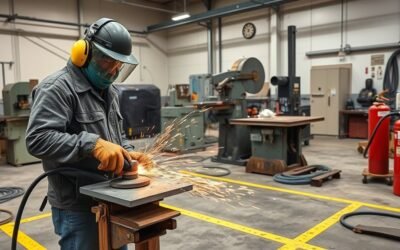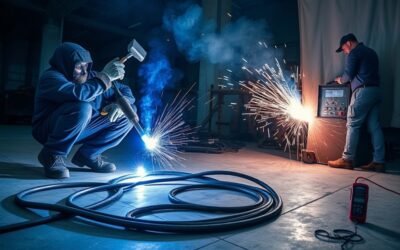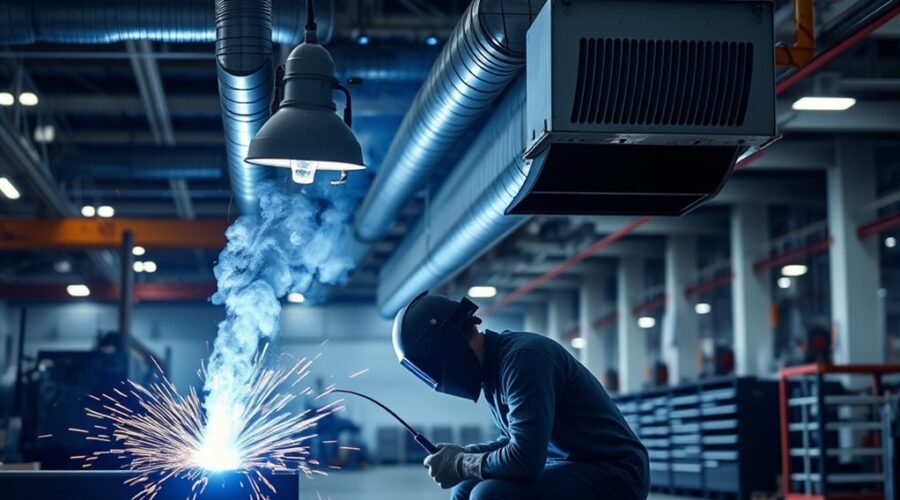
Welding ventilation must keep fumes and gases out of the welder’s breathing zone and below applicable occupational exposure limits. The right system depends on the welding process, base metal, coatings, filler metal, number of welders, room size, airflow, and whether the work is performed in a confined space. Local exhaust ventilation (LEV) is usually the most effective engineering control because it captures contaminants close to the arc before they spread through the shop.
Quick Answer
For U.S. workplaces, there is no single 4-ACH or 10-ACH rule that makes every welding area safe. OSHA requires ventilation sufficient to control airborne contaminants and sets specific mechanical-ventilation and local-exhaust requirements in certain situations. Source capture should be placed close to the weld and verified through airflow checks and, when needed, exposure monitoring.
Key Takeaways
Key Takeaways
- Use local exhaust ventilation whenever practical to capture welding fumes before they enter the breathing zone.
- Do not rely on a universal air-changes-per-hour number. Ventilation must control the actual contaminants generated by the process.
- Under OSHA general-industry rules, mechanical ventilation is required in specified small, low-ceiling, confined, or poorly cross-ventilated areas unless qualifying local exhaust or respiratory protection is provided.
- OSHA’s 100-fpm figure applies to specified local exhaust hood and enclosure arrangements; it is not a universal inlet-velocity specification for every extractor.
- Confined-space welding requires additional atmospheric, ventilation, communication, entry, and rescue precautions. Oxygen must never be used for ventilation.
- Lead, cadmium, beryllium, hexavalent chromium, zinc and other hazardous constituents may require tighter exposure controls than ordinary mild-steel welding.
Welding Ventilation Basics
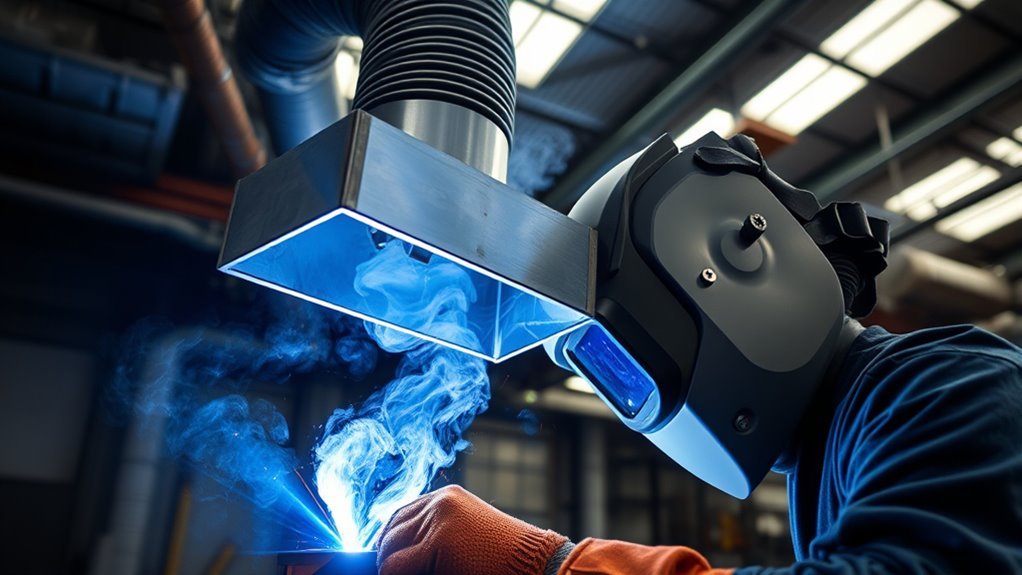
Welding produces airborne particles and gases from the base metal, filler metal, coatings, fluxes, shielding gases, and contaminants on the workpiece. The exact mixture changes with the process and material, so ventilation should be designed around the hazard rather than one generic airflow number.
Ventilation can include natural air movement, general mechanical ventilation, local exhaust ventilation, or a combination of these controls. Local exhaust ventilation is generally preferred for fume control because it captures contaminants near their point of generation before they spread through the shop.
The goal is not simply to move a large amount of air. The goal is to keep hazardous contaminants out of the breathing zone and below the applicable exposure limits.
OSHA’s general welding rule requires local exhaust or general ventilation to keep toxic fumes, gases, and dusts below the applicable limits in 29 CFR 1910.252 and the relevant air-contaminant standards.
AWS/ANSI Z49.1:2021 follows the same basic performance approach: adequate ventilation must keep personnel exposure to hazardous airborne contaminants below allowable limits. The amount of ventilation needed therefore depends on the space, welding process, number of operations, contaminants generated, natural airflow, and position of workers relative to the plume.
Note: Air changes per hour can be useful as an engineering calculation, but ACH by itself does not prove that welding-fume exposure is controlled. Source capture and exposure measurements may still be necessary.
General Ventilation Rules for Welding
For U.S. general-industry workplaces, OSHA does not give every welding shop one universal minimum ACH value. Instead, the regulation looks at the size and configuration of the area, number of welders, materials being welded, and the ability of ventilation to control contaminants.
Under OSHA 29 CFR 1910.252(c)(2), mechanical ventilation is required for general welding or cutting on materials not covered by more specific provisions when any of the following conditions applies:
- There is less than 10,000 cubic feet of space per welder.
- The room has a ceiling height of less than 16 feet.
- The work occurs in a confined space or the area contains partitions, balconies, or other barriers that significantly restrict cross-ventilation.
When that general mechanical-ventilation requirement applies, OSHA specifies a minimum rate of 2,000 CFM per welder, except where compliant local exhaust hoods or booths are used or where qualifying respiratory protection is provided as allowed by the regulation.
This 2,000-CFM figure should not be confused with the airflow rating of a portable source-capture extractor. LEV systems work differently because they capture a smaller contaminated air stream close to the arc.
Air Changes and Dilution
General dilution ventilation replaces contaminated room air with clean air. It can help control background contamination that escapes source extraction, but it should not be treated as a substitute for effective capture when fumes are concentrated near a welder.
For a room, the basic airflow relationship is:
Required airflow in m³/h = room volume in m³ × selected air changes per hour.
For example, a 25 × 40 meter shop with a 6 meter ceiling has a volume of 6,000 m³. Five air changes per hour would equal 30,000 m³/h. That calculation only tells you the airflow associated with five ACH; it does not establish that five ACH is the correct or legally sufficient welding-control rate for that shop.
An industrial hygienist or ventilation designer should consider fume generation, contaminant toxicity, number of active arcs, make-up air, exhaust discharge location, cross-drafts, and measured employee exposure before selecting the final airflow.
Source Capture Requirements
Source capture removes the contaminant before it can disperse through the work area. OSHA permits movable hoods positioned as close as practicable to the work and requires sufficient airflow to maintain a velocity toward the hood of 100 linear feet per minute in the welding zone when the hood is at its most remote working distance.
For the specific 3-inch-wide flanged suction opening described by OSHA, the regulation provides these minimum airflow values:
| Hood Distance From Arc or Torch | OSHA Minimum Airflow | Listed Duct Diameter |
|---|---|---|
| 4–6 inches | 150 CFM | 3 inches |
| 6–8 inches | 275 CFM | 3.5 inches |
| 8–10 inches | 425 CFM | 4.5 inches |
| 10–12 inches | 600 CFM | 5.5 inches |
These numbers describe the OSHA hood arrangement specified in the regulation. A commercial extraction gun, downdraft table, backdraft hood, enclosed cell, or proprietary extraction arm may require different airflow to achieve effective capture.
When Mechanical Ventilation Is Required
Mechanical ventilation becomes necessary when natural air movement cannot reliably control welding contaminants or when a specific OSHA provision requires it. The requirement can arise because of room size, ceiling height, restricted cross-ventilation, confined-space conditions, process type, or hazardous material.
Mechanical ventilation may consist of general mechanical air movement, local exhaust, or a combination of controls. For many welding operations, LEV offers better exposure control because it removes fumes before they spread through the room.
Confined Space Needs
OSHA requires welding and cutting in confined spaces to be adequately ventilated to prevent toxic-material buildup and possible oxygen deficiency. Replacement air must be clean and respirable.
Warning: Never use oxygen for ventilation. Adding oxygen can create an oxygen-enriched atmosphere and greatly increase fire hazards. Confined-space welding also requires evaluation of atmospheric, fire, electrical, engulfment, access, communication, and rescue hazards—not ventilation alone.
If adequate ventilation cannot be provided, OSHA may require appropriate atmosphere-supplying respiratory protection. Immediately dangerous to life or health conditions require specifically approved pressure-demand breathing equipment.
General-industry employers must also determine whether a space falls under OSHA’s permit-required confined-space standard. A hazardous atmosphere includes oxygen below 19.5% or above 23.5%, excessive flammable gas or vapor, excessive airborne toxic contaminants, or another atmosphere that is immediately dangerous to life or health.
Before applicable permit-space entry, the atmosphere must be evaluated with appropriate calibrated instruments. Testing normally covers oxygen, flammable gases and vapors, and potential toxic contaminants. Conditions must remain acceptable while workers are inside.
Where the welding standard calls for an outside worker or where the permit-space program requires an attendant, that person must remain outside and perform the required monitoring, communication, and emergency duties. Rescue arrangements must be established before entry rather than improvised after an emergency occurs.
Toxic Metal Hazards
Welding-fume risk is strongly affected by the material being welded. Mild-steel fume and fumes containing highly toxic metals cannot be treated as if they share one exposure limit.
| Hazard | Important U.S. Limit / Rule | Ventilation Consideration |
|---|---|---|
| Hexavalent chromium, Cr(VI) | OSHA PEL: 5 µg/m³ as an 8-hour TWA | May occur during stainless-steel or chromium-containing work. Engineering and work-practice controls are central to exposure control. |
| Lead | OSHA PEL: 50 µg/m³ as an 8-hour TWA | Lead-bearing metals and coatings have specific ventilation and respiratory-protection provisions. |
| Beryllium | OSHA PEL: 0.2 µg/m³ 8-hour TWA; STEL: 2.0 µg/m³ over 15 minutes | Requires strict exposure assessment and controls because very low airborne concentrations are regulated. |
| Cadmium | Material-specific OSHA controls apply | Cadmium-bearing or cadmium-coated materials can create highly toxic fumes and require special control. |
| Zinc | OSHA includes specific provisions for zinc-bearing materials | Galvanized steel can generate zinc oxide fume associated with metal fume fever. |
Always identify the base metal, coatings, plating, paint, filler metal, flux, and cleaning chemicals before welding. Safety data sheets and exposure assessments can reveal hazards that are not obvious from the finished part.
How Local Exhaust Ventilation Captures Fumes
Local exhaust ventilation captures contaminated air close to the point where fumes are generated. Common capture devices include movable extraction arms, small hoods, fume extraction guns, backdraft systems, downdraft tables, and enclosed welding cells.
Effective LEV creates enough airflow to pull the rising fume plume into the capture device without first drawing the plume through the welder’s face. Distance matters because capture velocity falls rapidly as a small hood is moved away from the source.
Pro Tip: Position the hood close enough to capture the plume, but arrange the welder, workpiece and hood so the contaminated air travels away from the breathing zone. Reposition a movable arm as the weld progresses instead of leaving it fixed while the arc moves away.
Cross-drafts from doors, pedestal fans, supply diffusers, vehicles, or other exhaust systems can overpower the capture field and push fumes toward the worker. Excessive extraction placed too close to gas-shielded processes can also disturb shielding gas and affect weld quality, so the system must balance effective fume capture with process requirements.
Visible removal of the plume is useful feedback, but it does not prove compliance. Where exposure is uncertain, breathing-zone air sampling provides better evidence that the ventilation system is actually controlling hazardous contaminants.
Common Welding LEV System Types
Welding LEV systems can be grouped by where and how they capture contaminants.
- Low-vacuum, high-volume extraction arms and hoods: Move a larger volume of air and create a broader capture zone near the weld.
- High-vacuum, low-volume extraction: Uses smaller nozzles or extraction guns positioned very close to the fume source.
- Downdraft or backdraft tables: Pull fumes away through the work surface or rear of a workstation.
- Fixed booths and enclosures: Useful for repeatable processes where the source remains in a controlled position.
- Portable extractors: Useful when welders move between stations, provided the hood or nozzle is repositioned correctly.
- Centralized systems: Serve multiple welding stations through common ductwork and filtration or outdoor exhaust.
No system type is automatically best for every operation. Selection should account for process mobility, fume generation rate, contaminant toxicity, hood access, duct losses, filtration, make-up air, discharge location, maintenance requirements, and the number of welders who may operate simultaneously.
How to Size and Place Fume Extractors
Fume-extractor sizing should start with the capture method, not with one generic CFM-per-welder number. Room dilution airflow and source-capture airflow perform different jobs.
- Identify the contaminants. Review the base metal, plating, paint, filler metal, flux, cleaning products, and welding process.
- Choose the capture method. Decide whether the operation is best controlled by an extraction arm, fume gun, table, booth, enclosure, or another engineered system.
- Determine the required capture performance. Follow applicable OSHA requirements, recognized ventilation design practices, and the equipment manufacturer’s specifications.
- Place the hood close to the source. Capture efficiency decreases as the hood is moved farther away.
- Keep the plume out of the breathing zone. Do not position the welder between the arc and exhaust hood.
- Check cross-drafts. Doors, fans and supply air can interfere with capture.
- Provide clean replacement air. Exhausted air must be replaced without creating drafts that defeat the LEV system.
- Verify performance. Check airflow and system indicators and use exposure monitoring where necessary.
For room ventilation, engineers may calculate airflow from room volume and a selected air-change rate, but that calculation must be tied to contaminant control. For source extraction, hood geometry, distance and capture velocity are more important than room ACH.
Do not assume a larger extractor is automatically safer. Excess airflow can increase noise, energy use and make-up-air requirements and may disturb shielding gas. The correct system provides reliable capture without interfering with the process.
Maintaining Welding Exhaust Performance
LEV performance can deteriorate as filters load, ducts leak, hoses kink, dampers move, or extraction arms become damaged. A preventive-maintenance program should include:
- Inspection of flexible hoses, ducts, joints, seals and extraction arms.
- Filter servicing or replacement at the manufacturer’s recommended interval or pressure-drop limit.
- Checks of airflow, suction or system gauges.
- Cleaning where deposited particulate reduces duct or hood performance.
- Verification after process changes, system modifications, or relocation of workstations.
- Employee training on proper hood positioning and warning signs of poor capture.
If a ventilation system is recirculating filtered air into the workplace, the employer must ensure that the filtration arrangement is suitable for the contaminants involved and complies with applicable requirements. Recirculation should not be assumed safe merely because visible smoke has disappeared.
Ventilation Rules for Confined Spaces
Confined-space welding can rapidly change the atmosphere because fumes, shielding gases and combustion products may accumulate while oxygen is displaced or consumed. Ventilation must therefore be planned before entry and maintained while the work continues.
For OSHA general-industry welding, confined-space operations must be adequately ventilated to prevent toxic accumulation and possible oxygen deficiency. Clean, respirable replacement air must be supplied for air that is exhausted.
The broader permit-space requirements may also apply. Before entry, determine whether the space has or could develop a hazardous atmosphere or another serious hazard. Where the permit-space standard applies, atmospheric testing and monitoring must establish that acceptable entry conditions exist and continue to exist during the work.
Key controls can include:
- Testing oxygen, flammable gases or vapors, and expected toxic contaminants.
- Maintaining oxygen within acceptable limits; OSHA treats below 19.5% and above 23.5% as hazardous atmospheric conditions.
- Using mechanical ventilation to control contaminants without using oxygen as ventilation air.
- Keeping welding machines and gas cylinders outside confined spaces where required.
- Maintaining communication between entrants and attendants.
- Providing appropriate retrieval and rescue arrangements.
- Stopping work if ventilation fails or atmospheric conditions move outside acceptable limits.
If engineering controls cannot maintain acceptable conditions, respiratory protection may be required. Required respirator use in general industry must comply with OSHA 29 CFR 1910.134, including hazard evaluation, respirator selection, medical evaluation, fit testing for tight-fitting respirators, training, maintenance, and program administration.
Hazards That Need Extra Protection
Some welding jobs require additional controls because the fume contains particularly hazardous substances or the process creates additional gases, radiation or atmospheric risks.
Stainless steel and chromium-containing materials: Welding can generate hexavalent chromium. OSHA’s Cr(VI) PEL is 5 µg/m³ as an 8-hour time-weighted average, so exposure assessment and effective engineering controls are important.
Lead, cadmium and beryllium: These materials are subject to material-specific OSHA requirements. Do not rely on the generic appearance of the fume or on a general room-ventilation rate.
Galvanized steel: Zinc oxide fume can cause metal fume fever. Remove coatings only by an appropriate safe method and provide effective source capture for the welding operation.
Chlorinated cleaning solvents: Keep solvent vapors away from welding arcs. OSHA’s construction regulation specifically requires chlorinated solvents to be at least 200 feet from an exposed inert-gas metal-arc operation unless shielded, and surfaces cleaned with them must be thoroughly dry before welding. General-industry rules similarly require cleaning operations to be located so chlorinated-hydrocarbon vapors cannot reach the welding atmosphere.
Confined spaces: Atmospheric hazards can develop quickly and may require mechanical ventilation, continuous or periodic monitoring, an attendant, retrieval provisions, respiratory protection, or a formal permit-space program depending on the conditions.
Coated or painted metals: Identify the coating before heating it. Paints and surface treatments can contain lead, chromium, zinc, isocyanate-related materials or other hazardous substances.
Note: A fume extractor does not eliminate the need to identify the material. The applicable exposure limit is often determined by the most hazardous component of the fume, not by total visible smoke.
Frequently Asked Questions
What are the OSHA requirements for welding ventilation?
OSHA requires ventilation sufficient to keep toxic fumes, gases and dusts below applicable exposure limits. In general industry, mechanical ventilation is required in certain small, low-ceiling, confined, or poorly cross-ventilated work areas. Where that general mechanical ventilation rule applies, OSHA specifies at least 2,000 CFM per welder unless qualifying local exhaust or respiratory protection is provided. Material-specific rules can impose additional requirements.
How many CFM does a welding fume extractor need?
There is no universal CFM rating for every welding fume extractor. Required airflow depends on hood design, hood-to-arc distance, process, cross-drafts and contaminant toxicity. For OSHA’s specified 3-inch flanged movable hood, the regulation lists 150 to 600 CFM as distance increases from 4–6 inches to 10–12 inches. The separate 2,000-CFM-per-welder rule applies to certain general mechanical ventilation situations, not to every LEV unit.
Is 100 feet per minute required for welding fume extraction?
OSHA specifies 100 linear feet per minute toward certain movable local-exhaust hoods in the welding zone at the hood’s most remote working distance, and at least 100 fpm away from the welder for the fixed enclosure described in the standard. That figure should not be treated as a universal inlet-velocity specification for every extractor design.
How many air changes per hour are required for welding?
OSHA does not establish one universal 4-ACH shop rule or 10-ACH confined-space rule for all welding. General ventilation must provide enough air movement to keep contaminants within applicable exposure limits, while OSHA also sets specific airflow requirements under defined conditions. ACH can help engineers calculate room airflow, but it does not replace source capture or exposure assessment.
What are the regulations regarding welding fume extraction?
U.S. requirements depend on the workplace and hazard. OSHA 29 CFR 1910.252 covers general-industry welding ventilation, while separate standards address substances such as lead, beryllium and hexavalent chromium. Construction and shipyard operations have their own welding provisions. AWS/ANSI Z49.1 provides additional consensus safety guidance.
Can a fan replace local exhaust ventilation?
A fan may improve general air movement, but it can also blow the fume plume through the welder’s breathing zone or interfere with an LEV hood. Source extraction is usually more reliable for concentrated fumes. Any fan arrangement should move contamination away from workers and should not disrupt shielding gas or defeat the exhaust system.
Why do welders drink milk after welding?
Drinking milk is a traditional practice, but there is no scientific evidence that milk prevents metal fume fever, cancer, or other harm from inhaled welding fumes. Milk enters the digestive system while welding fumes enter through the respiratory system. Effective ventilation, exposure control and appropriate respiratory protection are the protective measures that matter.
Conclusion
Effective welding ventilation is based on hazard control, not one universal ACH or CFM number. Capture fumes as close to the arc as practical, keep the plume out of the breathing zone, provide clean replacement air, and verify that the system continues to perform as intended. Confined spaces and metals such as lead, cadmium, beryllium and chromium require additional precautions and may trigger separate OSHA standards. When exposure cannot be adequately controlled through engineering and work-practice controls, use respiratory protection that meets the applicable OSHA requirements.
Sources
- OSHA 29 CFR 1910.252 — Welding, Cutting and Brazing — general welding ventilation, mechanical ventilation, local exhaust and confined-space requirements.
- OSHA 29 CFR 1910.146 — Permit-Required Confined Spaces — atmospheric testing, oxygen limits, entry conditions and permit-space controls.
- OSHA 29 CFR 1910.134 — Respiratory Protection — respirator selection, medical evaluation, fit testing, training and program requirements.
- OSHA 29 CFR 1910.1026 — Chromium (VI) — hexavalent chromium exposure limits and exposure assessment requirements.
- American Welding Society — AWS/ANSI Z49.1:2021 — consensus safety guidance covering ventilation, respiratory protection and confined spaces.
- NIOSH — Welding Fumes and Manganese — health hazards associated with welding fumes and inhaled manganese.