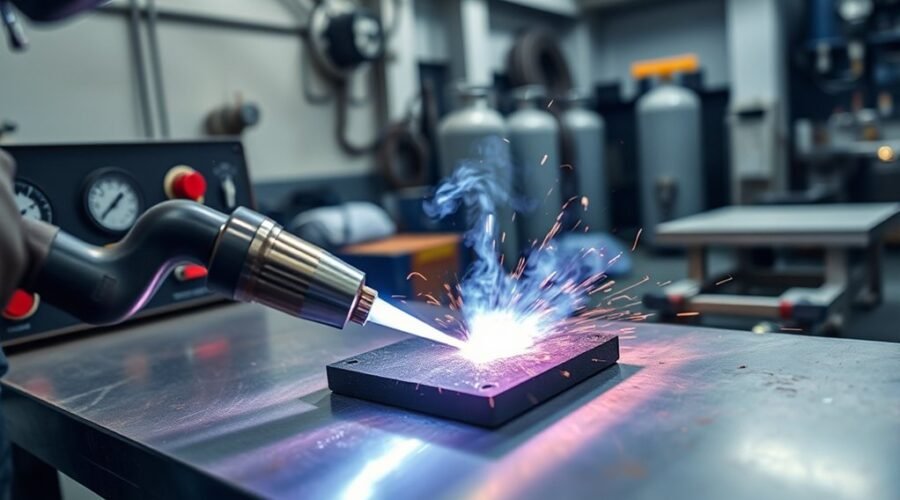
Plasma arc welding (PAW) is a precision arc-welding process that concentrates heat through a small nozzle instead of letting the arc spread freely. That focused arc can produce narrow welds, controlled penetration, and low distortion when the setup is right. Current matters, but gas flow, nozzle size, torch position, and travel speed can be just as important.
Quick Answer
Plasma arc welding (PAW) joins metal with a constricted plasma arc formed around a non-consumable tungsten electrode. Compared with TIG, the focused arc is stiffer and more energy-dense. Microplasma handles very thin work, medium-current PAW covers general precision welding, and keyhole PAW can make deep, narrow welds when current, gas flow, nozzle size, and travel speed are balanced.
Key Takeaways
- Transferred-arc PAW sends the welding current through the workpiece; a non-transferred arc stays between the electrode and nozzle.
- Microplasma commonly operates at 0.1–15 A, while medium-current welding is typically 15–200 A and keyhole welding generally starts above 100 A.
- PAW normally uses separate plasma-gas and shielding-gas streams, so gas selection and flow affect both arc behavior and weld protection.
- Keyhole PAW can make single-pass full-penetration welds in stainless steel up to about 10 mm under suitable conditions.
- PAW equipment and setup are more complex than conventional TIG, and normal welding hazards such as UV radiation, fumes, burns, and electric shock still require proper controls.
What Is Plasma Arc Welding?
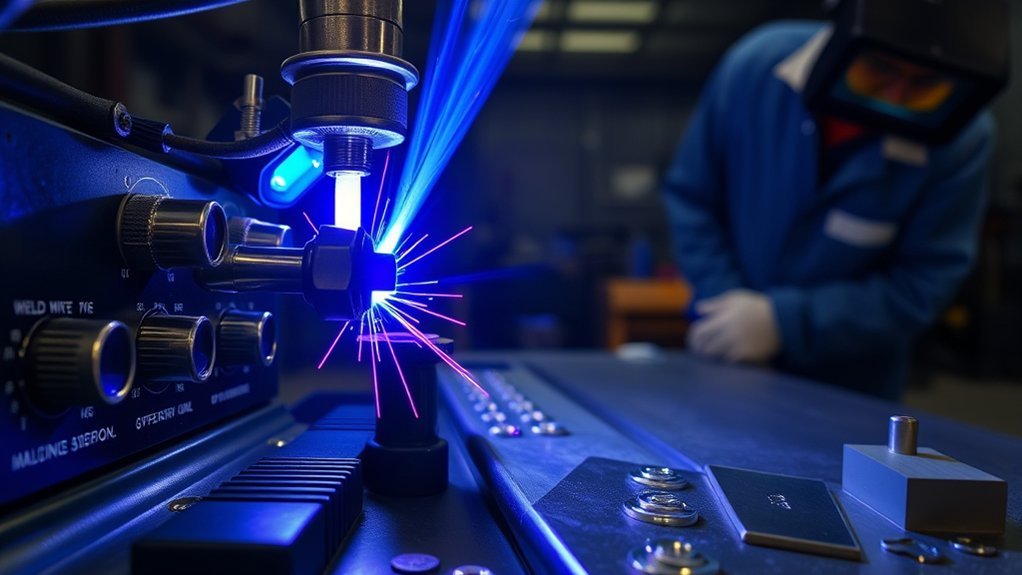
Plasma arc welding is an arc-welding process in which a constricting nozzle shapes the arc into a narrow, high-energy plasma column. In the usual transferred-arc arrangement, the arc runs between a non-consumable tungsten electrode and the workpiece. The American Welding Society definition of PAW also covers non-transferred operation, where the arc is maintained between the electrode and the constricting nozzle.
The torch feeds gas around the recessed electrode and forces the ionized gas through a fine-bore copper nozzle. This constriction increases energy concentration and creates a stiff, directional arc that is less sensitive to normal changes in arc length than an open TIG arc.
The plasma itself becomes extremely hot. Linde’s plasma arc welding guidance notes that the plasma can reach about 25,000°C (45,000°F) in some operating conditions.
PAW usually uses one gas stream to form the plasma and another to shield the molten weld pool. Depending on the material and procedure, argon, helium, and compatible gas mixtures may be used.
Three practical operating ranges cover most applications: microplasma for delicate thin material, medium-current or melt-in welding for general precision joining, and keyhole welding for deeper penetration.
Do not confuse PAW with plasma cutting. For example, this site’s guide to plasma cutters with built-in air compressors covers equipment designed primarily to sever metal. A built-in compressor does not replace the controlled plasma and shielding-gas systems used by a PAW setup.
How PAW Creates a Weld
A PAW weld forms by first establishing a pilot arc inside the torch and then, in transferred operation, transferring the main arc to the workpiece. The constricting nozzle concentrates that arc on the joint, melts the base metal, and creates a weld pool that solidifies behind the moving torch.
Warning: Plasma arc welding exposes you to intense arc radiation, hot metal, welding fumes, electrical hazards, and burns. Use the correct helmet, protective clothing, ventilation, electrical precautions, and the equipment manufacturer’s safety procedures. OSHA identifies metal fumes, UV radiation, burns, eye injury, and electrical shock among common welding hazards.
The normal sequence is straightforward:
- Start the pilot arc. The arc initially forms between the tungsten electrode and copper nozzle, ionizing the plasma gas.
- Transfer the arc. In transferred PAW, the main arc establishes between the electrode and conductive workpiece.
- Constrict the plasma. Gas and arc energy pass through the nozzle bore, forming a concentrated plasma column.
- Create the weld pool. The focused heat melts the joint. Filler metal can be added when the welding procedure requires it.
- Move along the joint. Travel speed, current, and gas flow are kept in balance so penetration and bead shape remain stable.
- Allow the pool to solidify. The molten metal closes behind the torch and forms the finished weld bead.
The pilot arc ionizes the gas; the constricted main arc then concentrates heat at the joint to form and control the weld pool.
The recessed electrode is protected from accidental contact with the workpiece, which helps reduce tungsten contamination. The concentrated arc also gives PAW good directional control and allows narrow fusion zones when the procedure is properly set.
If you are also comparing plasma cutters, remember that cutting-tool ratings do not indicate PAW weld quality. Cutting removes metal with a plasma jet; plasma arc welding controls a molten pool to join it.
PAW Modes and Arc Types
PAW is described in two different ways: by the electrical arc path and by the operating mode. Transferred and non-transferred describe where the arc flows, while microplasma, medium-current or melt-in, and keyhole describe how much energy and plasma force are being used.
Transferred Arc Mode
Transferred arc mode places the workpiece in the electrical circuit, with the main arc established between the tungsten electrode and the workpiece. This arrangement delivers energy efficiently into the metal and is the normal choice for fusion welding and keyhole PAW.
The focused arc can create deeper penetration than a comparable open TIG arc. At higher current and plasma-gas flow, it can produce a through-thickness keyhole that travels along the joint.
Stable keyhole welding depends on keeping current, plasma-gas flow, nozzle geometry, and travel speed within the qualified operating window. Too little energy can lose penetration, while excessive arc force can make the pool difficult to control.
- Workpiece forms part of the electrical circuit.
- Energy is delivered directly to the joint.
- Suitable for melt-in and keyhole welding.
- Supports narrow, deep penetration.
- Often used for mechanized production welding.
Non-Transferred Arc Mode
In non-transferred operation, the arc remains between the tungsten electrode and the constricting nozzle. The workpiece is outside the electrical arc circuit and receives heat from the plasma jet instead of directly carrying welding current.
This configuration delivers less electrical energy directly into the workpiece than transferred operation. It is therefore associated more with controlled plasma heating and specialized applications than with conventional transferred-arc fusion welding.
| Parameter | Effect |
|---|---|
| Arc path | Electrode to constricting nozzle |
| Workpiece circuit | Workpiece is not part of the arc circuit |
| Heat delivery | Plasma jet transfers heat to the workpiece |
| Typical role | Controlled heating and specialized plasma applications |
The pilot arc used to start transferred PAW is also an arc between the electrode and nozzle, but it should not be confused with every commercial cutter feature carrying the same name. For example, a plasma cutter’s non-contact pilot arc is a cutting feature, not evidence that the machine performs plasma arc welding.
PAW Operating Modes
Operating mode is mainly controlled through current, plasma-gas flow, nozzle bore, and the welding procedure. TWI’s plasma welding guidance divides the process into microplasma at 0.1–15 A, medium-current welding at 15–200 A, and keyhole welding above 100 A.
| PAW mode | Typical current range | How it behaves | Typical use |
|---|---|---|---|
| Microplasma | 0.1–15 A | Fine, stable, pencil-like arc | Very thin sheet, wire, mesh, precision components |
| Medium-current / melt-in | 15–200 A | Melts the joint without intentionally making a through-keyhole | General precision joining and automated seams |
| Keyhole | Above 100 A | Arc force opens a hole through the molten joint; metal closes behind it | Deep penetration and mechanized single-pass welding |
The current ranges overlap because current alone does not determine the mode. Nozzle bore and plasma-gas flow also determine arc constriction and whether a stable keyhole forms.
TWI reports microplasma use on sheet as thin as about 0.1 mm and keyhole welding of stainless steel up to about 10 mm in a single pass. Those figures are examples of process capability, not universal thickness limits for every alloy, joint, torch, or procedure.
Torch Parts, Gases, and Power Source
A PAW system combines a recessed tungsten electrode, constricting copper nozzle, separate gas passages, power source, control system, and usually a cooling system. These parts work together, so changing one item such as nozzle bore or plasma flow can change arc shape, penetration, and component life.
The tungsten electrode sits behind the nozzle rather than projecting openly toward the workpiece as it does in TIG. The electrode tip is prepared to a pointed geometry, while the torch itself is held at the angle required by the welding procedure. The original 30–60-degree figure commonly refers to the prepared electrode-tip geometry, not to holding the entire torch 30–60 degrees from the plate.
The copper nozzle constricts the arc. Its bore must suit the current and plasma-gas flow: an unsuitable bore/flow combination can increase nozzle erosion, destabilize the arc, or contribute to double arcing.
Torch performance depends on the relationship between electrode condition, nozzle bore, current, gas flow, cooling, and torch-to-work position.
PAW also separates the plasma gas from the shielding gas. Argon is commonly used as the plasma gas. Shielding may use argon, helium, or compatible mixtures, including hydrogen-containing mixtures for suitable materials and procedures. Reactive alloys require especially careful shielding and may also need root or trailing protection.
The TWI equipment guide for plasma welding notes that PAW power sources are almost exclusively DC with a drooping, constant-current characteristic. Electrode-negative polarity is normal, while specialized polarity arrangements may be used for materials such as aluminum.
Because the arc and gas system are specialized, a normal plasma cutter is not automatically a plasma welder. For example, the LOTOS 55A appears in this site’s plasma-cutter coverage; cutting equipment should not be substituted for PAW equipment unless the manufacturer explicitly provides a welding function and procedure.
Key PAW Settings for Better Welds
Good plasma arc welding comes from balancing several variables rather than chasing one ideal amperage. Current controls available heat, but plasma flow and nozzle geometry shape the jet, while travel speed and torch position determine how that energy is applied to the joint.
| Setting | What it changes | What to watch |
|---|---|---|
| Welding current | Heat input and penetration potential | Too little may lose penetration; excessive current can overheat the joint or torch components |
| Plasma-gas flow | Jet force, constriction, and keyhole behavior | Must match current and nozzle bore |
| Nozzle bore | Degree of arc constriction | Incorrect bore/current/flow combinations can damage the nozzle or destabilize the arc |
| Travel speed | Heat per unit length and keyhole dwell time | Too fast can reduce fusion; too slow can widen the pool or increase heat input |
| Torch position and stand-off | Arc alignment and how energy enters the joint | Keep the torch steady and follow the qualified procedure |
| Shielding gas | Pool protection, arc behavior, and metallurgy | Gas composition must be compatible with the base material |
Hydrogen additions should not be treated as a universal recipe. Argon-hydrogen shielding can improve heat input and penetration for compatible alloys, but the correct gas depends on the material and welding procedure.
Likewise, there is no single torch angle or travel speed that suits every PAW joint. The goal is a stable, centered arc and consistent pool or keyhole, not an arbitrary universal number.
Pro Tip: When a previously stable PAW suddenly changes bead shape, inspect the electrode and nozzle before changing several machine settings at once. Worn or damaged torch components can change arc constriction and make a correct procedure appear wrong.
If you are choosing among welding processes for beginners, remember that PAW adds nozzle, plasma-gas, shielding-gas, pilot-arc, and cooling considerations beyond the basic current and travel controls found on simpler processes.
Plasma Arc Welding vs TIG Welding
PAW and TIG both use a non-consumable tungsten electrode and shielding gas, but PAW places the electrode inside a torch with a constricting nozzle. That nozzle creates a stiffer, more concentrated arc, while TIG uses a more open arc directly between its exposed tungsten electrode and the workpiece.
| Feature | Plasma arc welding | TIG welding |
|---|---|---|
| Arc shape | Constricted, stiff, concentrated | Open, broader arc |
| Electrode | Recessed tungsten inside the torch | Tungsten projects from the torch |
| Gas system | Separate plasma and shielding-gas flows | Shielding gas surrounds the TIG arc |
| Penetration | Can produce narrow, deep penetration and keyhole welding | Excellent control but normally without a PAW-style constricted keyhole jet |
| Arc-length sensitivity | Generally more tolerant of stand-off variation | Arc shape changes more with torch distance |
| Equipment | More complex torch, control, gas, and cooling system | Simpler and more widely available |
PAW can weld faster than TIG in some production and keyhole applications because its concentrated arc can provide deeper penetration at useful travel speeds. It is not automatically faster on every joint, especially where setup time, access, filler handling, or low-volume manual work matters more than travel speed.
PAW Applications and Limits
Plasma arc welding is most valuable where manufacturers need precise heat control, repeatable penetration, or automated production. It can be used on stainless steel, carbon and alloy steels, aluminum, copper alloys, titanium, nickel alloys, and other weldable metals when the torch, polarity, shielding, and procedure suit the material.
Microplasma is especially useful for thin sections, fine components, wire, mesh, sensors, and small precision assemblies. Medium-current PAW overlaps many TIG applications but offers a stiffer arc and good tolerance to stand-off changes.
Keyhole PAW is used where a narrow, penetrating arc can reduce joint preparation or achieve full penetration in one pass. TWI gives up to about 10 mm of stainless steel as an example of single-pass keyhole capability under suitable conditions.
For sections beyond a proven single-pass procedure, the solution may involve groove preparation, filler metal, multiple passes, another PAW variant, or a different welding process. There is no universal rule that every plate above one fixed thickness should use the same two-pass sequence.
Common industrial applications include automated tube and pipe seams, stainless fabrication, aerospace components, medical devices, instrumentation, automotive parts, and other work where repeatability and controlled heat input matter.
PAW also has limits. The torch and control system are more complex than TIG equipment, setup variables interact strongly, access can be harder with a larger torch, and keyhole stability becomes sensitive to parameter changes.
For shops that mainly need conventional MIG, TIG, and stick capability, multi-process welders may provide broader everyday versatility. They should not be assumed to provide PAW’s constricted-arc or keyhole functions unless the manufacturer specifically supports plasma welding.
PAW’s strength is controlled, concentrated welding, not universal simplicity.
Common PAW Problems and What Causes Them
Many PAW problems come from interactions among the torch consumables, plasma-gas flow, current, travel speed, and shielding. If a weld changes suddenly, inspect the physical torch condition and gas delivery before making large parameter changes.
| Problem | Likely areas to check |
|---|---|
| Keyhole collapses or penetration disappears | Current, plasma-gas flow, travel speed, nozzle condition, and joint fit-up |
| Nozzle erodes or overheats | Nozzle bore, current level, plasma flow, cooling, and signs of double arcing |
| Oxidized or contaminated weld | Shielding-gas coverage, gas purity, leaks, drafts, trailing protection, or root shielding where required |
| Irregular bead or unstable arc | Electrode condition, nozzle damage, torch alignment, gas delivery, and travel consistency |
Use the torch manufacturer’s procedure data and a qualified welding procedure when the joint has structural, pressure-containing, aerospace, medical, or other critical requirements. Visual appearance alone cannot prove that a weld has acceptable penetration or mechanical properties.
Frequently Asked Questions
What Is the Plasma Arc Welding Process?
Plasma arc welding is a fusion process that constricts an electric arc through a small nozzle to create a concentrated plasma jet. The jet melts the joint while a separate shielding-gas stream protects the weld area. PAW normally uses a non-consumable tungsten electrode and may be run in microplasma, medium-current, or keyhole mode.
What Are the 5 Parameters of Welding?
There is no universal list of exactly five welding parameters for every process. In PAW, the most important variables include welding current, plasma-gas flow, nozzle orifice size, travel speed, and torch-to-work geometry. Shielding-gas composition and flow, polarity, filler addition, and joint design can also affect the result.
Is Plasma Arc Cutting AC or DC?
Plasma arc cutting normally uses DC power. Plasma arc welding is also normally operated on DC constant current, usually electrode negative, although specialized polarity-control systems can be used for applications such as aluminum welding. Always use the polarity and power mode specified for the particular machine and process.
Is Plasma Arc Welding Faster Than TIG?
Plasma arc welding can be faster than TIG in applications that benefit from its concentrated arc and deeper penetration, especially mechanized or keyhole welding. It is not automatically faster on every joint. Setup time, material thickness, joint design, filler requirements, and access all affect actual production speed.
What Gases Are Used for Plasma Arc Welding?
Argon is a common plasma gas, while shielding may use argon, helium, or suitable mixtures depending on the material and procedure. Some stainless and nickel-alloy procedures use hydrogen additions. Reactive metals require especially clean shielding, and some joints also need root backing or trailing-gas protection.
How Thick Can Plasma Arc Welding Weld in One Pass?
Single-pass capability depends on the material, joint, torch, and PAW mode. TWI reports microplasma use on sheet down to about 0.1 mm and keyhole welding of stainless steel up to about 10 mm in one pass. Those figures should not be treated as universal limits for every alloy or welding procedure.
Conclusion
Plasma arc welding gives you a more concentrated and controllable arc than conventional TIG by forcing the plasma through a constricting nozzle. Microplasma suits delicate work, medium-current PAW covers precision joining, and keyhole mode provides deep penetration when the current, gas flow, nozzle, travel speed, and joint setup stay in balance. For consistent results, follow the torch manufacturer’s procedure and use a qualified welding procedure for critical work.
Sources
- American Welding Society — Recommended Practices for Plasma-Arc Welding: PAW definition, transferred and non-transferred arc principles, torch terminology, and process fundamentals.
- TWI — What Is Plasma Welding?: microplasma, medium-current, and keyhole operating ranges; pilot arc; gases; power-source characteristics; and single-pass stainless-steel capability.
- TWI — Equipment for Plasma Welding: power-source polarity, torch construction, nozzle bore, gas-flow relationships, cooling, and aluminum considerations.
- Linde — Plasma Arc Welding: plasma temperature, gas functions, material applications, shielding, and PAW equipment.
- OSHA — Welding, Cutting, and Brazing Hazards and Solutions: welding-fume, UV, burn, eye-injury, electrical, and PPE safety guidance.