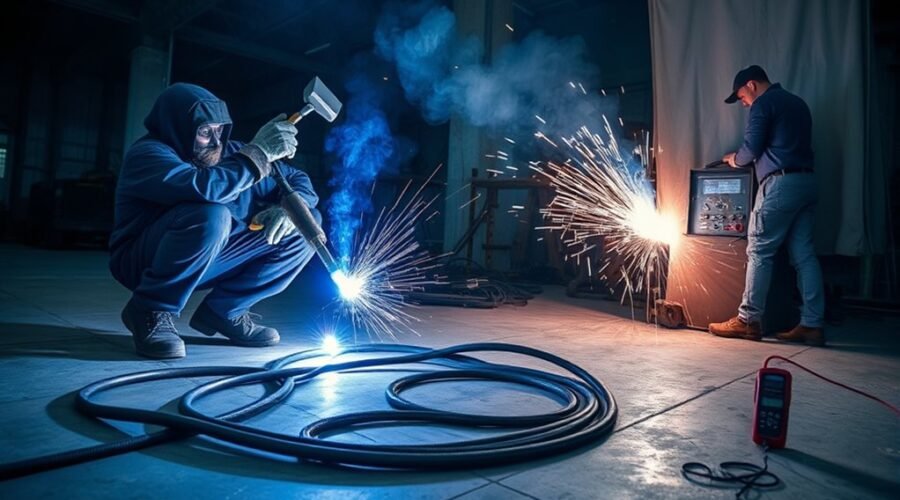
Welding creates electromagnetic fields (EMF) whenever electric current flows through the power source, welding leads, torch or electrode holder, arc, workpiece, and return path. These fields are non-ionizing and are different from the ultraviolet, visible, and infrared radiation produced by the welding arc. For most welders, practical exposure control comes down to cable layout, distance, equipment setup, and following the manufacturer’s safety instructions.
Quick Answer
Welding produces non-ionizing EMF whenever current flows through the welding circuit. Keep the outgoing and return cables together, keep both cables away from your body, connect the return clamp close to the weld, and increase distance from the power source where practical. Anyone with an implanted or body-worn medical device needs device-specific medical guidance.
Key Takeaways
- Arc welding creates electric and magnetic fields as current flows through the welding circuit; TIG equipment may also use high-frequency energy for arc starting or stabilization.
- Established EMF effects at sufficiently high exposure depend on frequency and can include sensory, nerve, muscle, or heating effects. Common nonspecific symptoms such as headaches and fatigue have not been shown to be caused by ordinary low-level EMF exposure.
- Pacemakers, ICDs, insulin pumps, and other medical devices may be affected by electromagnetic interference, so users should follow their clinician’s and device manufacturer’s instructions.
- Keep welding and return cables close together and on the same side of your body, never wrap them around yourself, and place the return clamp near the weld.
- There is no single universal welding-EMF exposure number. Occupational limits depend on frequency, field quantity, waveform, and the applicable national rules.
Warning: If you have a pacemaker, implantable cardioverter-defibrillator, neurostimulator, insulin pump, other implanted or body-worn medical device, or another condition that may place you at particular risk, do not rely on a generic welding-current limit. Consult the healthcare team responsible for your device and follow the device manufacturer’s electromagnetic-interference guidance before welding or working close to welding equipment.
What Is EMF Radiation in Welding?
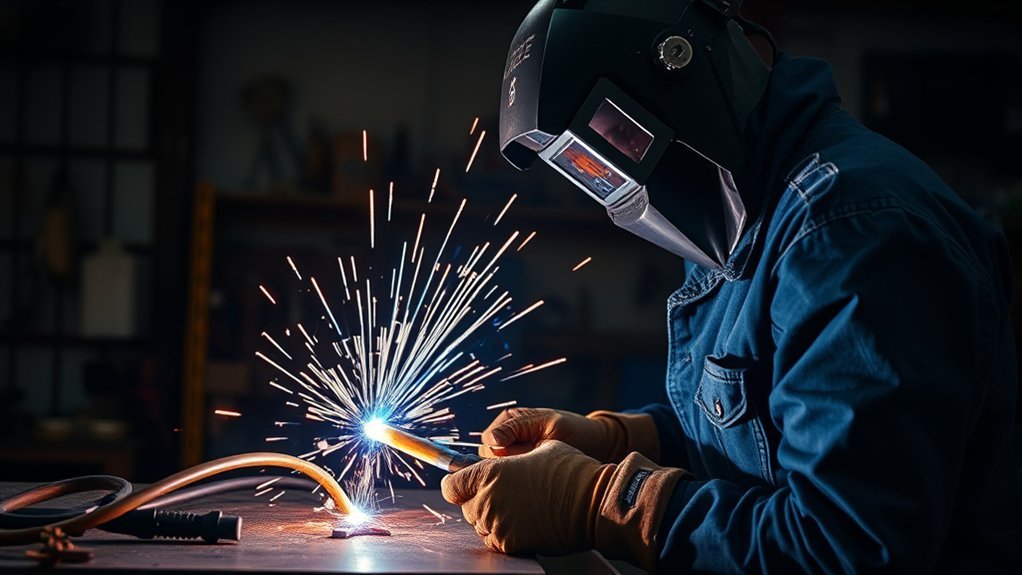
EMF in welding refers to the electric and magnetic fields associated with the welding circuit and, on some equipment, higher-frequency arc-starting or stabilizing systems. Electric current flowing through a conductor creates a magnetic field around that conductor, so welding leads carrying hundreds of amperes can create relatively strong local magnetic fields close to the cable.
Welding EMF is generally classified as non-ionizing electromagnetic energy. It should not be confused with ionizing radiation such as X-rays or gamma rays. It is also different from the intense ultraviolet, visible, and infrared optical radiation emitted by an arc, which is why welders still need appropriate helmets, filters, clothing, screens, and skin protection.
Welding EMF is strongest close to energized conductors and equipment. Increasing distance and reducing the area enclosed by the welding-current loop are two of the most useful practical controls.
The IEC 60974-9 arc-welding installation and use standard recommends keeping welding cables together, keeping the body away from the welding circuit, never coiling leads around the body, and connecting the return cable close to the weld.
Good equipment selection still matters for overall electrical and welding safety. For example, a beginner comparing welders for beginners should favor equipment with clear installation, electrical-safety, and EMF instructions. However, equipment grounding alone should not be presented as a guaranteed way to reduce welding EMF.
Where Welding EMF Comes From
The main magnetic-field source in ordinary arc welding is the welding current flowing through the electrode or torch lead, arc, workpiece, and return lead. The fields depend on more than amperage alone. Current waveform, frequency content, pulsing, AC versus DC operation, cable spacing, conductor position, and distance from the operator all affect the field that reaches the body.
| Factor | Why It Matters |
|---|---|
| Welding current | Higher current generally produces a stronger magnetic field around the welding circuit, although waveform and geometry also matter. |
| Cable separation | Separating outgoing and return conductors creates a larger current loop. Keeping them together helps their magnetic fields partially oppose each other. |
| Distance | Field strength falls as distance from the source increases, so avoid unnecessary close contact with leads and the power source. |
| Waveform and frequency | Pulsed and non-sinusoidal currents contain multiple frequency components, which is why professional exposure assessment may require frequency-weighted methods. |
| HF arc starting | Some TIG systems use high-frequency voltage for non-contact starting or stabilization, creating an additional source of electromagnetic interference. |
TIG is therefore not automatically the lowest-EMF choice in every situation. The operating mode, current, cable placement, arc-start system, equipment design, and the worker’s position all matter.
Shielding gas has a different job. A 75/25 argon-CO₂ MIG shielding-gas mix can affect arc behavior, penetration, spatter, and bead characteristics, but choosing 75/25 gas is not an established control for reducing a welder’s EMF exposure.
Work Return Versus Protective Grounding
The welding return cable carries welding current back to the power source. Connecting that return cable to clean metal reasonably close to the weld can shorten the intended current path and reduce unwanted current paths through a structure.
Protective earthing or grounding serves an electrical-safety function and should follow the welder manufacturer’s instructions and applicable electrical rules. It should not be treated as interchangeable with return-cable placement or advertised as a universal EMF-reduction technique.
Pro Tip: Think of the torch/electrode cable and return cable as one circuit pair. Route them beside each other whenever practical and keep the pair on the same side of your body rather than letting your torso sit inside the current loop.
Health Risks of Welding EMF Exposure
The health evidence needs an important distinction between established effects at sufficiently high field strengths and symptoms or long-term illnesses that have merely been attributed to EMF.
The European Commission’s EMF guidance describes established direct effects according to frequency. Low-frequency fields can stimulate sensory organs, nerves, or muscles at sufficiently high levels. Higher-frequency fields can cause tissue heating, while intermediate frequencies can involve both mechanisms. The EU occupational framework is designed around these established short-term effects and relevant indirect hazards.
| Concern | Evidence-Based Interpretation |
|---|---|
| Nerve or muscle stimulation | An established mechanism for sufficiently strong low-frequency fields and part of occupational exposure-limit frameworks. |
| Heating | An established concern at sufficiently strong higher-frequency exposures. |
| Medical-device interference | A recognized indirect risk that can occur below levels intended to protect workers from direct biological effects. |
| Headache, fatigue, poor concentration or memory problems | These symptoms are real but nonspecific. WHO states that controlled evidence has not established low-level EMF exposure as their cause. |
| Long-term neurological disease or leukemia from welding EMF | A causal relationship should not be claimed from current occupational EMF evidence. EU rules explicitly distinguish established short-term effects from suggested long-term effects that lack well-established causal evidence. |
The World Health Organization’s electromagnetic-hypersensitivity guidance states that symptoms attributed to EMF can be genuine and disabling, but controlled studies have not established EMF as their cause and “electromagnetic hypersensitivity” is not a recognized medical diagnosis with a confirmed EMF mechanism.
This distinction matters in a welding shop because headache, dizziness, fatigue, or poor concentration can also result from heat, dehydration, welding fumes, gases, low oxygen in confined spaces, medication, illness, or other hazards. Symptoms should not automatically be labeled “EMF sickness.”
Note: Welder duty cycle describes how long a machine can operate at a stated output before it requires cooling. The duty cycle of a TIG welder matters for equipment performance, but it is not a substitute for EMF exposure assessment.
Welding EMF and Medical Devices
Workers with pacemakers, implantable cardioverter-defibrillators, neurostimulators, cochlear implants, insulin pumps, or other active medical devices require special attention because welding fields can cause electromagnetic interference. Passive metallic implants and pregnancy may also require individual consideration under occupational EMF rules.
The EU Directive specifically tells employers to consider workers with active or passive implants, medical devices worn on the body, and pregnant workers during the risk assessment.
Device guidance is manufacturer-specific. For example, Medtronic’s current cardiac-device guidance advises its patients to consult their doctor before welding and gives precautions for welding below 160 A, including keeping the arc about 60 cm from the implanted device, keeping cables together, positioning the welding unit farther away, and attaching the work clamp close to the weld. That 160 A figure is not a universal safe limit for every pacemaker or ICD.
Do not assume TIG welding is inherently safer for every implant wearer. High-frequency TIG starting can itself be an electromagnetic-interference source. Process choice should follow the specific device manufacturer’s guidance, medical advice, and workplace risk assessment.
A welding table may help keep the work organized, but the table itself is not an EMF shield. The useful controls remain proper cable geometry, distance, equipment configuration, and device-specific precautions.
Standard welding aprons, jackets, helmets, gloves, and vests remain essential for other welding hazards but should not be relied on to shield a pacemaker or the body from low-frequency welding magnetic fields.
Reducing EMF Exposure During Welding
For ordinary manual arc welding, the most useful controls are simple layout changes that keep the welding-current circuit compact and farther from the operator.
- Route the electrode/torch cable and work-return cable together whenever practical. Tape or otherwise secure them together where permitted by the equipment instructions.
- Keep both cables on the same side of your body.
- Never coil, wrap, or drape welding cables around your torso, shoulders, arms, or legs.
- Connect the return clamp to clean metal as close to the welding area as practical.
- Keep your head and torso away from energized welding leads and the power source where the job allows.
- Do not sit, lean, or rest against the welding power source while welding.
- Do not carry an energized power source or wire feeder against your body unless the equipment is specifically designed and approved for that use.
- Follow the manufacturer’s installation, return-path, cable, and electromagnetic-compatibility instructions.
A sturdy welding cart can make cable organization easier and help maintain distance from the power source, but the cart does not itself block EMF.
EMF Safety Tips for TIG and Arc Welding
Stick, MIG/MAG, flux-cored, and TIG welding all create magnetic fields from the welding current. TIG equipment may add high-frequency energy when an HF oscillator is used for arc starting or stabilization.
Keep the two welding-current conductors together, keep them off your body, and keep yourself outside the loop formed by the welding circuit.
For TIG equipment, consult the operating manual to determine whether the machine uses lift-arc, scratch start, high-frequency start, or continuous high frequency. High-frequency systems are particularly relevant to electromagnetic compatibility because they can interfere with nearby electronic, communications, measurement, and control equipment.
The latest consolidated IEC 60974-10:2020+A1:2026 addresses electromagnetic-compatibility requirements for arc-welding equipment. EMC requirements concern how equipment emits or tolerates electromagnetic disturbances; they are related to, but not the same as, occupational human-exposure limits.
Control welding current according to the joint, material, electrode or wire, procedure specification, and manufacturer recommendations. A welder’s material-thickness capability helps determine whether it can make the required weld, but material-thickness ratings are not EMF safety ratings.
Dry gloves, dry footwear, intact insulation, and a dry working area remain important for electrical-shock prevention. Ambient temperature or humidity should not be described as a primary control for transmission of welding EMF.
When Does Welding EMF Need to Be Measured?
Not every welding shop needs continuous EMF measurements. A sensible assessment starts with information that already exists:
- Identify the welding processes, maximum currents, operating modes, cable layouts, and worker positions.
- Check the welder manufacturer’s EMF and installation information.
- Check applicable national guidance, standards, exposure databases, or recognized industry guidance.
- Identify workers who may be at particular risk, including people with implants or body-worn medical devices.
- If compliance cannot be established reliably from existing information, use a competent person to perform calculations or measurements.
- Review the assessment when equipment, process, current range, layout, or worker circumstances change significantly.
The UK’s Health and Safety Executive EMF guidance similarly explains that measurements or calculations are generally needed when available information is insufficient, particularly with more powerful equipment or higher currents.
Professional assessment of modern welding waveforms can be more complicated than placing a simple magnetic-field meter near a cable. Pulsed and non-sinusoidal welding currents contain multiple frequency components, so applicable standards may require weighted-peak or equivalent validated methods.
EMF Welding Rules and Compliance
Workplace requirements depend on the country. The European Union has a detailed occupational EMF framework in Directive 2013/35/EU. In the United States, OSHA states that there is currently no specific OSHA standard addressing extremely low-frequency fields, so employers must also consider applicable electrical, welding, PPE, equipment-manufacturer, consensus-standard, and general workplace-safety requirements.
EU Directive Compliance
Directive 2013/35/EU requires employers to identify and assess workplace EMF risks and reduce those risks where necessary. The assessment considers frequency, level, duration, type of exposure, worker position, direct effects, indirect effects, multiple sources, manufacturer information, and workers at particular risk.
The Directive does not require every employer to continuously measure EMF. Manufacturer data, recognized guides, standards, or other reliable information may be sufficient. Measurements or calculations become necessary when compliance cannot otherwise be established reliably.
Employers should preserve the assessment in a traceable form and update it when significant changes could make it outdated or when health-surveillance information indicates that review is necessary.
Exposure Assessment Limits
EU compliance uses Exposure Limit Values (ELVs) and Action Levels (ALs). They are not a single universal magnetic-field number.
| Term | Meaning |
|---|---|
| ELV | A limit linked to established biophysical effects inside the body, such as induced electric fields or absorbed energy. |
| AL | A measurable external-field level used to simplify assessment and determine when specified protective or preventive action may be required. |
Under Directive 2013/35/EU, staying below the relevant Action Levels is accepted as demonstrating compliance with the corresponding Exposure Limit Values. Exceeding an Action Level triggers further assessment or controls; it does not automatically mean an ELV has been exceeded.
Because the values change with frequency and physical quantity, a generic statement such as “the occupational EMF limit is 10 mA/m” is incorrect.
Mitigation And Training
Effective EMF management combines engineering, layout, training, and assessment rather than relying on one piece of protective equipment.
- Train welders to route the outgoing and return cables together.
- Keep cables and power sources away from the head and torso where practical.
- Use equipment-manufacturer EMF information when available.
- Identify workers with implants or other special-risk circumstances.
- Restrict access to stronger-field areas where the risk assessment requires it.
- Reassess exposure after significant equipment, layout, process, or current changes.
- Use competent EMF measurement or calculation when accessible information cannot establish compliance.
Specialized shielding can sometimes be used to control electromagnetic interference, but improvised metal mesh or shielding around high-current welding leads should not be recommended without engineering analysis and manufacturer guidance.
Likewise, price or general build quality alone does not establish low EMF emissions. When reviewing welding equipment and deals, use the manufacturer’s EMF, EMC, installation, and safety documentation rather than assuming a particular machine is safer because of marketing claims or added features.
Frequently Asked Questions
How do you decrease EMF exposure while welding?
Keep the electrode or torch cable and return cable close together, keep both cables on the same side of your body, never wrap them around yourself, connect the return clamp near the weld, and keep reasonable distance from the power source and energized leads. Follow the equipment manufacturer’s EMF instructions.
Does welding give off EMF?
Yes. Current flowing through welding cables, the arc, workpiece, and return circuit produces electric and magnetic fields. TIG equipment may also use high-frequency energy for arc starting or stabilization. Welding EMF is non-ionizing and is separate from the UV, visible, and infrared optical radiation produced by the arc.
Can you weld if you have a pacemaker or ICD?
Possibly, but the answer is device- and patient-specific. Welding can interfere with pacemakers and implantable defibrillators. Consult the healthcare professional responsible for your device and follow the implant manufacturer’s welding guidance before welding or working close to welding equipment. Do not assume that one amperage limit applies to every implant.
Does every welding shop need an EMF meter?
No. Many assessments can start with manufacturer data, recognized standards, exposure databases, and workplace information. Measurements or calculations are appropriate when those sources cannot reliably show that the applicable exposure requirements are met, or when unusual high-current or complex exposure conditions exist.
Why do some welders drink milk after welding?
Drinking milk after welding is an old workplace tradition, especially around concern about metal-fume fever. Milk has not been established as an antidote or protective treatment for inhaled welding fumes. Preventing exposure requires appropriate process controls, local exhaust ventilation where needed, ventilation, and suitable respiratory protection. Anyone who develops significant breathing problems, fever, chest symptoms, or other illness after welding should seek medical advice.
What does “EMF sickness” feel like?
There is no established medical diagnosis called “EMF sickness.” People sometimes attribute headaches, dizziness, fatigue, sleep problems, or concentration difficulties to EMF, but WHO reports that controlled evidence has not established low-level EMF as the cause of these nonspecific symptoms. A welder who becomes dizzy or unwell should stop work and consider other urgent hazards such as fumes, gases, heat, low oxygen, or electrical exposure as well as seeking appropriate medical evaluation.
Conclusion
Welding EMF is a real occupational factor, but its risks should be described using established evidence rather than broad claims about “EMF sickness.” The most practical controls are straightforward: keep the welding and return cables together, keep them off the body, stay outside the current loop, place the return clamp close to the weld, maintain reasonable distance from the power source, and follow equipment instructions.
Workers with implanted or body-worn medical devices need individual guidance from their healthcare team and device manufacturer. Employers should assess EMF exposure using reliable equipment data and recognized guidance, then use measurements or calculations when existing information is not sufficient. Standard welding controls for fumes, electrical shock, UV radiation, burns, fire, and confined spaces remain essential because those hazards are separate from EMF.
Sources
- Directive 2013/35/EU — EUR-Lex — occupational EMF Action Levels, Exposure Limit Values, risk assessment, workers at particular risk, and training requirements.
- World Health Organization — Electromagnetic Hypersensitivity — evidence concerning nonspecific symptoms attributed to low-level EMF.
- UK Health and Safety Executive — EMF FAQs — workplace EMF assessment and when measurement or calculation may be required.
- IEC 60974-9:2018 — Arc Welding Equipment: Installation and Use — recognized welding-equipment installation and safe-use framework, including EMF considerations.
- IEC 62822-2:2016 — Arc Welding EMF Assessment — standardized assessment of human exposure to magnetic fields produced by arc-welding equipment.
- Medtronic — Cardiac Device Electromagnetic Compatibility Guidance — manufacturer-specific welding precautions for patients with certain implanted cardiac devices.