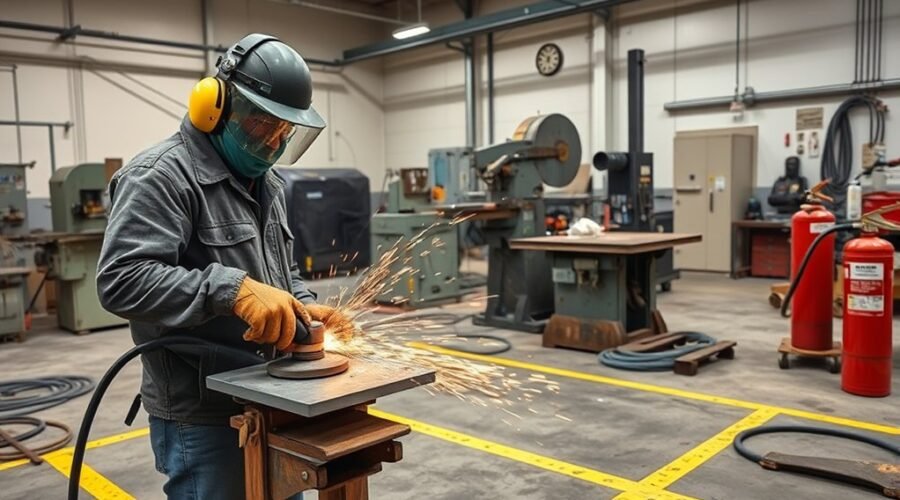
Metal fabrication shops combine welding, cutting, grinding, forming, lifting, electrical equipment, compressed gases, chemicals, and moving machinery in the same workspace. That mix can expose workers to flying metal, burns, fumes, excessive noise, caught-in hazards, electrical shock, strains, and fire. A strong safety program starts with hazard assessment and engineering controls, then adds safe procedures, training, maintenance, and task-specific PPE.
Quick Answer
Metal fabrication shop safety depends on identifying hazards before work begins, controlling fumes and noise at the source, guarding machinery, using lockout/tagout during hazardous servicing, selecting task-specific PPE, controlling hot work and compressed gases, keeping floors clear, and maintaining an emergency plan that matches the shop’s actual risks.
Key Takeaways
- Use a documented hazard assessment to choose engineering controls, work practices, and PPE for each fabrication task.
- Treat 85 dBA as OSHA’s 8-hour hearing-conservation action level, not as a simple instantaneous noise cutoff.
- Keep machine guards in place during operation and use lockout/tagout when servicing creates a hazardous-energy risk.
- Control welding fumes and dust with ventilation first; required respirator use triggers additional OSHA program requirements.
- Match fire extinguishers to the actual fire hazard, including Class D protection where combustible-metal hazards require it.
- Keep emergency routes clear, train employees for assigned duties, and review emergency procedures whenever responsibilities or the plan change.
Note: This guide summarizes common U.S. general-industry safety requirements. The employer’s workplace hazard assessment, applicable OSHA standards, equipment-manufacturer instructions, local fire codes, and any OSHA-approved State Plan requirements control for a specific facility.
Spot the Biggest Fabrication Hazards
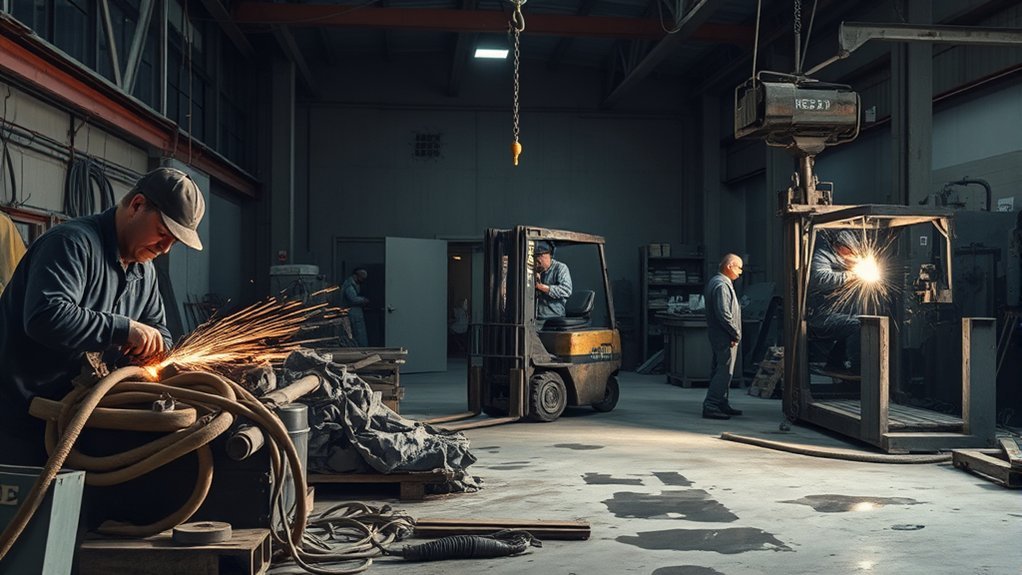
The most serious hazards in a metal fabrication shop commonly include excessive noise, welding fumes and metal dust, unguarded machinery, hazardous energy, hot work, compressed gases, electrical equipment, manual material handling, slips and trips, and fire.
Start with a workplace hazard assessment instead of choosing PPE by habit. OSHA’s general PPE standard requires employers to assess the workplace for hazards that require PPE, select protection for those hazards, ensure proper fit, and certify that the assessment was completed.
Routine walkthroughs should look for missing guards, damaged cords, leaking hoses, blocked exits, unsecured cylinders, accumulated combustible material, poor ventilation, oil or water on walking surfaces, damaged PPE, and changes in a process that create new exposure.
Proper safety features such as flame-resistant glove cuffs can reduce exposure during appropriate welding tasks, but gloves must still be selected for the specific hazard. Loose gloves or clothing can create an entanglement hazard around rotating machinery.
Choose the Right PPE for Fabrication
Once the major fabrication hazards are identified, select PPE for the actual exposure rather than applying one equipment list to every job.
Depending on the task, protection may include safety glasses with side protection, face shields, welding helmets with the correct filter shade, hearing protection, protective footwear, flame-resistant clothing, and gloves selected for heat, sharp edges, or chemicals. A face shield generally supplements rather than replaces required eye protection.
Welding helmets must protect against harmful optical radiation as well as sparks and spatter. Grinding and cutting can require different eye and face protection because the primary hazard may be high-speed flying particles rather than arc radiation.
Cut-resistant gloves can help when handling sharp sheet metal, while welding gloves must address heat and sparks. Avoid treating gloves as universal protection; near exposed rotating parts, a glove can itself become an entanglement hazard.
Each item should be inspected before use, fitted correctly, kept sanitary, and replaced when damaged. Investing in high-quality gloves can improve protection and comfort when the glove type matches the job.
Control Noise, Dust, and Fumes
Noise, dust, and welding fumes should be controlled at the source whenever feasible. Enclosures, quieter equipment, isolation, local exhaust ventilation, general ventilation, and good process maintenance can reduce exposure before PPE is added.
Under OSHA’s occupational-noise standard, an employee exposure at or above 85 dBA as an 8-hour time-weighted average is the action level for a hearing-conservation program. Shops should measure potentially significant exposure rather than deciding by how loud a machine sounds.
An 85 dBA reading is not a universal instant cutoff. OSHA’s hearing-conservation action level is based on an employee’s 8-hour time-weighted average exposure.
Welding fumes and metal dust require similar attention. Local exhaust placed near the fume source is usually more effective than relying only on room air movement. Keep exhaust systems maintained and position work so contaminants move away from the worker’s breathing zone.
Do not treat a disposable dust mask as a substitute for adequate exposure control. When respirators are required, OSHA’s Respiratory Protection Standard generally requires a written program, hazard-based respirator selection, medical evaluation, training, maintenance, and fit testing for employees using tight-fitting respirators.
Pro Tip: Evaluate ventilation with the actual welding, cutting, or grinding process running. A hood that appears well positioned while the station is idle may capture fumes poorly once the worker, workpiece, fan, or cross-draft changes position.
Properly maintained welding equipment and protective gear with appropriate safety features can support the overall control program, but equipment purchases should not replace ventilation, exposure monitoring, or training.
Keep Machines Guarded and Use Lockout/Tagout
Metal fabrication machinery can expose employees to points of operation, rotating parts, ingoing nip points, flying chips, sparks, and stored energy. OSHA’s machine-guarding requirements call for guarding where machine hazards can injure operators or other employees.
| Checkpoint | What to Verify |
|---|---|
| Guards | Required guards are installed, secure, undamaged, and appropriate for the operation. |
| Safety devices | Interlocks and other protective devices function as designed and are not bypassed. |
| Emergency controls | Emergency controls are accessible and maintained, but are not treated as substitutes for energy isolation. |
| Maintenance | Inspection and maintenance follow manufacturer instructions and applicable workplace procedures. |
Routine maintenance should follow the manufacturer’s guidance. Worn components, damaged guards, defective switches, abnormal vibration, and other safety-related defects should be addressed before continued operation when they create a hazard. The same durability focus used when selecting protective equipment such as welding jackets should also apply to shop machinery and its safety systems.
Use Lockout/Tagout for Hazardous Servicing
Machine guarding protects workers during operation, while lockout/tagout addresses hazardous energy during covered servicing and maintenance. OSHA’s Control of Hazardous Energy Standard applies when unexpected energization, startup, or release of stored energy could injure an employee.
Cleaning jams, changing components, entering a danger zone, repairing equipment, or performing other covered servicing may require the machine to be shut down, isolated from its energy sources, locked or tagged according to the energy-control procedure, and verified before work begins. Energy can include electrical, hydraulic, pneumatic, mechanical, thermal, gravitational, and stored pressure.
Warning: Pressing an emergency-stop button or switching a machine control to “off” is not the same as isolating hazardous energy. Servicing covered by OSHA’s lockout/tagout standard requires the applicable energy-control procedure.
Manage Welding, Cutting, and Fire Risks
Welding and cutting can ignite nearby combustibles through flame, sparks, slag, and hot metal. OSHA’s welding, cutting, and brazing requirements call for fire hazards to be removed from the vicinity when practicable or protected when they cannot be moved.
Before hot work begins, inspect the area above, below, and on the opposite side of walls or partitions where sparks and heat could travel. Protect combustible materials, control openings, and use fire watchers where the applicable conditions require them. Continue following the facility’s hot-work procedure after the arc or flame stops because hot slag and heated material can remain ignition sources.
Select Fire Extinguishers for the Actual Hazard
Do not assume that an ordinary ABC extinguisher covers every fabrication-shop fire. OSHA requires portable extinguishers provided for employee use to be selected and distributed according to the types and sizes of anticipated workplace fires.
Class A protection addresses ordinary combustibles, Class B addresses flammable liquids, Class C addresses energized electrical equipment, and Class D extinguishing agents are used for certain combustible-metal hazards. OSHA’s portable-fire-extinguisher guidance specifically addresses Class D protection where combustible metal powders, flakes, shavings, or similarly sized materials create the covered hazard.
If employees are expected or permitted to use portable extinguishers, provide the education and training required by the applicable OSHA provisions. Employees should also understand when conditions are beyond an incipient-stage fire and evacuation is the correct action.
Secure and Handle Compressed Gas Cylinders Safely
Compressed-gas cylinders can become severe impact, fire, or explosion hazards if damaged or mishandled. Store cylinders in protected, ventilated locations where they cannot be knocked over or damaged. Keep valve-protection caps in place when required, close valves before moving cylinders, and protect cylinders from sparks, slag, excessive heat, and electrical circuits.
OSHA’s oxygen-fuel gas welding standard contains specific cylinder storage and handling requirements. A purpose-built welding cart with a proper cylinder restraint can help prevent cylinders from tipping while they are being positioned or used, provided the arrangement meets the applicable requirements.
Never use a cylinder as a roller or support, lift a cylinder by its valve-protection cap, or allow oxygen equipment to become contaminated with oil or grease.
Prevent Electrical Hazards
Fabrication shops rely heavily on welders, grinders, plasma cutters, saws, extension cords, panels, and powered machinery. Damaged insulation, exposed conductors, improper repairs, wet conditions, and overloaded or unsuitable equipment can create shock, burn, or fire hazards.
OSHA’s general electrical requirements require electrical equipment to be free from recognized hazards likely to cause serious injury and to be installed and used according to its listing and labeling.
Remove damaged electrical equipment from service according to the facility’s procedure, protect cords from sharp edges and traffic, keep required electrical working space clear, and do not defeat grounding or protective devices. When servicing exposes employees to hazardous electrical or other stored energy, use the applicable energy-control procedure.
Follow Safe Lifting and Housekeeping Rules
Safe material handling reduces strains, crush injuries, caught-between hazards, and trips. Fabrication shops should evaluate the whole lifting task rather than relying on one universal weight cutoff.
Safe Lifting Techniques
Workers should plan a lift before moving material. Consider the load’s weight, shape, sharp edges, center of gravity, gripping points, travel path, destination, and whether the task requires reaching, twisting, repetitive lifting, or carrying over distance.
Keep manageable loads close to the body, avoid unnecessary twisting, and use stable footing. Mechanical aids such as hoists, cranes, lift tables, carts, and other handling equipment should be used when the task’s risk warrants them. Team lifting may help in some situations, although it does not eliminate every handling hazard.
There is no universal OSHA rule that every load above 50 pounds must be mechanically lifted. The NIOSH Revised Lifting Equation evaluates factors such as load weight, hand location, vertical travel, twisting, frequency, duration, and grip quality to estimate manual-lifting risk.
Clear Shop Floors
Keeping shop floors clear of clutter reduces trip hazards and makes it easier to move sheet, tubing, assemblies, carts, and lifting equipment safely.
Store tools after use, remove scrap promptly, route hoses and cords away from travel paths where feasible, and address oil, coolant, water, or other contamination. OSHA requires walking-working surfaces to be maintained in a clean, orderly, and safe condition.
Do not drag or manhandle heavy material when a suitable handling device can reduce the risk. Supervisors should correct blocked aisles, unstable storage, protruding stock, and other hazards before they contribute to an injury.
Manage Hazard Communication and Chemicals
Fabrication shops may use paints, coatings, solvents, degreasers, shielding gases, pickling products, adhesives, and other hazardous chemicals. OSHA’s Hazard Communication Standard requires covered employers to maintain a written hazard communication program, provide appropriate workplace labeling, maintain accessible Safety Data Sheets, and train employees about chemical hazards and protective measures.
The HCS was updated in 2024 to align primarily with GHS Revision 7, and OSHA extended several compliance dates in January 2026. As of September 21, 2026, manufacturers, importers, and distributors evaluating substances have passed the May 19, 2026 compliance date. Employers have until November 20, 2026 to make required substance-related updates to alternative workplace labeling, the hazard communication program, and additional employee training as necessary. Later mixture-related transition dates extend into 2027 and 2028.
Train workers to find and understand SDS information, recognize pictograms and signal words, follow storage and incompatibility precautions, and respond correctly to spills or exposures.
Create an OSHA-Compliant Emergency Plan
An emergency action plan is required whenever another applicable OSHA standard requires one. Under OSHA’s Emergency Action Plan standard, a required plan must address emergency reporting, evacuation procedures and exit assignments, critical operations performed before evacuation, employee accountability, rescue or medical duties, and the person or job title employees can contact for more information.
A required EAP normally must be written, kept in the workplace, and available for employee review. Employers with 10 or fewer employees may communicate the plan orally.
Evacuation Routes
Evacuation routes should be easy to identify, unobstructed, and usable under foreseeable emergency conditions. Employees need to know their assigned routes and what alarm signals mean.
| Item | Good Practice / Requirement | Purpose |
|---|---|---|
| Exit marking | Keep required exit identification visible. | Fast recognition |
| Routes | Keep evacuation paths clear and usable. | Safe egress |
| Accountability | Use the plan’s procedure for accounting for employees after evacuation. | Identify missing personnel |
Practice drills can be valuable for finding blocked paths, confusing alarm signals, or accountability problems. OSHA 1910.38 specifically requires designated employees who assist evacuation to be trained and requires the plan to be reviewed with covered employees when it is developed, when an employee’s responsibilities change, and when the plan changes.
Emergency Responsibilities
A compliant Emergency Action Plan should make responsibilities unmistakable. Employees need to know how to report a fire or other emergency, when to evacuate, who helps direct evacuation, and which workers—if any—are authorized to remain temporarily for critical operations before leaving.
The plan must address procedures for employees who perform rescue or medical duties and identify the name or job title of a person employees can contact for more information.
Alarms, radios, public-address systems, or other communication methods should match the facility and remain understandable in a noisy shop environment.
If employees are expected to use fire extinguishers, provide the applicable extinguisher education or designated-user training. Do not encourage untrained personnel to fight a growing fire instead of evacuating.
Provide First Aid and Emergency Washing Where Required
First-aid readiness is another part of emergency planning. OSHA requires adequate first-aid supplies to be readily available and, when no infirmary, clinic, or hospital is in near proximity for treatment, adequately trained first-aid personnel must be available.
Where employees’ eyes or bodies may be exposed to injurious corrosive materials, OSHA requires suitable facilities for quick drenching or flushing in the work area for immediate emergency use.
Train Workers and Document Safety Controls
Written rules alone do not control hazards. Employees need training that matches the work they actually perform, including machine operation, PPE, hazardous energy, welding and cutting hazards, chemical communication, respirator use where applicable, emergency duties, material handling, and reporting defective equipment or unsafe conditions.
Supervisors should verify that required inspections and preventive maintenance occur on schedule and that safety-critical defects are addressed. Required records can include hazard-assessment certification, training records, respirator-program records, lockout/tagout inspections, exposure-monitoring information, and maintenance documentation depending on the applicable standard and process.
Encourage prompt reporting of damaged guards, abnormal machine behavior, ventilation problems, blocked exits, damaged PPE, cylinder issues, chemical-label problems, and near misses. The goal is to correct developing hazards before they become injuries.
Frequently Asked Questions
What Are the Safety Considerations in a Fabrication Shop?
Fabrication-shop safety starts with hazard identification and control. Common priorities include machine guarding, lockout/tagout, welding-fume ventilation, noise control, eye and face protection, hot-work fire prevention, compressed-gas safety, electrical safety, safe material handling, housekeeping, chemical communication, and emergency planning.
What Are the OSHA Requirements for Fabrication Shops?
There is no single OSHA standard covering every fabrication shop. Applicable general-industry requirements can include PPE and hazard assessment, occupational noise, respiratory protection, machine guarding, lockout/tagout, Hazard Communication, welding and cutting, electrical safety, walking-working surfaces, portable fire extinguishers, medical and first aid, and emergency planning. The exact requirements depend on the processes and exposures at the facility.
What Are 10 Safety Rules in a Metal Workshop?
- Complete a hazard assessment before assigning PPE.
- Wear eye, face, hearing, foot, hand, and welding protection appropriate to the task.
- Keep required machine guards and safety devices in place.
- Use lockout/tagout when covered servicing exposes workers to hazardous energy.
- Control welding fumes, dust, and excessive noise at the source.
- Keep combustibles away from hot work and follow fire-prevention procedures.
- Secure and handle compressed-gas cylinders correctly.
- Inspect electrical equipment and remove hazardous damaged equipment from service.
- Keep aisles, floors, exits, and work areas clean and unobstructed.
- Report hazards promptly and follow the facility’s emergency procedures.
What Are the Safety Precautions in a Metal Shop?
Use engineering controls and safe work practices first, then add PPE appropriate to the remaining hazards. Keep machinery guarded, isolate hazardous energy during covered servicing, maintain ventilation, control hot work, store cylinders correctly, keep chemical labels and SDSs accessible, use suitable lifting methods, maintain clean floors, and train workers for emergencies.
Conclusion
Metal fabrication safety depends on controlling hazards before they reach the worker. Start with a documented hazard assessment, use ventilation and other engineering controls, keep machines guarded, apply lockout/tagout during covered servicing, manage hot work and compressed gases, and select PPE for the actual task. Safe material handling, good housekeeping, chemical communication, electrical maintenance, first-aid readiness, and a clear emergency plan complete the system.
The most effective shop safety programs are specific to the equipment and processes in the facility. Review controls whenever machinery, materials, chemicals, layouts, or work practices change, and use the applicable OSHA standards and manufacturer instructions rather than relying on generic rules or fixed shortcuts.
Sources
- OSHA 29 CFR 1910.95 — Occupational Noise Exposure — hearing-conservation action level, monitoring, training, and hearing protection requirements.
- OSHA 29 CFR 1910.134 — Respiratory Protection — respirator programs, medical evaluation, fit testing, selection, and training.
- OSHA 29 CFR 1910.212 — Machine Guarding — guarding of points of operation, rotating parts, chips, sparks, and other machine hazards.
- OSHA 29 CFR 1910.147 — Control of Hazardous Energy — lockout/tagout requirements for covered servicing and maintenance.
- OSHA 29 CFR 1910.252 — Welding, Cutting, and Brazing — fire prevention, PPE, ventilation, and welding-work controls.
- OSHA 29 CFR 1910.38 — Emergency Action Plans — emergency reporting, evacuation, accountability, assigned duties, training, and plan review.