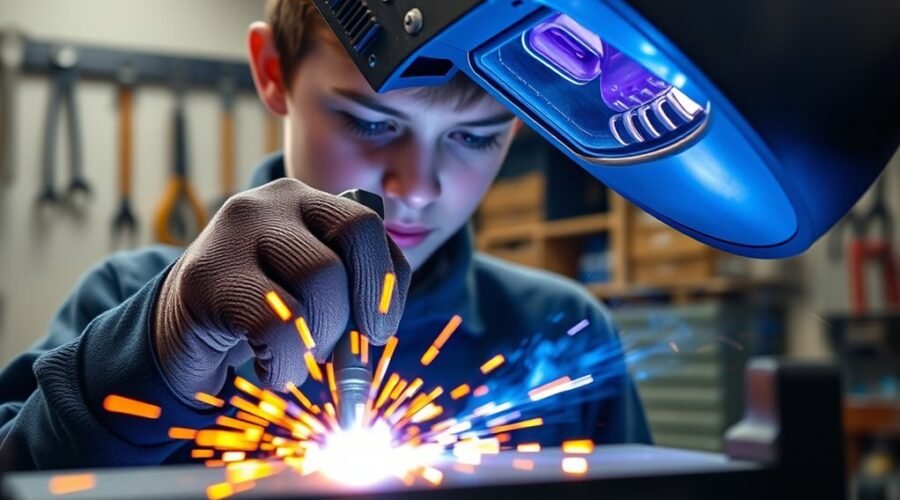
Welding is learnable, but it is not effortless. Most beginners can understand the basic idea quickly; the harder part is repeating a clean, safe weld with the right heat, travel speed, angle, and joint preparation. MIG welding is usually the easiest common process to begin with, while stick and TIG introduce different coordination and control challenges. The difficulty also changes with your goal: a hobby repair is very different from passing a code-based performance test for professional work.
Quick Answer
Welding is moderately difficult to learn but very achievable with safe instruction and regular practice. MIG is usually the easiest common process for beginners because the wire feeds automatically. Basic bead control may come quickly, while consistent structural-quality work, multiple positions, and certification can take months or longer.
Key Takeaways
- Welding is learnable, but the first challenge is combining safety, setup, hand coordination, and repeatable movement.
- MIG is usually the easiest common starting process; stick is practical for outdoor and repair work, while TIG demands finer coordination.
- Travel speed, work angle, arc length or stickout, heat input, and joint preparation all affect weld quality.
- Hands-on classes can speed progress because an instructor can spot unsafe habits and technique errors immediately.
- There is no universal 7-to-12-month certification timeline. Training programs vary, and AWS Certified Welder qualification is performance-based.
Is Welding Hard to Learn at First?
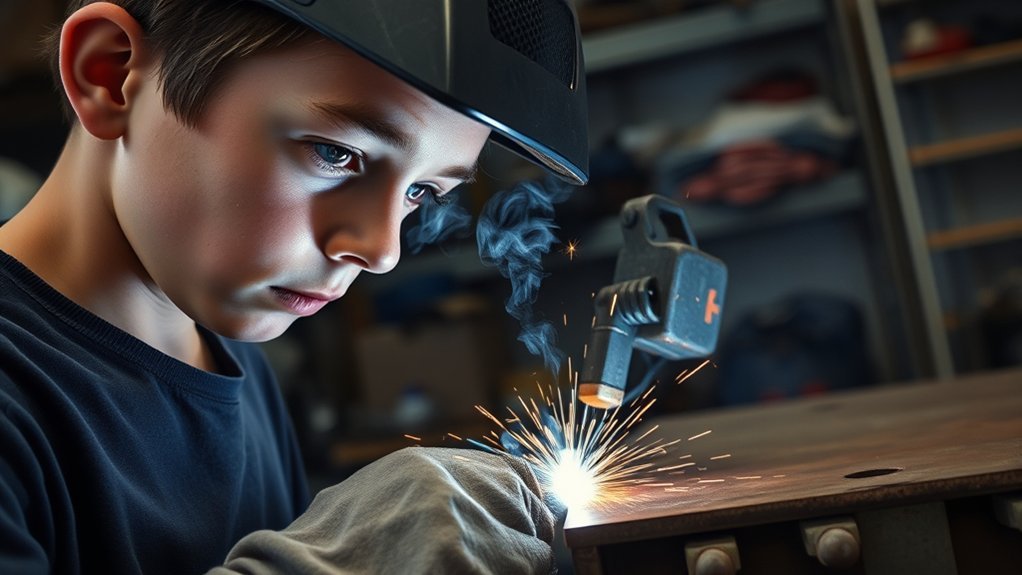
At first, welding can feel intimidating because a beginner has to think about several things at once: machine setup, joint preparation, body position, arc control, travel speed, and safety. That learning curve is real, but it does not mean welding is only for people with prior shop experience.
Many training programs introduce safe setup, controlled movement, and basic coordination step by step. Miller describes MIG as fairly easy for most people to learn, largely because the machine feeds the wire automatically and the operator can focus on gun position and travel. The ease-of-use factors in beginner welder choices also matter because clear controls make practice less confusing.
Starting an arc is only the first milestone. The real skill is producing the same sound weld repeatedly, in different joints and positions, without sacrificing safety.
Progress comes from hands-on practice, not observation alone. Repetition helps build steadier control, more consistent beads, and better judgment about sound, puddle behavior, and travel speed. Good instruction also matters because an experienced teacher can correct errors before they become habits.
With patience, disciplined practice, and realistic goals, welding becomes more approachable. A beginner may make a recognizable bead during an early session, but dependable weld quality takes longer than simply learning how to make sparks.
What Welding Is and How It Works?
Welding is a fabrication process used to make a permanent joint between materials, most commonly metals. In the arc-welding processes beginners often encounter—MIG/GMAW, TIG/GTAW, stick/SMAW, and flux-cored/FCAW—an electric arc provides heat that melts the base metal and, when used, filler metal. The molten weld pool then cools and solidifies into the joint.
Before welding begins, the surfaces should be prepared and aligned so the joint can form correctly. Rust, paint, oil, scale, poor fit-up, or gaps can change arc behavior and weld quality. The operator then controls heat input and movement while watching the weld pool.
Different types of welding use different equipment and techniques. MIG feeds wire continuously through a gun. Stick uses a consumable coated electrode. TIG uses a nonconsumable tungsten electrode and often a separate filler rod. Flux-cored welding uses tubular wire containing flux. A beginner should understand which process suits the material, thickness, location, and desired result. These welder options for home use can help compare equipment types once the required process is clear.
Safety is part of the process, not a separate afterthought. OSHA identifies welding hazards that include metal fumes, ultraviolet radiation, burns, eye damage, and electrical shock. Proper PPE, ventilation or local exhaust where required, fire prevention, and process-specific training are essential.
Warning: Do not practice welding until you understand your machine manual, electrical hazards, fire control, PPE, and ventilation. Coated, galvanized, painted, stainless, or unknown metals can create additional fume hazards. Never assume a normal room fan is an adequate control for every material or workspace.
A structured training program can help a beginner learn these habits in a controlled environment, but the right path depends on whether the goal is DIY work, employment, apprenticeship, or a specific welding qualification.
Which Welding Types Are Easiest?
Among the most common arc-welding processes, MIG is generally the easiest starting point for beginners. The continuous wire feed removes the need to repeatedly strike an electrode as in stick welding, and the operator can concentrate on travel speed, work angle, gun angle, and stickout. That does not make MIG automatic: voltage, wire feed speed, gas coverage, polarity, and material preparation still matter.
Shielded Metal Arc Welding, or stick welding, has simple, portable equipment and works well for repair, field, and outdoor jobs. It can be harder at first because the beginner must strike and maintain the arc while the electrode gets shorter. Flux-Cored Arc Welding has a learning feel similar to wire-fed MIG. Self-shielded FCAW can work without an external shielding-gas cylinder, while other FCAW applications do use shielding gas.
TIG welding usually demands the finest coordination because the operator controls the torch, often feeds filler rod separately, and may also adjust amperage with a foot pedal or fingertip control. It is an excellent process for precise work, but it is usually not the quickest route to a first usable weld. If MIG is the chosen starting process, these MIG welder options can help compare machine features without changing the need for proper training.
| Process | Beginner learning feel | Main early challenge |
|---|---|---|
| MIG / GMAW | Usually easiest to start | Matching settings and maintaining gun position, stickout, and speed |
| Stick / SMAW | Simple equipment, harder arc control | Striking the arc and holding a consistent arc length |
| Flux-cored / FCAW | Beginner-friendly wire feed | Settings, slag management, and smoke/fume control |
| TIG / GTAW | Most coordination-intensive of these four | Torch angle, arc length, filler timing, and heat control |
- MIG welding usually offers the shortest initial learning curve.
- Stick welding suits construction, repair, and many outdoor tasks.
- Self-shielded FCAW adds portability when external shielding gas is impractical.
- TIG rewards precision but usually takes more coordination to learn.
- Trade schools may teach several processes because job requirements vary.
What Skills Make Welding Easier to Learn?
You do not need perfect natural coordination to begin welding, but several trainable skills make progress easier. The U.S. Bureau of Labor Statistics highlights attention to detail, manual dexterity, hand-eye coordination, physical stamina, strength, and spatial-orientation skills as useful qualities for welders.
- Hand-eye coordination: helps maintain position while watching the leading edge of the weld pool.
- Attention to detail: helps spot poor fit-up, contamination, undercut, porosity, or inconsistent bead shape.
- Patience: prevents the common beginner habit of moving too fast just to finish the bead.
- Basic math and measurement: support layout, angles, dimensions, and blueprint work.
- Comfort with repetition: makes practice coupons useful instead of frustrating.
- Physical control: helps maintain a stable stance and supported hands in awkward positions.
Pro Tip: Practice on clean, flat mild-steel coupons before moving to complex projects. Change only one variable at a time—such as travel speed, angle, or machine setting—so you can see what actually improved or hurt the bead.
What Makes Welding Hard for Beginners?
For beginners, welding becomes difficult when safety, setup, and technique all compete for attention. The operator must control the arc or torch, prepare the joint, maintain a workable body position, and match machine settings to the material. Equipment limits matter too; understanding the duty cycle and controls of a welder helps prevent confusion when a machine reaches its thermal limit or behaves differently from expected.
Safety and Precision
Safety and precision are two of the biggest early hurdles because welding involves intense light, hot metal, sparks, electrical energy, and potentially hazardous fumes. PPE and engineering controls solve different problems: a welding helmet, safety glasses, gloves, hearing protection, and flame-resistant clothing help protect against radiation, spatter, and heat, while ventilation or local exhaust is used to control airborne contaminants when required.
The precision required also matters. A small change in angle, arc length, wire stickout, travel speed, or fit-up can change penetration and bead shape.
- Proper cleaning removes many contaminants before joining.
- Work angle and travel angle influence where heat and filler metal go.
- Correct machine settings support stable arc behavior.
- Safe cable, lead, cylinder, and work-area management reduce avoidable hazards.
- Repeated inspection helps a beginner connect technique with the finished bead.
Disciplined habits matter as much as steady hands. A visually smooth weld is not automatically a structurally sound weld, so beginners should avoid using practice-quality welds on critical structures until the work can be evaluated appropriately.
Technique and Setup
Technique and setup create a steep early learning curve because the beginner must set the machine, position the work, brace the body, and control motion at the same time.
In MIG welding, voltage and wire feed speed must suit the material and wire being used, while gas flow, polarity, contact-tip-to-work distance, and travel technique also affect results. TIG demands steadier torch control and often separate filler-metal timing. Stick requires the welder to maintain arc length while the electrode continuously shortens.
Material type and thickness change the required settings and technique, so practice should progress from simple flat coupons to fillet and groove joints, then to more difficult positions. Safety remains nonnegotiable throughout that progression.
Community colleges, trade schools, apprenticeships, and supervised employer training can help learners build these skills through repeated practice and immediate correction.
Common Beginner Welding Mistakes
- Welding dirty metal: paint, rust, oil, mill scale, and coatings can destabilize the process or create defects and fume hazards.
- Moving too fast or too slow: both can change bead profile, fusion, and heat input.
- Ignoring the machine chart or procedure: random settings make troubleshooting much harder.
- Using an unstable stance: unsupported hands and awkward body position make consistent movement difficult.
- Watching only the bright arc: beginners need to learn to watch the weld pool and joint edges through the proper lens.
- Assuming appearance proves strength: visual quality is useful, but critical welds may require formal inspection or testing.
- Skipping ventilation and material identification: the fume risk changes with the metal, filler, coating, and workspace.
Can You Learn Welding at Home?
You can practice basic welding at home, but the workspace must be suitable and the safety controls must match the process. A detached, noncombustible work area with good fire control and appropriate ventilation is very different from a small enclosed room or attached garage full of combustibles. Beginners should follow the equipment manufacturer’s instructions and applicable workplace or local safety requirements.
Online lessons can explain settings and technique, but video cannot see your work from every angle, hear an unstable arc in real time, or inspect your practice coupon. For that reason, even a short in-person class can be valuable before independent practice.
Note: Home practice and professional qualification are different goals. A beginner may learn basic beads at home, but employer, code, or project requirements can call for documented procedures, supervised testing, or specific welder qualifications.
How Do Welding Classes Help You Learn Faster?
Welding classes can accelerate learning by placing beginners in a structured setting where guided, hands-on practice replaces much of the guesswork of trial and error.
For someone trying to learn welding efficiently, instruction is especially useful for safety, body position, process setup, and diagnosing why a bead looks or behaves differently from expected.
- Instructors demonstrate core techniques and stable body position.
- Safety training covers PPE, fire control, electrical hazards, fumes, and shop discipline.
- Immediate feedback helps correct travel speed, angle, arc length, stickout, and settings.
- Exposure to MIG, TIG, stick, or FCAW lets students compare how each process behaves.
- Career-focused programs may prepare students for employer or industry qualification tests.
- Classes can also expose students to multi-process welders, which combine more than one welding process in a single machine.
How Long Does It Take to Learn Welding?
There is no single number that applies to every learner. You may understand machine setup and make simple practice beads in your first few sessions, but that is not the same as being job-ready or qualified for code work. AWS states that its Certified Welder program is performance-based and has no required prerequisite course; beginners may spend several months developing the skill needed for a performance qualification test.
Formal school programs also vary widely in length and scope. Some short certificates focus on a few processes, while larger certificates or associate-degree pathways include blueprint reading, fabrication, shop math, multiple welding processes, and general education. A 7-to-12-month program can exist, but it should not be presented as the universal time required to learn welding or become certified.
Practice quality matters more than simply owning expensive equipment. A machine should match the intended process, input power, material, and duty cycle. For learners who eventually choose TIG, these TIG welders under $1,000 are examples of equipment options to compare after deciding that TIG is the right process for the work.
Basic Skills Timeline
A useful way to think about the timeline is by goal rather than by a single month count.
| Learning goal | Realistic expectation |
|---|---|
| Understand setup and make first practice beads | Often possible during early supervised sessions, but consistency is still developing. |
| Basic hobby competence | Usually requires repeated practice across several sessions and simple joints. |
| Entry-level job readiness | Often takes months of structured practice plus safety, blueprint, and shop training; employer requirements differ. |
| Certification or code qualification | Depends on the exact process, material, position, procedure, test, and the welder’s starting skill—not a fixed course duration. |
| Advanced TIG, pipe, multiple positions, or specialty work | Continues well beyond basic training and may take years to master across applications. |
- Foundational programs commonly cover safety, joints, equipment setup, and process fundamentals.
- Hands-on training builds control, bead placement, fit-up, and consistency.
- Instructor feedback helps correct technique before errors become habits.
- Practice develops repeatability, which matters more than producing one good-looking bead.
MIG often serves as an early teaching process because the wire feed simplifies one part of the coordination. Advanced TIG, pipe, and out-of-position work normally require substantially more practice.
Practice Speeds Progress
Consistent practice is one of the main factors that shortens the learning curve because repeated hands-on work improves bead control, gun or torch handling, and troubleshooting. The most useful practice is deliberate: set a specific goal, make several similar beads, inspect them, and adjust one variable at a time.
| Practice focus | Effect |
|---|---|
| Arc starts | Cleaner initiation |
| Travel speed | Steadier beads |
| Joint setup | Better fit-up |
| Heat control | Less distortion and more consistent fusion |
| Inspection | Faster correction of recurring errors |
A beginner may spend several months building dependable foundational skills, but the pace varies with instruction, practice frequency, process, material, and desired standard. Community forums can provide practical ideas and encouragement, but safety-critical advice and qualification requirements should be checked against manufacturers, instructors, applicable codes, and official sources.
Certification Course Length
Training programs and welding certification are related, but they are not the same thing. A school may offer a certificate after a defined set of courses, while an industry welding qualification may be earned by passing a specific performance test.
For the AWS Certified Welder program, there are no required prerequisite courses or minimum months of schooling. The candidate completes a performance qualification test at an AWS Accredited Test Facility using the applicable Welding Procedure Specification and acceptance criteria. A person with prior experience may be ready sooner; a beginner may need months of preparation.
- Foundational school certificates build broad shop and process skills.
- Employer or industry qualification tests verify performance under specific requirements.
- Entry-level roles may also include additional on-the-job training.
- OSHA 10- and 30-hour Outreach cards are course-completion cards, not welding certifications or licenses.
- AWS and employer qualifications should be described by the exact process, material, position, and code or procedure involved.
- Continued practice supports specialization in structural, pipe, TIG, fabrication, repair, and other welding work.
This distinction gives beginners a clearer path: choose training for the skills you need, then pursue the specific qualification required by the employer, code, or project rather than assuming one generic certificate covers every welding job.
Frequently Asked Questions
Is Welding a Lot of Math?
Welding uses practical math more often than advanced math. Common tasks include reading a tape measure, working with fractions and decimals, checking angles, calculating dimensions, and reading blueprints or welding symbols. Shop math, geometry, and basic algebra are useful; trigonometry can appear in more complex layout and fabrication work.
Do Welders Make $100 an Hour?
A $100-per-hour base wage is not typical for welders. The U.S. Bureau of Labor Statistics reports a May 2025 median of $25.84 per hour for welders, cutters, solderers, and brazers, with the highest 10 percent earning more than $77,530 per year. Specialized contract work, overtime, travel, diving, or unusual project conditions can raise total compensation, but beginners should not plan on $100 per hour as a normal wage.
Is 35 Too Old to Start Welding?
No general rule makes 35 too old to learn welding. Adults can enter through school, apprenticeship, employer training, or self-directed practice with proper safety instruction. The work can be physically demanding, so strength, stamina, vision, mobility, and any role-specific medical requirements matter more than an arbitrary age cutoff. BLS projects about 40,300 openings per year on average from 2025 to 2035, largely from replacement needs.
Can You Make $100,000 as a Welder?
Yes, some specialized welders can exceed $100,000, but it is not typical pay for the occupation as a whole. BLS reports a 2025 median annual wage of $53,750 and says the highest 10 percent earned more than $77,530. Specialized commercial-diving welding, overtime-heavy travel work, certain union or industrial jobs, and other high-skill assignments can pay more. AWS cites Lightcast 2025 data showing $100,000-plus potential in underwater welding, but compensation varies widely.
Can You Teach Yourself to Weld?
You can teach yourself some basic technique, but a beginner benefits from in-person safety instruction and feedback. Welding hazards are not limited to the arc itself; fumes, hot metal, fire, electrical shock, gas cylinders, coatings, and confined spaces may require controls that are difficult to judge from a video alone. A short class can make independent practice safer and more productive.
What Metal Should a Beginner Practice Welding?
Clean mild steel is a common beginner practice material because it is widely available and works with MIG, stick, flux-cored, and TIG processes. Use known, uncoated material of a thickness appropriate for the machine and process. Avoid unknown coatings, closed containers, and safety-critical projects while learning.
Conclusion
Welding is not effortless at first, but it becomes much more manageable when the learning path is broken into safe setup, simple joints, controlled technique, and repeated practice. MIG is usually the easiest common starting process, while stick, flux-cored, and TIG add different challenges. The biggest mistake is treating a first decent-looking bead as proof of mastery. Reliable welding comes from consistency, inspection, safety discipline, and practice across materials, joints, and positions.
For career-focused learners, the timeline should be tied to the exact job or qualification rather than a fixed number of months. School certificates, AWS performance qualification, employer tests, and OSHA safety training are different things. With that distinction clear, a beginner can choose training that matches the work they actually want to do.
Sources
- Occupational Safety and Health Administration — Welding, Cutting, and Brazing: Hazards and Solutions — welding fumes, ultraviolet radiation, burns, eye injury, electrical shock, and hazard controls.
- American Welding Society — Certified Welder Program — performance-based qualification, no prerequisite course requirement, testing, and certification timeline.
- U.S. Bureau of Labor Statistics — Welders, Cutters, Solderers, and Brazers — training pathways, physical demands, May 2025 pay data, and 2025–2035 employment outlook.
- Occupational Safety and Health Administration — Outreach Training Program FAQ — OSHA 10- and 30-hour cards are course-completion cards, not certifications or licenses.
- Miller — MIG Welding Tips and Techniques for Beginners — beginner MIG fundamentals, gun control, settings, and stickout.
- American Welding Society — Underwater Welder Career Profile — specialized underwater-welding training and compensation context.