Lack of fusion is a weld defect where the weld metal doesn’t fully melt into the base metal or into the previous pass, leaving an unbonded boundary. Cold lap (also called overlap) is the visible surface form: weld metal rolls over the toe and sits on the plate without fusing. Both are usually caused by too little heat, travel that’s too fast or too slow, a poor gun or rod angle, or dirty metal. They’re found by visual inspection at the toes, bend tests, ultrasonic testing and macro-etch, and fixed by grinding out the unfused metal and rewelding with more heat and better technique.
Lack of fusion is one of the most dangerous defects because a weld can look acceptable on the surface while being weak inside. It’s also one of the top reasons welders fail bend tests. Here’s how to recognize it, why it happens and how to stop it.
Lack of Fusion vs Cold Lap vs Incomplete Penetration
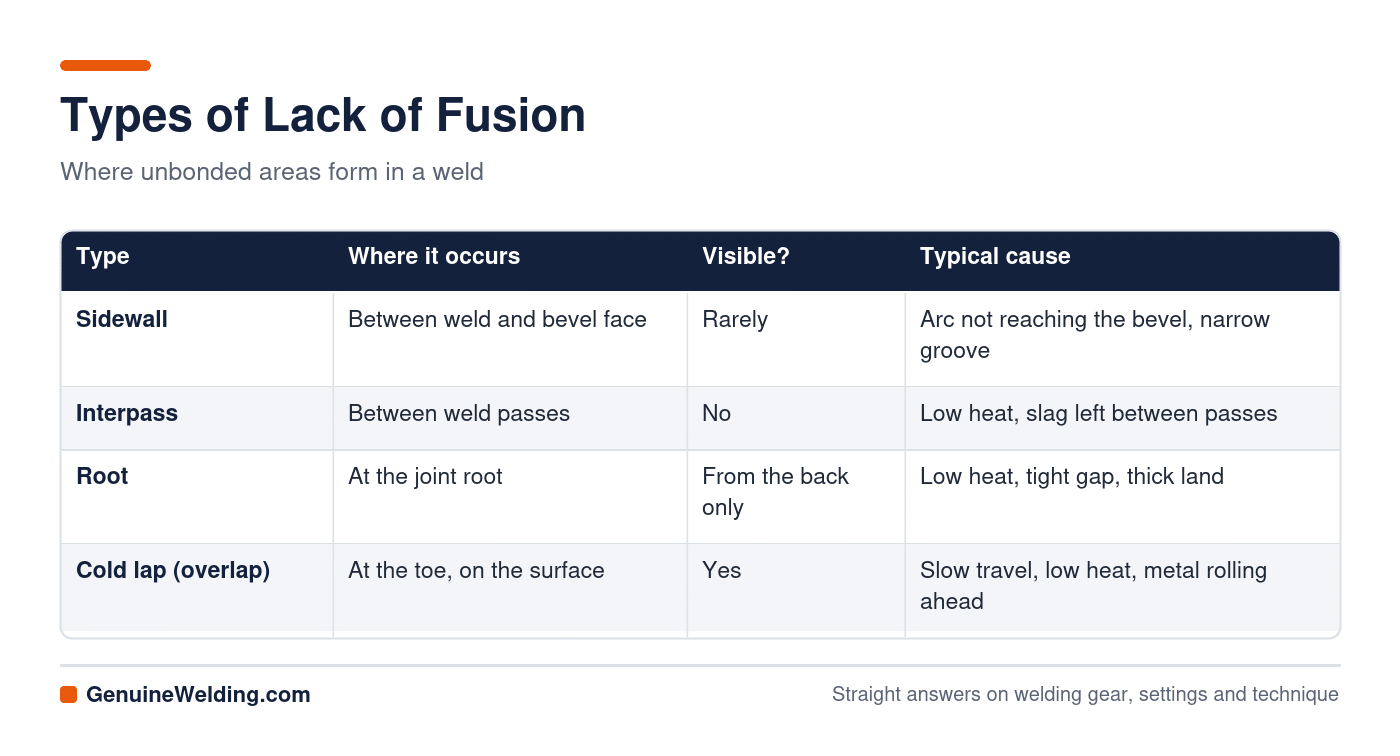
- Lack of fusion (incomplete fusion): no bond between the weld and base metal, or between passes. It can be at the sidewall, between beads (interpass) or at the root.
- Cold lap / overlap: weld metal flows onto the base metal surface beyond the toe without fusing. It’s visible as a rolled edge or shelf.
- Incomplete joint penetration: the weld doesn’t extend through the full joint thickness as required, leaving an unwelded root. It’s related but different: the weld may be fused where it exists, it just doesn’t go deep enough.
See overlap in welding and full penetration welds.
What Causes Lack of Fusion and Cold Lap?

The MIG short-circuit problem
Short-circuit MIG runs cooler than other modes. On thicker plate, a low-voltage MIG weld can look smooth while barely melting the sidewalls. That’s why many codes limit short-circuit transfer on thicker structural joints and require qualification testing. If you MIG weld thick steel, use enough voltage and wire speed, consider spray or pulsed transfer, and bevel the joint.
How to Detect Lack of Fusion

Visually, look for a bead with sharp, undercut-free edges that seem to “sit” on the plate, or a rolled lip at the toe. On fillets, a tall convex bead with a sharp notch at the toe is a warning sign. See good weld vs bad weld.
How to Fix Lack of Fusion and Cold Lap
- Mark the area. Use the inspection results to locate the defect length and depth.
- Grind or gouge it out. Remove all unfused metal down to sound weld and base metal, with a smooth U-shaped groove so you can reach the bottom.
- Clean and check. Use dye penetrant or magnetic particle testing to confirm the defect is gone when required.
- Reweld with correct settings. Raise heat, adjust travel speed and angle, and tie into both toes.
- Re-inspect. Repeat the original inspection method on the repair.
Small surface cold lap at a toe can sometimes be blended by grinding if the remaining weld still meets size, but internal lack of fusion must be removed and rewelded.
How to Prevent Lack of Fusion
- Use enough heat for the thickness: the middle to upper end of the rod or wire range.
- Keep the arc on the leading edge of the puddle, not on top of it. Riding the puddle insulates the base metal.
- Control travel speed: fast enough to stay on the leading edge, slow enough to melt both sides.
- Aim at the sidewalls: pause briefly at each toe when weaving.
- Use the right angle: about 45° into fillets, with a 5–15° push or drag.
- Clean every pass and remove mill scale and rust from bevels.
- Open the joint: use a proper bevel angle and root opening so you can reach the root. See groove weld types.
- Preheat thick or high-conductivity metals such as thick steel, aluminum and copper.
- Plan bead placement so each pass ties in without deep valleys.
More fixes in our weld troubleshooting guide and common welding defects.
Are Lack of Fusion Defects Allowed by Codes?
Generally no. AWS D1.1 visual criteria require complete fusion between adjacent layers of weld metal and between weld metal and base metal, and lack of fusion found by radiography or ultrasonic testing is usually rejectable as a planar discontinuity. ASME and API 1104 have similar requirements. Always check the specific acceptance criteria for your job. See welding codes and standards.
Lack of Fusion and Cold Lap: FAQs
What is the difference between cold lap and lack of fusion?
Cold lap is a surface condition where weld metal overlaps the base metal without bonding. Lack of fusion is the broader term for any unbonded area, including inside the weld.
Can you see lack of fusion?
Sometimes at the surface, as cold lap or a rope-like bead. Internal lack of fusion usually needs bend tests, ultrasonic testing or cross-sectioning to find.
Why do MIG welds have lack of fusion?
Low voltage, short-circuit transfer on thick metal, fast travel and pointing the gun at the puddle instead of the joint are the most common reasons.
Does more amperage fix lack of fusion?
Often, but not always. Arc placement, travel speed and joint access matter as much as heat.
Is lack of fusion a crack?
No, but it acts like one: a sharp, flat, unbonded plane that concentrates stress and can grow into a crack under load.