A stick welding rod usually sticks because the amperage is too low, you’re pushing the rod into the metal instead of striking and lifting, the rod is damp or damaged, or the work clamp connection is poor. Other causes are the wrong polarity, a hard-to-start rod on a weak AC machine, and dirty or rusty metal. Most of the time, raising the amps 5 to 15 percent, using a quick “scratch like a match” start, clamping to clean metal and using dry rods solves it.
Every new stick welder goes through the rod-sticking phase. The good news is that it’s usually one of seven simple problems. Work through them in order and you’ll be striking arcs cleanly in minutes.

Fix 1: Turn Up the Amperage
Low amperage is the number-one reason rods stick. Without enough current, the arc can’t establish and the rod fuses to the plate. As a starting point, many welders use about 1 amp per 0.001 in of rod diameter: roughly 125 A for a 1/8 in (0.125 in) rod, then adjust.

Raise the amps 5 to 10 A at a time until the rod strikes easily and the bead lays flat. If the puddle gets too fluid or you get undercut, back off slightly. See the welding rod size and amps chart.
Fix 2: Use the Right Striking Technique
- Scratch start: drag the rod tip across the plate like striking a match, then lift slightly to establish the arc. Easiest for beginners.
- Tap start: tap the rod straight down and lift quickly. Good in tight spaces and for 7018 restarts.
- Don’t push: pressing the rod into the plate shorts it out and welds it in place.
- Lift slightly once lit: hold an arc length about equal to the rod’s core diameter.
If the rod does stick, twist and snap it free quickly or release it from the stinger. Don’t let it glow red; that ruins the coating. Some welders also have “anti-stick” or hot start features that help; check your machine’s settings.
Fix 3: Use Dry, Undamaged Rods
Damp flux makes rods hard to strike, sticky and spattery, and low-hydrogen rods like 7018 are especially sensitive. Store rods sealed or in a rod oven, and re-dry per the manufacturer’s instructions. Cracked or chipped flux at the tip also causes sticking; snap off the damaged end. See how to store 7018.
Fix 4: Clean the Work and the Clamp Connection
Rust, paint, mill scale and a loose or dirty ground clamp all add resistance and weaken the arc. Grind a bright spot for the work clamp, clamp close to the weld, and clean the area where you’re striking. Also check the stinger jaws and cable connections. See welding leads explained.
Fix 5: Check the Polarity
Most rods, including 7018, 6010 and 6011, run best on DCEP (electrode positive). Running DCEN by mistake can make some rods hard to start and erratic. 6010 needs DC; it won’t run properly on AC. See welding polarity explained.
Fix 6: Match the Rod to Your Machine
Small AC buzz-box welders have a lower open-circuit voltage and struggle to start some rods, especially standard 7018 and 6010. Use rods designed to start easily on AC, such as 6011, 6013 or 7018 AC. Smaller rods (3/32 in) are also easier to start on low-output machines.
Fix 7: Watch Your Arc Length and Angle
Once the arc is lit, letting the rod creep too close to the puddle shorts it out and it sticks. Keep a consistent arc length as the rod burns down (it gets shorter, so you must feed it toward the work steadily), and use a 10 to 20 degree drag angle. Learn more in stick welding tips.
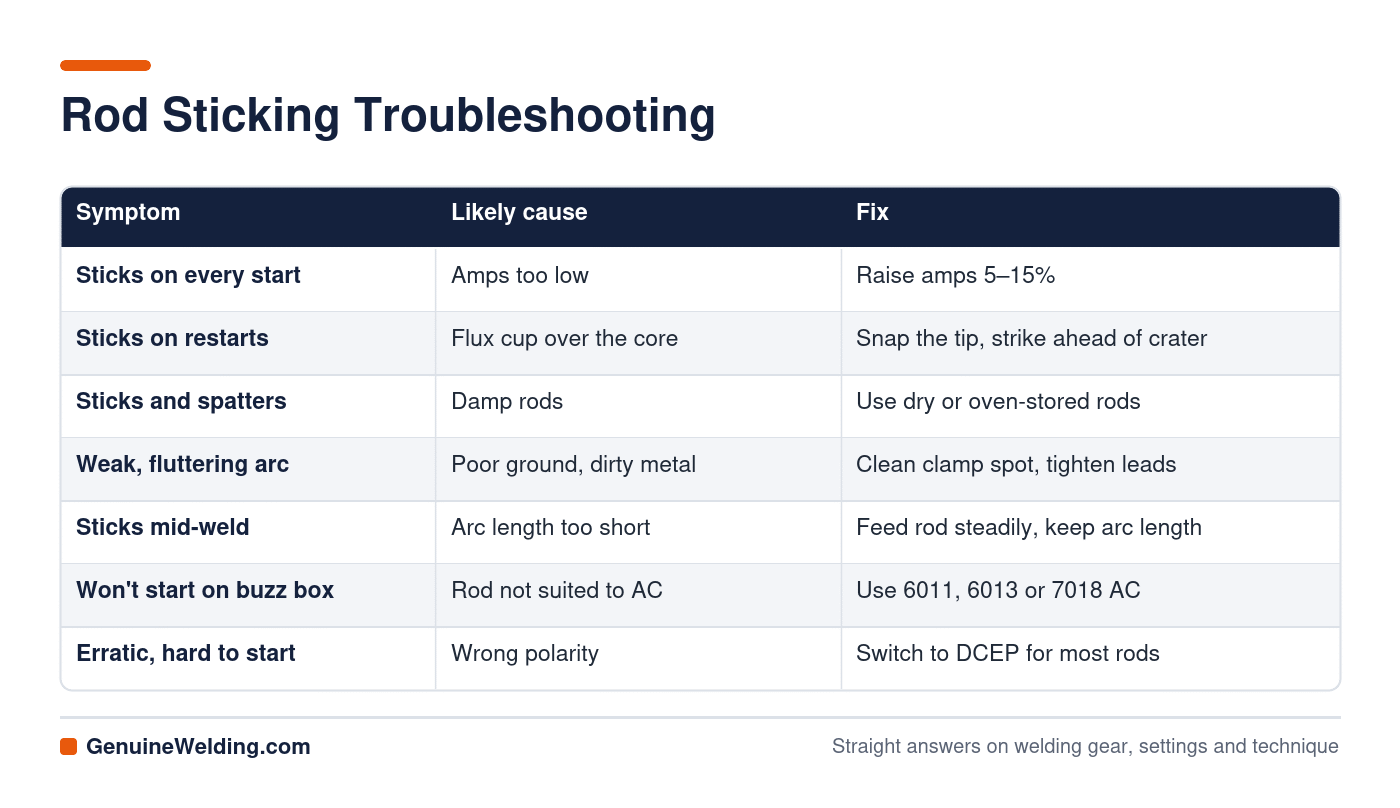
Troubleshooting Table
Is Rod Sticking Bad for the Welder?
Occasional sticking won’t hurt a welder, but holding a stuck rod for a long time is a dead short that heats the rod, stinger and leads, and can trip thermal protection. Release it quickly. If your machine has an anti-stick function, it reduces current automatically when the rod sticks.
For more stick welding help, see the SMAW welding guide and arc welding troubleshooting.
Stick Rod Sticking FAQs
Why does my 7018 rod keep sticking?
Usually low amps, damp rods, or a weak AC machine. Raise amps, use oven-dry rods, strike with a quick scratch, and consider 7018 AC rods on buzz boxes.
Why does my welding rod stick when restarting?
The flux at the tip forms an insulating cup after a weld. Snap or scrape the tip to expose fresh metal, and strike just ahead of the crater.
What is hot start on a stick welder?
A feature that briefly boosts current at the start of the arc to make striking easier and prevent sticking.
Does a longer arc stop sticking?
A slightly longer arc helps at the start, but too long an arc causes spatter, porosity and an unstable weld. Shorten it once the arc is established.
Should I use a smaller rod if it keeps sticking?
On a low-output machine, yes. A 3/32 in rod starts more easily than 1/8 in, especially on 120V welders.