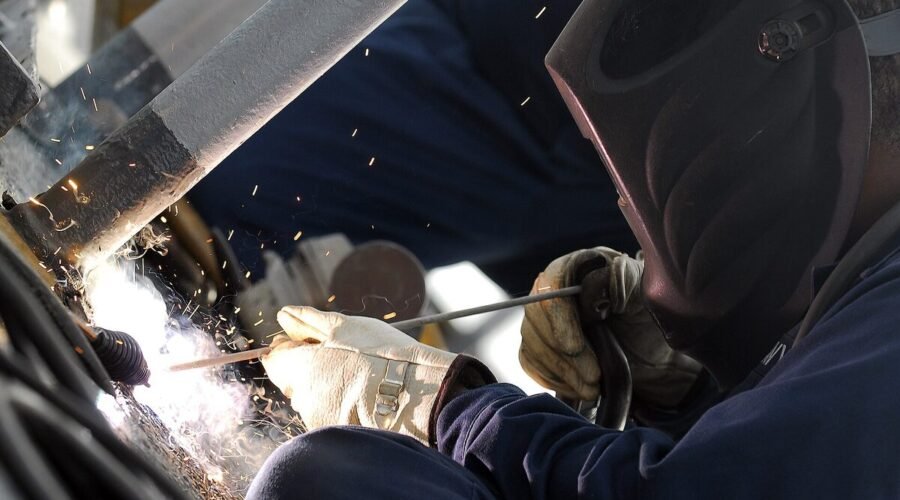
Welding slag is the glassy, brittle crust that forms on top of a weld made with a flux-shielded process such as stick (SMAW), flux-cored (FCAW) or submerged arc welding. The flux melts, floats to the surface, protects the molten weld from air and then hardens. Slag itself is normal; problems start when it gets trapped inside the weld (slag inclusion) or is hard to remove. You remove it with a chipping hammer and wire brush, and you prevent trapped slag with the right amps, angle, travel speed and cleaning between passes.
What Is Slag in Welding?
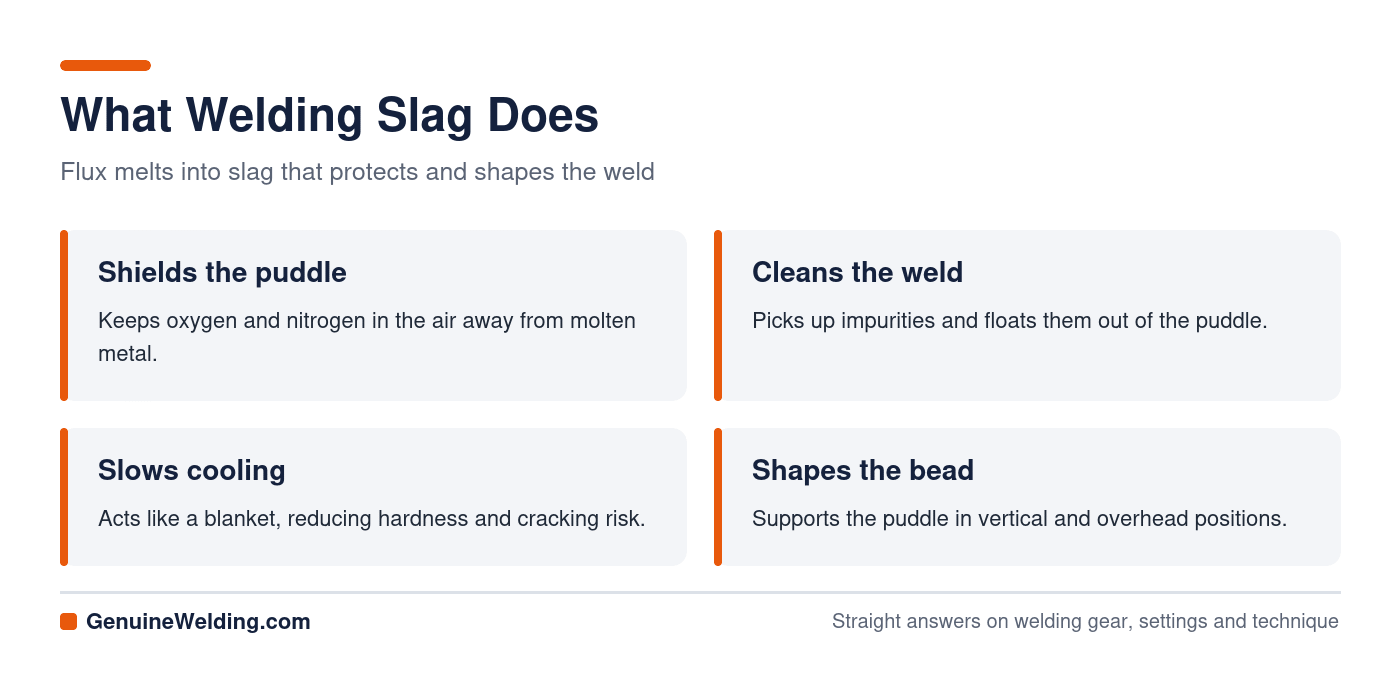
Stick electrodes and flux-cored wires carry flux, either as a coating on the outside of the rod or in the core of the wire. In the heat of the arc, the flux melts and does several jobs at once:
- Shields the puddle from oxygen and nitrogen in the air, which would otherwise cause porosity and brittle welds.
- Cleans the weld by combining with impurities and floating them out of the molten metal.
- Slows cooling, which reduces hardness and cracking risk.
- Shapes the bead, helping it lay flat or hold its shape in vertical and overhead positions.
- Adds alloys in some electrodes to boost strength or toughness.
Once the weld cools, the leftover flux becomes a hard layer of slag that has to be removed. Learn more about how flux works in what is flux in welding.
Which Welding Processes Produce Slag?
| Process | Slag? | Notes |
|---|---|---|
| Stick (SMAW) | Yes | Coating melts into slag; 7018 peels easily, 6010 leaves a thin, tight layer |
| Flux-cored (FCAW-S and FCAW-G) | Yes | Gasless wires make more slag; dual-shield slag usually peels well |
| Submerged arc (SAW) | Yes | Granular flux forms a thick slag blanket that often lifts off in one piece |
| MIG (GMAW) | Minimal | Small glassy “silicon islands” from deoxidizers, not true slag |
| TIG (GTAW) | No | Shielded only by gas; any “slag” usually means contamination |
Slag is also different from spatter (droplets of metal thrown from the arc) and dross (the resolidified metal left on the bottom of a plasma or torch cut). See our guide on reducing weld spatter.
How to Remove Welding Slag
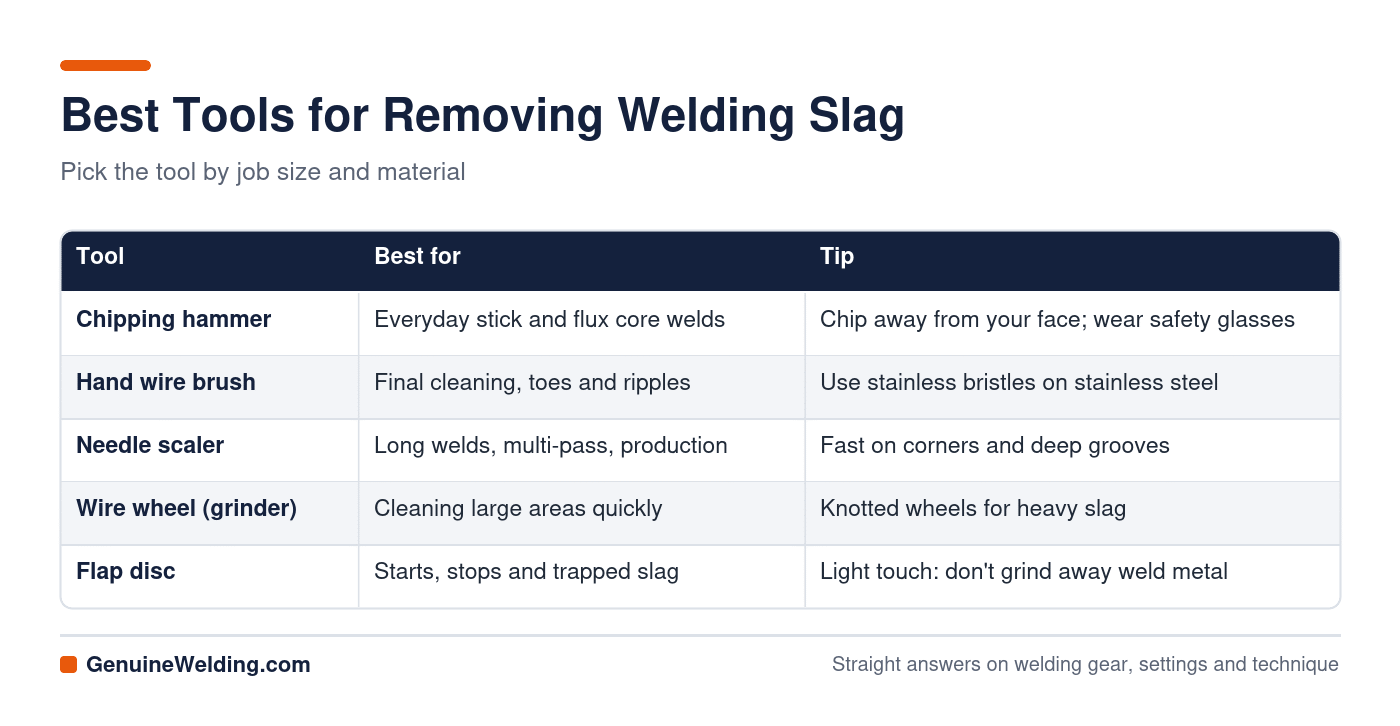
- Let it cool a few seconds. Slag often cracks and releases as it cools. Many 7018 and dual-shield beads peel off on their own.
- Chip it off. Tap along the bead with the chisel end of a chipping hammer, working away from your face.
- Wire brush the weld. Brush along the bead and the toes to remove loose pieces. Use a stainless brush on stainless steel so you don’t contaminate it with carbon steel.
- Use a needle scaler on long welds, multi-pass joints and stubborn slag. It is fast and reaches into corners.
- Grind only when needed. A flap disc or grinding wheel can clean trapped slag at starts and stops, but grinding too much removes weld metal.
- Inspect before the next pass. Every bit of slag must be gone before you weld over it.
Always wear safety glasses under your helmet when chipping. Hot slag flies off with surprising force and is a common cause of eye injuries. Our welding safety guide covers eye protection in detail.
Why Is My Slag Hard to Remove?
Slag that sticks like glue is a sign something in the technique or settings is off:
- Amperage too low: the weld is narrow and convex, and slag locks into the edges.
- Arc too long: slag mixes into the puddle; keep the arc length about the rod diameter.
- Bead too convex: undercut and overlap create notches that grab slag.
- Wrong electrode: some rods, such as 6010 and 6011, naturally leave a tighter slag than 7018 or 6013.
- Dirty metal: rust and mill scale make slag stickier.
Slag Inclusions: When Slag Gets Trapped
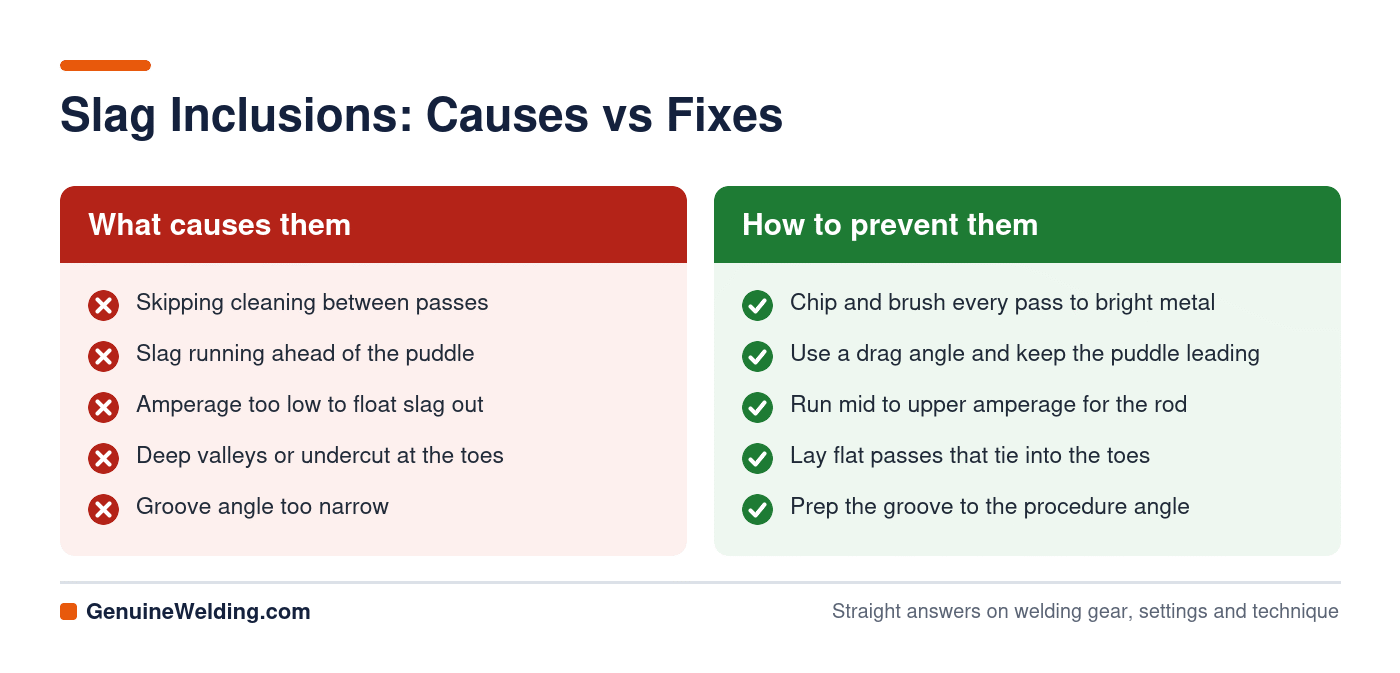
A slag inclusion is slag trapped inside the weld or between passes. It weakens the joint and is a common reason welds fail X-ray and bend tests. Inclusions usually come from:
- Not cleaning slag completely between passes
- Slag running ahead of the puddle because travel is too slow or the rod angle is wrong
- Deep valleys or undercut along the toes of previous passes
- Amperage too low to float slag out of the puddle
- Too narrow a groove angle that traps slag at the sidewalls
For testing methods and repair, see our detailed guide to slag inclusion in welds.
How to Prevent Slag Problems
- Use a drag angle of about 5 to 15 degrees with stick and gasless flux core so slag stays behind the puddle.
- Keep the puddle in the lead. If slag starts flowing in front of the arc, speed up or steepen your angle.
- Set enough heat. Run the middle to upper end of the electrode’s range for good fusion and fluid slag.
- Clean every pass back to bright metal, especially at the toes.
- Plan bead placement so each pass lays flat and leaves no deep valleys.
- Grind starts and stops on multi-pass and pipe welds.
- Use proper joint prep with a groove angle wide enough to reach the sidewalls.
Flux core users can find more help in flux core welding tips, and stick welders in stick welding tips.
Is Welding Slag Hazardous?
Slag is mostly a mix of oxides and silicates from the flux. It is not considered highly toxic in solid form, but it can be dangerous while hot, and chipping and grinding it creates dust. Wear eye protection, gloves and long sleeves, and control fumes and dust with ventilation. Dispose of slag with ordinary shop waste unless you weld coated or specialty metals that require special handling under local rules.
Welding Slag FAQs
Should welding slag come off easily?
With most 7018, 6013 and dual-shield flux-cored wires, yes. If slag is consistently hard to remove, check amperage, arc length and bead shape.
Do you have to remove slag after welding?
Yes, before welding another pass, painting or inspecting. Slag hides defects and paint will not stick to it.
Does MIG welding produce slag?
Solid-wire MIG produces only small glassy islands, not true slag. Flux-cored wire run in a MIG welder does produce slag.
What causes slag holes in welds?
“Slag holes” are usually slag inclusions that were exposed by grinding, or porosity mistaken for slag. Clean between passes and keep slag behind the puddle.
What is the best tool to remove slag?
A chipping hammer and wire brush handle most jobs. For production or heavy multi-pass welds, a pneumatic needle scaler is the fastest.