E71T-GS is a gasless (self-shielded) flux-cored welding wire for single-pass welds on mild steel. Under AWS A5.20, E means electrode, 7 means 70,000 psi minimum tensile strength, 1 means all positions, T means tubular (flux-cored), G means the polarity and operating characteristics are set by the manufacturer, and S means single-pass only. Most E71T-GS wires run on DCEN. It’s great for thin to medium steel repairs outdoors, but it isn’t meant for multi-pass, structural or code-quality welds.
E71T-GS is the wire that comes with most budget flux-core welders and fills the shelves at hardware stores. Knowing what the classification actually promises (and what it doesn’t) helps you use it well and know when to step up to a better wire.
What E71T-GS Means, Letter by Letter
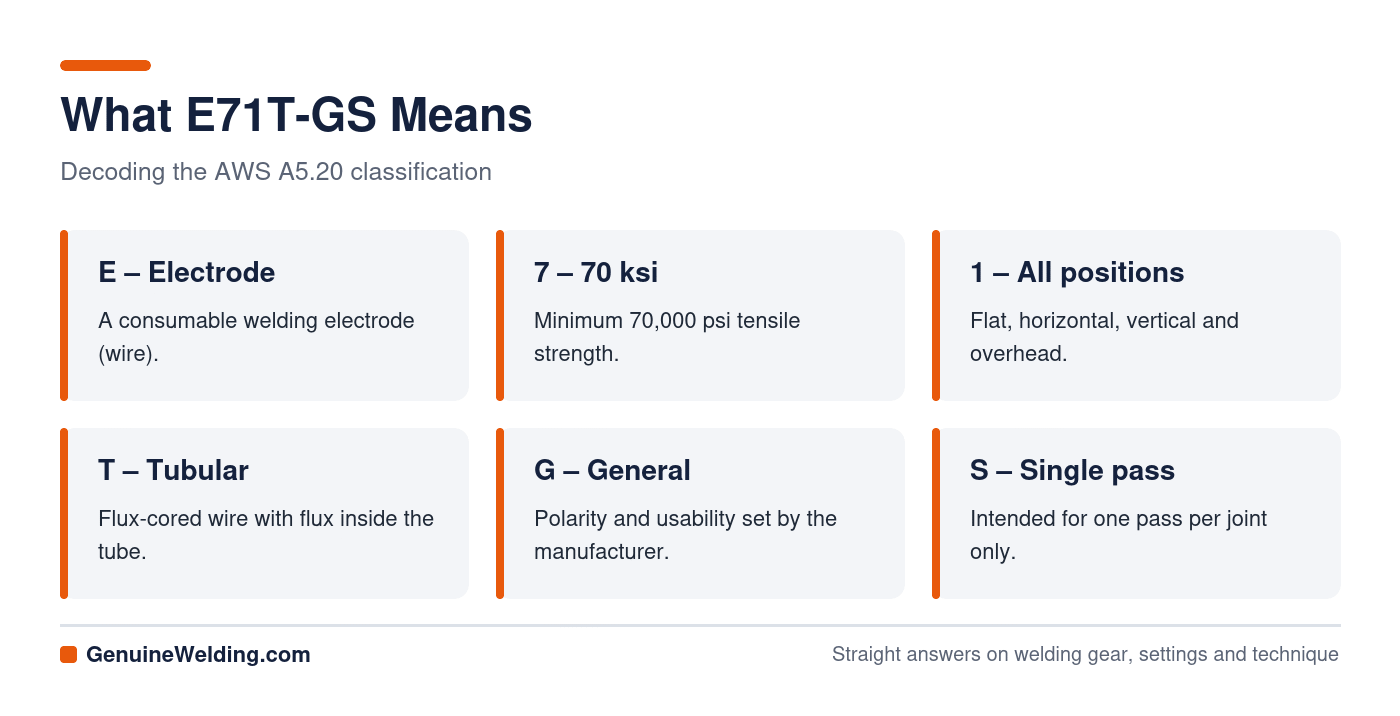
- E: electrode.
- 7: the weld metal has at least 70,000 psi (70 ksi, about 490 MPa) tensile strength.
- 1: usable in all positions: flat, horizontal, vertical and overhead. (A 0 would mean flat and horizontal only.)
- T: tubular, meaning a flux-cored wire.
- G: “general.” The usability (shielding, polarity and arc characteristics) isn’t defined by the AWS spec, so the manufacturer decides. Read the spool label for polarity and settings.
- S: single-pass only. The wire is tested and intended for one pass per joint.
For context on other wire and rod classifications, see flux-cored electrode classification and welding rod numbers explained.
Why Is E71T-GS Single-Pass Only?
Self-shielded flux-cored wires rely on strong deoxidizers (such as aluminum) in the core to protect the weld from air. In a single pass, that chemistry works well. In multiple passes, those elements build up in the weld metal and can make it brittle or prone to cracking. The “S” designation also means the AWS testing is limited: E71T-GS only has to meet a minimum tensile strength, with no requirements for yield strength, elongation or impact toughness.
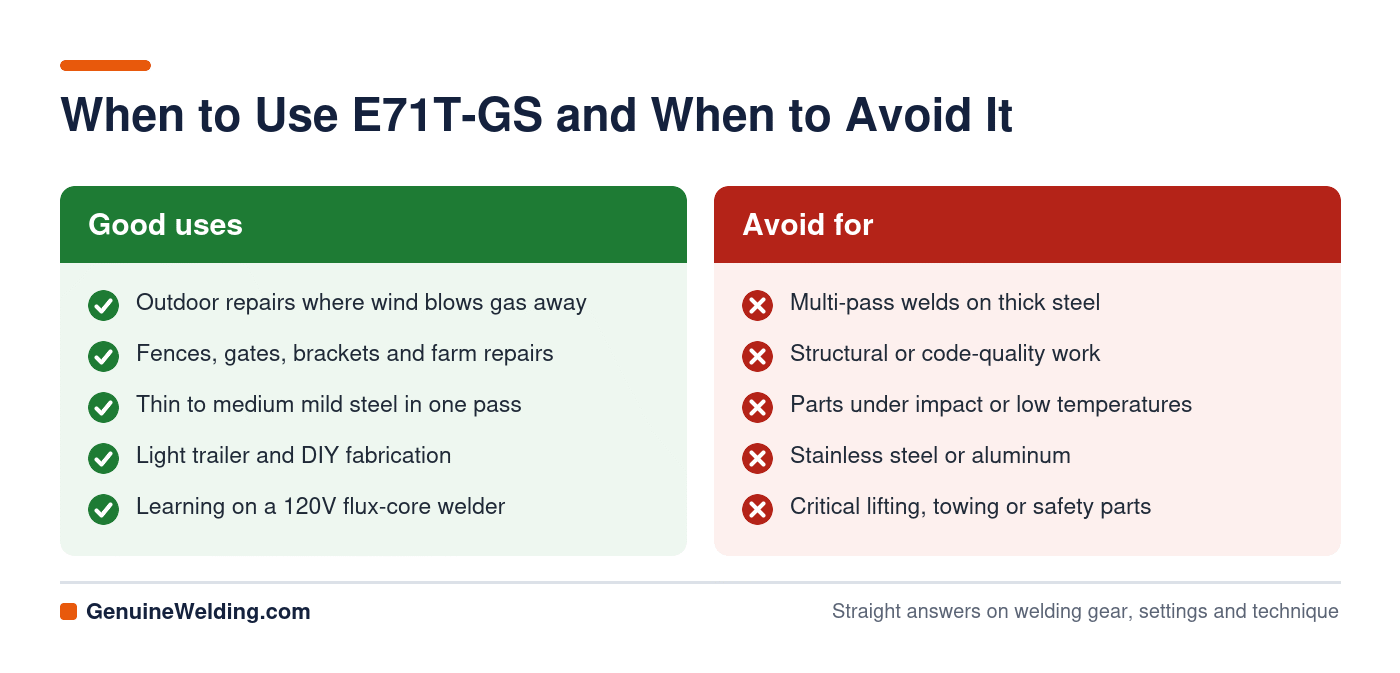
That’s why E71T-GS is fine for a fence repair or a trailer bracket, but not for structural steel, pressure work or anything where a code calls for tested toughness.
E71T-GS Polarity
Because the “G” leaves polarity to the manufacturer, always check the spool. Nearly all E71T-GS wires are designed for DCEN (electrode negative, gun lead to the negative terminal). DCEN puts more heat into the wire and less into the base metal, which helps on thin steel and reduces burn-through. On most MIG/flux-core machines you swap the polarity leads inside the machine or on the front panel when switching from gas MIG to gasless flux core. See welding polarity explained.
E71T-GS vs E71T-11 and Other Flux-Core Wires
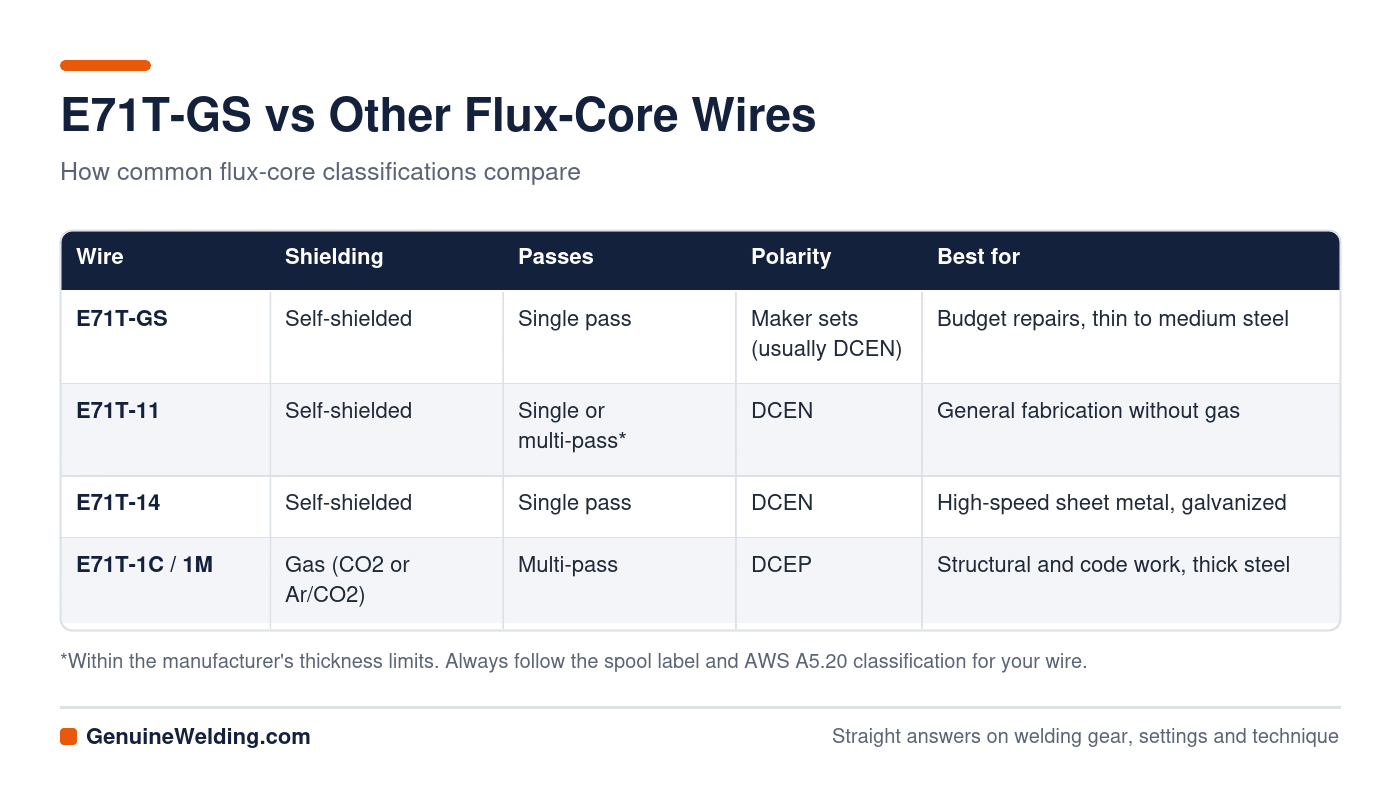
If you need multiple passes on thicker steel without gas, step up to an E71T-11 wire. For structural or code work, use a gas-shielded (dual-shield) wire such as E71T-1C/1M, or an all-position self-shielded wire with the required impact properties. Compare options in best flux core welding wires.
When to Use E71T-GS (and When Not To)
E71T-GS Settings and Technique
| Wire diameter | Typical steel thickness (single pass) | Notes |
|---|---|---|
| .030 in (0.8 mm) | About 18 gauge to 3/16 in | Best for 120V welders and thinner steel |
| .035 in (0.9 mm) | About 16 gauge to 1/4 in | All-around size for 120V and 240V |
| .045 in (1.2 mm) | Thicker steel on larger machines | Needs a 240V welder and a .045 tip and roller |
- Set DCEN polarity as the spool directs.
- Use knurled drive rolls and light drive-roll tension so the soft tubular wire isn’t crushed.
- Match the contact tip to the wire diameter. See MIG contact tips.
- Use a drag (pull) angle of about 10 to 15 degrees so slag stays behind the puddle.
- Keep stickout around 1/2 in (roughly 3/8 to 3/4 in). Too short causes spatter and tip burnback; too long makes a cold, porous weld.
- Clean the joint of heavy rust and paint for best results, even though flux core is more forgiving.
- Chip and brush the slag after welding. Since it’s single-pass wire, plan joints so one pass does the job.
Need more help? Read flux core welding settings and tips, .030 vs .035 flux core wire and flux core welding tips.
Storing Flux-Core Wire
Flux-cored wire can pick up moisture, which causes porosity and rough arcs. Keep unused spools in their sealed bags, and store open spools in a dry place or a sealed container with desiccant. Remove the spool from the welder if it will sit unused in a humid shop for weeks.
E71T-GS FAQs
Can you do multiple passes with E71T-GS?
It isn’t recommended. The wire is classified for single-pass welds; multiple passes can produce brittle, crack-prone weld metal. Use E71T-11 or a dual-shield wire for multi-pass work.
Is E71T-GS strong?
It meets a 70,000 psi minimum tensile strength, which is plenty for many repairs. But it has no required toughness or ductility, so it’s not suited to structural or impact-loaded parts.
Does E71T-GS need gas?
No. It’s self-shielded; the flux in the core produces the shielding. Adding shielding gas isn’t needed and isn’t recommended unless the manufacturer says so.
What polarity is E71T-GS?
Usually DCEN (electrode negative), but the “G” means the manufacturer decides, so always check the spool.
Can I weld galvanized steel with E71T-GS?
You can, but zinc fumes are hazardous. Remove the coating where possible and use strong ventilation. See how to weld galvanized steel safely.
Sources
- American Welding Society: AWS A5.20 Carbon Steel Electrodes for Flux Cored Arc Welding
- Material Welding: E71T-GS Welding Wire