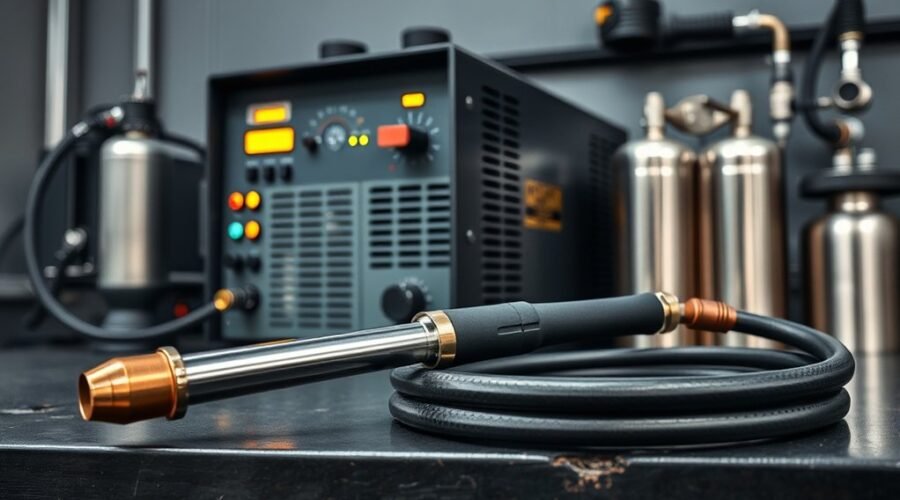
Plasma arc welding (PAW) equipment works as a matched system: the torch, power source, pilot-arc control, plasma gas, shielding gas, cooling, and joint setup all affect arc stability and weld quality. Microplasma, medium-current, and keyhole modes use the same basic principle, but their current range, nozzle bore, gas flow, and automation needs differ. The safest way to choose equipment is to start with the material, thickness, joint, and qualified welding procedure, then select components that the manufacturer approves for those conditions.
Quick Answer
Plasma arc welding equipment combines a constant-current power source, a specialized water-cooled torch with a recessed tungsten electrode and constricting copper nozzle, separate plasma and shielding gas circuits, and pilot-arc controls. Select the torch, nozzle, current, gas flow, cooling, and automation level as one matched system rather than as independent parts.
Key Takeaways
- PAW uses a recessed tungsten electrode and a constricting copper nozzle to produce a narrow, stable plasma arc.
- Microplasma is typically about 0.1–15 A, medium-current plasma about 15–200 A, and keyhole plasma generally above 100 A.
- Argon is the usual plasma gas; the shielding gas is supplied separately and may be argon or an application-approved mixture.
- Nozzle bore, electrode setback, plasma-gas flow, current, and cooling limits must be treated as a matched set.
- PAW equipment is not the same as plasma-cutting equipment; cutting features such as built-in air compressors do not determine PAW suitability.
How Plasma Arc Welding Equipment Works
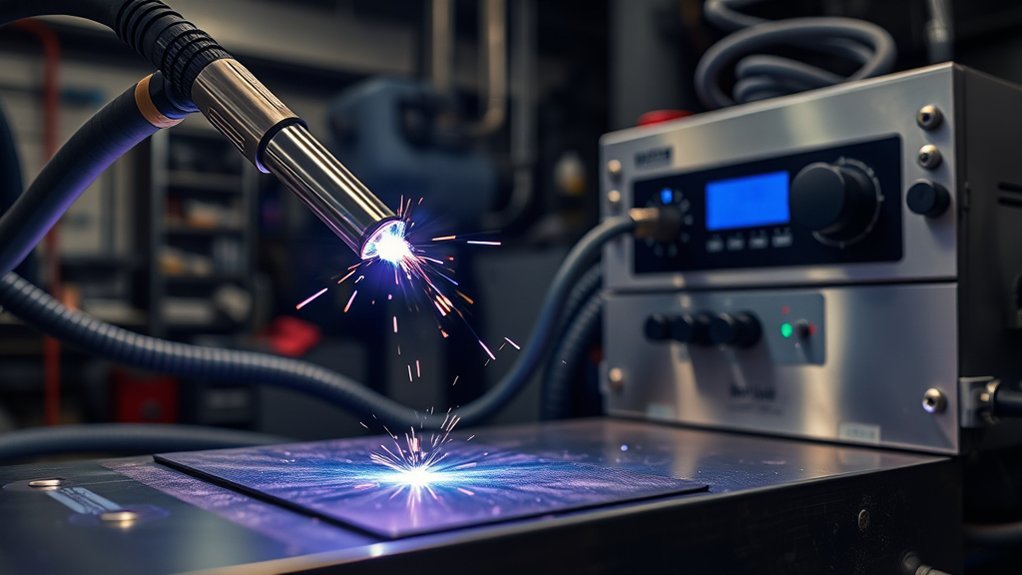
Plasma arc welding is closely related to TIG/GTAW, but the tungsten electrode sits back inside the torch behind a fine-bore, usually water-cooled copper nozzle. The nozzle constricts the arc into a narrow plasma column with higher energy density and greater directional stability than a conventional TIG arc.
The process normally starts with a low-current pilot arc between the tungsten electrode and the copper nozzle. When welding begins, the arc transfers to the workpiece. This design gives reliable starting while keeping the electrode protected inside the torch.
Published research shows that PAW arcs can reach temperatures above 20,000 °C, with values around 25,000 °C reported in reviews and about 28,000 K predicted in specific numerical models. The exact temperature is not a fixed equipment specification; it changes with current, gas, nozzle geometry, and operating mode.
PAW uses separate gas paths. Plasma gas flows through the constricting nozzle and forms the plasma jet. A second shielding gas surrounds the weld pool and protects it from the atmosphere. Argon is the most common plasma gas because it supports stable operation and low electrode/nozzle wear. Shielding gas may be argon or an application-approved mixture such as argon with a small amount of hydrogen for suitable materials.
The core PAW variables are linked: nozzle bore, electrode position, current, plasma-gas flow, and cooling capacity must stay within the torch maker’s approved operating window.
At higher current and plasma-gas flow, PAW can operate in keyhole mode. The concentrated arc opens a hole through the joint, and molten metal flows around it and closes behind the torch. TWI notes that keyhole PAW can make single-pass welds in stainless steel up to about 10 mm under suitable conditions, although thinner sections are more typical for routine single-pass work.
The nozzle geometry controls arc constriction, while the cooling circuit protects the torch and consumables during sustained use. If you also use plasma cutting equipment, dual-voltage plasma cutters are a separate equipment category; their input-voltage features should not be used as PAW torch or power-source selection criteria.
What You Need in a Complete Plasma Arc Welding Setup
| Component | What It Does | What to Check |
|---|---|---|
| Constant-current power source | Supplies welding current. | Approved current range, polarity, duty cycle, and compatibility with the PAW control unit. |
| Plasma control/pilot-arc unit | Controls pilot arc and plasma-gas functions. | Compatibility with the power source, torch, automation interface, and gas controls. |
| PAW torch | Holds the recessed tungsten electrode and constricting nozzle. | Current rating, nozzle sizes, electrode specification, manual or robotic format, and cooling requirement. |
| Plasma-gas circuit | Creates and shapes the plasma column. | Approved gas, purity, regulator, flow control, hose condition, and leak-free connections. |
| Shielding-gas circuit | Protects the molten pool from atmospheric contamination. | Material-compatible gas or mixture, flow rate, cup/nozzle coverage, and separate supply where the system requires it. |
| Cooling unit | Removes heat from water-cooled torch parts. | Coolant flow, return flow, temperature, leaks, and required cooling capacity. |
| Backing/purge equipment | Supports the root side and protects it where needed. | Joint-specific groove or backing design, underside shielding, and clearance for keyhole efflux. |
| Wire feed or automation | Adds filler and/or controls travel speed and torch position. | Stable wire delivery, synchronized travel, and repeatable torch-to-work distance. |
Current Fronius plasma systems illustrate this matched-system approach: the manufacturer combines a TIG-class power source and cooling unit with a plasma module and dedicated plasma torch, while its robot torches use separate connections for welding current/shielding gas, pilot arc/plasma gas, coolant supply, and coolant return.
Plasma Welding Modes and Current Ranges
| Mode | Typical Current | Typical Use |
|---|---|---|
| Microplasma | About 0.1–15 A | Foil, thin sheet, wire, mesh, and precision parts. |
| Medium current | About 15–200 A | Melt-in welding where a stiff, concentrated arc and deeper penetration than TIG are useful. |
| Keyhole plasma | Generally above 100 A | Mechanized full-penetration welding of thicker joints. |
These ranges overlap because the operating mode is not determined by amperage alone. Nozzle bore, plasma-gas flow, torch design, material, and joint thickness also determine whether the arc behaves as microplasma, melt-in plasma, or keyhole plasma.
Choose the Right Plasma Welding Torch
Select the torch around the application, not around a single amperage number. Start with material type, thickness, joint design, welding position, required penetration, production speed, and whether the job will be manual or mechanized.
The nozzle bore diameter is critical. A bore that is too small for the selected current and plasma-gas flow can overheat, erode, or melt. A bore that is too large can weaken arc constriction and make keyhole stability harder to maintain. Use the torch manufacturer’s nozzle/current/gas-flow chart rather than a generic rule.
Electrode setback also matters. The distance between the tungsten tip and plasma nozzle changes the permissible current and arc behavior. Modern robotic PAW manuals specify this dimension with setting gauges for each nozzle size, so it should be checked after consumable service rather than estimated by eye.
Torch maintenance is equally important. Inspect the tungsten tip, copper nozzle, centering parts, seals, hosepack, and cooling circuit at the intervals stated by the manufacturer. For mechanized production, small changes in nozzle wear or electrode position can change the penetration profile even when the machine settings have not moved.
Manual PAW is possible, especially at lower currents, but keyhole welding usually benefits from mechanized travel because current, gas flow, travel speed, torch position, and keyhole closure must stay closely balanced. If you also shop for plasma cutters, built-in air compressors improve cutting portability but are not a core PAW torch requirement.
Power Sources and Arc Stability
PAW normally uses a drooping or constant-current power source. That output characteristic helps hold current relatively steady as arc voltage changes. A dedicated plasma system may use its own power source, while some systems add a plasma-control module to a compatible TIG power source.
Older PAW references often cite open-circuit voltages around 70 V or higher, but that should not be treated as a universal modern purchase specification. Current equipment has manufacturer-specific voltage limits and starting systems. For example, current Fronius robot plasma-torch documentation lists a maximum permitted open-circuit voltage of 113 V for specific torch configurations. Match the torch, power source, and control unit by the manufacturer’s approved system data.
For most conventional PAW, DC electrode negative (DCEN) is standard. Aluminum is a special case because its oxide layer requires cleaning action. Modern aluminum PAW may use square-wave or variable-polarity operation with specialized equipment; a 2024 review describes variable-polarity PAW as an established method for aluminum and magnesium alloys. Do not assume a standard DC-only PAW package can provide this function.
Many current systems also monitor current, voltage, gas flow, coolant flow, and temperature. These controls improve repeatability, but they do not replace a qualified welding procedure or the equipment maker’s operating limits. Likewise, dual-voltage plasma cutters use different selection criteria from PAW power sources.
Plasma and Shield Gas Setup
PAW normally keeps plasma gas and shielding gas separate so each flow can be controlled for its own job. Argon is the usual plasma gas because it supports stable arc formation and gives low electrode and nozzle erosion. The shielding gas protects the molten pool and surrounding hot metal from atmospheric contamination.
A common shielding choice for suitable steels and nickel alloys is argon with a small hydrogen addition. TWI describes argon plus roughly 2–5% hydrogen as a normal shielding combination in PAW, while its equipment guide also discusses wider application-dependent ranges. Hydrogen-containing shielding gas is not appropriate for every alloy or code application, so the WPS, material requirements, and equipment manufacturer’s gas chart take priority.
Gas flow rates affect penetration, arc stiffness, keyhole behavior, surface quality, and consumable life. Too little plasma-gas flow for a given nozzle and current can promote double arcing and nozzle damage; excessive flow can destabilize the pool or keyhole. Set flow with a calibrated control and verify that hoses, regulators, and torch passages are clean and leak-free.
Pro Tip: Treat a nozzle change as a setup change. Recheck electrode setback, plasma-gas flow, current limit, coolant flow, and pilot-arc behavior before returning to production.
PAW gas control is different from oxy-fuel work, but general hot-work discipline still matters. If your shop also uses fuel-gas equipment, these oxy-acetylene safety practices cover a different process and should not be used as a substitute for PAW-specific gas and electrical procedures.
Cooling, Backing, and Automation
Many PAW torches are water-cooled. Cooling capacity and minimum coolant flow are part of the torch rating, not optional accessories. A blocked return line, weak pump, wrong coolant, or low flow can overheat the nozzle and torch body even when welding current appears to be within range.
Keyhole welding may also need a backing arrangement that leaves enough clearance below the joint for the plasma jet. TWI notes that if the efflux plasma strikes the backing bar, it can disturb the arc and weld pool and contribute to porosity. Root-side shielding or purge gas may also be required for reactive or oxidation-sensitive materials.
Automation improves repeatability when the process window is narrow. A mechanized carriage, robot, seam tracker, positioner, or synchronized wire feeder can control travel speed and torch position more consistently than manual motion. This is especially valuable for keyhole PAW, where small changes in travel speed or plasma-gas flow can close the keyhole or push the process toward burn-through.
Safe Setup and Startup
Warning: PAW combines electric-shock, intense UV/IR radiation, hot metal, compressed gas, fume, and fire hazards. OSHA requires appropriate controls and PPE for welding operations. Use trained personnel, adequate ventilation or local exhaust, proper eye/face and skin protection, secured gas cylinders, and the equipment manufacturer’s lockout/service procedures.
- Confirm the procedure. Identify the material, thickness, joint, filler, position, and required WPS or manufacturer starting parameters.
- Inspect the torch. Check the tungsten, nozzle, centering parts, seals, hosepack, and torch head for wear or damage.
- Verify cooling. Confirm the cooling unit is on, coolant can circulate, and the return path is not restricted.
- Connect gases correctly. Use the specified plasma gas and shielding gas, correct regulators, and leak-free lines. Do not assume one gas source can serve both circuits unless the system is specifically designed that way.
- Set the electrode and nozzle. Use the manufacturer’s gauge or specified setback for the installed nozzle.
- Set current and gas flow. Stay inside the approved operating window for that torch/nozzle combination.
- Purge and test. Purge the gas circuits as the manufacturer directs, establish the pilot arc, and verify stable transfer on a test coupon before production welding.
- Make one change at a time. If penetration or stability is wrong, adjust only within the WPS/manufacturer range and document the result.
Common Plasma Welding Problems and Fixes
| Problem | Likely Causes | What to Check |
|---|---|---|
| Pilot arc will not start | Missing/damaged tungsten, wrong electrode-to-nozzle distance, short circuit, gas problem, or start-control fault. | Electrode installation, setback, nozzle condition, gas supply, and control connections. |
| Nozzle overheats or wears fast | Too much current, too little plasma-gas flow, poor cooling, damaged nozzle, or wrong electrode position. | Torch loading chart, coolant flow, gas flow, nozzle bore, and electrode setback. |
| Porosity or contamination | Poor shielding, leaks, dirty joint, wrong gas, disturbed backside protection, or backing-bar interference. | Gas coverage, gas purity, leaks, surface preparation, purge/backing arrangement, and nozzle condition. |
| Unstable keyhole | Current, plasma flow, travel speed, stand-off, or joint fit-up outside the process window. | Return to qualified starting values, verify fit-up, then tune one variable at a time. |
| Incomplete penetration | Low heat input, low plasma force, excessive travel speed, poor fit-up, or oversized nozzle for the setup. | Current, gas flow, travel speed, nozzle selection, joint preparation, and torch alignment. |
| Burn-through or excessive undercut | Excess current/gas force, slow travel, poor keyhole closure, or incorrect joint preparation. | Reduce parameters only within the WPS range, stabilize travel, and verify slope-out/keyhole-closing settings. |
Do not confuse the PAW pilot arc with a plasma cutter’s stand-off or non-contact cutting feature. A cutting product such as the non-contact pilot arc is designed for cutting behavior, not as a specification for a plasma welding torch.
Frequently Asked Questions
What gas is used in a plasma welding torch?
Argon is the usual plasma gas in PAW. The shielding gas is supplied separately and may be argon, argon-hydrogen for suitable materials, or another manufacturer/WPS-approved mixture. Helium can be used in some applications, but it changes arc behavior and can reduce the nozzle’s current capacity when used as plasma gas.
How much does a plasma welding torch cost?
There is no universal price. Dedicated PAW torches are industrial equipment and can cost well into four figures before the power source, controller, cooler, regulators, and automation are added. As of September 2026, Castolin Eutectic’s UK webshop lists several plasma hand torches from roughly £1,300 to a little over £3,100 before model-specific options. Always price the complete compatible system, not just the torch body.
Are all plasma welding torches the same?
No. Torches differ in current rating, cooling, nozzle sizes, tungsten size, electrode setback, manual or robotic design, hosepack connections, pilot-arc system, gas-flow limits, and supported welding modes. Use a torch that is approved for the power source/control package and the required process window.
What are the downsides of plasma arc welding?
PAW equipment is more complex than TIG because the torch has a constricting nozzle, separate gas control, pilot-arc hardware, and often water cooling. Consumable condition and electrode setback need close attention. Keyhole PAW also has a narrower process window and is commonly mechanized. Its strength is precision—including on very thin material in microplasma mode—so thin sheet itself is not a general disadvantage.
Can I use a plasma cutting torch for plasma arc welding?
Not unless the manufacturer specifically designed the system for both functions. Plasma cutting and PAW use different torch geometry, gas strategy, controls, arc behavior, and consumable design. A cutting torch with compressed air or a cutting pilot arc should not be assumed to be suitable for welding.
Is plasma arc welding better than TIG?
Neither process is universally better. PAW offers a stiff, concentrated arc, good low-current stability, and keyhole capability, while TIG is simpler, widely available, and often easier to set up manually. The better choice depends on material, thickness, required penetration, production volume, operator skill, and equipment budget.
Conclusion
Plasma arc welding equipment performs best when the torch, nozzle, electrode position, power source, plasma gas, shielding gas, cooling, and travel system are treated as one process. Microplasma, medium-current, and keyhole modes cover very different jobs, so generic amperage or voltage rules are not enough. Start with the material and joint, use the manufacturer’s torch-loading data and an approved welding procedure, and verify gas flow, cooling, and consumable condition before welding. That approach gives PAW its main advantage: a concentrated, repeatable arc without relying on guesswork.
Sources
- TWI — Plasma Arc Welding — operating modes, current ranges, gas choices, power-source characteristics, keyhole behavior, and applications.
- TWI — Equipment for Plasma Welding — torch design, nozzle selection, electrode setup, gas flow, backing systems, and protective equipment.
- Fronius — Robacta PTW Plasma Welding Torch Instructions — current equipment connections, cooling, electrode setup, loading limits, and troubleshooting.
- OSHA — Welding, Cutting, and Brazing: Hazards and Solutions — welding fume, UV radiation, burns, electrical shock, PPE, and ventilation controls.
- Journal of Manufacturing Processes (2024) — Variable Polarity Plasma Arc Welding Review — current review of variable-polarity PAW for aluminum and magnesium alloys.