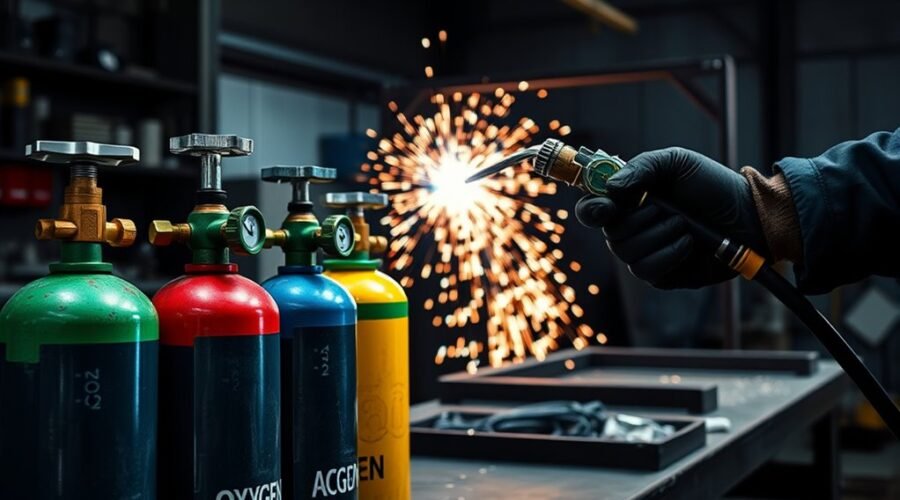
Welding gases protect the molten weld pool, influence arc behavior, and can change penetration, bead shape, spatter, and travel speed. There is no single best gas for every job. The right choice depends on the welding process, base metal, filler wire or rod, material thickness, transfer mode, and work environment.
Quick Answer
Welding gas choice depends on both the process and the metal. For TIG, 100% argon is the most common starting point. For MIG on mild steel, 75% argon/25% CO2 is a common all-purpose mix, while 100% CO2 gives deeper penetration but more spatter. Aluminum commonly uses argon, with helium added when more heat is needed.
Key Takeaways
- Shielding gases keep atmospheric oxygen, nitrogen, and moisture away from the hot weld area and help reduce porosity, oxidation, and other defects.
- 100% argon is a common TIG gas and a standard choice for many aluminum MIG and TIG applications.
- A 75% argon/25% CO2 mix is widely used for short-circuit MIG welding mild steel, while 100% CO2 generally produces deeper penetration with more spatter.
- Helium increases heat transfer and can help on thicker non-ferrous material; oxygen, hydrogen, and nitrogen are normally used only in carefully selected blends or specialized applications.
- Gas cylinders must be secured and handled correctly, and adequate ventilation is essential because shielding gases can displace oxygen.
What Do Welding Gases Do?
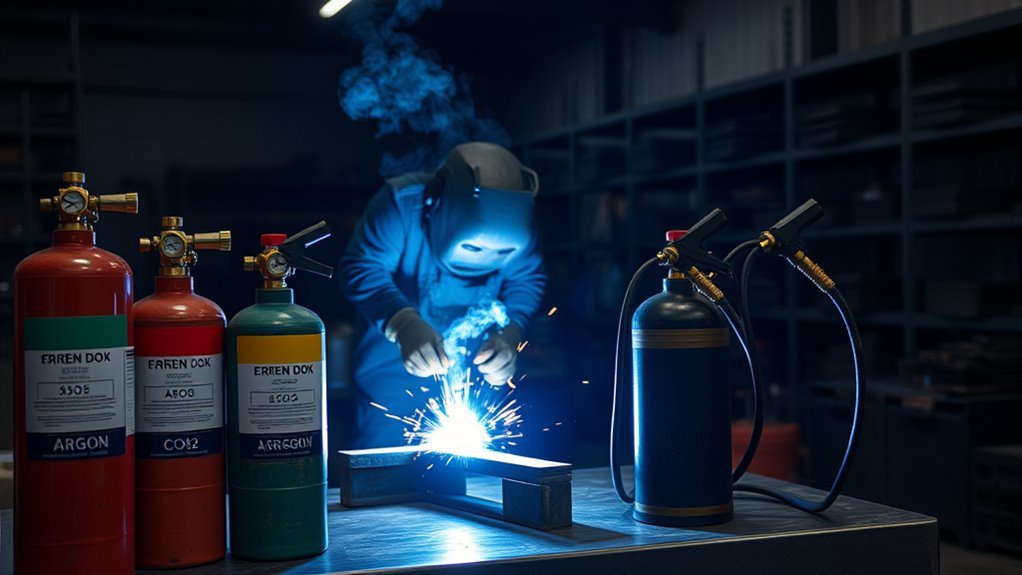
Welding gases used for shielding create a protective atmosphere around the arc and molten weld pool. This limits contact with air while the metal is hot and helps reduce porosity, oxidation, unstable arc behavior, and other weld defects.
Inert gases such as argon and helium are chemically nonreactive under normal welding conditions. Reactive gases such as carbon dioxide, and small additions of oxygen in selected mixtures, can deliberately change arc characteristics, heat transfer, penetration, and bead wetting.
Gas composition also influences metal transfer in MIG welding. For example, a 75/25 argon-CO2 mix is a common MIG choice for mild steel, while different transfer modes and materials may need higher-argon or specialized mixtures.
Miller’s mild-steel MIG guidance notes that 75% argon/25% CO2 provides good all-around performance, while 100% CO2 gives deeper penetration but typically creates more spatter and a rougher bead.
Gas flow matters as much as gas type. Too little flow may leave the weld pool exposed. Excessive flow can create turbulence that pulls surrounding air into the shielding envelope, so simply turning the flow higher is not always better.
Note: There is no universal shielding-gas flow setting. Nozzle size, torch design, welding current, joint geometry, indoor drafts, outdoor wind, and the equipment manufacturer’s recommendations all affect the correct flow.
Shielding Gases vs Fuel, Purge, and Process Gases
The phrase welding gas can describe several different jobs, so it helps to separate them.
- Shielding gases: Argon, helium, carbon dioxide, and carefully selected mixtures protect the arc and weld pool in processes such as MIG, TIG, and gas-shielded FCAW.
- Active gas additions: Small amounts of CO2 or oxygen may be blended with argon to change arc behavior, wetting, penetration, and metal transfer. Oxygen is not normally used by itself as a shielding gas.
- Fuel gases: Acetylene and other fuel gases are burned with oxygen for oxy-fuel welding, brazing, heating, and cutting. They perform a different job from MIG or TIG shielding gas.
- Purge or backing gases: Argon, nitrogen, helium, and specialized mixtures may protect the back side or root of certain welds from oxidation.
- Specialized process gases: Nitrogen and hydrogen appear in selected welding and cutting applications, but material compatibility and the qualified procedure matter because the wrong mixture can create metallurgical problems.
What Are the Main Types of Welding Gas?
The most familiar welding gases are argon, carbon dioxide, helium, oxygen, nitrogen, hydrogen, and acetylene, but they do not all serve the same purpose.
- Argon: An inert gas that provides easy arc starting and stable shielding. It is widely used for TIG and for MIG welding aluminum and other non-ferrous metals.
- Carbon dioxide: An active shielding gas used with steel. It is inexpensive and can provide strong penetration, but it usually creates more spatter than common argon-CO2 blends.
- Helium: An inert gas with high thermal conductivity. Adding helium can increase heat input, travel speed, and penetration, especially on thicker aluminum, copper, and other non-ferrous materials.
- Oxygen: Used only in small percentages in selected shielding-gas blends. It can improve arc stability and wetting, but too much oxidation can damage weld properties or corrosion resistance.
- Nitrogen: Used in selected purge, stainless, duplex, and cutting applications. It is not a universal substitute for argon.
- Hydrogen: Used in carefully controlled specialty blends for certain stainless or nickel applications. It can cause porosity or hydrogen-related problems in unsuitable metals.
- Acetylene: A fuel gas used with oxygen for oxy-acetylene welding, brazing, heating, and cutting. It is not a MIG or TIG shielding gas.
- Mixed gases: Argon-CO2, argon-helium, argon-oxygen, and multi-component mixtures are used to tune arc stability, penetration, wetting, heat input, and transfer characteristics.
Gas choice is also tied to the capabilities of the machine. A multi-process welder may support several processes, but each process still requires the correct shielding setup, filler metal, polarity, and operating parameters.
Which Welding Gas Is Best for Each Process?
The best welding gas depends on both the process and the base metal. The table below shows common starting points rather than universal rules. Always follow the filler-metal manufacturer, machine chart, welding procedure specification, or qualified procedure when one applies.
| Process / Material | Common Gas | What to Know |
|---|---|---|
| MIG, mild steel | 75% Ar / 25% CO2 | Common all-purpose choice for short-circuit transfer with good bead appearance and relatively low spatter. |
| MIG, mild steel | 100% CO2 | Economical and gives strong penetration, but typically produces more spatter and a rougher arc than argon-rich blends. |
| MIG, aluminum | 100% argon | Most common general-purpose choice. Argon-helium mixtures can increase heat input on thicker sections. |
| TIG, many metals | 100% argon | The most common starting gas for TIG because it provides stable shielding and easy arc starting. |
| TIG, thicker non-ferrous material | Argon-helium blend | Helium can increase heat transfer and penetration when more heat is useful. |
| MIG, stainless steel | Low-O2 or low-CO2 argon blend; some applications use tri-mix | The correct blend depends on transfer mode, stainless grade, wire, thickness, and procedure. A carbon-steel C-25 mix should not automatically be assumed suitable. |
| Gas-shielded FCAW | 100% CO2 or Ar/CO2 | Use the gas listed for the specific flux-cored wire. |
| Self-shielded FCAW | No external shielding gas | The flux inside the wire generates the shielding needed around the arc. |
| Oxy-fuel welding / cutting | Oxygen + fuel gas such as acetylene | This is a combustion process, not shielding-gas welding. |
The gas must match the process, metal, filler, and transfer mode. A gas that works well for aluminum TIG may perform poorly in carbon-steel MIG, even though both applications use an electric arc.
For MIG welding mild steel, 75% argon/25% CO2 is widely used because it provides stable short-circuit transfer, good bead appearance, and less spatter than straight CO2. Pure CO2 remains a practical lower-cost option when deeper penetration is useful and additional spatter is acceptable.
Pure argon by itself is generally not the normal choice for solid-wire MIG welding carbon steel because the arc and bead profile are less suitable than with an active argon-based blend. Linde’s GMAW guidance explains how argon-based gases use controlled CO2 or oxygen additions for carbon and high-alloy steels.
For TIG welding, 100% argon is the most common starting point on carbon steel, stainless steel, aluminum, and many other metals. It is not the only option. Linde’s TIG guidance also describes argon-helium mixtures and specialized blends used for particular materials and production goals.
For aluminum MIG and TIG, 100% argon is widely used. Adding helium can increase heat transfer and help on thicker sections where additional heat and penetration are useful.
For stainless steel MIG, use a mixture specified for stainless and the intended transfer mode. Low percentages of oxygen or carbon dioxide in an argon-rich mixture can improve arc behavior and wetting, while some short-circuit applications use helium-containing tri-mixes. For stainless TIG, pure argon is a common choice; specialized mixtures should be used only when appropriate for the alloy and procedure.
For flux-cored welding, first determine whether the wire is gas-shielded or self-shielded. Gas-shielded FCAW commonly uses CO2 or an argon-CO2 blend. Self-shielded FCAW needs no external shielding-gas cylinder, which can make it useful where wind would otherwise disturb gas shielding.
If you are still choosing equipment as well as gas, this beginner welder guide provides additional context on process selection.
How Do You Choose the Right Welding Gas Blend?
Choose a welding gas blend by matching it to the base metal, process, filler metal, material thickness, transfer mode, desired bead characteristics, and work environment. Cost matters, but the cheapest gas may create more cleanup, spatter, rework, or unsuitable weld characteristics.
- Mild steel: 75/25 argon-CO2 is a common all-purpose short-circuit MIG mixture. Higher-argon blends may be required for other transfer modes.
- Aluminum: Argon is the standard general-purpose choice; argon-helium blends can add heat on thicker material.
- Stainless steel: Choose a stainless-specific mixture based on MIG or TIG process, transfer mode, alloy, and filler recommendation.
- Thicker non-ferrous material: Helium-containing mixtures can increase heat transfer and penetration.
- High-volume carbon-steel work: CO2 can reduce shielding-gas cost, but increased spatter and bead appearance may affect total job cost.
- Outdoor work: Wind can strip shielding gas from the weld area. A wind screen may help, but self-shielded FCAW is often better suited to genuinely windy conditions than simply increasing gas flow.
The machine’s output range also affects the practical choice. For example, this Hobart Handler 140 vs Lincoln 140 comparison shows why welder capacity and material thickness need to be considered alongside gas and wire selection.
How Do You Know If Shielding Gas Flow Is Wrong?
Porosity or inconsistent shielding does not automatically mean you need more gas. Check the whole gas path before changing settings.
- Too little flow: The weld pool may be exposed to air, increasing porosity and oxidation.
- Too much flow: Turbulence can pull surrounding air into the shielding stream.
- Drafts or wind: Even a normal flow rate may fail if moving air pushes the shield away from the arc.
- Leaks: Loose fittings, damaged hoses, worn seals, or regulator problems can reduce the gas reaching the torch.
- Blocked or dirty nozzle: Spatter buildup can disturb the gas pattern around a MIG weld.
- Wrong gas for the process: A perfectly leak-free system can still perform badly if the gas does not match the wire, transfer mode, or base metal.
Pro Tip: When porosity suddenly appears, inspect the nozzle, hose, regulator connections, cylinder valve, drafts, and actual gas flow before increasing the flowmeter setting.
How Do You Store and Handle Welding Gas Safely?
Compressed welding-gas cylinders contain significant stored energy and must be handled as pressure vessels. Requirements vary by location and workplace, so follow the cylinder supplier, equipment manufacturer, Safety Data Sheet (SDS), and applicable workplace regulations.
Warning: Argon, helium, nitrogen, and similar gases can displace breathable oxygen without producing a warning odor. Never assume an inert gas is harmless in a confined or poorly ventilated space. Confined-space welding requires appropriate ventilation, atmospheric controls, and workplace procedures.
For applicable U.S. construction work, OSHA 29 CFR 1926.350 includes detailed requirements for moving, storing, and using compressed-gas cylinders.
- Secure cylinders: Keep cylinders properly restrained so they cannot be knocked over. OSHA construction rules generally require compressed-gas cylinders to be secured upright except for limited handling situations.
- Protect the valve: Keep the valve-protection cap installed when required during storage or movement, and never lift a cylinder by the cap.
- Use a cylinder cart: Move cylinders with equipment designed for cylinder transport instead of dragging, dropping, or rolling them carelessly.
- Close the valve: Close cylinder valves when work is finished, when the cylinder is empty, and before appropriate movement or service.
- Keep cylinders away from welding hazards: Place them where sparks, slag, flame, hot metal, electrical circuits, and physical impacts cannot damage them.
- Separate oxygen and fuel gas when required: OSHA construction rules require stored oxygen cylinders to be separated from fuel-gas cylinders or combustible materials by at least 20 feet, or by an approved noncombustible barrier meeting the regulation.
- Keep oil and grease away from oxygen: Oxygen valves, regulators, fittings, and cylinders must not be contaminated with oil or grease.
- Provide ventilation: Prevent accumulation of shielding gases and welding fumes, especially in pits, tanks, enclosed rooms, and other restricted spaces.
Before use, inspect the regulator, hose, fittings, and torch. A manufacturer-approved leak-detection solution or appropriate soap-and-water solution can reveal a leak when bubbles form. Do not continue using damaged equipment or a leaking connection until the problem has been corrected safely.
OSHA’s general welding requirements also address ventilation and exposure to hazardous welding fumes and gases. Shielding gas protects the weld, but it does not protect the welder’s lungs from welding fume.
If your shop also uses gas-fed cutting equipment, the process-gas setup and safety requirements can differ from welding. This existing guide to budget plasma cutters covers another common metalworking process where equipment-specific gas requirements matter.
Frequently Asked Questions
How to Choose the Right Welding Gas for a Specific Project?
Start with the welding process, base metal, filler metal, material thickness, and transfer mode. Then check the wire or electrode manufacturer’s gas recommendation and your welder’s setup chart. For common mild-steel MIG, 75% argon/25% CO2 is a typical starting choice; TIG commonly starts with 100% argon, while aluminum MIG commonly uses argon.
Why Do Welders Drink Milk After Welding?
Drinking milk after welding is an old workplace tradition, but milk does not protect the lungs from welding fumes or prevent metal-fume fever. Cancer Council Australia notes that there is no scientific evidence that milk prevents the harmful effects of welding fumes. Proper controls include reducing fume generation, local exhaust ventilation, adequate general ventilation, and suitable respiratory protection when required.
What Are the Different Types of Welding Gases Used?
Common welding-related gases include argon, helium, carbon dioxide, oxygen, nitrogen, hydrogen, and acetylene. Argon, helium, and CO2 are used mainly for shielding or shielding-gas mixtures. Oxygen can be a small active addition or part of an oxy-fuel process. Nitrogen and hydrogen have specialized uses, while acetylene is a fuel gas rather than a MIG or TIG shielding gas.
Is It Better to Weld With Argon or CO2?
Neither is universally better. For carbon-steel MIG, 100% CO2 is economical and provides strong penetration but usually causes more spatter. Pure argon is normally not the preferred gas for solid-wire carbon-steel MIG. An argon-CO2 mixture such as 75/25 is a common compromise. For TIG and aluminum MIG, argon is far more commonly used than CO2.
Can You MIG Weld Mild Steel With 100% Argon?
A MIG arc may be established on mild steel with pure argon, but it is generally not the recommended shielding gas for conventional solid-wire carbon-steel MIG. The arc and bead profile are usually less suitable than with an active argon-CO2 or argon-oxygen blend. Follow the wire manufacturer’s recommended gas.
What Gas Is Commonly Used for TIG Welding Stainless Steel?
100% argon is a common shielding gas for TIG welding stainless steel because it gives stable shielding and predictable arc behavior. Specialized argon-helium, argon-hydrogen, or other mixtures can be used for particular alloys and production requirements, but they should be selected for the specific procedure rather than treated as universal substitutes.
Can Welding Shielding Gas Cause Suffocation?
Yes. Inert shielding gases such as argon and helium can displace oxygen, especially in confined or poorly ventilated spaces. They may create a dangerous oxygen-deficient atmosphere without an obvious odor or irritation warning. Follow confined-space procedures and applicable ventilation and atmospheric-monitoring requirements.
Conclusion
Choosing the right welding gas means matching the gas to the process, base metal, filler, thickness, and transfer mode. Argon is the most common starting point for TIG and many aluminum applications, 75/25 argon-CO2 is a common mild-steel MIG choice, CO2 offers economical penetration with more spatter, and helium can add heat for thicker non-ferrous work. Correct gas flow, sound equipment, adequate ventilation, and safe cylinder handling are just as important as choosing the gas itself.
Sources
- OSHA 29 CFR 1926.350 — Gas Welding and Cutting — cylinder transport, securing, valve protection, oxygen/fuel-gas separation, and handling requirements.
- OSHA 29 CFR 1910.252 — General Welding Requirements — ventilation, confined-space precautions, welding fumes, and gases.
- Miller — MIG Welding Mild Steel — 75/25 argon-CO2 and 100% CO2 characteristics.
- Linde — Gas Metal Arc Welding — GMAW shielding-gas components, reactive additions, and application ranges.
- Linde — TIG Welding — argon, helium, argon-helium, and specialized TIG shielding mixtures.
- Cancer Council Australia — Milk and Welding Fumes — evidence-based correction of the milk-protection myth.