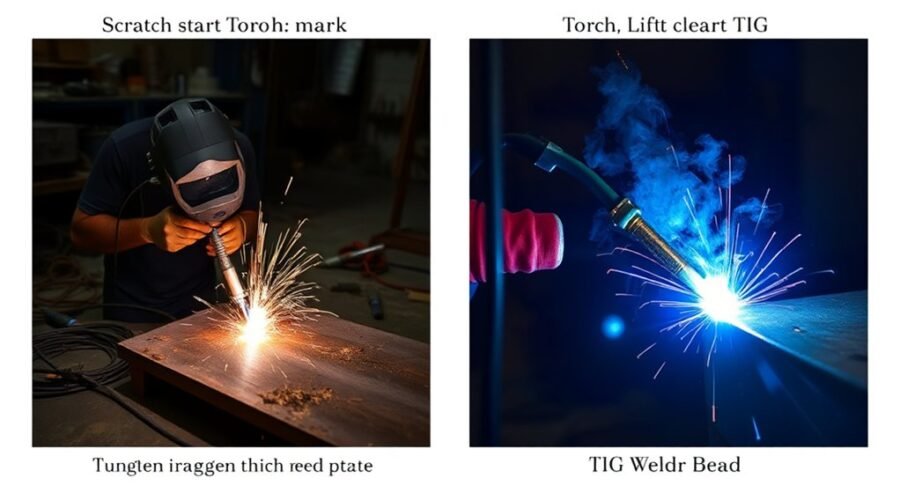
Scratch Start TIG and Lift Arc TIG both use contact with the workpiece to begin a TIG arc, but the similarity ends there. Scratch Start relies on physically striking or dragging the tungsten to establish the arc, while a true Lift Arc system electronically controls the brief contact before the torch is lifted. That difference affects starting cleanliness, tungsten life, ease of use, and the type of equipment you need.
Quick Answer
Lift Arc TIG is generally easier and cleaner to start than Scratch Start TIG because the tungsten only touches the work briefly under controlled starting conditions. Scratch Start is simpler and works with some basic DC constant-current setups, but it carries a higher risk of tungsten sticking, surface marking, and start-related contamination.
Key Takeaways
- Scratch Start TIG establishes the arc by touching and moving the energized tungsten across the workpiece, which increases the chance of sticking or contaminating the electrode.
- Lift Arc uses a controlled touch-and-lift sequence and is designed to reduce start-related tungsten contamination.
- Lift Arc improves the starting sequence, but it does not automatically make the welding puddle stable after the arc is established.
- High-frequency TIG is a third option that can start the arc without touching the workpiece.
- Your material, power source, polarity, AC/DC capability, control requirements, and manufacturer instructions should determine which start method you use.
What Is Scratch Start TIG?
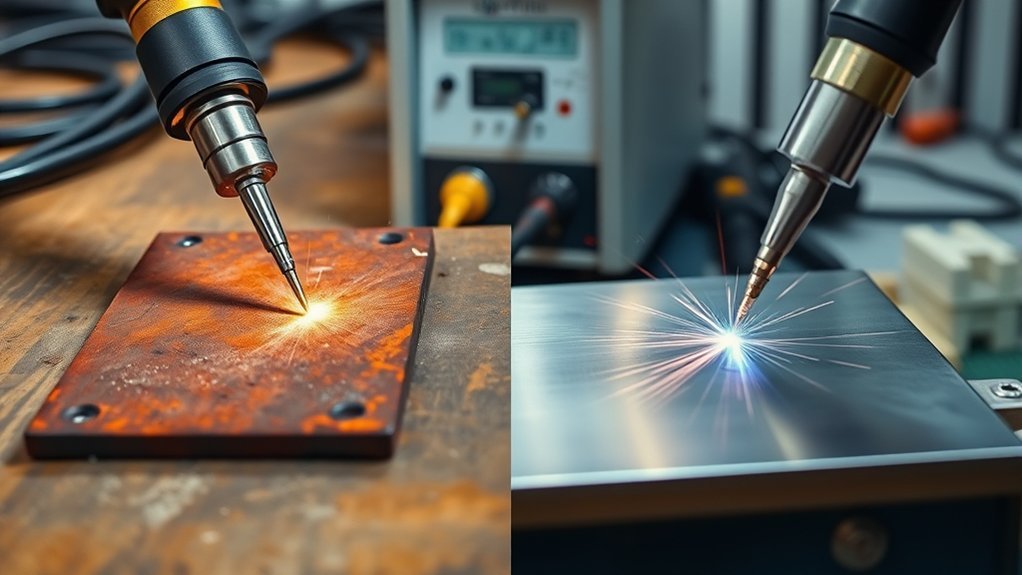
Scratch Start TIG is an arc initiation method in which the tungsten electrode is brought into contact with the workpiece and moved enough to establish an arc, much like striking a match. Once the arc forms, the operator immediately lifts the torch to the normal TIG arc length.
The method is mechanically simple because it does not require a dedicated Lift Arc sensing circuit or high-frequency starter. It can therefore be used with some basic TIG equipment and compatible DC constant-current stick power sources that have been set up correctly for TIG welding.
The main drawback is that the tungsten is electrically active while it contacts the work. If it sticks, chips, or picks up base-metal contamination, the electrode normally needs to be reconditioned before high-quality welding continues. Scratching can also leave an unwanted mark outside the intended weld area.
For that reason, Scratch Start is better suited to non-critical fabrication, practice, repairs, and situations where the available equipment does not provide a more controlled starting system. Operators looking for more refined TIG welders for the money will often find Lift Arc or high-frequency starting on more fully featured machines.
Pro Tip: If the tungsten sticks to the workpiece or touches the molten puddle, stop and inspect it. A contaminated tip should be properly reconditioned before continuing rather than welded with until the problem becomes worse.
What Is Lift Arc TIG?
Lift Arc TIG is a controlled contact-start system. The operator touches the tungsten to the workpiece, activates the welding output as required by the machine, and then lifts the electrode slightly. The power source detects the contact-and-lift sequence and establishes the welding arc without requiring the tungsten to be dragged across the metal.
Miller defines Lift-Arc as a feature that starts a TIG arc without high frequency and is designed to avoid contaminating the weld with tungsten during normal starting. The exact sensing voltage, timing, trigger sequence, and starting current vary by machine, so the welder’s manual remains the final authority for the correct procedure.
Lift Arc is common on modern DC TIG and multi-process welders. However, the presence of Lift TIG does not automatically mean a machine can TIG-weld aluminum; conventional aluminum TIG normally requires an AC-capable TIG power source.
Arc Start Process
A typical Lift Arc sequence works like this:
- Prepare clean base metal and a correctly ground tungsten.
- Set the machine to its Lift TIG or Lift Arc mode.
- Position the tungsten at the intended start point.
- Touch the tungsten lightly to the workpiece as instructed by the manufacturer.
- Activate the torch switch, pedal, or output control if the machine requires it.
- Lift the torch a small distance to establish the arc.
- Maintain the normal TIG arc length and begin welding.
This is different from Scratch Start. The operator should not drag the tungsten across the work like a match when using a true Lift Arc mode. The machine is designed to recognize the controlled contact and then transition to welding output as the electrode lifts.
Clean Arc Initiation
The main advantage of Lift Arc is a cleaner arc initiation process. Because the tungsten does not need to scrape along the surface, there is less chance of gouging the workpiece or transferring material to the electrode during the start.
That advantage should not be confused with automatic improvement of the entire weld. After ignition, weld quality still depends on tungsten preparation, shielding gas, current, polarity, arc length, material cleanliness, filler technique, travel speed, and the operator’s control.
Lift Arc can also be useful where a dedicated high-frequency starter is undesirable. It avoids the HF ignition pulse itself, although welding equipment can still generate electromagnetic interference and must be installed and operated according to the manufacturer’s instructions.
Scratch Start TIG vs Lift Arc
Scratch Start TIG and Lift Arc TIG are both contact-start methods, but they handle that contact very differently.
| Feature | Scratch Start TIG | Lift Arc TIG |
|---|---|---|
| Starting motion | Touch and scratch or drag the tungsten to establish the arc | Touch briefly, then lift to establish the arc |
| Machine control | No dedicated Lift Arc sensing circuit required | Requires a power source with a true Lift TIG/Lift Arc function |
| Tungsten sticking risk | Higher | Lower when used correctly |
| Start-related contamination | Higher risk | Lower risk |
| Surface marking | More likely if the tungsten is dragged outside the joint | Usually limited to the intended touch point |
| Learning curve | Requires quicker hand coordination | Generally easier to repeat consistently |
| Typical use | Basic DC setups, practice, repairs, non-critical work | General fabrication, field TIG, modern inverter machines |
One common misconception is that Lift Arc creates a more stable puddle throughout the weld. The starting system only controls how the arc is initiated. Once the arc is established, both methods can produce a stable TIG arc when the power source, tungsten, gas, polarity, connections, and technique are correct.
Scratch Start remains available on basic equipment, while many newer machines include Lift TIG as a more controlled alternative. Higher-feature TIG machines may also provide non-contact HF starting. Buyers comparing equipment such as AC/DC TIG welders under $2,000 should check the exact start modes in the manufacturer’s specifications rather than assuming every TIG machine works the same way.
Lift Arc mainly improves the moment the arc starts; gas coverage, tungsten condition, current, arc length, and technique still determine how the weld behaves afterward.
When High Frequency TIG Makes Sense
High-frequency TIG uses an electrical HF pulse to ionize the gap between the tungsten and workpiece so the welding arc can begin without the electrode touching the metal. That makes HF useful when a non-contact start is desirable.
Compared with Scratch Start, HF avoids the deliberate tungsten-to-work contact that can produce scratch marks or start-related inclusions. Compared with Lift Arc, it eliminates physical contact during a normal start altogether.
HF starting is especially common on full-featured AC/DC TIG machines used for aluminum and precision fabrication. However, the exact HF sequence varies by machine. Some power sources use HF only to initiate the arc, while other designs handle AC arc stabilization differently. Always use the operating mode specified by the manufacturer.
The Lincoln Square Wave TIG 200, for example, is an AC/DC TIG and Stick machine whose manufacturer documentation specifies a high-frequency arc-start circuit. That makes it an HF-start example rather than a Lift-Arc example.
Note: High-frequency TIG equipment can interfere with nearby radio, television, communication, or electronic equipment if installation and grounding are unsuitable. Follow the welder manufacturer’s grounding, cable-routing, and interference-control instructions.
For users comparing machines for general shop work, welders for home use may offer Scratch, Lift, HF, or multiple start options depending on the model.
- Scratch Start: simplest hardware, but highest contact-related start risk.
- Lift Arc: controlled contact start without a dedicated HF pulse.
- HF Start: non-contact starting where the machine supports it.
Best Budget TIG Welders by Start Type
Start type is useful when comparing affordable TIG equipment, but price alone no longer determines the technology. Many inexpensive inverter welders now include Lift TIG, while dedicated AC/DC TIG machines with high-frequency start usually add controls that basic DC machines lack.
| Start Type | Budget / Equipment Note |
|---|---|
| Scratch Start TIG | Can be the lowest-cost route when a compatible DC constant-current power source, TIG torch, regulator, and shielding-gas system are already available. |
| Lift Arc TIG | Requires built-in Lift TIG circuitry, but the feature is now common on many affordable inverter and multi-process machines. |
| High-Frequency TIG | Provides non-contact starting and is common on more complete TIG machines, especially AC/DC models. |
| Example | Lincoln Square Wave TIG 200 — AC/DC TIG with high-frequency arc starting, not a Lift-Arc-only example. |
Do not choose a machine solely because one start system sounds more advanced. Check output range, AC/DC capability, duty cycle, remote or pedal support, gas control, pulse functions, torch compatibility, service support, and the materials you actually plan to weld.
For buyers comparing lower-cost AC/DC options, this guide to TIG welders under $1,000 can help narrow the equipment category before comparing individual start systems.
Which TIG Start Method Should You Choose?
Choose the TIG start method that matches the equipment, material, weld requirements, and working environment rather than treating one method as universally correct.
- Choose Scratch Start when you already have compatible basic DC equipment, cost is the priority, and the work is non-critical.
- Choose Lift Arc when you want easier, more repeatable contact starting without a dedicated HF ignition pulse.
- Choose HF Start when you want non-contact ignition and your TIG machine is designed to provide it.
- For aluminum, confirm that the machine itself supports the required AC TIG operation. A Lift TIG label alone does not prove aluminum capability.
- For code or critical work, follow the applicable welding procedure specification, qualification requirements, and equipment instructions rather than relying on a general internet rule.
Material and Application Considerations
For mild steel and stainless steel, DC electrode negative is commonly used for TIG, and either Lift Arc or HF start may be available depending on the machine. Scratch Start can also be used with appropriate equipment, but the extra contact makes electrode cleanliness harder to control.
Aluminum normally calls for an AC-capable TIG power source. A low-cost DC machine that advertises Lift TIG does not become an aluminum TIG welder simply because it has a cleaner start method.
Critical fabrication demands more than selecting Lift or HF. Joint preparation, material traceability, filler selection, qualified procedures, shielding, heat input, and inspection requirements can matter far more than the ignition method.
Troubleshooting Common TIG Starting Problems
If the TIG arc is difficult to start, check the complete setup before blaming the start method.
- Tungsten sticks: confirm the correct start mode and use a light touch rather than pressing the electrode into the work.
- Tungsten becomes dirty or discolored: stop, inspect the tip, recondition contaminated tungsten, and check gas coverage.
- Arc will not establish: inspect the work clamp, torch connections, polarity, selected process mode, and shielding-gas supply.
- Arc wanders: check tungsten preparation, arc length, gas flow, contamination, and machine settings.
- HF is present but the welding arc does not start: follow the manufacturer’s troubleshooting procedure; contaminated tungsten, excessive arc gap, poor connections, or gas problems may contribute.
Beginners comparing complete setups may also find it useful to review welders for beginners before deciding whether TIG is the right first process.
TIG Welding Safety Before You Start
TIG produces intense arc radiation and involves live electrical equipment, hot metal, compressed shielding gas, and potentially harmful fumes. Treat every start method as an arc-welding operation requiring proper PPE and a safe work area.
Warning: Wear a properly rated welding helmet, eye protection, dry welding gloves, and protective clothing. Provide adequate ventilation, keep flammable materials away, secure gas cylinders, keep cables and insulation in good condition, and never weld in wet conditions or on hazardous containers unless the work has been made safe by qualified procedures.
OSHA’s welding requirements address protection from arc radiation, ventilation, electrical hazards, and other hot-work risks. Workplace requirements may be stricter depending on the material, environment, and employer.
Frequently Asked Questions
What Is the Hardest Welding Test to Pass?
There is no single test that is universally the hardest because difficulty depends on the process, code, joint, material, thickness, and test conditions. However, the 6G fixed-pipe position is widely regarded as one of the most challenging configurations because the pipe remains fixed at an angle and the welder must transition through several welding positions around the joint.
What Are the Key Differences Between Lift TIG and TIG Welding?
Lift TIG is not a separate welding process from TIG. It is an arc-start method used within TIG, also called GTAW. A TIG machine may use Scratch Start, Lift Arc, high-frequency start, or more than one of these methods. The underlying TIG process still uses a nonconsumable tungsten electrode and shielding gas.
What Is the Rule of 33 in TIG Welding?
There is no widely accepted universal TIG “Rule of 33” that says to use 33 amps for every 1/16 inch of metal. Actual TIG current depends on material, thickness, joint design, position, tungsten, shielding gas, machine, and technique. Manufacturer charts or an approved welding procedure are better starting points. For example, published Miller guidance places 1/16-inch mild-steel TIG roughly in the 55–90 amp range.
What Are the Key Differences Between Arc and TIG Welding?
TIG is itself an arc-welding process, so “arc welding vs TIG” is not a precise comparison. If the intended comparison is Stick welding versus TIG, Stick uses a consumable flux-coated electrode and is generally simpler for outdoor or heavier work. TIG uses a nonconsumable tungsten electrode with shielding gas and offers finer control, low spatter, and clean weld appearance, but normally requires more operator coordination.
Can You TIG Weld Aluminum With Lift Arc?
Only if the welding machine is designed for the required aluminum TIG process. Most conventional aluminum TIG work uses an AC-capable power source. Many inexpensive machines advertise DC Lift TIG only, which is suitable for common steel and stainless applications but does not provide normal AC aluminum TIG capability. Always check the manufacturer’s process specifications.
Is Lift Arc the Same as High-Frequency TIG Start?
No. Lift Arc is a controlled contact-start method: the tungsten touches the work and the arc forms as it is lifted. High-frequency TIG is normally a non-contact start in which HF energy helps the welding arc cross the gap between the tungsten and workpiece.
Conclusion
Scratch Start TIG and Lift Arc TIG differ mainly in how the arc is initiated. Scratch Start uses deliberate tungsten-to-work contact and movement, making it simple but more prone to sticking, surface marking, and start-related contamination. Lift Arc uses a controlled touch-and-lift sequence that makes starting cleaner and easier to repeat.
High-frequency start adds a third option by allowing non-contact ignition on machines designed for it. None of these start methods replaces correct tungsten preparation, shielding gas, polarity, current, joint preparation, or welding technique. Choose the method supported by your power source and appropriate for the material and quality requirements of the job.
Sources
- Miller Welding Dictionary — definition and purpose of Lift-Arc TIG starting.
- Miller Guide to TIG Welding Basics — tungsten preparation, gas flow, arc-start and arc-stability troubleshooting.
- Miller Welding on the Farm: Selecting a Welding Unit — approximate TIG amperage guidance by material thickness.
- Lincoln Electric Square Wave TIG 200 Operator’s Manual — HF arc-start system, TIG capability, equipment safety, and HF interference guidance.
- OSHA 29 CFR 1910.252 — Welding, Cutting, and Brazing — eye protection, ventilation, and welding-safety requirements.
- American Welding Society — How to Pass a Welding Test — 6G pipe-test difficulty and preparation.