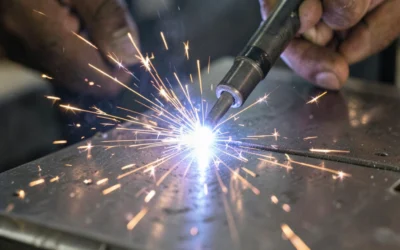
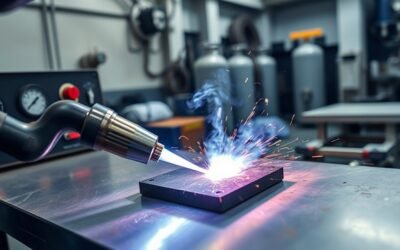
A typical welding arc is about 5,500°C (roughly 10,000°F) at its core, hotter than the surface of the sun (about 5,500°C). Constricted plasma arcs used in plasma welding and cutting can reach roughly 20,000 to 28,000°C (36,000 to 50,000°F). An oxy-acetylene flame is much cooler at about 3,480°C (6,300°F), but still more than hot enough to melt steel, which melts at about 1,370 to 1,540°C (2,500 to 2,800°F).
Those numbers are exciting, but what really matters to a welder is how that heat is concentrated and transferred into the metal. This guide covers arc temperatures by process, why they differ, and what it means for your welds and safety.

Why Is a Welding Arc So Hot?
A welding arc is an electrical discharge through ionized gas, called plasma. Current flowing through the gas gap between the electrode and the workpiece heats the gas until electrons are stripped from its atoms. That plasma conducts electricity and releases enormous energy as heat and light in a very small space. The hottest part is the arc column near the electrode tip; temperatures fall off quickly toward the edges.
Arc temperature depends on:
- Current (amps): more current means more energy in the arc.
- Shielding gas: helium and hydrogen produce hotter arcs than pure argon.
- Arc constriction: forcing the arc through a small orifice (as in plasma) concentrates it and raises the temperature dramatically.
- Electrode and polarity: how heat splits between the electrode and the workpiece changes with DCEN, DCEP and AC.
Welding Temperatures by Process
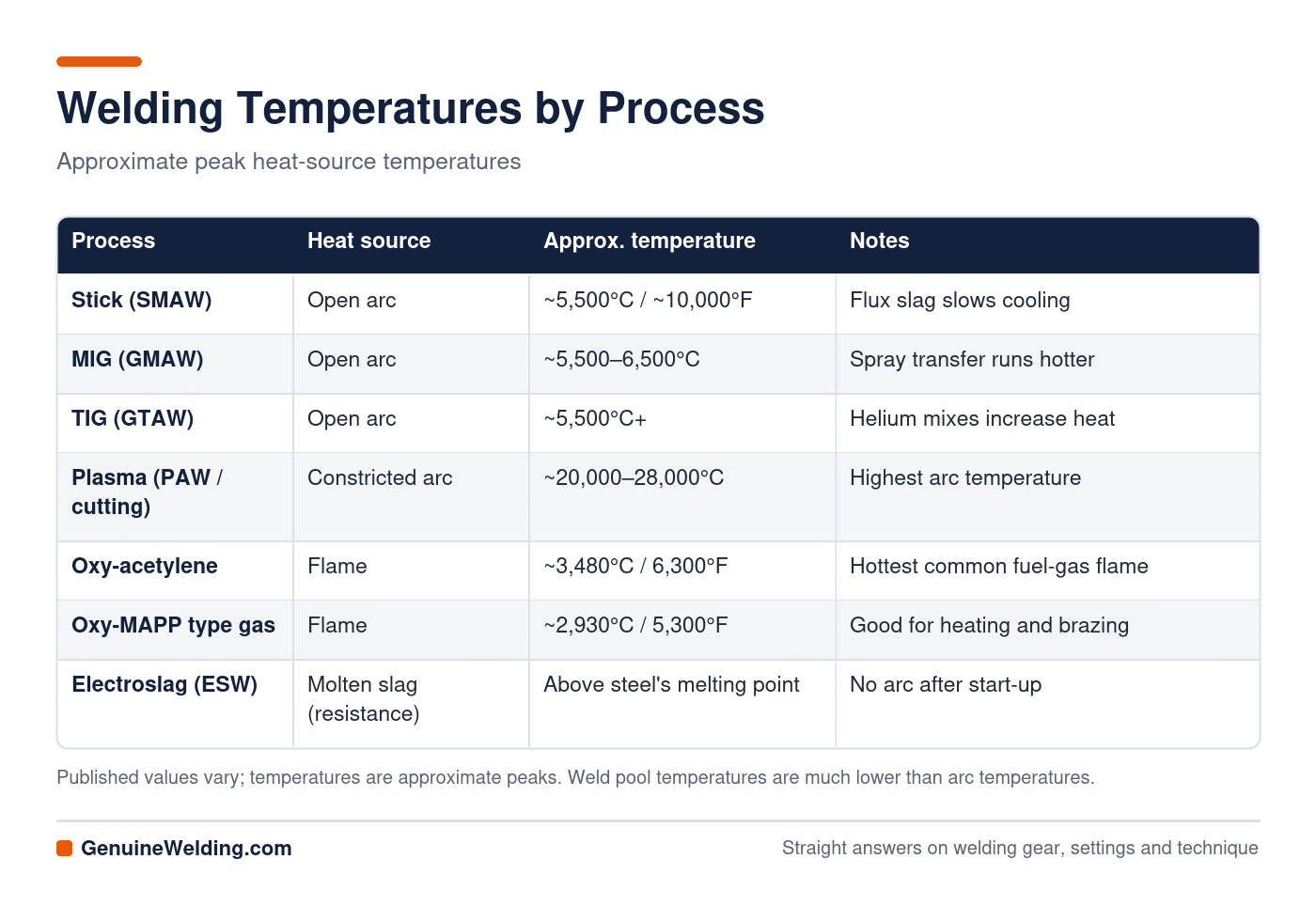
Arc temperatures are hard to measure exactly and vary across the arc, so published figures differ. Treat these as typical approximate ranges.
How Hot Is a Welding Arc Compared With Metal Melting Points?

The arc is far hotter than any metal’s melting point, so the challenge in welding isn’t reaching melting temperature; it’s controlling how much heat goes into the part. Too much heat causes burn-through, distortion and a large heat-affected zone; too little causes lack of fusion. That’s why welders talk about heat input rather than arc temperature.
Arc Temperature vs Heat Input
Heat input measures how much energy goes into the weld per length of joint. A common formula is:
Heat input (kJ/in) = (Volts × Amps × 60) ÷ (Travel speed in in/min × 1,000)
Codes also multiply by a process efficiency factor in some calculations. A fast-moving 5,500°C arc can put less heat into a part than a slow, wide weave at the same temperature. That’s why travel speed is just as important as amperage for controlling distortion and metallurgy.
Why TIG Feels Different From MIG and Stick
- TIG (GTAW): a small, focused arc gives precise heat control; adding helium raises arc temperature and penetration.
- MIG (GMAW): the arc melts the wire continuously, so much of the heat goes into droplets that transfer into the weld. Spray transfer runs hotter than short circuit.
- Stick (SMAW): the flux coating burns to create gas and slag; the slag blanket slows cooling.
- Plasma: a constricted arc concentrates energy, enabling keyhole welding and fast cutting.
For more, see welding processes compared and plasma arc welding.
How Hot Does the Workpiece Get?
- Weld pool: just above the metal’s melting point, roughly 1,500 to 2,000°C for steel.
- Heat-affected zone: heated high enough to change the metal’s structure, but not melted.
- Nearby metal: can stay hot enough to burn skin for many minutes after welding. Steel glows dull red at about 500 to 600°C, but metal can be dangerously hot well below glowing.
Use temperature crayons or an infrared thermometer to check preheat and interpass temperatures when your procedure calls for them.
Safety: Heat, Light and Burns
- Arc light: the arc emits intense UV and infrared radiation that can burn eyes (arc eye) and skin in seconds. Use the right shade; see the welding lens shade chart.
- Spatter and slag: molten droplets can be well over 1,000°C. Wear leather gloves and FR clothing.
- Hot parts: mark or quench parts and never pick up metal with bare hands after welding.
- Fire: sparks can travel 35 feet or more. See the welding safety guide.
How Hot Is a Welding Arc? FAQs
Is a welding arc hotter than the sun?
Hotter than the sun’s surface (about 5,500°C). A typical arc core is in the same range, and plasma arcs are several times hotter. The sun’s core, at about 15 million °C, is far hotter.
What is the hottest welding process?
Plasma arc welding and cutting produce the hottest arcs, reaching roughly 20,000 to 28,000°C. Laser and electron beam welding focus energy even more tightly, but are usually described by power density rather than temperature.
How hot is a MIG welder?
A MIG arc is roughly in the same range as other open arcs, around 5,500 to 6,500°C in the core depending on current and gas.
How hot is an oxy-acetylene torch?
About 3,480°C (6,300°F) at the hottest part of a neutral flame, just ahead of the inner cone.
Why doesn’t the tungsten melt in TIG welding?
Tungsten melts at about 3,422°C, the highest of any metal. On DCEN most of the arc heat goes into the workpiece, and argon gas cools the tungsten, so it stays solid if amperage matches its size.
Sources
- Wikipedia: Plasma arc welding (arc and plasma temperatures)
- Wikipedia: Adiabatic flame temperature (oxy-acetylene and other flames)
- OSHA: Welding, Cutting and Brazing