If you have seen “MMA” on a welder’s spec sheet or in a UK or Australian forum thread, you have met the same process Americans call stick welding. MMA stands for manual metal arc, and it is one of the oldest and most widely used ways to join steel. This guide explains the name, how the process works, what you need to start, and when it is the right choice.
MMA welding at a glance
- MMA means manual metal arc. It is the same process as stick welding and shielded metal arc welding (SMAW).
- An electric arc melts a flux-coated metal rod and the base metal, and the flux makes its own shielding, so no gas bottle is needed.
- It works outdoors, on rusty or painted steel, and on thick plate, which is why it is common for repair and field work.
- It is harder to run on thin sheet metal and leaves slag that has to be chipped off after each pass.
One process, many names
| Name | Where you will see it | What it means |
|---|---|---|
| MMA / MMAW | UK, Europe, Australia, welding machine spec sheets | Manual metal arc (welding) |
| SMAW | United States, AWS standards, school curricula | Shielded metal arc welding |
| Stick welding | Everyday speech in the US and UK | Named after the rod, or stick, used as the electrode |
| Arc welding | Casual use, often meaning stick | Broad term that also covers MIG and TIG, so it can be ambiguous |
How MMA welding works
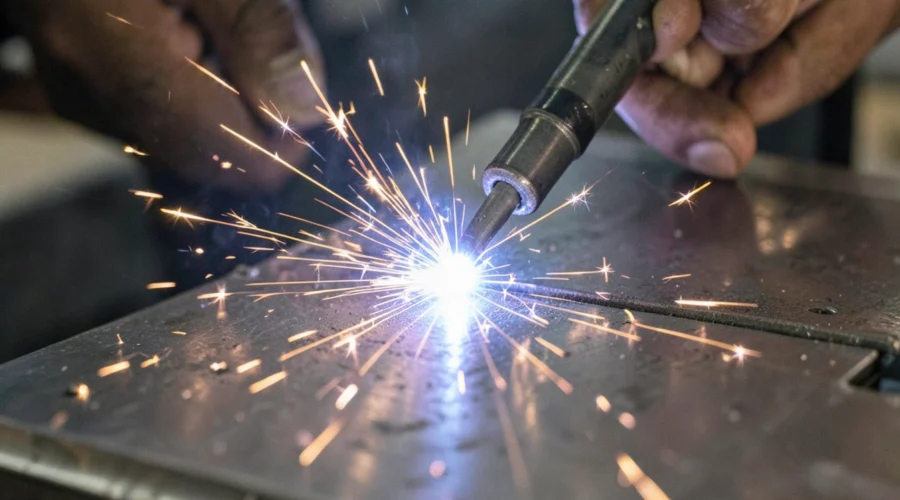
The welder clamps a flux-coated rod in an electrode holder and connects a ground clamp to the work. Touching or scratching the rod against the metal starts an arc. The heat of that arc melts the metal core of the rod and the surface of the base metal together into a molten pool.
The coating on the rod does the shielding job that bottled gas does in MIG or TIG. As it burns it releases gases that keep air away from the puddle, and what is left cools into a layer of slag that protects the bead while it hardens. You chip that slag away when the weld has cooled. The process is called manual because the welder controls the arc length, angle and travel speed by hand and feeds the rod down as it burns.
What equipment you need
Equipment is simple, which is a big part of the appeal:
- A power source. This can be an AC transformer, a DC inverter, or an engine-driven unit. Many multi-process machines also run stick.
- An electrode holder and ground clamp with cables rated for your amperage.
- Electrodes matched to the steel and the job, for example E6013 for easy general work or E7018 for stronger structural joints. Our 7014 vs 7018 comparison covers two of the common choices.
- Safety gear: an auto-darkening or passive helmet with the right shade, leather gloves, a flame-resistant jacket and good ventilation.
- A chipping hammer and wire brush for slag.
Strengths of MMA welding
Because the flux supplies the shielding, the arc is not blown off course by moderate wind the way a MIG gas shield can be. That makes the process a natural fit for outdoor repair, farm work and construction. Stick machines are also usually cheaper and lighter than gas-shielded setups, and the consumables are just rods.
It handles dirty, rusty or painted steel better than TIG, which wants clean metal, and it can be used in all positions with the right rod. Many shops use it for structural steel, pipe, heavy equipment and repair work.
Limits to know about
MMA is slower than MIG for long production welds because you stop to change rods and chip slag. It is also hard to use on very thin material, since the arc is strong and burn-through is easy. Learning to hold a steady arc length takes practice, and a long arc causes spatter and porosity. If you mostly weld sheet metal, MIG or TIG is usually the easier path. Our TIG vs stick welding guide compares those trade-offs in more detail.
Is MMA the same as arc welding?
MMA is one type of arc welding. “Arc welding” is a family name for any process that uses an electric arc as the heat source, including MIG, TIG and flux-cored welding. In casual conversation people often say “arc welding” when they mean stick, which is where the confusion comes from. If you are choosing between electric arc and flame methods, see arc welding vs gas welding.
Getting started
Start with a 1/8-inch E6013 rod on clean mild steel plate and practise running straight beads. Set the amperage in the middle of the range printed on the rod box and adjust from there. Our how to stick weld walkthrough covers striking the arc, rod angle and travel speed step by step, and is stick welding AC or DC explains polarity.
Always weld in a ventilated area, wear proper eye and skin protection, and keep flammable material well away from sparks.
FAQs
What does MMA stand for in welding?
MMA stands for manual metal arc. It is the term used in the UK, Europe and Australia for what Americans call stick welding or shielded metal arc welding (SMAW).
Is MMA welding the same as stick welding?
Yes. MMA, MMAW, SMAW and stick welding are different names for the same process, which uses a flux-coated consumable electrode and needs no external shielding gas.
Do you need gas for MMA welding?
No. The flux coating on the rod creates the protective gases and slag, so a separate gas cylinder is not required.
Is MMA welding good for beginners?
It is inexpensive and forgiving of dirty metal, but holding a steady arc takes practice. Many beginners start with an easy rod such as E6013 on clean steel plate.
Bottom Line
MMA welding is simply the international name for stick welding. It is a simple, rugged, gas-free process that suits outdoor work, repairs and thicker steel, and it is a sensible first process to learn if you want a low-cost way into welding.
Sources
- TWI: Manual Metal Arc Welding (MMA, SMAW or Stick Welding)
- Linde: MMA Welding Process
- The Fabricator: Shielded Metal Arc Welding glossary
- EWM: MMA basics