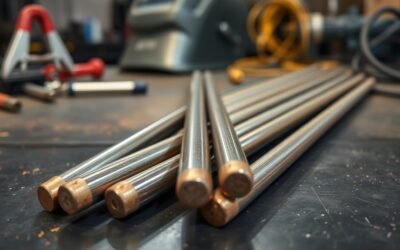
A MIG contact tip is the small copper tube at the front of the gun that guides the wire and transfers welding current into it. Match the tip size to your wire (.023/.024, .030, .035 or .045 in are the most common), use the thread style that fits your gun (Tweco, Lincoln, Miller/Hobart, Bernard or Binzel styles) and replace it when the hole wears oval, the wire burns back, the arc gets erratic or spatter won’t clean off.
Contact tips are cheap, but a worn or wrong tip causes more MIG problems than almost any other part. This guide covers sizes, types, recess settings and exactly when to swap them.
What Does a MIG Contact Tip Do?
In a MIG gun, the wire slides through the contact tip on its way to the arc. The tip has two jobs:
- Transfer current: welding current passes from the tip into the wire at the point where they touch, just inside the bore.
- Guide the wire: it centers the wire in the nozzle so the arc lands where you aim.
The tip screws into a gas diffuser (also called the retaining head), and the nozzle slips over both. Together they are called front-end consumables. Learn more about the gun in our guide to MIG welding.
MIG Contact Tip Sizes
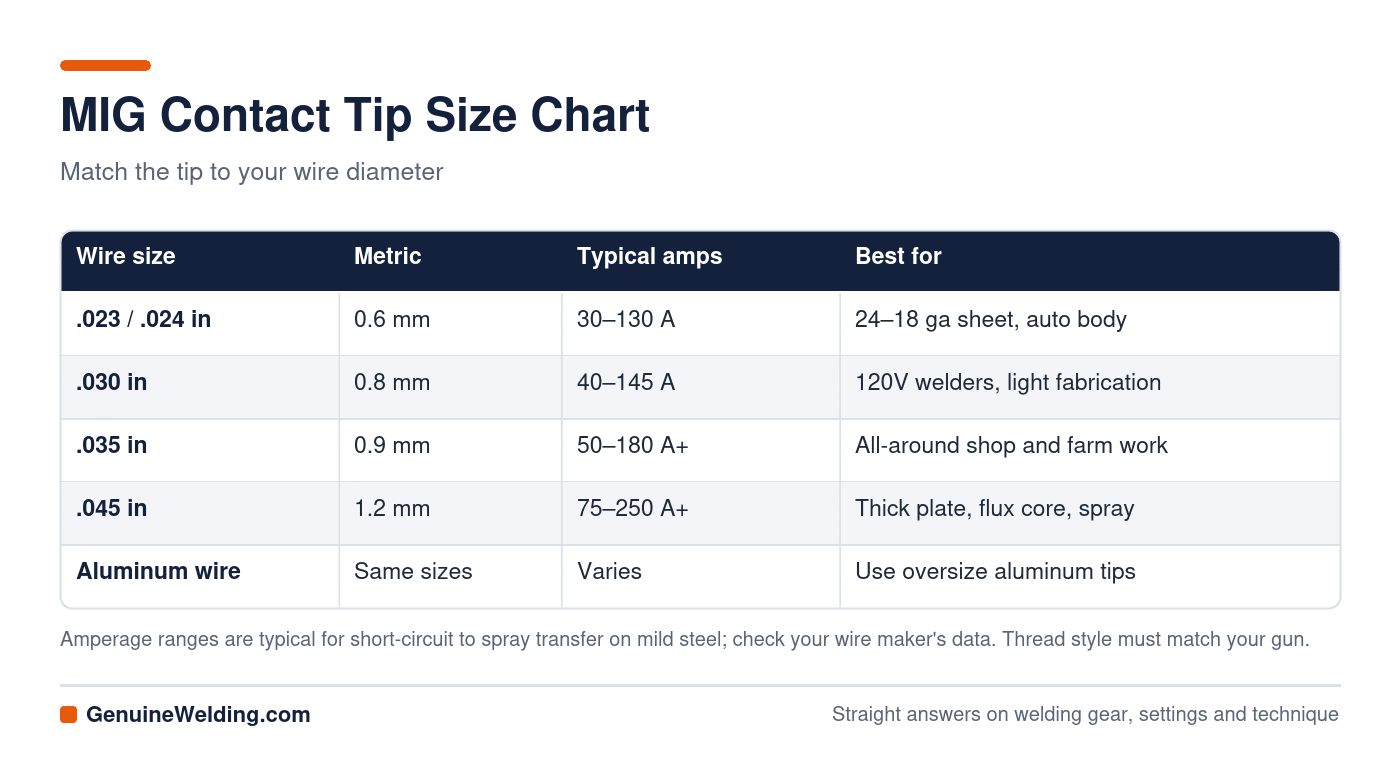
The tip size is the wire diameter it is made for, and it is usually stamped on the tip. Using a tip that is too large lets the wire wander and causes poor current transfer; too small and the wire jams.
| Wire diameter | Metric | Tip to use | Common use |
|---|---|---|---|
| .023 / .024 in | 0.6 mm | .023/.024 tip | Thin sheet metal, auto body |
| .030 in | 0.8 mm | .030 tip | Most 120V welders, light fabrication |
| .035 in | 0.9 mm | .035 tip | All-around shop wire, 120V and 240V |
| .045 in | 1.2 mm | .045 tip | Thick plate, flux-cored, spray transfer |
| Aluminum wire | — | Aluminum (oversize) tip | Allows for heat expansion of aluminum wire |
For aluminum, use tips made for aluminum wire, which have a slightly larger bore so the soft wire doesn’t seize as it heats. For flux-cored wire, match the tip to the wire diameter just as you would with solid wire. See .030 vs .035 flux core wire and MIG wire types.
Types of MIG Contact Tips
By material
- Standard copper (E-Cu): the most common, good conductivity and low cost. Fine for most short-circuit and hobby welding.
- Chrome zirconium copper (CuCrZr): harder and more heat resistant. Lasts longer at high amperage, in spray transfer and in robotic welding.
- Plated tips: silver or other coatings that help resist spatter adhesion.
By style and gun
Tips are not universal. The thread, length and taper must match your gun’s diffuser. Common families include Tweco-style (used on many hobby and industrial guns, numbered by series such as 14 for small guns), Lincoln-style, Miller/Hobart-style, Bernard Centerfire and Quik Tip, and Binzel-style (15AK, 24KD, 36KD) on many inverter welders. Check your gun’s manual or the old tip’s part number before you order.
Heavy-duty and tapered tips
Heavy-duty tips have more copper mass to soak up heat, so they last longer at high amperage. Tapered tips give better access and visibility in tight joints.
Contact Tip Recess and Stickout
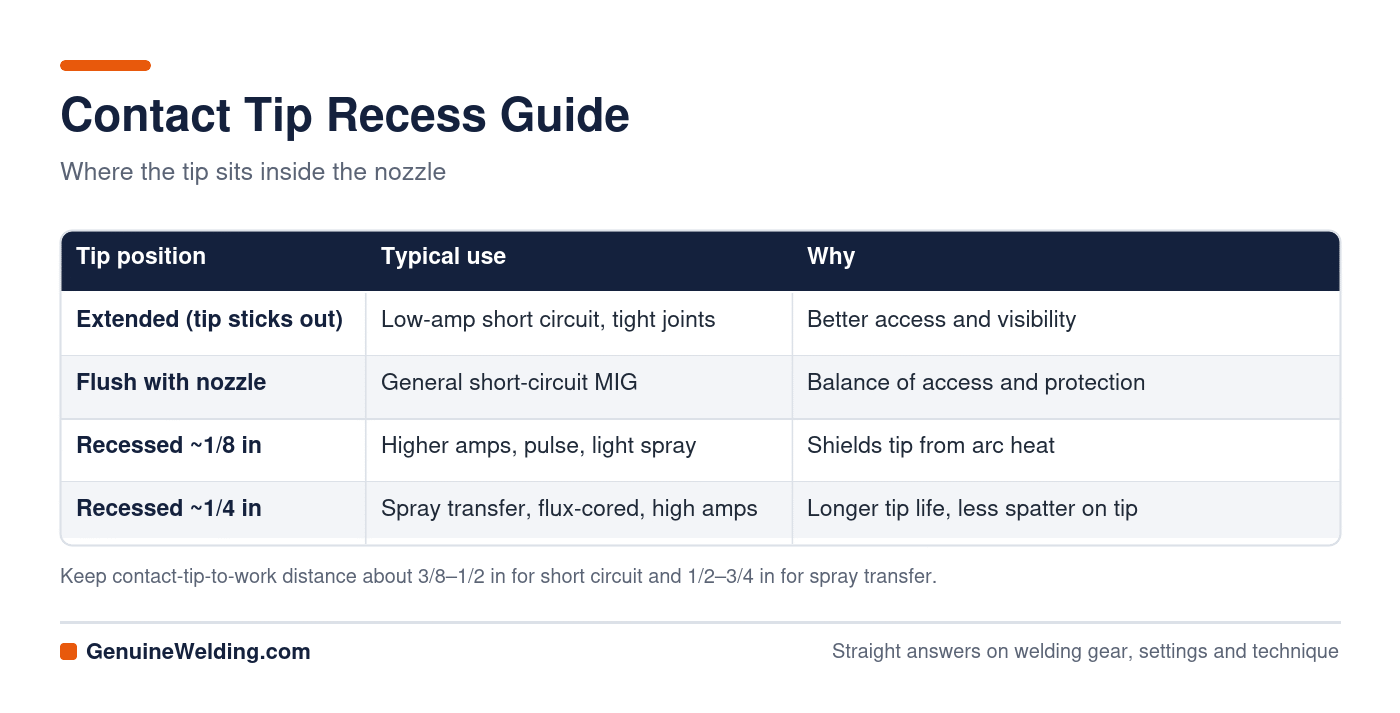
The tip’s position inside the nozzle affects how much wire sticks out (contact-tip-to-work distance, or CTWD). For short-circuit MIG, keep CTWD around 3/8 to 1/2 in. For spray transfer, 1/2 to 3/4 in is typical. Too much stickout makes the arc cold and erratic; too little overheats the tip. Read metal transfer modes for more.
When to Replace a MIG Contact Tip
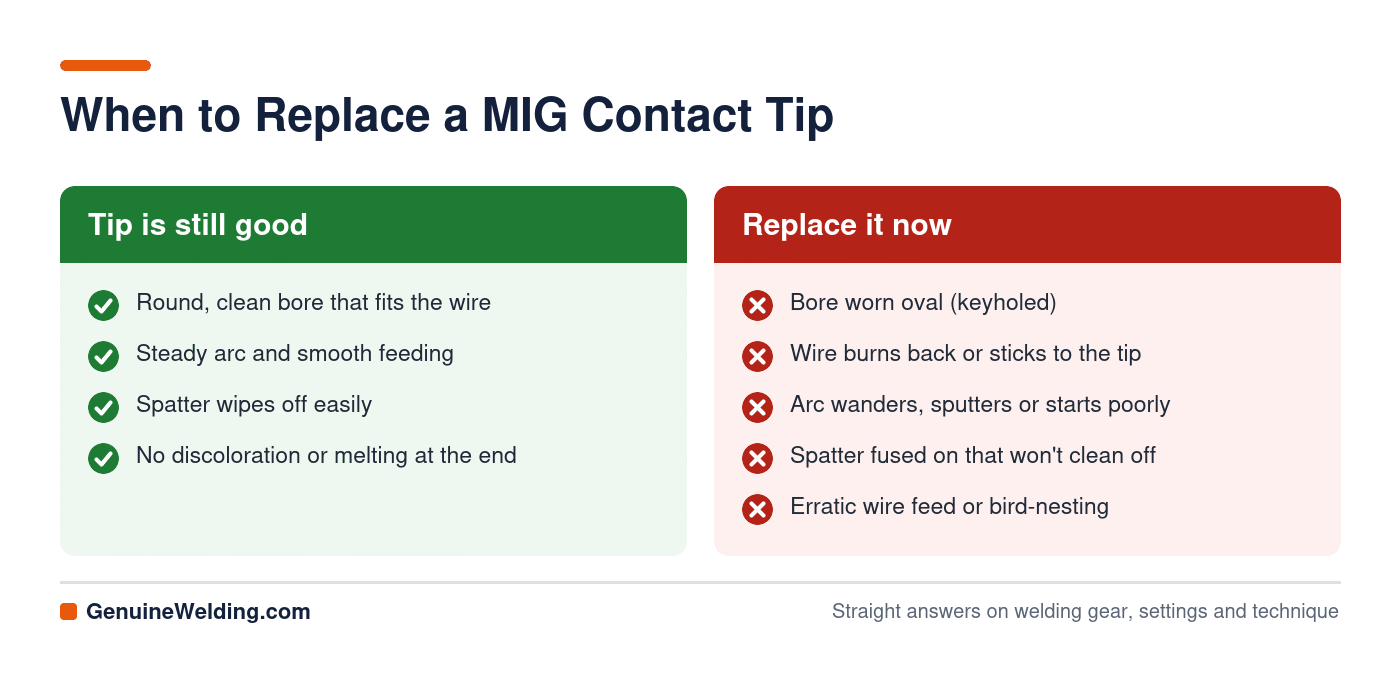
There’s no fixed schedule. A hobbyist might go through several spools on one tip; a production welder running spray transfer may change tips every shift. Replace the tip as soon as you see the warning signs, not after the welds get bad. Keep a few spare tips in your bag; they cost far less than the time lost to a bad arc.
What Makes Contact Tips Wear Out Fast?
- Wrong tip size for the wire
- Too short a stickout, putting the tip too close to the arc heat
- Burnback from incorrect settings or stopping with the trigger
- Poor work clamp connection, causing arcing inside the tip
- Feeding problems: worn liner, wrong drive rolls or too much drive tension
- Dirty or rusty wire that drags contamination into the bore
- High-heat welding such as spray transfer, especially with standard copper tips
If tips keep failing, check the whole feed path. Our guide to weld troubleshooting covers feeding issues.
How to Change a MIG Contact Tip
- Turn off the welder and let the gun cool.
- Pull or twist off the nozzle.
- Unscrew the old tip with MIG pliers (welpers). Don’t grip the diffuser threads.
- Inspect the gas diffuser for spatter and damage; clean or replace it.
- Snip the wire clean, slide on the new tip and thread it in snug, but don’t overtighten.
- Reinstall the nozzle, trim the wire to the right stickout and test on scrap.
A dab of nozzle gel or anti-spatter spray helps spatter wipe off. See best MIG welding pliers.
MIG Contact Tip FAQs
Can I use a .035 tip with .030 wire?
It will feed, but the loose fit reduces current transfer and lets the wire wander, causing an erratic arc. Use the matching tip whenever possible.
Do I need a different tip for flux core wire?
Use a tip that matches the flux-core wire diameter. You’ll also need knurled drive rolls and the correct polarity (usually DCEN for gasless wire).
Why does my wire keep burning back to the tip?
Common causes are wire speed too slow for the voltage, too short a stickout, a worn tip, feeding problems or a poor work connection.
Are all MIG tips the same thread?
No. Thread size and tip length differ between gun brands and series. Match the tip to your gun’s diffuser.
How long should a contact tip last?
It varies from a few hours in heavy production to many spools in hobby use. Watch the bore and the arc, not the calendar.