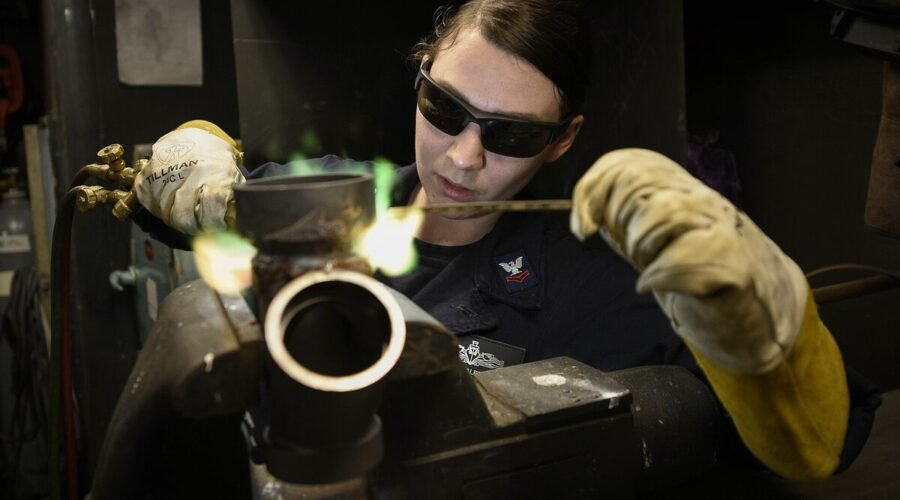
The 6G welding test is a pipe groove weld made with the pipe fixed at a 45-degree angle, so you weld flat, vertical and overhead in one joint without rotating the pipe. It is the hardest common position test, and passing it qualifies you for all positions under codes such as ASME Section IX and AWS D1.1. Most 6G tests use a beveled carbon steel pipe coupon welded uphill, then cut into bend specimens (or X-rayed) to check for defects.
A 6G certification opens the door to pipe, refinery, power plant and pipeline jobs that pay well above the average welder. Here is exactly how the test is set up, how it is graded and the habits that get welders through it.
What Is 6G Welding?
“6G” is a welding position code. The 6 means the pipe axis is inclined at 45 degrees and the pipe is fixed in place; the G means a groove weld. As you work around the joint, the torch or rod angle and the puddle behavior change constantly, which is why 6G is the ultimate test of control. Compare it to the other positions in our guide to welding positions 1G to 6G.
A 6GR test adds a restriction ring next to the joint. It is used under AWS D1.1 for tubular T-, K- and Y-connections and is even harder because the ring blocks part of your access.
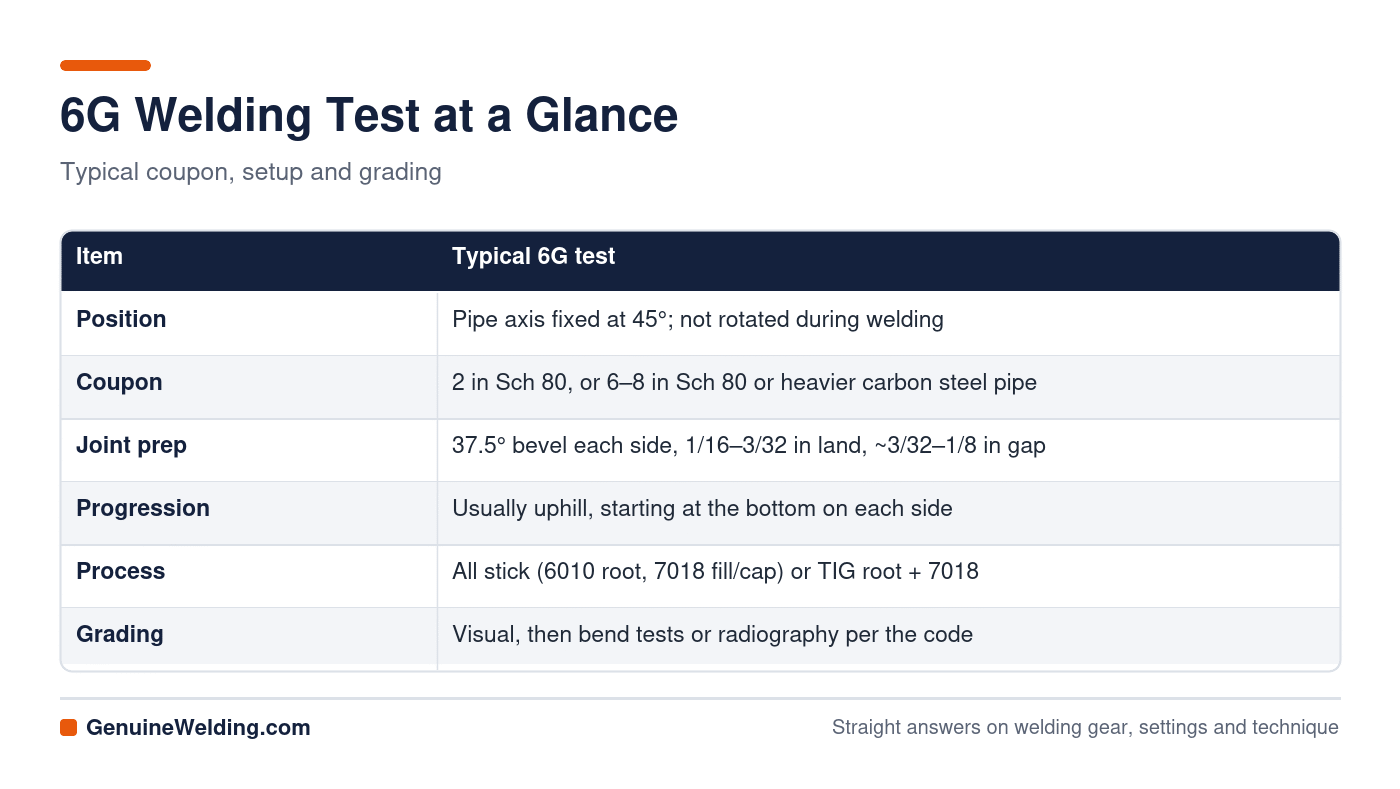
Typical 6G Test Setup
- Pipe: commonly 2 in Schedule 80 (small-bore) or 6 in or 8 in Schedule 80 or heavier carbon steel. Larger, thicker coupons qualify a wider range of sizes.
- Bevel: 37.5° on each pipe end (75° included).
- Land (root face): about 1/16 to 3/32 in.
- Root opening: about 3/32 to 1/8 in, depending on process and rod.
- Position: pipe axis at 45° and locked; most tests are welded uphill.
- Process: all stick (6010 root, 7018 fill and cap), or a combination such as TIG root and hot pass with 7018 fill and cap.
The test facility gives you a welding procedure specification (WPS) to follow. Read it carefully: amperage ranges, filler metal, preheat and interpass rules are part of the test.
How the 6G Test Is Graded
- Visual inspection. The inspector checks the cap and root for cracks, undercut, porosity, incomplete fusion, excess reinforcement and root concavity. A visual reject ends the test.
- Bend tests or radiography. Under ASME Section IX, coupons are usually cut into bend specimens at set locations around the pipe. Thinner pipe gets face and root bends; on thicker wall (3/8 in and up) side bends are used. The specimens are bent around a mandrel. Generally, any open defect larger than 1/8 in on the stretched surface fails. Some facilities use radiography (X-ray) instead, where permitted.
Learn more about how bend specimens are prepared in destructive weld testing.
What a 6G Test Qualifies You For
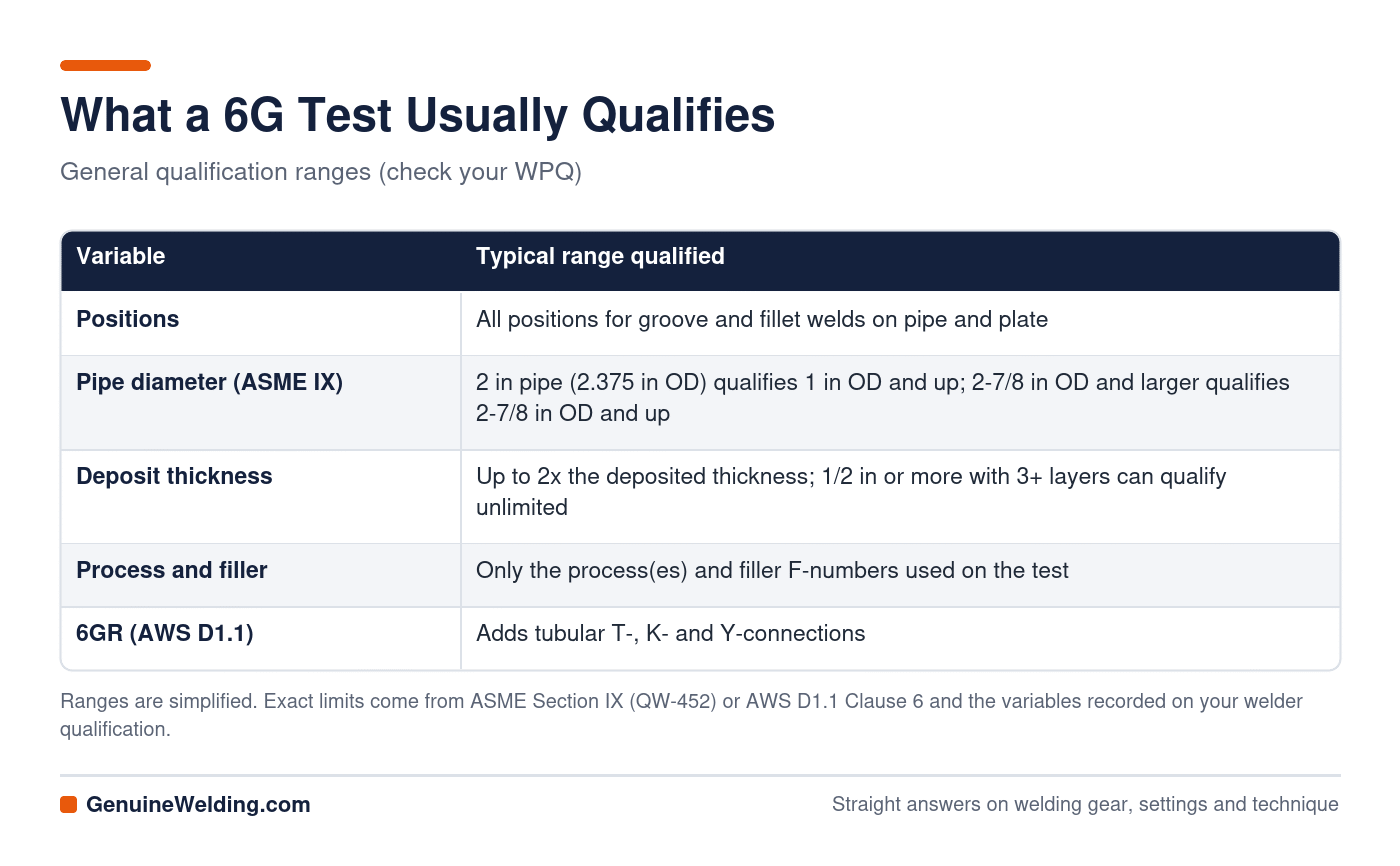
Exact ranges depend on the code and the variables in your test (process, filler F-number, backing and so on). Always check your welder performance qualification record (WPQ). For background on the codes, read welding codes and standards and our welding certifications guide.
How to Pass the 6G Welding Test: Tips
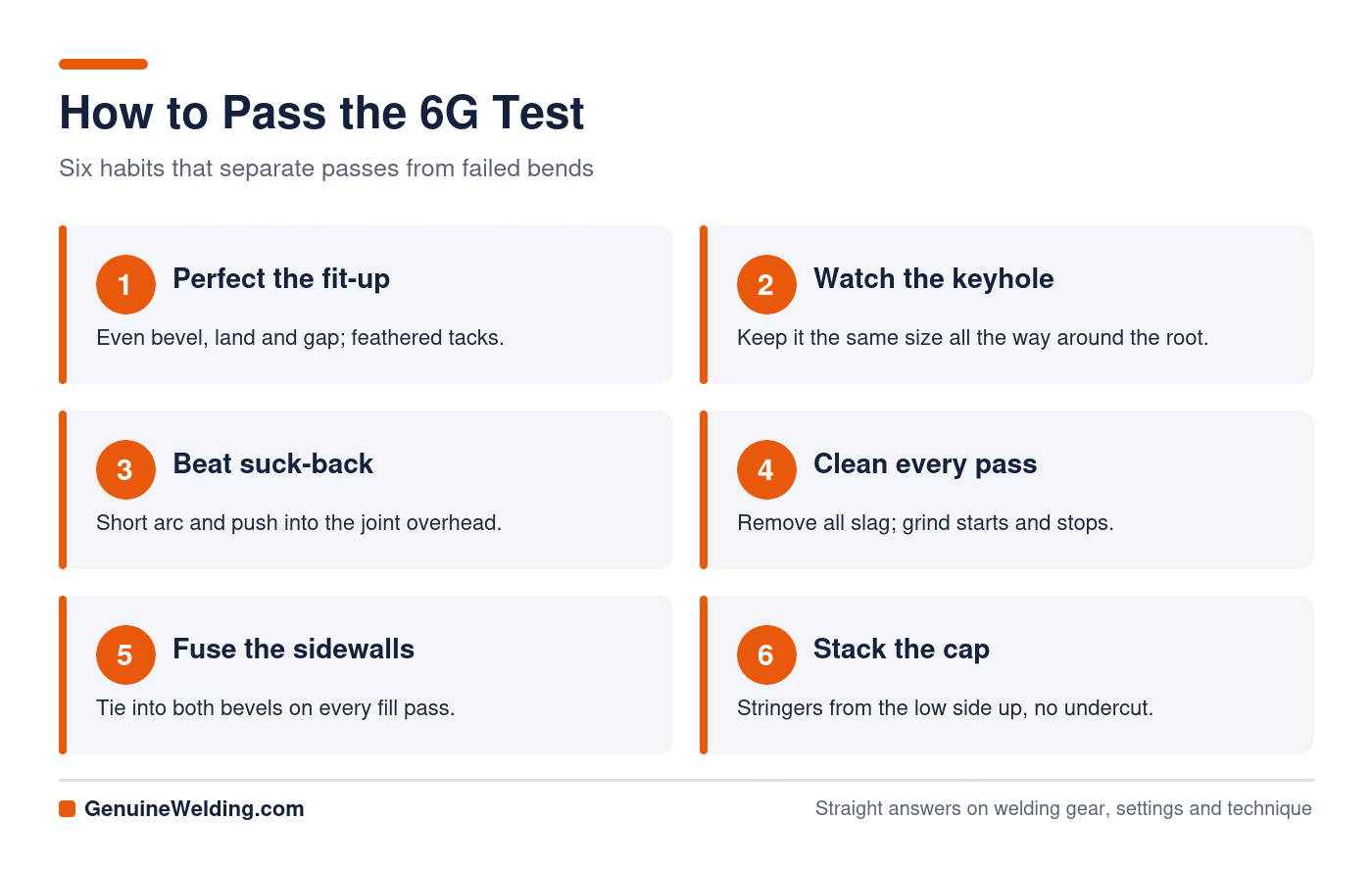
Prep and fit-up
- Grind bevels and land clean and even. An uneven land makes an uneven root.
- Set a consistent gap and tack in three or four places. Feather the tacks so the root ties in smoothly.
- Clean inside and outside the pipe for at least 1 in back from the bevel.
Root pass
- Start just past bottom center (6 o’clock) and weld uphill toward the top on each side.
- Watch the keyhole. Keep it the same size all the way around; it tells you that you are penetrating both sides.
- Fight suck-back (concavity) in the overhead section by keeping a short arc and pushing the rod into the joint.
- Grind starts and stops so tie-ins don’t leave cold laps or porosity.
Hot pass and fill
- Run a hot pass hot enough to burn out any “wagon tracks” of slag along the root.
- Clean every pass completely. Slag inclusions are one of the top reasons 6G coupons fail.
- Tie into both sidewalls. Lack of sidewall fusion opens up on bend tests.
- Keep the joint even and slightly below the bevel edges before the cap.
Cap
- On the 45° incline, most welders run the cap as stacked stringer beads, starting on the low side and working up, rather than a wide weave.
- Overlap each stringer by about half, keep reinforcement around 1/16 to 1/8 in and avoid undercut on the top edge.
For stick technique, see 7018 welding rod settings and stick welding tips. For TIG roots, see our TIG welding tips. Our pipe welding guide also covers 5G and 6G technique.
Common Reasons Welders Fail the 6G Test
- Incomplete root penetration or root concavity in the overhead section
- Lack of fusion on the sidewalls or between passes
- Slag inclusions from poor interpass cleaning
- Porosity at starts, stops and tie-ins
- Undercut or excess reinforcement on the cap
- Not following the WPS (wrong rod, amps or preheat)
How Much Does a 6G Test Cost?
Costs vary by test facility, code and material. Many employers pay for the test as part of hiring. If you pay yourself, expect a facility fee for materials, booth time and bend testing or X-ray, plus any certification body fees; for example, the AWS Certified Welder program charges an application fee on top of the facility’s test fee. Ask for a full quote before you book.
6G Welding Test FAQs
How long does a 6G test take?
Most welders finish in two to four hours, though facilities set their own time limits. Small 2 in pipe goes faster than 6 or 8 in Schedule 80.
Is 6G harder than 5G?
Yes. 5G keeps the pipe horizontal, so you weld uphill around a level joint. The 45° tilt in 6G changes your angles constantly and makes the cap much harder.
Does a 6G certification expire?
Under ASME Section IX and AWS programs, welder qualifications generally stay valid as long as you use the process at least every six months and document it. Lapse that, and you must retest.
Can I practice for 6G at home?
Yes, with a pipe stand that locks at 45°, beveled practice coupons and a stick or TIG welder. Cut and bend your practice coupons to check your work.
What is the best rod for a 6G test?
Common choices are E6010 for the root and E7018 for fill and cap on all-stick tests. Always use what the test WPS specifies.
Sources
- ASME BPVC Section IX: Welding, Brazing and Fusing Qualifications
- American Welding Society: Certification and Education