A stitch weld is an intermittent fillet weld: short weld segments with gaps between them instead of one continuous bead. On an AWS welding symbol it’s shown as a normal fillet weld symbol with two numbers to the right separated by a dash, such as 2-6. The first number is the length of each weld segment, and the second is the pitch, the center-to-center distance between segments. So “1/4 ◿ 2-6” means a 1/4 in fillet, 2 in long, spaced 6 in on center, leaving 4 in gaps.
Stitch welds save filler metal, time and heat compared with continuous welds, which also means less distortion on long joints. Reading them correctly on a drawing is a basic skill for any fabricator. Here’s exactly how.
How to Read a Stitch (Intermittent) Weld Symbol

- Fillet symbol: the triangle shows it’s a fillet weld. Below the reference line means arrow side; above means other side.
- Size (left): the fillet leg size, for example 1/4 in.
- Length (right, first number): the length of each weld segment.
- Pitch (right, after the dash): the distance from the center of one segment to the center of the next.
Gap = pitch − length. A 2-6 callout leaves a 4 in unwelded space between segments. Remember that pitch is center to center, not the size of the gap. This is the most common mistake when reading stitch welds.
Chain vs Staggered Intermittent Welds
When you need stitch welds on both sides of a joint, such as a T-joint, there are two patterns:

- Chain intermittent: segments on both sides line up directly opposite each other. The fillet symbols sit directly above and below the reference line.
- Staggered intermittent: segments on one side line up with the gaps on the other side. The fillet symbols are offset along the reference line.
Staggered stitches spread heat more evenly and reduce distortion. Chain stitches are stronger at each location and easier to inspect.
Where Do the Stitches Start and End?
Under AWS A2.4, intermittent welds are generally placed so there is a weld segment at each end of the joint, and the pitch is then measured between segments. If the drawing needs welds only in a certain zone, it will show the extent with dimension lines or a note. When the numbers don’t divide evenly into the joint length, the shop may adjust spacing slightly or the engineer will specify. Ask if in doubt; extra welds can add distortion and cost.
Combining Stitch Welds With Continuous Welds
Some joints need continuous welds at the ends and stitches in the middle, for example at highly stressed connections. Drawings show this with separate symbols or with dimension lines that mark each zone. Read every symbol on the arrow and any notes in the tail.
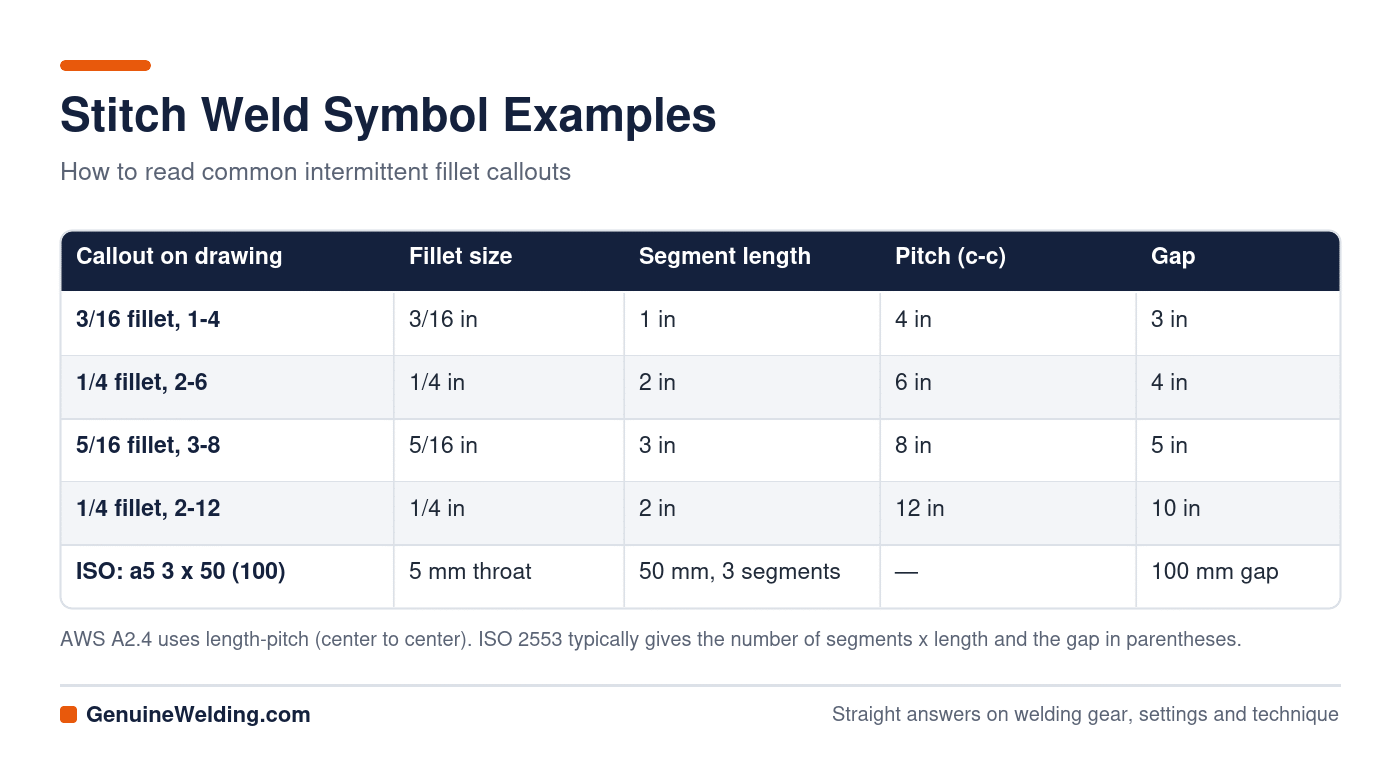
Stitch Weld Examples
ISO 2553 Intermittent Weld Notation
European and international drawings use ISO 2553, which shows intermittent fillets differently: the throat or leg size (for example a5 or z7), then the number of segments times the segment length, and the spacing in parentheses, such as a5 ◿ 3 × 50 (100). In ISO notation the number in parentheses is usually the distance between segments (the gap), not the center-to-center pitch, and a staggered weld is marked with a “Z”-shaped symbol. Always check which standard a drawing uses.
When to Use Stitch Welds
- Long, lightly loaded joints such as stiffeners, brackets and frames
- Thin sheet metal where continuous welds would warp the part
- Trailer decks, cross members and non-watertight joints
- Where the design load doesn’t require a continuous weld
Avoid stitch welds where you need a watertight or airtight seal, on fatigue-critical members (gaps act as stress raisers) or where corrosion can start in the gaps. Some designers seal the gaps with caulk or paint, or specify continuous welds instead.
Tips for Welding Stitch Welds
- Lay out segment centers with soapstone before welding.
- Use a sequence that spreads heat, such as welding every other segment, then going back; see burn-through and distortion tips.
- Fill each crater to full size so segments don’t crack at the ends.
- Check leg size with a fillet gauge; stitch welds still have to meet the size on the drawing.
Learn the basics of all symbols in our welding symbols chart and fillet weld symbols guide.
Stitch Weld Symbol FAQs
What does 2-6 mean on a weld symbol?
Weld segments 2 in long, spaced 6 in center to center, leaving 4 in gaps.
Is pitch measured center to center or gap?
On AWS symbols, pitch is center to center. On ISO 2553 symbols, the value in parentheses is usually the gap between segments.
What’s the difference between stitch welding and tack welding?
Stitch welds are final, full-size welds specified on the drawing. Tack welds are small temporary welds that hold parts during fit-up. See the tack weld symbol.
How do you show a staggered intermittent weld?
Place fillet symbols on both sides of the reference line, offset from each other, with length-pitch dimensions on each.
Are stitch welds strong?
They’re strong enough for the loads they’re designed for, but they carry less load than a continuous weld of the same size and aren’t ideal for fatigue loading.
Sources
- American Welding Society: AWS A2.4 Standard Symbols for Welding, Brazing and NDE
- ISO 2553: Welding and allied processes – Symbolic representation on drawings