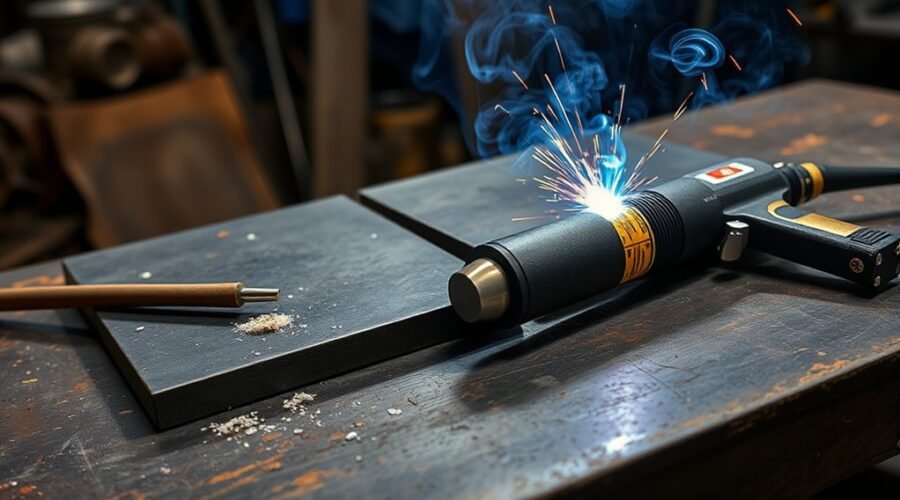
In stick vs flux core welding, the biggest difference is how filler metal reaches the joint. Stick welding uses individual flux-coated electrodes, while flux-cored arc welding (FCAW) feeds tubular wire continuously through a gun. Stick favors simple, highly portable field setups; flux core generally favors faster deposition and longer welds. Outdoors, both stick and self-shielded flux core work well, while gas-shielded FCAW needs protection from wind.
Quick Answer
Choose stick for a simple portable setup, broad electrode choice, and varied field repairs. Choose self-shielded flux core for continuous wire feed, faster deposition, and high productivity on steel. Neither process is automatically stronger or cleaner; filler metal, joint design, settings, preparation, and operator skill determine weld quality.
Key Takeaways
Key Takeaways
- Stick and self-shielded FCAW both work without an external shielding-gas cylinder and suit windy outdoor work.
- Flux core normally deposits metal faster because its wire feeds continuously instead of stopping for electrode changes.
- Both processes produce slag that must be removed, and flux-core welding can generate heavy smoke and fumes.
- Stick offers a particularly broad electrode selection for steels, stainless steel, cast iron, and specialized repair work.
- For beginners choosing only between these two processes, flux core is often easier to start because the machine controls wire feed.
How Stick Welding Works
)
Stick welding, formally called Shielded Metal Arc Welding (SMAW), creates an arc between the workpiece and a consumable flux-coated electrode. The electrode melts into the joint, while its coating produces shielding gases and a layer of slag that protects the molten weld metal.
The TWI guide to shielded metal arc welding explains that both the electrode and workpiece surface melt, while the flux creates gas and slag. After each run, the cooled slag must be removed before inspection or another pass.
Stick welding needs relatively little equipment: a suitable power source, electrode holder, work lead, electrodes, and safety gear. It does not need a wire feeder or external shielding-gas cylinder.
Stick welding combines simple equipment with a wide choice of electrodes, making it especially useful for repair and field work.
Electrode selection changes penetration, deposition rate, usable welding positions, polarity, and mechanical properties. That makes stick welding adaptable to mild steel, stainless steel, cast iron, hardfacing, and other applications when the correct electrode and procedure are used.
Stick is also relatively forgiving of rust and surface contamination, but that does not mean preparation should be skipped. Removing paint, heavy rust, oil, scale, and dirt improves fusion and reduces defects.
For users comparing machines, the existing guide to stick welder features and input-voltage options can help match the power source to the work.
How Flux Core Welding Works
Flux-cored arc welding uses a continuously fed tubular wire electrode containing flux. That continuous feed reduces the stops required for stick-electrode changes and is a major reason FCAW can achieve higher deposition rates.
The American Welding Society’s FCAW overview separates the process into two important types: self-shielded FCAW and gas-shielded FCAW. Treating every flux-core setup as “gasless” is a common mistake.
Flux Core Process
In FCAW, a wire feeder pushes the consumable electrode through the gun while an electric arc melts both the wire and base metal. The flux supports shielding, arc stability, slag formation, and the final weld chemistry.
Self-shielded FCAW (FCAW-S) creates its shielding from the wire itself and does not require a separate gas cylinder. Gas-shielded FCAW (FCAW-G) uses flux-cored wire plus an external shielding gas.
That distinction affects portability and outdoor use. FCAW-S is well suited to exposed field work, while FCAW-G is normally used where its shielding-gas envelope can be protected from drafts and wind.
Wire formulation matters as much as the machine. The existing guide to flux-core welding wires covers that consumable choice in more detail.
Self-Shielding Wire Welds
Self-shielded flux-core wire provides its own atmospheric protection, which removes the need to transport a shielding-gas cylinder. This is one reason FCAW-S is popular for construction, field repair, and other outdoor steel work.
The flux also creates slag over the weld bead. That slag must be chipped or brushed away before inspecting the weld or depositing another pass.
Self-shielded wire tolerates some dirt, rust, and scale better than gas MIG, but clean metal remains the preferred starting point. Welding directly over paint, grease, heavy corrosion, or unknown coatings can introduce weld defects and hazardous fumes.
Gas-shielded FCAW is different. If you use that process, shielding-gas choice and protection from drafts matter; the existing shielding gas guide provides related gas-selection background.
Stick Vs Flux Core Welding: Main Differences
The central difference is simple: stick feeds filler metal through individual coated rods, while flux core feeds wire continuously. That changes equipment complexity, productivity, learning curve, and the kind of work each process handles most conveniently.
| Attribute | Stick | Flux Core |
|---|---|---|
| Electrode | Individual flux-coated rod | Continuously fed tubular wire |
| Shielding | Flux coating; no external gas | Self-shielded or external gas plus flux |
| Portability | Very high; simple equipment | Good, but requires wire-feed equipment |
| Outdoor use | Very good | Very good with FCAW-S; FCAW-G needs wind protection |
| Materials | Broad range with the correct electrode | Commonly carbon steel, stainless steel, and hardfacing alloys |
| Speed | Moderate; stops for rod changes | Generally faster with higher deposition |
| Learning curve | More manual arc-length control | Continuous wire feed is often easier for beginners |
| Slag | Yes | Yes |
| Thin sheet | Difficult, especially for beginners | Possible with suitable wire and settings, but less forgiving than MIG |
Neither process has an automatic advantage in weld strength. Strength depends on the filler-metal classification, base metal, joint design, penetration, procedure, settings, workmanship, and whether the finished weld meets the required acceptance standard.
That is why choosing the correct consumable matters. For stick work, the existing guide to general-purpose welding rods can help explain common electrode choices.
Which Is Better for Outdoor Welding?
Both stick welding and self-shielded flux-core welding are strong outdoor choices. Neither relies on the exposed external shielding-gas cloud used by MIG or FCAW-G. The better choice outdoors therefore depends more on portability, weld length, productivity, access, and available equipment than on wind alone.
Miller’s filler-metal selection guidance specifically recommends stick electrodes or self-shielded flux-cored wire for windy outdoor situations instead of gas-dependent processes.
Wind Resistance
Stick and FCAW-S both tolerate wind because their protection comes from flux rather than a gas cylinder feeding an exposed shielding envelope. This makes either process practical for fences, equipment repair, construction, farm work, and other exposed jobs.
Gas-shielded FCAW is the exception. Because it depends on an external shielding gas, sufficient wind can disturb coverage and increase the risk of porosity.
Wind resistance does not remove the need for clean preparation. Stick and self-shielded flux core tolerate imperfect surfaces better than gas MIG, but heavy rust, oil, paint, moisture, and scale should still be removed where practical.
Outdoor Portability
Stick usually has the simpler field kit. A power source, leads, electrode holder, work clamp, rods, and safety equipment can cover many repairs without a feeder or spool of wire.
Self-shielded flux core adds a gun and wire-feed system but compensates with fewer stops on long seams. That can make FCAW-S more productive on structural fabrication, long fillets, and repeated field welds.
For short, scattered repairs or awkward access, stick’s simplicity often matters more. For longer welds where productivity matters, FCAW-S can reduce interruptions.
Weld Quality in Stick Vs Flux Core
Neither stick nor flux core inherently produces a higher-quality weld. Both can produce code-quality structural welds when the correct filler, qualified procedure, settings, joint preparation, and technique are used.
Stick gives the operator direct manual control of electrode angle and arc length, but that control also demands more skill. A long arc, poor rod angle, wrong amperage, or incomplete slag removal can cause porosity, undercut, lack of fusion, or slag inclusions.
Flux core reduces rod-change interruptions and can make consistent travel easier, but it introduces other variables: wire-feed speed, voltage, polarity, drive-roll setup, contact-tip condition, stickout, and wire storage.
Filler selection is especially important. Miller’s guidance notes that weld strength and toughness depend on choosing a filler metal that matches the base material and service requirements.
For budget-conscious stick setups, the existing guide to stick welders under $500 provides a machine-focused comparison.
Speed And Productivity Compared
Flux core generally wins on productivity. Continuous wire feed eliminates frequent electrode changes and allows high deposition rates, which is useful on long welds, thick sections, and production work.
Stick remains efficient for short repairs, intermittent work, and situations where hauling or positioning a wire feeder would offset the time saved during welding.
Weld Speed
Flux-core welding can maintain a longer uninterrupted arc because wire keeps feeding from the spool. Stick welding stops each time the electrode burns down, adding restart time and unused electrode stub loss.
That advantage becomes more important as weld length increases. On a few small repair beads, the difference may be minor; on long structural seams, it can materially affect labor time.
Deposition Rate
Deposition rate varies greatly with wire or electrode type, diameter, amperage, position, machine output, and procedure. A universal “pounds per hour” figure for either process would therefore be misleading.
A useful real-world example comes from a Miller structural-welding case study. In that specific setup, 0.072-inch self-shielded flux-core wire produced about a 249% deposition-rate increase over a 1/8-inch 7018 stick electrode in flat and horizontal positions, and about 162% in vertical-up and overhead work.
Those percentages describe that particular consumable and application, not every stick-versus-flux-core combination. The broader lesson is that FCAW’s continuous feed can provide a substantial productivity advantage on suitable work.
Cleanup Time
Both processes create slag, so neither is a no-cleanup process. Slag must be removed before another pass and before properly inspecting the finished bead.
Stick often requires frequent cleanup because each short electrode produces a separate run. Some flux-core wires release slag more easily, but slag volume and removal difficulty vary by wire formulation, welding position, settings, and technique.
For that reason, fixed claims that cleanup always consumes a certain percentage of total welding time are not reliable across different electrodes, wires, joints, and operators.
Heat Control And Burn-Through Risk
Thin material is challenging for both stick and self-shielded flux core. Stick is particularly difficult on light sheet because even a small electrode can put considerable heat into a narrow area. Flux core offers continuous wire control but can still burn through when voltage, wire size, or travel speed is too aggressive.
Miller’s flux-core welding guide notes that wire diameter, voltage, amperage, joint design, material thickness, position, and travel technique all affect heat input and penetration.
- Use the wire or electrode type and diameter recommended for the material thickness.
- Follow the consumable manufacturer’s polarity and setting range.
- Keep travel speed consistent instead of dwelling in one spot.
- Use clean, tight fit-up to reduce the need to fill large gaps.
- Practice on scrap of the same thickness before welding the actual part.
For delicate sheet, cosmetic work, or precision fabrication, another process can make heat control easier. The existing guide to TIG welder options covers one alternative.
Slag, Smoke, And Cleanup
Stick and flux core both leave slag. The important difference is not that flux core eliminates cleanup, but that FCAW can maintain a continuous weld for longer before the operator stops.
Flux-core welding can also generate substantial smoke. TWI notes that FCAW commonly produces more visible smoke than manual metal arc welding, which can make the puddle harder to see and increases the importance of fume control.
Welding fumes contain particles and gases from the electrode, flux, coatings, and base material. NIOSH guidance on welding-fume controls recommends controlling exposure at the source where practical, while OSHA’s welding safety guidance identifies fumes, UV radiation, burns, eye injury, electrical shock, and fire among the major welding hazards.
Warning: Do not treat outdoor air alone as adequate fume protection. Keep your head out of the plume, provide suitable ventilation or local exhaust, wear appropriate welding PPE, remove nearby combustibles, and use additional respiratory protection when the hazard assessment requires it.
Slag also hides the actual bead until it is removed. Chip and brush each pass before inspection and before placing another pass over it.
If damaged metal must be cut away before repair, the existing guide to budget plasma cutters covers a separate cutting process.
Best Materials for Each Process
Stick has the broader practical consumable range for varied repair work. With the correct electrode and procedure, SMAW is commonly used on carbon and low-alloy steels, stainless steel, cast iron, hardfacing alloys, and other specialized materials.
Flux core is heavily associated with steels. Carbon-steel, low-alloy, stainless, duplex, and hardfacing flux-cored wires are available, but wire selection and process limitations vary considerably.
- Mild and structural steel: both processes are widely used.
- Stainless steel: both can be used with the correct consumable and procedure.
- Cast iron: stick welding has established specialized electrodes and repair procedures.
- Rusty or dirty steel: both tolerate some contamination, but cleaning remains recommended.
- Aluminum: ordinary flux-core welding is not a practical choice.
TWI’s technical overview of FCAW notes its use on carbon, stainless, and duplex steels and explains that aluminum is not suitable for this process.
Material alone does not select the process. Thickness, joint design, access, service conditions, welding position, required mechanical properties, and governing code all matter.
For a home shop covering several kinds of projects, the existing guide to welders for home use can help compare broader process choices.
Which Welding Process Should You Choose?
Choose by the work you actually expect to do. Stick is usually the better fit for simple equipment, short field repairs, broad electrode flexibility, and awkward locations. Self-shielded flux core makes more sense when continuous welding and higher productivity justify the extra wire-feed equipment.
- Choose stick for varied repairs, remote work, short welds, broad electrode choice, and minimum equipment complexity.
- Choose self-shielded flux core for long steel welds, faster deposition, repetitive fabrication, and outdoor productivity.
- Choose gas-shielded flux core for suitable shop or sheltered fabrication where the required wire and procedure call for external gas.
- Choose another process when very thin cosmetic sheet, aluminum, or highly controlled precision work is the main job.
Equipment and Cost
A basic stick setup is usually simpler because there is no wire feeder, gun liner, contact tip, drive-roll system, or spool mechanism. That simplicity can reduce purchase cost and makes field troubleshooting straightforward.
Flux-core equipment has more components, but its productivity can offset the extra equipment cost on larger jobs. Continuous wire also reduces the downtime and electrode-stub waste associated with stick welding.
If you want both processes available from one machine, a multi-process welder can provide more flexibility, provided its output, duty cycle, polarity options, and wire-feed system suit the intended work.
Pro Tip: Before buying a welder, list your three most common jobs and their material thicknesses. A process that handles those jobs comfortably is usually more useful than a machine chosen only by maximum amperage or the number of processes printed on the box.
Note: Structural, trailer, lifting, pressure-containing, vehicle-structure, and other safety-critical welds may require qualified procedures, qualified welders, inspection, or a governing code. Do not rely on a process comparison alone for those repairs.
Frequently Asked Questions
What Are the Disadvantages of Flux Core?
Flux core produces slag, smoke, fumes, and spatter, and its wire-feed system has more components than a basic stick setup. FCAW-G also needs external shielding gas and protection from wind. Flux-core consumables are mainly intended for steels and related alloys rather than aluminum.
Is Stick Welding Becoming Obsolete?
No, stick welding remains useful for field repair, construction, maintenance, pipe work, and jobs where portability and simple equipment matter. Wire processes offer greater productivity for many applications, but SMAW still solves problems that make its portability, electrode choice, and outdoor capability valuable.
Is Flux Core Welding Good for Body Work?
Flux core can weld some thin steel with the right wire, machine, settings, fit-up, and technique, but it is not usually the easiest choice for cosmetic automotive body panels. MIG generally gives better control on thin sheet and leaves no slag, reducing cleanup around delicate panels.
What Type of Welding Is Best for Beginners?
MIG is often the easiest general process for beginners because wire feeds continuously and there is no slag to remove. Between stick and flux core, flux core is usually easier to start because the machine feeds the wire, while stick requires more practice with arc starts and arc length. See the existing beginner welder guide for machine options.
Does Flux Core Welding Need Shielding Gas?
Sometimes. Self-shielded FCAW uses flux in the tubular wire to provide protection and does not need an external gas cylinder. Gas-shielded FCAW uses flux-cored wire plus an external shielding gas, so its gas supply must be protected from disruptive wind.
Conclusion
Stick welding and flux core solve overlapping but different problems. Stick offers the simpler, highly portable setup and broad consumable flexibility; flux core adds continuous wire feed and higher productivity. For outdoor work, compare stick with self-shielded FCAW rather than assuming one automatically handles wind better. Match the process to the material, joint, weld length, safety requirements, and required finished quality.
Sources
- TWI — Manual Metal Arc Welding: SMAW process, flux shielding, slag, electrodes, and operating characteristics.
- American Welding Society — Flux Cored Arc Welding: FCAW process, self-shielded and gas-shielded variants, applications, and material limitations.
- Miller — Choosing Filler Metal for DIY Welding: outdoor process selection, filler-metal choice, thin-sheet considerations, and weld-property matching.
- Miller — Structural FCAW Productivity Case Study: documented FCAW versus 7018 stick deposition-rate comparison.
- Miller — Flux-Cored Welding Basics: FCAW shielding, slag, preparation, wire selection, settings, and technique.
- NIOSH — Welding Fumes and Fume Extraction: welding-fume hazards and engineering-control principles.
- OSHA — Welding, Cutting, and Brazing Hazards: fumes, radiation, burns, electrical shock, fire hazards, and protective measures.
- TWI — Flux-Cored Arc Welding: FCAW advantages, smoke, slag, outdoor use, materials, and aluminum limitation.