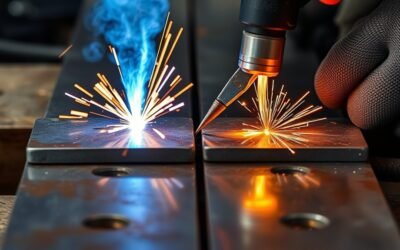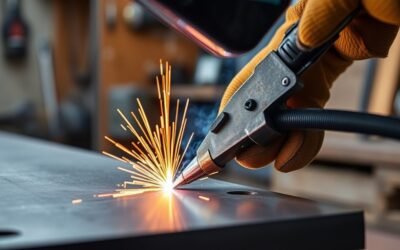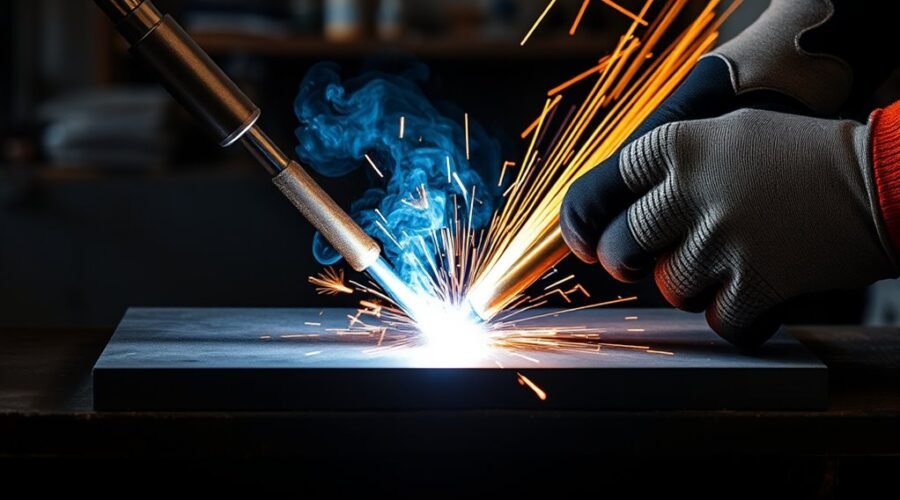
Forehand and backhand welding describe two ways to aim and move a welding torch or gun relative to the direction of travel. In general, forehand, also called push welding, points the heat source toward the unwelded joint, while backhand, also called pull or drag welding, points it back toward the completed weld. The effect on penetration, bead shape, visibility, and usable angle depends on the welding process.
Quick Answer
Forehand welding pushes the torch or gun in the direction of travel and generally produces a wider, flatter bead with less penetration. Backhand welding pulls or drags the torch and generally produces a narrower bead with deeper penetration. The best technique depends on the welding process, material thickness, joint design, position, and required bead profile.
Key Takeaways
- Forehand or push: the torch or gun points toward the direction of travel and usually gives a wider, flatter, shallower bead.
- Backhand or pull: the torch or gun points back toward the deposited weld and usually gives deeper penetration and a narrower bead.
- Traditional oxy-fuel guidance commonly uses forehand on light material and backhand on material over about 1/8 inch (3.2 mm).
- MIG/GMAW commonly uses a much smaller travel angle—about 5–15 degrees from perpendicular—than traditional oxy-fuel torch angles.
- Travel direction alone does not guarantee weld strength. Settings, joint preparation, filler metal, shielding, heat input, fusion, and procedure requirements also matter.
- When a welding procedure specification, electrode manufacturer, wire manufacturer, or equipment manual specifies a technique, follow that requirement instead of a generic push-versus-pull rule.
Forehand vs Backhand Welding at a Glance
| Feature | Forehand / Push | Backhand / Pull |
| Direction | Torch or gun points toward the direction of travel | Torch or gun points back toward the completed weld |
| Typical bead | Wider and flatter | Narrower with more reinforcement |
| Penetration | Generally lower under otherwise similar GMAW conditions | Generally deeper under otherwise similar GMAW conditions |
| Visibility | Usually gives a clearer view of the joint ahead in MIG welding | Often gives a clearer view of the puddle and completed bead |
| Common use | Thin material, flatter bead, joint visibility | Greater penetration, thicker material, narrower bead |
Warning: Welding can expose you to intense light, hot metal, fire, fumes, compressed gases, and—in arc processes—electric shock. Use suitable eye and face protection, protective clothing, ventilation, and fire precautions. For oxygen-fuel equipment, keep oxygen fittings free of oil and grease, secure and handle cylinders correctly, and use approved equipment and protective devices required for the installation.
What Is Forehand Welding?
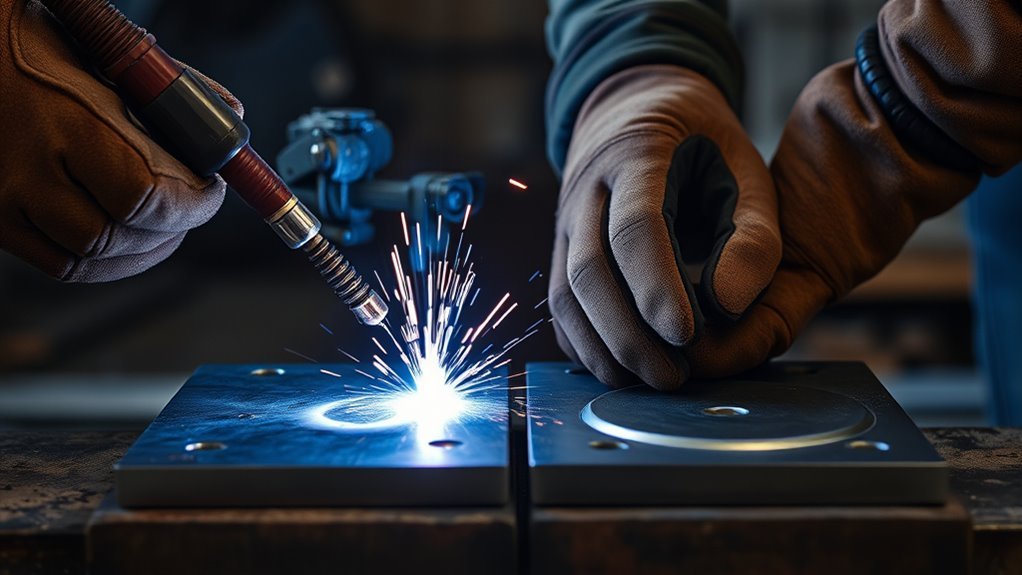
Forehand welding, also called push or forward welding, means the torch, gun, or electrode is angled toward the direction in which the weld is progressing.
In traditional oxy-fuel welding, the filler rod is positioned ahead of the torch and the flame is directed toward the joint ahead of the molten puddle. This helps preheat the plate edges immediately before they enter the weld pool and gives the welder good control over a relatively small puddle.
Traditional oxy-fuel training commonly recommends forehand technique for sheet and light plate up to roughly 1/8 inch (3.2 mm). That thickness is a useful oxy-fuel rule of thumb rather than a universal cutoff for every welding process.
Forehand welding generally favors joint visibility, puddle control, and a wider, flatter bead rather than maximum penetration.
In MIG/GMAW, pushing the gun usually directs the arc force away from the weld puddle. Under otherwise similar conditions, this tends to produce lower penetration and a wider, flatter bead. It also gives the operator a useful view of the joint and the path ahead.
Forehand technique can therefore be practical for thin sheet, body panels, light fabrication, and applications where bead placement and joint visibility matter. It should not, however, be selected solely because the material falls below a fixed thickness number.
What Is Backhand Welding?
Backhand welding, also called pull, drag, or trailing technique, angles the torch or gun back toward the molten puddle and the weld that has already been deposited.
In traditional oxy-fuel backhand welding, the torch tip precedes the filler rod and the flame points back toward the molten puddle. This concentrates heat at the weld area and can improve root fusion on heavier material.
In MIG/GMAW, a pull technique generally produces deeper penetration, a narrower bead, and more bead buildup than a comparable push technique.
Backhand Welding Basics
The defining feature of backhand welding is direction, not one universal torch angle. The heat source points back toward the weld puddle while travel continues along the joint.
Traditional oxy-fuel instruction may use a torch angle of roughly 45–60 degrees to the work, depending on the procedure and joint. MIG/GMAW is different: normal gun travel angles are commonly only about 5–15 degrees from perpendicular.
Note: Do not copy an oxy-acetylene torch angle directly into MIG welding. “Forehand” and “backhand” describe the travel orientation, but the appropriate numerical angle depends on the process, joint, position, consumable, and procedure.
Traditional oxy-fuel guidance describes backhand welding as particularly useful on material more than about 1/8 inch thick because it can improve control of a larger puddle and make root fusion easier to obtain.
Backhand Welding Benefits
The main advantage of backhand technique is its tendency to focus more heat and arc force into the joint. In MIG/GMAW, that usually creates deeper penetration and a narrower weld profile than pushing under otherwise similar conditions.
For oxy-fuel welding on heavier material, backhand technique can also reduce the amount of torch manipulation needed and may permit a narrower joint preparation than a comparable forehand procedure.
These effects can make backhand technique useful for thicker sections and applications where penetration is important. They do not mean every pulled weld is automatically stronger. Adequate fusion, correct filler metal, proper joint design, acceptable weld size, correct settings, and freedom from defects are all necessary for weld quality.
Spatter should also be treated as a process-and-setting issue rather than a guaranteed advantage of one direction. Excessive travel angle, unstable settings, incorrect stickout, contamination, and poor shielding can all increase spatter in arc welding.
How the Torch Moves
Forehand and backhand welding differ mainly in how the torch or gun is oriented relative to the direction of travel.
With forehand, the tip points toward the joint ahead. With backhand, the tip points back toward the puddle and completed bead.
Two separate angles must be considered: travel angle, measured along the weld direction, and work angle, measured across the joint. Confusing these two measurements is one reason welding-angle recommendations often appear contradictory.
Torch Angle and Travel
For MIG/GMAW, equipment manufacturers commonly recommend keeping the gun relatively close to perpendicular, with a travel angle around 5–15 degrees. Excessive travel angle can reduce penetration, increase spatter, and make the arc less stable.
Traditional oxy-fuel technique uses noticeably larger torch angles. The exact angle varies with material thickness, welding position, joint design, tip size, and whether forehand or backhand technique is used.
- Forehand: point the torch or gun toward the direction of travel.
- Backhand: point the torch or gun toward the deposited bead.
- Travel angle: controls the push-or-pull orientation.
- Work angle: positions the heat source across the joint.
- Excessive angle: can cause poor shielding, spatter, unstable arc behavior, or reduced fusion in applicable arc processes.
Pro Tip: Establish the correct work angle first, then add only the travel angle needed for the required push or pull technique. This makes it easier to keep the wire or flame centered in the joint instead of accidentally steering it toward one sidewall.
Push Versus Pull
In MIG welding, the push motion points the gun ahead of the puddle. It usually provides a good view of the unwelded joint while producing a flatter, wider bead and somewhat lower penetration.
The pull motion points the gun back at the puddle. Under comparable settings it generally produces deeper penetration, a narrower bead, and more reinforcement.
Neither direction is automatically correct for every weld. Joint fit-up, material thickness, welding position, transfer mode, shielding gas, wire type, procedure requirements, and desired bead contour all affect the decision.
Penetration and Heat Differences
Push versus pull changes how the heat and arc force interact with the joint. In GMAW, pushing directs more of the arc force ahead of the puddle. This usually spreads the weld bead and reduces penetration compared with pulling at the same basic settings.
Pulling points the arc back toward the puddle and joint, generally creating a narrower fusion profile with greater penetration.
- Forehand/push generally gives a wider, flatter bead.
- Backhand/pull generally gives deeper penetration in comparable GMAW conditions.
- Current, voltage, wire feed speed, travel speed, electrode extension, shielding gas, and joint geometry can change the result substantially.
- Thin material may benefit from the lower penetration of a push technique.
- Thicker material may benefit from a pull technique when the procedure permits it.
Travel direction should therefore be treated as one welding variable, not as a substitute for proper machine settings or joint preparation.
Spatter and Weld Quality Differences
Spatter is influenced by far more than forehand versus backhand travel. Voltage, amperage or wire-feed speed, polarity, shielding gas, contact-tip-to-work distance, surface condition, transfer mode, and torch angle can all affect arc stability and droplet transfer.
In MIG welding, an excessive travel angle—whether pushing or pulling—can increase spatter and reduce penetration. Keeping the gun within the equipment or procedure recommendation is more important than assuming one direction will always be cleaner.
Bead quality also depends on fusion, bead size, undercut, porosity, overlap, cracking, contamination, and other acceptance criteria. A smooth-looking weld is not necessarily a sound weld.
Slag is a separate issue. Solid-wire GMAW with shielding gas does not normally create the flux slag associated with stick welding or many flux-cored wires. Slag-removal claims should therefore only be applied to processes that actually produce slag.
When to Use Forehand Welding
Forehand welding is useful when the goal is good joint visibility, a wider and flatter bead, or reduced penetration compared with pulling at similar settings.
In traditional oxy-fuel welding, forehand technique is commonly used for sheet and light plate up to approximately 1/8 inch (3.2 mm). The operator can control a relatively small puddle while preheating the joint edges ahead of it.
In MIG welding, a push technique is commonly useful for thin sheet and automotive body work because the lower penetration can help reduce the risk of burn-through.
- Use the correct process-specific travel angle.
- Keep the heat source centered on the joint.
- Watch the leading edges of the puddle for consistent fusion.
- Maintain the required travel speed instead of lingering in one area.
- Use settings appropriate for the metal thickness and joint.
If burn-through occurs, travel direction is only one adjustment. Also check voltage, wire-feed settings, travel speed, joint gap, tack spacing, and the suitability of the selected welding process.
When to Use Backhand Welding
Backhand welding is commonly useful when greater penetration or a narrower bead is required and the process or welding procedure permits a pull technique.
Traditional oxy-fuel guidance recommends backhand technique for material heavier than roughly 1/8 inch (3.2 mm). Directing the flame back toward the puddle helps concentrate heat and can improve fusion at the root of heavier joints.
In MIG welding, pulling typically increases penetration relative to pushing with otherwise similar settings. This can make it useful on heavier material, but adequate penetration must still be confirmed by the applicable procedure and weld-quality requirements.
Do not select backhand technique merely because the weld is vertical or overhead. Welding progression and torch orientation in those positions depend on the process, consumable, joint, material thickness, and approved procedure. Some traditional oxy-fuel vertical-welding instructions, for example, use a forehand motion.
Welding position does not by itself determine whether you should push or pull; process and procedure requirements come first.
Forehand vs Backhand Welding in MIG and Gas
The terms forehand and backhand are used in both gas and arc welding, but the actual technique is not identical. The most important distinction is the recommended torch or gun angle.
Forehand and Backhand in MIG Welding
For solid-wire MIG/GMAW, manufacturer guidance commonly uses a small travel angle of approximately 5–15 degrees from perpendicular.
- Push/forehand: lower penetration, wider and flatter bead, good view of the joint ahead.
- Pull/backhand: deeper penetration, narrower bead, greater bead buildup.
- Travel angles greater than roughly 20–25 degrees can contribute to spatter, reduced penetration, and arc instability.
Those characteristics assume the other welding variables remain reasonably comparable. Changing voltage, wire-feed speed, travel speed, shielding gas, stickout, or transfer mode can alter the result.
Forehand and Backhand in Oxy-Fuel Gas Welding
Traditional oxy-acetylene welding uses larger torch angles than MIG welding. In forehand technique, the filler rod leads the torch and the flame is directed toward the joint ahead of the puddle. In backhand technique, the torch leads and points the flame back toward the puddle, with the filler rod positioned between the flame and molten metal.
Traditional training uses forehand technique on light material and commonly recommends backhand welding for steel thicker than about 1/8 inch because of its penetration and puddle-control advantages.
Note: A thickness guideline taken from oxy-acetylene welding should not be treated as a universal MIG, TIG, FCAW, or stick-welding rule.
How to Choose the Right Welding Technique
Select the technique by looking at the complete welding procedure rather than material thickness alone.
1. Identify the welding process. MIG/GMAW push and pull angles differ substantially from traditional oxy-fuel torch angles. Flux-cored and stick electrodes can also have process- or consumable-specific travel requirements.
2. Check the procedure or consumable instructions. If a welding procedure specification, manufacturer data sheet, code-qualified procedure, or instructor specifies travel direction and angle, follow it.
3. Consider penetration. In MIG welding, pull technique normally increases penetration while push technique normally reduces it under comparable conditions.
4. Consider bead shape. Push technique normally produces a wider, flatter profile. Pull technique normally creates a narrower bead with more reinforcement.
5. Consider material thickness and burn-through risk. Thin material often benefits from controlled heat input and the lower penetration associated with pushing. Heavier material may benefit from the penetration of pulling where permitted.
6. Consider visibility. Push MIG often gives a better view of the joint ahead. Pulling can make the puddle and deposited bead easier to watch.
7. Evaluate the finished weld. A direction that feels comfortable is not acceptable if the weld shows lack of fusion, excessive penetration, undercut, overlap, porosity, or other defects.
Common Problems and What to Check
- Too little penetration: check travel direction, voltage/current or wire-feed settings, travel speed, joint preparation, stickout, and work angle.
- Burn-through on thin metal: reduce excessive heat input, avoid moving too slowly, control joint gap, and consider a push technique if appropriate.
- Excessive spatter: check settings, polarity, shielding gas, stickout, contamination, and excessive travel angle.
- Porosity: check shielding-gas flow and coverage, drafts, leaks, contamination, nozzle condition, and travel angle.
- Uneven bead placement: confirm work angle, joint visibility, travel speed, and a consistent torch-to-work distance.
Frequently Asked Questions
Which Is Better, Forehand or Backhand Welding?
Neither is universally better. Forehand or push technique is useful when you want good joint visibility, a flatter bead, or lower penetration. Backhand or pull technique is useful when deeper penetration and a narrower bead are desirable. The correct choice depends on the welding process, joint, material, position, consumable, and procedure.
Why Is Backhand Better Than Forehand in Some Welds?
Backhand welding can be preferable when additional penetration is needed. In MIG welding, pulling generally concentrates the arc more into the joint and creates a narrower, deeper fusion profile. In traditional oxy-fuel welding, backhand technique is commonly used on heavier material. It is not automatically stronger or better for every weld.
What Are the Three Main Welding Techniques?
MIG, TIG, and stick are three of the most commonly taught arc-welding processes, but they are not the only welding methods. Others include flux-cored arc welding, submerged arc welding, oxy-fuel welding, resistance welding, laser welding, and additional specialized processes. Forehand and backhand describe travel technique rather than separate welding processes.
When Using a Forehand Technique, Do I Push the Weld Puddle?
Yes. Forehand is commonly called the push technique because the torch or gun points in the direction of travel and advances toward the unwelded joint. In MIG welding this generally produces a wider, flatter bead with less penetration than an equivalent pull technique.
What Angle Should I Use for Forehand or Backhand MIG Welding?
A normal MIG/GMAW travel angle is commonly about 5–15 degrees from perpendicular. Point the gun slightly ahead for push technique or slightly back for pull technique. Excessive angles can reduce shielding effectiveness, penetration, and arc stability, so follow the equipment, wire, and procedure recommendations for the job.
Does Pulling a MIG Weld Make It Stronger?
Not automatically. Pulling normally increases penetration compared with pushing under similar conditions, but weld strength depends on whether the joint achieves the required fusion, weld size, filler-metal properties, joint design, and acceptance criteria without harmful defects.
Conclusion
Forehand and backhand welding mainly differ in the direction the torch or gun points relative to travel. Forehand or push welding generally gives a wider, flatter bead and lower penetration, while backhand or pull welding generally produces a narrower bead with deeper penetration.
The important qualification is that the correct angle and application depend on the welding process. Traditional oxy-fuel welding commonly uses forehand technique on lighter material and backhand technique on material over about 1/8 inch, while MIG/GMAW normally uses much smaller travel angles and has its own push-versus-pull characteristics.
Choose the technique according to the process, joint design, material thickness, welding position, required penetration, consumable instructions, and applicable welding procedure—not simply because one direction is described as stronger or cleaner.
Sources
- Miller — Understanding the Basics of MIG Welding for Mild Steel — backs up push-versus-pull penetration, bead profile, visibility, and MIG travel-angle guidance.
- U.S. Department of Defense / Navy Training Manual — supports traditional oxy-fuel forehand/backhand technique, torch orientation, and the over-1/8-inch backhand guideline.
- OSHA 29 CFR 1910.252 — Welding, Cutting, and Brazing — supports eye protection, protective clothing, ventilation, and general welding-safety requirements.
- OSHA 29 CFR 1910.253 — Oxygen-Fuel Gas Welding and Cutting — supports oxygen-fuel equipment, cylinder, oxygen cleanliness, and protective-device requirements.