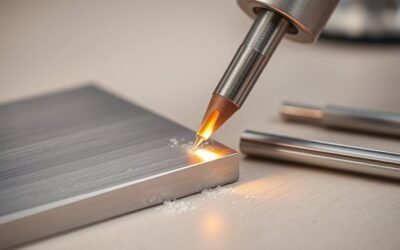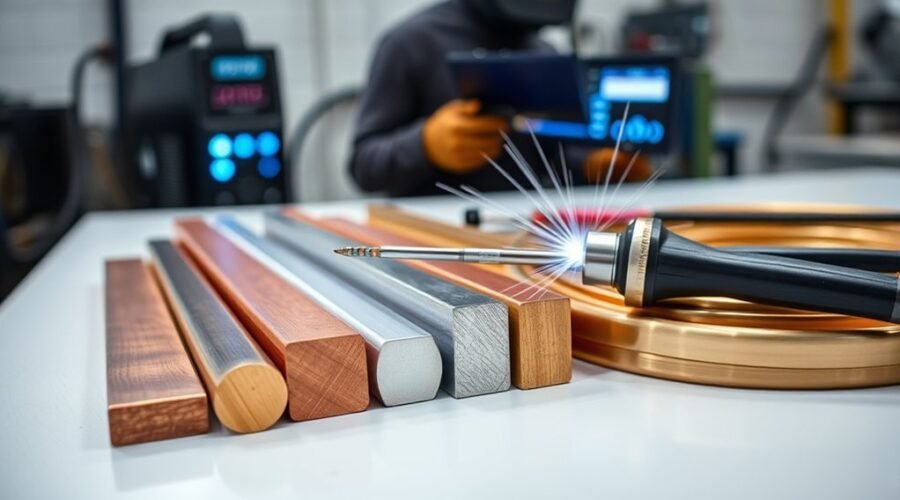
Non-ferrous metals are metals and alloys whose main constituent is not iron. Aluminum, copper, nickel, titanium, magnesium, lead, and tin all belong to this group, but they do not share one set of welding properties. Successful welding depends on identifying the exact alloy, controlling heat, cleaning correctly, choosing a compatible filler and process, and protecting reactive metal from the atmosphere.
Quick Answer
Non-ferrous metals contain little or no iron as a main constituent. Aluminum, copper, nickel, titanium, magnesium, lead, and tin all qualify, but they weld very differently. Good results depend on identifying the alloy, cleaning it correctly, selecting a compatible process and filler, controlling heat, and maintaining suitable shielding.
Key Takeaways
Key Takeaways
- Non-ferrous describes iron content, not one universal set of properties; some members are light, some are dense, and nickel is magnetic.
- Aluminum, copper, nickel, titanium, magnesium, lead, and tin require different welding processes, filler choices, cleaning methods, and heat strategies.
- High thermal conductivity makes aluminum and especially copper strong heat sinks, while reactive titanium needs shielding as the weld cools.
- Porosity, cracking, incomplete fusion, contamination, and distortion usually trace back to alloy choice, surface condition, shielding, filler selection, or heat input.
- Some non-ferrous metals and coatings create serious fume or fire hazards, so ventilation and metal-specific fire precautions matter as much as weld technique.
What Are Non-Ferrous Metals?
)
Non-ferrous metals are metals or alloys in which iron is not the main constituent. The category includes familiar materials such as aluminum and copper as well as nickel, titanium, magnesium, lead, tin, zinc, cobalt, and precious metals.
“Non-ferrous” identifies a metal by composition; it does not mean every non-ferrous metal is light, corrosion-proof, or non-magnetic.
The distinction matters because these materials can behave very differently from carbon steel during fabrication. Aluminum is valued for low density, copper for electrical and thermal conductivity, titanium for high strength relative to its weight, and nickel alloys for corrosion and high-temperature performance.
Some common generalizations need qualification. Lead is dense rather than lightweight, while bulk nickel is ferromagnetic. Many non-ferrous metals resist corrosion well, but corrosion behavior depends on the alloy and its environment.
Many are also highly recyclable. Their combination of conductivity, corrosion resistance, formability, strength-to-weight performance, or specialized chemical resistance makes them useful when steel is not the best material for the job.
Common Types of Non-Ferrous Metals
The most common non-ferrous metals differ substantially in density, conductivity, strength, melting behavior, and weldability. Identifying the base metal and alloy grade should therefore come before choosing a welding process or filler.
Aluminum combines low density with useful corrosion resistance and good conductivity. It is widely used in transportation, aerospace, structures, heat-transfer equipment, and consumer products.
Copper has very high electrical and thermal conductivity. It is common in electrical conductors, bus bars, plumbing, heat exchangers, and copper-alloy marine components.
Lead is soft, dense, and relatively low-melting. It appears in shielding and specialized industrial applications, but welding or heating lead requires strict exposure controls.
Nickel and nickel alloys provide corrosion resistance and useful performance at elevated temperatures. Nickel is also an important alloying element in many stainless steels and high-performance alloys.
Tin is soft, corrosion resistant, and low-melting. It is widely used in solder and as a coating on other metals, including tinplate used for food containers, rather than primarily as a structural fusion-welded metal.
Titanium provides a strong strength-to-weight combination and excellent corrosion resistance. It is common in aerospace, chemical-processing, marine, and medical applications.
Magnesium is especially light and is used where mass reduction matters. Its alloys can be welded, but magnesium dust, chips, and shavings create an important combustible-metal hazard.
Key Properties for Welding
Welding non-ferrous metals depends on the thermal, chemical, and metallurgical behavior of the exact alloy. Conductivity, oxide formation, thermal expansion, solidification range, contamination sensitivity, and filler compatibility can all change the required technique.
| Property | Welding Effect |
|---|---|
| High conductivity | Heat leaves the weld zone quickly, making fusion harder on metals such as copper and aluminum |
| Ductility | Can help accommodate deformation, but weld and heat-affected-zone ductility still depend on the alloy |
| Alloy variation | Changes weldability, cracking risk, filler choice, strength, and corrosion performance |
| Shielding gas | Protects the molten or hot metal from atmospheric contamination |
| Preheating need | Depends on metal, grade, thickness, process, restraint, and the qualified welding procedure |
Argon is common in TIG and MIG welding of several non-ferrous alloys, but there is no universal shielding gas for every application. Helium or specific gas mixtures may be useful where more arc energy or different weld-pool behavior is required.
Filler choice is also more complex than simply matching the base metal as closely as possible. A compatible non-matching filler may be deliberately selected to reduce cracking or produce the required strength and corrosion performance.
Why Non-Ferrous Metals Weld Differently
Non-ferrous metals weld differently because their physical properties vary far more than the label suggests. Copper acts as an intense heat sink, aluminum combines high conductivity with a stubborn oxide film, nickel alloys are sensitive to certain contaminants, and hot titanium reacts readily with gases in the atmosphere.
Heat Conductivity Differences
Thermal conductivity determines how quickly heat spreads away from the arc. This directly affects arc starting, penetration, preheat requirements, travel speed, and how the weld pool changes as the workpiece heats up.
| Metal | Conductivity | Welding impact |
|---|---|---|
| Copper | Very high | Acts as a strong heat sink; thicker sections may require substantial preheat |
| Aluminum | High | Heat moves rapidly from the arc, while the weld pool can become increasingly fluid as the part heats |
| Titanium | Much lower than copper | Heat remains more localized, while atmospheric shielding during cooling becomes especially important |
Pure copper is among the most demanding common metals in this respect. TWI’s copper welding guidance notes that high thermal conductivity can make substantial preheat necessary, while some copper-nickel alloys have much lower conductivity and can often be fusion welded without preheat.
Aluminum also conducts heat quickly. That can make the beginning of a weld feel cold, followed by a progressively hotter and more fluid weld pool as heat accumulates in the workpiece.
Low Melting Point and High-Temperature Effects
Melting behavior varies widely among non-ferrous metals, so they should not all be described as low-melting. Lead and tin melt comparatively easily, while nickel and titanium tolerate far higher temperatures. The important welding issue is the usable temperature window of the specific alloy.
Aluminum can lose shape quickly once the base metal becomes hot, even though its surface oxide remains difficult to melt. Magnesium also needs careful heat control, while titanium’s main high-temperature concern is atmospheric contamination rather than a low melting point.
- Identify the alloy before selecting current, polarity, filler, and shielding.
- Control travel speed and arc dwell to avoid excessive heat accumulation.
- Use preheat only when the material, thickness, and welding procedure call for it.
How to Weld Non-Ferrous Metals
There is no single procedure for welding non-ferrous metals. Start by identifying the alloy, then choose a process and filler approved for that material, clean the joint with methods that will not contaminate it, establish suitable shielding, and set heat input for the metal’s conductivity and thickness.
Warning: Welding or cutting lead, cadmium-bearing material, beryllium, zinc-bearing alloys, and some coatings can create serious fume hazards. OSHA welding requirements specify ventilation and, for certain materials and conditions, respiratory protection. Identify coatings and base metals before applying heat.
Metal-Specific Welding Methods
Process selection should follow the base alloy rather than the general label “non-ferrous.” TIG and MIG cover many applications, but the best choice changes with alloy, section thickness, productivity, shielding requirements, and the desired weld properties.
Aluminum: TIG offers fine control for thinner sections and repair work, while MIG provides higher deposition rates for production and thicker material. Some high-strength alloys have limited fusion weldability; AWS aluminum welding guidance specifically warns that alloys such as 2024 and 7075 are generally poor candidates for conventional fusion welding because of cracking and corrosion concerns.
Copper and copper alloys: TIG and MIG are established choices, but pure copper’s conductivity can demand much more heat than a copper-nickel alloy. Brass requires additional caution because zinc can vaporize during fusion welding and create fumes and porosity; lower-zinc brasses are more weldable than high-zinc grades.
Nickel alloys: TIG, MIG, stick, and other conventional processes can be used on suitable grades. The main discipline is cleanliness. TWI’s nickel-alloy guidance identifies hot cracking as a major concern and notes that grease, oil, dirt, sulfur, lead, and other contaminants can contribute to cracking.
Titanium: TIG is widely used because it provides precise heat and shielding control. Titanium must remain protected as the weld and heat-affected zone cool; TWI’s titanium welding guidance states that above about 500°C titanium has a strong affinity for oxygen, nitrogen, and hydrogen. Argon or helium shielding may therefore be required over the weld pool, hot bead, and root.
Magnesium: TIG is common for repair and precision work, while MIG can be used with suitable equipment and filler. Keep chips, grinding dust, and shavings away from the hot-work area. OSHA classifies fires involving magnesium or titanium powders, flakes, or shavings as combustible-metal fires requiring a Class D extinguisher.
- Resistance spot welding can join suitable thin sheet where alloy and equipment permit.
- Laser welding can provide concentrated heat and limited distortion in controlled industrial applications.
- Friction stir welding joins suitable alloys, especially aluminum, in the solid state without melting the joint.
Note: Structural, pressure-containing, aerospace, medical, and code-controlled welds should follow an approved welding procedure specification and the applicable code or engineering requirements. General process advice is not a substitute for a qualified procedure.
Surface Prep And Cleanliness
Surface preparation is one of the most important controls in welding non-ferrous metals. Oil, moisture, oxides, shop dirt, marking compounds, and particles from other metals can cause porosity, cracking, lack of fusion, or loss of corrosion resistance.
For aluminum, remove oil and grease first with a suitable cleaner, then remove the oxide with a dedicated stainless steel brush, scraper, or approved cleaning method. A brush previously used on steel can transfer contamination to aluminum.
Titanium requires even stricter contamination control. Clean joint faces and filler material, avoid touching prepared surfaces with bare hands, and do not use ordinary carbon-steel brushes on the weld area.
Nickel alloys should also be thoroughly degreased and cleaned before welding because low-melting contaminants and sulfur-bearing residues can promote cracking.
Pro Tip: Keep cleaning brushes and abrasives dedicated to one metal family. A tool that looks clean can still transfer steel, copper, lead, or other particles that create defects in aluminum, titanium, or nickel-alloy welds.
Let cleaned surfaces dry completely before welding. Keep filler wire and rods clean and protected from moisture, dirt, and shop handling until they enter the weld pool.
Filler Metals And Heat
Filler metal must be compatible with the base alloy and the service requirement. A nominally matching filler is sometimes correct, but not always; aluminum welding often uses deliberately non-matching filler compositions to reduce solidification cracking or achieve the required corrosion and mechanical performance.
Heat input should likewise follow the material rather than a simple “low heat” rule. Pure copper can require added heat or preheat because it pulls energy away rapidly, while thin aluminum needs enough initial energy for fusion without allowing the increasingly hot workpiece to collapse or distort.
Titanium does not generally need blanket preheating simply because a section is thick. Instead, heat input, interpass temperature, shielding coverage, joint design, and any preheat requirement should come from the qualified procedure for that grade and application.
- Choose filler from an alloy compatibility chart, specification, or qualified procedure.
- Adjust heat for conductivity, thickness, joint design, and restraint.
- Protect reactive metals with adequate shielding until the hot metal is below its contamination-sensitive range.
Common Welding Problems and Fixes
Most non-ferrous welding defects can be traced to a short list of causes: contamination, inadequate or excessive heat, poor shielding, wrong filler, unsuitable alloy selection, or inconsistent technique. The fastest diagnosis starts with the appearance and location of the defect.
| Problem | Likely causes | What to check |
|---|---|---|
| Porosity | Moisture, hydrocarbons, oxide, unstable shielding, or unsuitable filler | Cleanliness, gas coverage, drafts, filler condition, and base alloy |
| Lack of fusion | Insufficient heat at the joint, excessive travel speed, oxide, or poor fit-up | Heat input, arc placement, preparation, travel speed, and joint geometry |
| Cracking | Wrong filler, crack-sensitive alloy, contamination, restraint, or poor crater termination | Alloy identification, filler selection, cleaning, joint restraint, and weld sequence |
| Distortion or burn-through | Excessive heat, slow travel, thin material, or poor heat distribution | Current, travel speed, sequence, fit-up, and heat buildup |
| Oxidized or contaminated titanium | Insufficient shielding while the weld is hot | Torch shielding, trailing coverage, root purge, leaks, and drafts |
Poor fusion is not always solved by simply increasing amperage. On aluminum, oxide or poor arc placement can prevent fusion even when enough total heat is present. On copper, the workpiece itself may be carrying heat away faster than the arc can establish a fluid pool.
Porosity commonly points back to surface contamination, moisture, or shielding problems. Aluminum is especially sensitive to hydrogen-related porosity, so both base metal and filler condition matter.
Warping is usually more severe in thin or poorly restrained material than in heavy sections. Control heat distribution, sequence, fit-up, and travel speed rather than relying on preheat as a universal distortion cure.
Cracking deserves an alloy-level investigation. Check whether the base alloy is readily weldable, whether the filler is compatible, and whether restraint or contamination is creating a crack-sensitive weld or heat-affected zone.
Common Uses for Non-Ferrous Metals
Non-ferrous metals are used where a particular property offers an advantage over ordinary carbon steel. Common drivers include lower mass, conductivity, corrosion resistance, high-temperature performance, non-sparking behavior in selected alloys, or biological compatibility.
In aerospace, aluminum and titanium alloys help reduce structural weight while still meeting demanding strength and corrosion requirements. Different alloys serve airframes, engine-related components, fasteners, and other specialized parts.
Transportation uses aluminum in body panels, structural members, rail equipment, trailers, and other components where reducing mass can improve efficiency or payload.
Electrical systems rely heavily on copper and aluminum conductors because of their electrical conductivity. Copper is common in wiring, motors, bus bars, and electronic components, while aluminum is widely used where lower mass is valuable.
Marine systems use copper alloys, nickel-containing alloys, aluminum, and titanium where the selected grade can resist the intended water chemistry and operating conditions.
Medical engineering uses titanium and selected titanium alloys for implants and instruments because they combine strength, corrosion resistance, and biocompatibility.
- Aerospace and transportation structures
- Electrical conductors and heat-transfer systems
- Marine, chemical-processing, and medical equipment
Frequently Asked Questions
What Are the Key Properties of Non-Ferrous Metals?
Non-ferrous metals do not share one universal set of properties. Depending on the metal or alloy, useful traits can include low density, high electrical or thermal conductivity, corrosion resistance, ductility, high strength-to-weight performance, or resistance to high temperatures and chemicals.
Are Non-Ferrous Metals Always Non-Magnetic?
No. Non-ferrous means that iron is not the main constituent; it does not guarantee non-magnetic behavior. Aluminum, copper, lead, and titanium are commonly treated as non-magnetic in ordinary applications, while nickel is a notable ferromagnetic non-ferrous metal.
What Two Metals Cannot Be Welded Together?
There is no simple pair that is absolutely impossible to join by every welding or joining method. Aluminum-to-copper and titanium-to-steel are difficult for conventional fusion welding because brittle intermetallic compounds can form, but specialized solid-state processes, interlayers, transition pieces, brazing, or other engineered methods can make such joints possible.
What Are 10 Types of Non-Ferrous Metals?
Ten common examples are aluminum, copper, lead, zinc, nickel, tin, titanium, magnesium, cobalt, and chromium. Gold, silver, platinum, and many copper-, nickel-, aluminum-, and titanium-based alloys also belong to the broader non-ferrous family.
What Are the 10 Properties of Non-Metals?
Non-metals are a different chemical category from non-ferrous metals. Common tendencies include poor electrical and thermal conductivity, relatively low density, brittle behavior when solid, high electronegativity, high ionization energy, covalent bonding, nonlustrous surfaces, formation of acidic oxides, variable room-temperature states, and reactions that often form compounds with metals.
What Shielding Gas Is Used for Welding Non-Ferrous Metals?
Argon is widely used, but there is no single shielding gas for every non-ferrous metal and process. Aluminum and titanium commonly use inert argon or helium, while copper alloys may use argon, helium-containing mixtures, or other process-specific gases depending on alloy, thickness, and welding method.
Conclusion
Non-ferrous metals are defined by composition, not by a single set of welding characteristics. Aluminum, copper, nickel, titanium, magnesium, lead, and tin each demand their own approach to heat, cleaning, filler selection, shielding, and safety.
Before striking an arc, identify the exact alloy and confirm that the proposed process and filler are suitable. That one step prevents many of the porosity, cracking, fusion, contamination, and safety problems that make non-ferrous welding seem more difficult than it needs to be.
Sources
- American Welding Society: Aluminum alloy selection, cleaning, shielding, filler selection, and weldability.
- TWI – Copper and Copper Alloys: Copper conductivity, preheating, brass weldability, filler, and shielding considerations.
- TWI – Titanium and Titanium Alloys: Atmospheric contamination, cleaning, and inert-gas shielding requirements.
- TWI – Welding of Nickel Alloys: Hot cracking, contamination, cleaning, and conventional welding processes.
- OSHA 29 CFR 1910.252: Welding ventilation and controls for lead, zinc, cadmium, beryllium, and related hazards.
- OSHA Portable Fire Extinguisher Guidance: Class D extinguishers for combustible-metal fires involving materials such as magnesium and titanium.