White metal welding is not one single procedure because “white metal” can describe several light-colored alloys. This guide focuses on zinc-based pot metal and Zamak die castings, where a low melting range and zinc fume generation make conventional fusion welding difficult. A reliable repair starts with identifying the alloy and choosing the lowest-heat joining method that can meet the joint’s strength requirements.
Quick Answer
White metal welding depends on the alloy. For zinc-based pot metal and Zamak castings, conventional arc welding has a very small margin for error, so low-temperature repair methods or resistance spot welding are often safer choices. Identify the alloy, clean it thoroughly, use a compatible filler, control heat closely, and manage zinc fumes.
Key Takeaways
Key Takeaways
- Do not assume every white metal part is zinc. Pot metal composition varies, while modern Zamak alloys have defined compositions and properties.
- Common Zamak die-casting alloys melt at roughly 375–404°C (707–759°F), depending on grade, leaving little room for uncontrolled heating.
- Conventional TIG or other arc welding should not be treated as the default repair process for zinc die castings; resistance spot welding and specialized low-temperature repairs are often better suited.
- Remove grease, plating, corrosion, and oxide where the selected repair process requires clean bare metal, but follow the actual filler or welding procedure rather than a universal flux recipe.
- Heating zinc can create zinc-oxide fumes. Use suitable ventilation and follow workplace respiratory-protection requirements rather than relying on smell or visible smoke.
Why White Metal Is Hard to Weld?
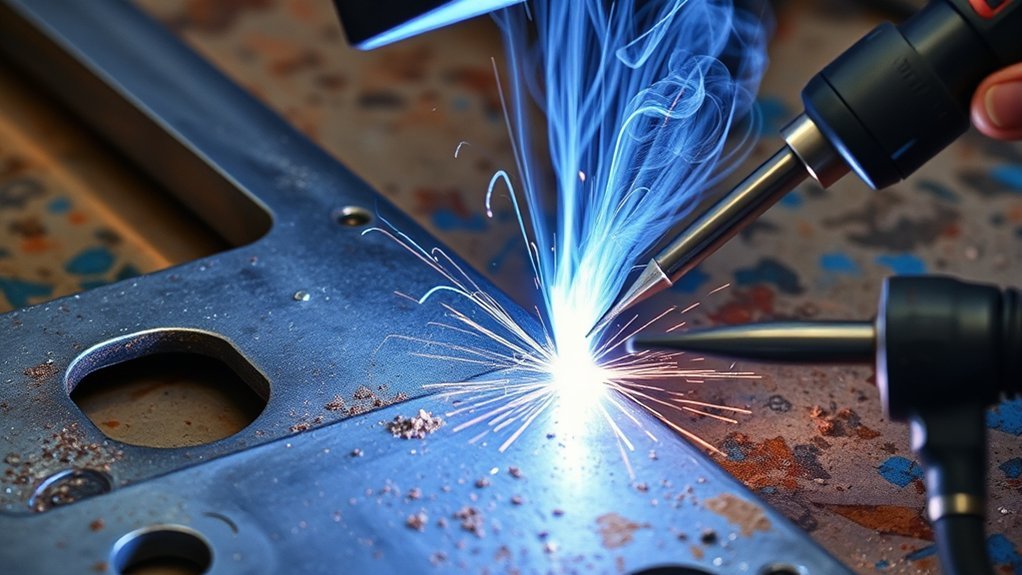
Zinc-based white metal is difficult to repair because it reaches its melting range at a much lower temperature than steel, while a welding arc or oxy-fuel flame is far hotter than the base metal needs. The result is a narrow working window between heating the joint enough for bonding and overheating, slumping, oxidizing, or vaporizing the casting.
The main challenge is not simply low melting temperature; it is keeping the joint inside a very narrow and controllable heat window.
The term “725°F melting point” is often quoted for white metal, but it should not be applied to every zinc material. The International Zinc Association’s physical-property data gives melting ranges of 381–387°C (718–729°F) for Zamak 3, 380–386°C (716–727°F) for Zamak 5, 379–390°C (714–734°F) for Zamak 2, and 375–404°C (707–759°F) for ZA-8.
| Zinc Die-Casting Alloy | Melting Temperature Range |
|---|---|
| Zamak 3 / ZP3 | 381–387°C (718–729°F) |
| Zamak 5 / ZP5 | 380–386°C (716–727°F) |
| Zamak 2 / ZP2 | 379–390°C (714–734°F) |
| ZA-8 / ZP8 | 375–404°C (707–759°F) |
Pure zinc is different again. PubChem lists pure zinc at about 419.53°C (787.15°F) melting temperature and about 907°C (1,665°F) boiling temperature. Because arc temperatures greatly exceed those values, excessive heat can cause intense oxidation, fumes, porosity, and loss of base metal.
Zinc alloys also conduct heat well, so the surrounding casting can draw heat away from the joint while the immediate repair area approaches its melting range. Cast porosity, corrosion, plating, previous solder, and unknown alloying elements can make an old pot-metal part even less predictable.
Modern zinc die-casting alloys should not simply be described as “brittle at room temperature.” Their ductility varies by alloy, age, casting quality, temperature, and previous damage. Old pot metal may fracture abruptly, but that behavior does not identify the composition by itself.
Finally, do not substitute ordinary steel welding consumables. A product such as Hobart E71T flux-core wire is intended for FCAW applications and should not be treated as a filler recommendation for zinc die cast.
How to Identify Zinc Alloys First
Before attempting white metal welding, identify the base material as closely as practical. Color, weight, and fracture appearance can provide clues, but none of them proves that a casting is zinc or tells you which zinc alloy you have.
Start with any casting marks, part drawings, manufacturer specifications, repair records, or material certificates. If the part is valuable, structural, pressure-containing, or difficult to replace, positive material identification such as X-ray fluorescence is more dependable than appearance alone.
Zinc die castings are commonly grey to silvery and feel substantially heavier than similar-size magnesium or aluminum parts. Zamak alloys normally contain zinc with controlled additions of aluminum and smaller amounts of other elements, so their behavior is more predictable than unidentified historical “pot metal.”
Electrical conductivity also varies by composition. For example, Zamak 3 is listed at about 27% IACS, but conductivity should be treated as a material property rather than a simple workshop identification test.
Do not confuse a steel MIG setup with a zinc-repair procedure. A 75/25 MIG shielding-gas mix may be useful for appropriate steel MIG applications, but it does not establish how an unidentified zinc casting should be repaired.
Clean and Degrease the Metal Surface
Clean metal is essential for most zinc-alloy repair methods because oil, corrosion, paint, plating, and oxide can interfere with filler wetting and fusion. The exact preparation depends on whether you are brazing, soldering, fusion welding, or resistance welding.
Work only on the area needed for the joint. Zinc castings can have thin sections, decorative detail, or plating that is easy to remove permanently, so aggressive grinding can create a larger repair than the original damage.
Surface Cleaning Methods
For a torch or filler-metal repair, expose clean base metal around the crack or fracture as required by the filler manufacturer. Sandpaper, a small file, a rotary burr, buffing, or careful grinding can remove oxide, corrosion, paint, and plating without unnecessarily reducing the section thickness.
Clean immediately before joining when practical because freshly exposed zinc surfaces begin oxidizing again after preparation. A dedicated clean brush can help prevent cross-contamination from steel or other shop work.
When a flux-coated or separate-flux filler is specified, clean metal gives the flux a better chance to remove the remaining oxide and allows the filler to wet the base metal. Follow the filler manufacturer’s cleaning and flux instructions rather than adding more flux to compensate for poor preparation.
A plasma cutter can be useful for appropriate cutting jobs on conductive metal, but it is not a substitute for careful surface preparation on a fragile casting. This LOTOS 55A plasma cutter guide covers cutting equipment separately from zinc repair.
Degreasing Before Welding
Degreasing removes oil, polishing compound, fingerprints, and other films that can contaminate a heated joint. Use a cleaner that is suitable for the metal and the joining process, then allow the surface to dry fully before heating.
Keep chlorinated-solvent vapors away from welding arcs. OSHA’s welding, cutting, and brazing requirements warn that chlorinated-hydrocarbon degreasing operations must be kept from contaminating the welding atmosphere because hazardous decomposition products can form.
| Method | Mechanism | Effect |
|---|---|---|
| Suitable solvent cleaning | Dissolves oils and films | Removes surface contamination |
| Ultrasonic cleaning | Cavitation action | Reaches fine recesses |
| Compatible alkaline cleaner | Lifts or emulsifies soils | Useful for stubborn contamination |
| Visual inspection | Checks the prepared surface | Finds residue, corrosion, or missed coating |
| Immediate use | Limits recontamination | Keeps the joint ready for repair |
Preparing For Strong Joints
A strong repair needs more than a shiny surface. The joint must also fit properly, stay aligned during heating, and provide enough sound base metal for the selected filler or welding process to carry the expected load.
Remove loose corrosion and damaged material until the repair reaches solid metal. If the filler manufacturer calls for a groove, bevel, backing, or preheat procedure, follow those instructions rather than using one joint preparation for every pot-metal casting.
Keep clamps and supports arranged so they do not force a cracked casting into a stressed position. Zinc parts can move quickly as they warm, and a repair that looks aligned while cold may open or sag when the surrounding metal softens.
Set the Right Flame for Zinc Alloys
If you use an oxy-fuel process with a filler specifically designed for zinc or white-metal repair, flame size and chemistry must match that consumable’s instructions. Older white-metal procedures commonly call for a small carburizing or reducing flame because excess oxygen promotes oxidation.
The flame should provide controlled, distributed heating rather than blasting the crack with the hottest part of the cone. If the surface soots heavily, the flame is too fuel-rich; if the casting starts to slump, pit, or produce heavy zinc fumes, heat input is already excessive.
Whenever possible, let the heated base metal bring the repair filler to its working temperature instead of holding the hottest part of the flame directly on the rod. This gives you more control over a material whose base-metal melting range may sit close to the filler’s working temperature.
Protect your hands, eyes, and exposed skin during torch work. This guide to TIG welding gloves and protective features covers hand protection, but ventilation remains a separate requirement whenever zinc is heated.
Choose the Best Filler Rod and Flux
The best filler rod is one that its manufacturer specifically approves for your base alloy and joining process. Do not assume that silicon bronze, an aluminum rod, pure zinc, or a generic “pot metal” rod will behave correctly on every unidentified casting.
One product already mentioned in this article, Aladdin 3-in-1, is currently listed for zinc-base-metal work at a 390°C (732°F) melting point. The current Aladdin 3-in-1 product information also states that it is used without flux for zinc-base metals. That matters because it shows why a universal flux prescription is unreliable.
Older instructions sometimes specify a mixture of 50% zinc chloride and 50% ammonium chloride. Do not treat that ratio as a general-purpose recipe for every modern repair rod. Flux chemistry, working temperature, cleanup, and corrosion risk need to match the actual filler system.
- Identify the parent alloy as closely as possible.
- Choose a filler intended for that alloy and repair process.
- Check whether the filler requires flux, comes flux-cored, or is designed for flux-free use.
- Follow its stated working-temperature and cleanup instructions.
- Test the procedure on scrap or a noncritical area when the alloy is uncertain and damage from a failed test is acceptable.
Eye and face protection is still essential during these repairs. A passive welding helmet can address arc and radiant-light protection when appropriate, but PPE cannot correct an incompatible filler or excessive heat input.
When to Use TIG vs. Oxy-Acetylene on Zinc
TIG should not be presented as the automatic choice for thin zinc die castings. The International Zinc Association’s engineering guidance says conventional fusion welding is best avoided for zinc die castings, while specialized repair procedures may still be used by experienced operators on known materials.
| Process | Best use |
|---|---|
| TIG welding | Specialized repair on a known alloy with a proven procedure; not a default pot-metal method |
| Oxy-acetylene | Specialty filler-based repairs where the rod manufacturer specifies an oxy-fuel procedure and heat can be tightly controlled |
| Both | Require alloy identification, clean metal, compatible filler, careful heat control, and fume management |
For production joining of suitable zinc die castings, resistance spot welding has stronger published technical support than conventional arc welding. The International Zinc Association’s welding guidance describes spot welding as practical and potentially reliable for zinc die-casting alloys.
If you do use an oxy-fuel setup, select the torch for fine heat control rather than cutting capacity alone. This oxy-acetylene torch kit guide covers torch hardware, but the repair rod’s instructions should determine the actual flame and heating procedure.
Note: For a safety-critical, load-bearing, pressure-containing, or irreplaceable casting, have the alloy and repair procedure evaluated by a qualified welding or materials professional before applying heat.
When Resistance Welding Works on Zinc Sheet
Resistance welding is well suited to certain zinc-alloy joints because it creates heat locally and for a short time instead of exposing the whole part to an arc or flame. Spot and seam configurations are especially useful where the parts overlap and the electrodes can clamp the joint directly.
For zinc die castings specifically, published IZA data says very short weld times are essential because of the alloys’ low melting temperature and short melting range. The correct current, force, tip geometry, and time still depend on the alloy, thickness, joint design, and equipment.
Surface Prep Matters
Surface preparation for resistance welding is process-specific. Unlike torch repair, where oxide and contamination often need to be removed aggressively, the IZA guidance states that bare zinc die castings do not require surface preparation before spot welding.
That does not mean dirt, heavy coatings, paint, corrosion, or poor contact can be ignored. Those conditions can change electrical resistance and electrode contact, so the actual welding procedure must account for the surface condition.
- Identify whether the part is bare zinc alloy, plated, painted, or otherwise coated.
- Clean or remove coatings only as required by the qualified welding procedure.
- Set the lap or flange so the electrodes make stable contact.
- Establish current, electrode force, and weld time from tested parameters for that alloy and thickness.
A general beginner welder guide can help explain common welding-machine categories, but resistance welding requires its own equipment and procedure.
Spot And Seam Joints
Spot and seam welding concentrate electrical resistance heating at the joint while electrode pressure holds the parts together. This makes them useful for overlapping sheet or cast features where the joint geometry gives the electrodes direct access.
For zinc die-casting alloys, IZA reports that very short welding times of roughly 2 to 9 periods can be necessary. That figure is not a universal machine setting: actual timing must be paired with the correct electrode force, current, tip design, material thickness, and alloy.
Good electrode contact and repeatable positioning matter because zinc softens quickly as temperature rises. If the electrodes indent the part excessively, the surface spits metal, or the nugget tears out inconsistently, the parameters need to be re-established rather than compensated for with more heat.
Heat Control Limits
Heat control is the central limit in resistance welding zinc alloys. Enough energy must reach the interface to form the weld nugget, but excess time or current can rapidly enlarge the molten zone, mark the surface, or distort a thin casting.
- Use parameters developed for the actual alloy and thickness.
- Keep electrode faces clean and in the specified condition.
- Apply consistent electrode pressure before and during the weld cycle.
- Inspect test welds for repeatable nugget formation and unacceptable surface damage.
If quality changes during a production run, check electrode condition, fit-up, coating condition, force, current, and timing before simply increasing heat. A controlled process is more repeatable than trying to compensate for every defect with additional energy.
Avoid Cracks, Porosity, and Toxic Fumes
Cracking and porosity usually become worse when an unknown zinc casting is overheated, contaminated, or repaired with an incompatible filler. Clean metal, correct fit-up, a suitable consumable, and the minimum effective heat input give you the best chance of avoiding a porous or brittle repair.
Fumes are a separate safety issue. Zinc oxide is a recognized cause of metal fume fever, and the NIOSH Pocket Guide for zinc oxide lists symptoms including chills, muscle aches, nausea, fever, cough, chest tightness, and breathing difficulty.
Warning: Do not weld, braze, cut, or heavily heat zinc in an unventilated area. Use effective source capture or mechanical ventilation as required, and select respiratory protection through the applicable workplace exposure assessment and safety rules. Stop work and seek medical attention if significant fume exposure is followed by breathing difficulty, chest symptoms, fever, or severe illness.
Also identify coatings before heating. Old parts may be plated, painted, previously soldered, or contaminated with metals and chemicals that create additional hazards when heated. Remove hazardous coatings only with a method that controls the resulting dust or fumes.
Machine capacity and cooling still affect process consistency, especially during repeated arc work. This AC/DC TIG welder guide discusses duty cycle and cooling, but those equipment features do not reduce zinc’s fume hazard.
Frequently Asked Questions
Is It Possible to Weld White Metal?
Yes, some white metals can be welded or otherwise thermally joined, but the correct process depends on the alloy. Zinc-based pot metal is especially heat-sensitive, so resistance welding or a specialized low-temperature repair may be more suitable than conventional arc welding.
Why Do Welders Coat Welding Rods With WD-40?
Welding rods generally should not be coated with WD-40 as a routine storage method because oil can contaminate the consumable and weld. Lincoln Electric’s electrode-storage guidance instead calls for proper dry storage and, for low-hydrogen electrodes, controlled storage and redrying procedures appropriate to the electrode type.
Can You Weld a Zinc Alloy?
Yes, zinc alloys can be joined, but process choice depends strongly on the alloy and part design. Zinc die castings are difficult to fusion weld because they melt at relatively low temperatures, while resistance spot welding and purpose-made low-temperature repair systems can provide better control in suitable applications.
What Two Metals Cannot Be Welded Together?
There is no universal pair of metals that can simply be labeled impossible to join under every process. Direct fusion welding may be unsuitable for some combinations because of melting-point differences, brittle phases, or contamination, while soldering, brazing, transition materials, or another joining method may still work; for example, SAE J473 specifies solder classes for joining zinc or galvanized material.
Conclusion
Successful white metal welding starts with knowing what metal you actually have. For zinc-based pot metal and Zamak, accurate identification, clean surfaces, a compatible filler or welding process, restrained heat, and effective fume control matter far more than applying more power. When the alloy or load requirement is uncertain, testing or professional repair is safer than experimenting on the finished part.
Sources
- International Zinc Association — Zinc Die Casting Physical Properties: Zamak/ZP alloy melting ranges, conductivity, and physical-property data.
- PubChem — Zinc: pure zinc melting and boiling temperatures.
- International Zinc Association — Welding Zinc Die Castings: fusion-welding limitations and resistance spot-welding guidance.
- OSHA 29 CFR 1910.252: ventilation, zinc-bearing hot work, and cleaning-solvent precautions.
- NIOSH Pocket Guide — Zinc Oxide: zinc-oxide exposure routes, symptoms, and respiratory-protection information.
- Lincoln Electric — Storing and Redrying Electrodes: correct electrode storage and moisture-control guidance.
- Lenco — Aladdin 3-in-1 Rod: stated zinc-base-metal use, melting point, and flux requirement.
- SAE J473 — Solders: solder-selection guidance for zinc and galvanized materials.