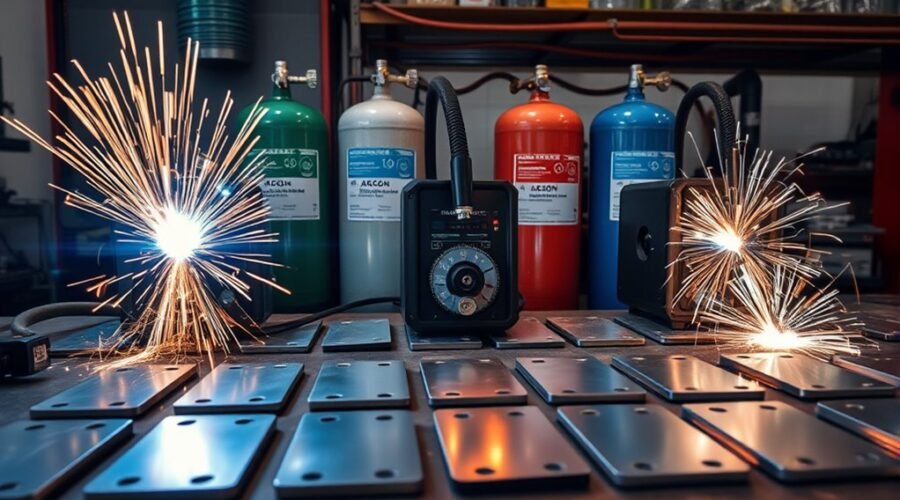
Plasma cutter gas choice depends on metal, thickness, and cut quality. Oxygen is best for mild steel because it cuts fastest and leaves cleaner edges. Nitrogen is preferred for stainless steel and aluminum, especially when oxidation must be minimized. Argon-hydrogen mixtures suit thick stainless and aluminum for high-energy, stable arcs. Compressed air remains the most economical general-purpose option for thin to moderate material. Shield gas selection strongly affects dross, edge finish, and overall process efficiency, as the details show.
Key Takeaways
- Oxygen is best for mild steel, giving the fastest cuts and cleanest edges through an exothermic reaction.
- Nitrogen works well for stainless steel and aluminum, reducing oxidation and preserving surface quality.
- Compressed air is the most economical all-purpose plasma gas for routine cuts on mild steel, stainless steel, and aluminum.
- Argon-hydrogen mixtures are used for thick stainless steel and aluminum when high heat and arc stability are needed.
- Gas choice should match material, thickness, and cut quality goals to balance performance, cost, and edge finish.
What Plasma Cutter Gas Should You Use?
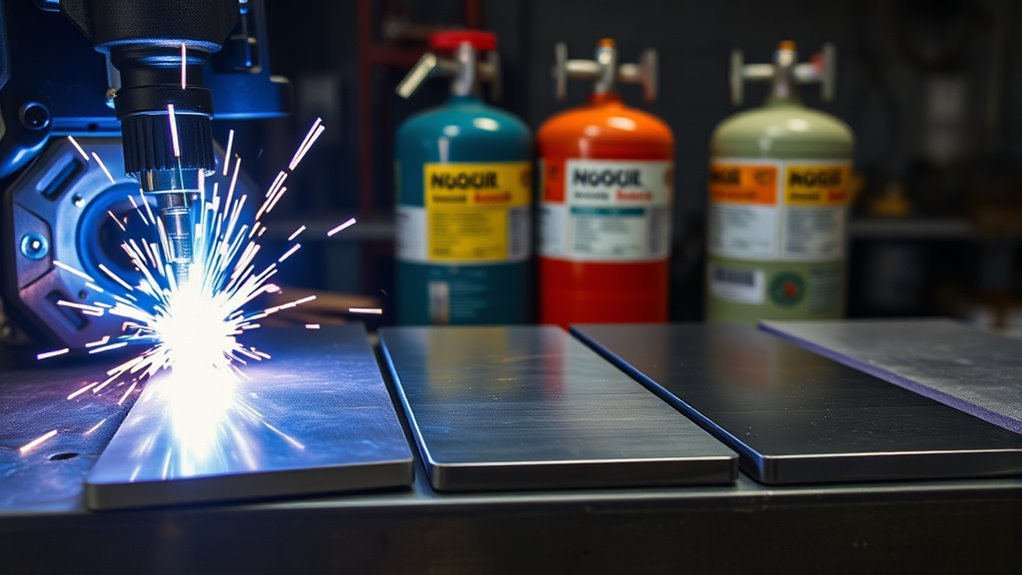
Selecting the proper plasma cutter gas depends on the base material, thickness, and required cut quality.
In plasma cutter gas selection, nitrogen is favored for stainless steel and aluminum, especially in thicker cutting applications, because it limits oxidation and preserves cut quality.
Oxygen delivers the highest cutting speed on mild steel and produces clean edges, yet it increases consumable demand and should not be used for stainless steel or aluminum.
For heavy sections, an argon-hydrogen mixture supports high-energy cutting on stainless steel and aluminum, yielding polished surfaces and superior finish, though at higher cost.
Material freedom is thus conditional, not absolute: each gas imposes tradeoffs between speed, edge condition, and expense.
Mild steel tolerates broader options, while stainless steel and aluminum require more disciplined gas selection.
The best choice aligns process economics with the mechanical and metallurgical demands of the job.
Compressed Air for Everyday Cuts
Compressed air is the most common plasma cutting gas for everyday work, offering a practical balance of versatility, cost, and cut quality. In plasma cutting, it supports cutting mild steel, stainless steel, and aluminum with dependable results for general use. As an economical choice, it lowers operational costs because no bottled gas purchase is required, making routine work more accessible.
- Suitable for workshops seeking flexible output
- Effective on material up to 1 inch
- Produces minimal slag and few residues
- May leave oxidized edges after cutting
- Requires maintenance to protect cut quality
Clean performance depends on compressor maintenance. Particulate matter, oil mist, and moisture can contaminate the stream and reduce cut quality.
When the air supply is dry and stable, compressed air enables efficient, technically sound cuts that preserve freedom of workflow without unnecessary expense or complexity.
Why Oxygen Is Best for Mild Steel
Oxygen is the preferred plasma gas for mild steel because it increases cutting speed and improves edge quality through its exothermic reaction with carbon steel. In this process, oxygen delivers higher cutting speeds, cleaner edges, and superior cut quality on mild steel, especially when thickness rises.
The added heat from oxidation supports efficient severing of material that would otherwise resist freedom from the cut path. Dross formation is reduced, so post-cut cleanup becomes faster and more exact. For professional applications, this performance advantage often outweighs higher operational costs tied to greater gas consumption.
As a plasma gas, oxygen enables disciplined, repeatable results where precision matters. By contrast, using oxygen on stainless steel or aluminum can promote oxidation and poor cut quality, so its value is specific to mild steel rather than universal.
When to Use Nitrogen
Nitrogen is well suited for cutting stainless steel and aluminum, where low oxidation and clean edge formation are required.
For thin metals, it can deliver smooth cuts with less char and better consumable life than air. Its inert properties also make it a practical option for manual plasma cutting when cut quality and surface integrity are priorities.
Nitrogen For Thin Metals
For thin stainless steel and aluminum sheets, nitrogen is often the preferred plasma gas when cut quality and surface appearance are priorities. It preserves surface quality by limiting oxidation and producing smooth edges with minimal dross.
- nitrogen supports clean cuts on thin sheets
- stainless steel benefits from reduced discoloration
- aluminum retains sharper detail and smoother edges
- manual plasma cutting gains an economical choice
- a gas mixture can improve performance further
In practical terms, nitrogen suits operators seeking control, consistency, and liberation from unnecessary rework.
Its availability and lower cost strengthen its role in manual plasma cutting systems.
When thin metals demand precise, shiny results, nitrogen remains a technical, efficient solution.
Nitrogen On Stainless Aluminum
When stainless steel or aluminum must be cut with clean edges, minimal oxidation, and a smooth surface finish, nitrogen is often the preferred plasma gas.
In fabrication, it delivers clean edges and stable performance on stainless steel and aluminum, especially where surface quality is critical. Its inert behavior limits oxidation and prevents the charred appearance common with compressed air, supporting a more liberated, precise cutting process.
Nitrogen also extends consumable life; electrodes and nozzles can exceed 1,000 starts when parameters are correct. It remains effective on material up to 3 inches thick, making it suitable for many production tasks.
For added performance, nitrogen may be blended with carbon dioxide or argon, further improving cutting consistency and finish on demanding work.
Argon-Hydrogen for Thick Metals
Argon-hydrogen mixtures generate exceptionally high heat intensity, making them suitable for plasma cutting thick metals where rapid penetration is required.
The blend is particularly effective on stainless steel and aluminum, producing stable arcs and high cut quality with reduced heat-affected zones.
For sections above 3 inches, it remains a strong choice because it preserves edge finish and consistency in high-alloy materials.
Argon-Hydrogen Heat Intensity
The argon-hydrogen blend delivers the highest heat intensity among common plasma gases, with a typical 65/35 argon-to-hydrogen ratio used for cutting thick metals over 1/2 inch. This argon-hydrogen cutting flame promotes arc stability, resists contamination, and supports high-quality cuts on stainless steel and aluminum in plasma systems.
- H-35 reaches very high thermal energy.
- It handles thick materials up to 4 inches.
- Water injection torches may be required.
- Polished surfaces and straight cuts are typical.
- Cost confines use to specialized applications.
For operators seeking liberation from slow, constrained cutting, the process favors decisive penetration and controlled motion. Its power suits high-intensity plasma systems, often at up to 1000 amps, where efficiency matters more than economy, especially for demanding industrial work.
Thick Metal Cut Quality
For thick metal cutting, H-35 and related argon-hydrogen mixes deliver superior cut quality because their high heat intensity maintains a stable arc and limits contamination. In a plasma cutter, this chemistry supports thick materials by preserving arc stability and producing minimal dross, even on stainless steel. The result is straighter kerfs, improved edge quality, and polished surfaces that reduce postprocess labor and expand operational freedom.
| Parameter | Effect | Outcome |
|---|---|---|
| Heat intensity | High | Faster piercing |
| Arc stability | Strong | Cleaner cuts |
| Contamination | Low | Better surfaces |
| Thickness range | Up to 4 in. | Broad capability |
| Nitrogen assist | Beneficial | Refined cut quality |
Although argon-hydrogen can cost more than nitrogen-based options, its performance on thick materials justifies the premium when durability and liberation from rework matter.
Stainless And Aluminum Use
A 65% argon / 35% hydrogen blend, commonly called H-35, is well suited to cutting thick stainless steel and aluminum above 1/2 inch because it produces the hottest plasma flame, maintains arc stability, and limits contamination.
This argon-hydrogen gas combination supports high-quality, polished cuts on high-alloy plates, especially where clean liberation from rough edges matters. For stainless steel, the strong arc helps preserve surface finish; for aluminum, it improves penetration and consistency.
- Arc stability remains high under load
- Shield gas can be nitrogen for cleaner exhaust
- Contamination risk stays low during cutting
- Polished cuts require correct amperage and travel speed
- Cost is higher, but performance is superior
How Shield Gas Affects Cut Quality
Shield gas selection directly shapes cut quality by influencing oxidation, edge smoothness, dross formation, and surface finish.
In plasma cutting, shielding gas governs how the arc interacts with metal, and the result is liberation from unnecessary rework. Air often degrades cut quality, especially on mild steel, because oxygen in the stream promotes edge oxidation and can increase dross.
By contrast, oxygen as a shielding gas can accelerate cutting and yield cleaner mild steel cuts, though it is unsuitable for stainless steel and aluminum.
Nitrogen offers a more controlled path, limiting oxidation and producing smoother edges on stainless steel and aluminum with better surface quality than air.
Argon and water-based shielding approaches are also used to refine finish, with water reducing fumes and often producing glossy results.
Proper gas selection thus determines whether the plasma cut is merely adequate or analytically optimized.
Choosing Gas by Metal Thickness
Material thickness largely determines plasma gas selection, because arc stability, heat transfer, and edge finish change as section depth increases. As metal thickness rises, the chosen gases should match the alloy and the desired cut quality.
- Compressed air suits mild steel, stainless steel, and aluminum up to 1/2 inch.
- Oxygen plasma accelerates cuts in mild steel over 1/2 inch.
- Nitrogen supports stainless steel and aluminum up to 3 inches.
- Argon-hydrogen mixture serves thicker stainless steel and aluminum above 1/2 inch.
- F5 blends favor thin sections under 3/8 inch for sharp edges.
For mild steel, oxygen plasma is decisive once thickness exceeds 1/2 inch, while compressed air remains flexible on lighter stock.
For stainless steel and aluminum, nitrogen preserves edge quality across wider metal thickness ranges. The argon-hydrogen mixture provides a hotter, more focused arc for deeper sections.
Selection by thickness enables cleaner separation, fewer defects, and greater process freedom.
The Most Cost-Effective Plasma Gas
Compressed air is generally the most cost-effective plasma gas because it is widely available and removes the need to purchase dedicated gas cylinders, making it practical for general cutting on mild steel, stainless steel, and aluminum up to 1 inch thick.
It reduces operational costs while delivering acceptable cut quality and cutting speed in lower-current applications. For many shops, this autonomy from bottled gases increases flexibility and lowers dependence on supply chains.
Clean, dry air from a well-maintained compressor is essential; moisture and oil contamination degrade consumables and reduce edge quality. The resulting oxidized edges can complicate downstream welding, so filler wire with deoxidizers may be required.
For thicker materials, blends using nitrogen or argon can improve penetration, productivity, and cut quality without fully sacrificing economy.
The best plasma gas consequently depends on balancing material thickness, process demands, and the freedom to minimize expense without surrendering performance.
Frequently Asked Questions
What Gas to Use With a Plasma Cutter?
Compressed air is the default plasma cutter gas, balancing cutting efficiency, gas availability, and cost considerations. For specific gas types, metal thickness, surface finish, arc stability, cutting speed, and equipment compatibility determine oxygen, nitrogen, or blends.
Are the Fumes From a Plasma Cutter Toxic?
Yes; plasma cutter fumes can be toxic, depending on fume composition, gas types, and metal fumes. Health risks include exposure symptoms and long term effects. Ventilation importance, protective equipment, safety measures, and workplace regulations reduce danger.
What Is 90/10 Welding Gas Used For?
90/10 welding gas is used for MIG welding thin stainless and mild steel, offering stable arcs, low spatter, and clean welds. Its gas mixture advantages, equipment compatibility, and cost considerations support industry usage trends and performance evaluations.
Which Plasma Gas Gives the Best Results for Cutting Mild Steel?
Oxygen plasma gas yields the best results for mild steel, despite cost comparison concerns; its arc stability, heat input, and thickness impact improve cutting efficiency, surface finish, and consumable lifespan, with safety precautions and air shield.
Conclusion
In summary, selecting the proper plasma cutter gas depends on metal type, thickness, and desired cut quality. Compressed air remains the most practical choice for routine work, while oxygen improves efficiency on mild steel. Nitrogen serves well on stainless and aluminum, and argon-hydrogen is reserved for thicker sections. Shield gas further influences edge finish and arc stability. In plasma cutting, gas selection acts as the hidden key that reveals performance, cost control, and precision.