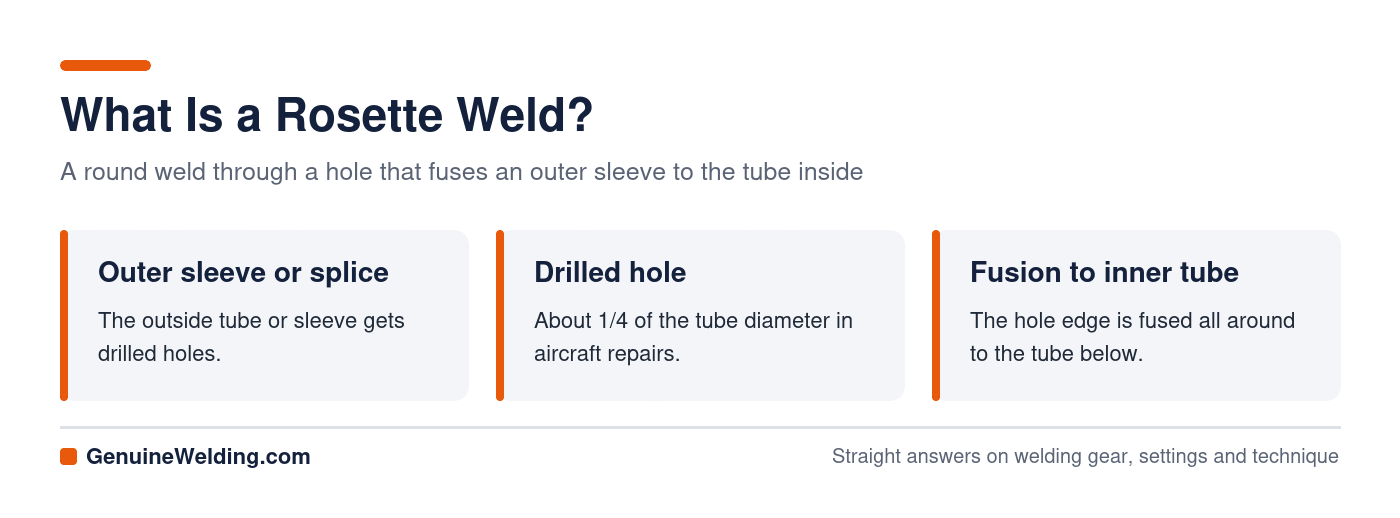
A rosette weld is a round weld made through a hole drilled in an outer tube or sleeve to fuse it to an inner tube or member underneath. The welder melts the edge of the hole into the inner piece all the way around, leaving a small rosette-shaped weld. Rosette welds are used mainly in steel-tube aircraft and race-car structures to lock splice sleeves and inner reinforcing tubes in place. FAA guidance (AC 43.13-1B) describes holes about one-fourth the diameter of the original tube, drilled in the outer splice.
Rosette welds look like plug welds, and they’re related, but they’re made and used a little differently. Here’s what they are, when to use them and how to make a good one.
Rosette Weld vs Plug Weld
Both welds are made in a hole through one piece to join it to a piece underneath. The difference is in how they’re made and where they’re used:
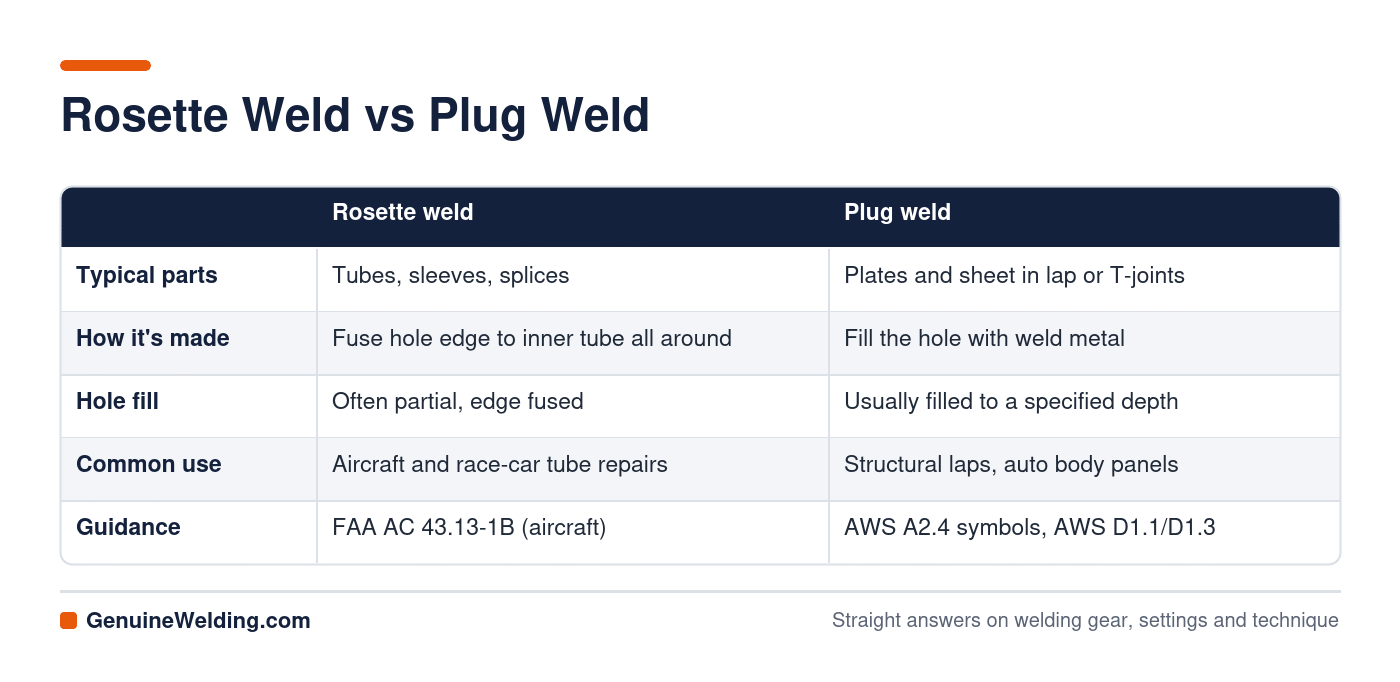
Under AWS and ASME definitions, a plug weld fills a hole in one member of a lap or tee joint, and a fillet-welded hole isn’t considered a plug weld. Rosette welds sit somewhere in between in practice: the edge of the hole is fused to the inner part, and the hole may or may not be fully filled. In structural work, use plug or slot welds as defined by your code; see slot and plug weld symbols.
Where Rosette Welds Are Used
- Aircraft tube splices: attaching outer split sleeves or splice tubes to the original tube during repairs on 4130 chrome-moly fuselages.
- Inner sleeve reinforcement: tying an inner reinforcing tube to an outer tube so both carry load.
- Race car and roll cage tubing: locking internal sleeves at tube joints or splices.
- Ag and light fabrication: joining telescoping tubes or sleeves where a fillet at the end isn’t enough.
For tube welding more broadly, see TIG welding tips and slot and plug weld symbols.
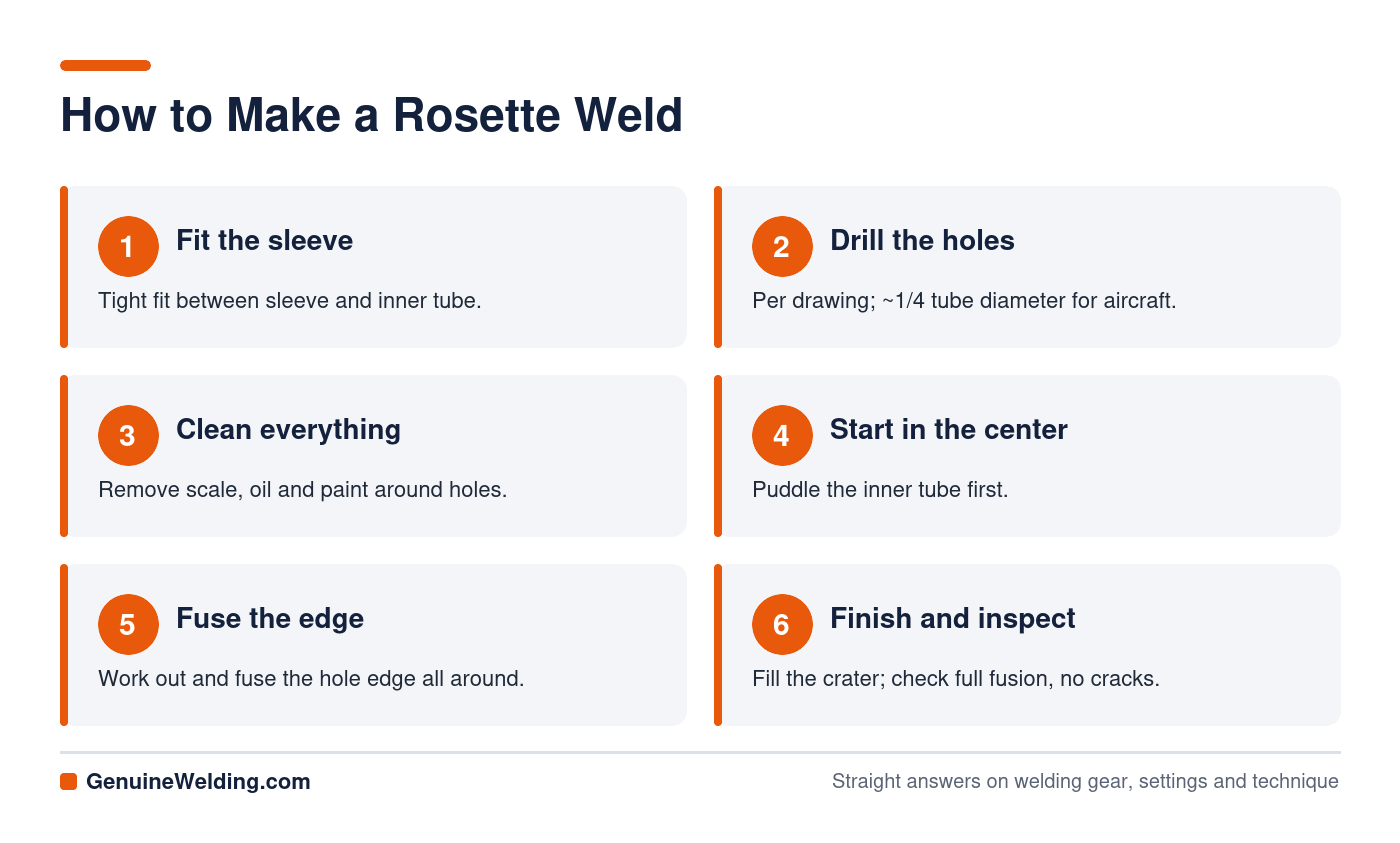
How to Make a Rosette Weld
Hole size and spacing
Aircraft repair guidance (FAA AC 43.13-1B) calls for rosette weld holes typically about one-fourth the diameter of the original tube, drilled in the outer splice or sleeve. Follow the specific repair drawing or approved data for the number and location of holes. In general fabrication, holes are commonly sized so you can comfortably fuse the edge without burning through, and spaced evenly around and along the sleeve.
The vent (relief) hole trick
When gas welding thin aircraft tubing, mechanics sometimes drill a small 1/8 in hole in the inner tube at the center of each rosette location. It helps control heat so the rosette stays small and doesn’t burn through the outer tube; it’s then closed as the weld is completed. Many TIG welders find it unnecessary because TIG offers precise heat control.
Technique tips
- Fit the sleeve tightly; gaps make it hard to fuse the inner tube.
- Clean both tubes inside and out where they meet.
- Start the puddle on the inner tube at the center, then work out to fuse the hole edge all around.
- Keep heat low and steady to avoid melting the hole edge away; add filler sparingly.
- Finish with a slightly convex, fully fused rosette and no crater cracks.
- For 4130 tubing, follow the procedure for filler choice (often ER70S-2 or ER80S-D2) and cooling.
Inspecting Rosette Welds
- Look for complete fusion around the full circumference of the hole.
- Check for cracks, especially in the crater and at the hole edge.
- Make sure the outer tube wasn’t overheated or thinned around the hole.
- Test sample welds by cutting and etching practice pieces to confirm the inner tube is fused.
For aircraft, inspection and acceptance follow the approved repair data and an authorized inspector. Aerospace TIG work is also one of the better-paid specialties; see our highest paying welding jobs guide.
Rosette Weld FAQs
What is a rosette weld used for?
To fuse an outer sleeve or splice to an inner tube through holes, most often in steel-tube aircraft and race-car frames.
How big should a rosette weld hole be?
FAA aircraft guidance uses holes about one-fourth the diameter of the original tube. Follow your repair drawing or approved data.
Is a rosette weld the same as a plug weld?
They’re similar. A plug weld typically fills the hole completely to join plates; a rosette weld fuses the edge of the hole to an inner tube, mainly in tubular structures.
Can you rosette weld with MIG?
Yes, but TIG and gas welding give more control on thin tubing. MIG is more common for thicker sleeves in general fabrication.
Is there a symbol for rosette welds?
AWS A2.4 has no separate rosette symbol. Drawings usually use the plug weld symbol with notes, or show the repair in a detail.
Sources
- FAA AC 43.13-1B: Acceptable Methods, Techniques and Practices – Aircraft Inspection and Repair
- Aircraft Systems: Repair of Steel Tubing Aircraft Structure (rosette welds)