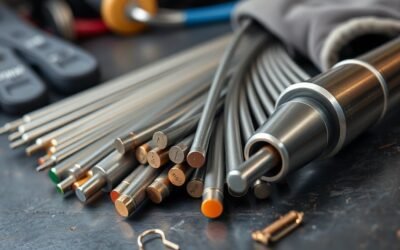
A TIG torch is built around a few key parts: the torch body and handle, a collet that grips the tungsten, a collet body (or gas lens) that holds the collet and spreads the argon, a ceramic or glass cup that directs the shielding gas, a back cap that locks the tungsten in place, and the power cable and gas hose (plus water hoses on water-cooled torches). Matching these parts to your tungsten size and torch series is the key to clean, stable TIG welds.
Most TIG problems that look like technique issues, such as porosity, wandering arcs and contaminated tungsten, actually come from the wrong or worn front-end parts. Here’s what each part does and how to choose it.

The Parts of a TIG Torch
Torch body (head)
The torch body is the metal core that carries current to the collet and channels gas forward. Its size and “series” (for example 9, 17, 20, 18 or 26) determine which consumables fit and how much amperage the torch can handle. A 9 or 20 series torch uses small “9/20-style” front ends, while 17, 18 and 26 series torches share larger “17/18/26-style” parts.
Collet
The collet is a slotted copper sleeve that clamps the tungsten when you tighten the back cap. It must match the tungsten diameter: 1/16 in (1.6 mm), 3/32 in (2.4 mm) or 1/8 in (3.2 mm) are the most common. A worn or wrong-size collet lets the tungsten slip or overheat.
Collet body
The collet body screws into the torch head and holds the collet. It has holes that let argon flow out into the cup. Standard collet bodies are the simplest and cheapest option.
Gas lens
A gas lens replaces the collet body. It has layered fine mesh screens that turn the argon into a smooth, even (laminar) stream. That lets you stick the tungsten out farther, reach into corners, use lower gas flow and get better coverage on stainless, titanium and aluminum. Gas lenses use their own matching cups.
Cup (nozzle)
The cup directs shielding gas over the weld. Cups are sized by inside diameter in sixteenths of an inch: a #7 cup is 7/16 in, a #8 is 1/2 in, and so on. Larger cups cover a bigger area. Common materials:
- Alumina (pink or white ceramic): cheap, durable, the everyday choice
- Silicon nitride: handles higher heat and thermal shock, lasts longer
- Fused quartz (clear “pyrex” cups): lets you see the tungsten and puddle; usually used with gas lenses
Back cap
The back cap screws into the rear of the torch head and pushes the collet into the collet body to lock the tungsten. Back caps come in long (holds a full 7 in tungsten), medium and short lengths. Short caps help in tight spaces but require shorter tungstens.
Insulators and O-rings
Heat-shield gaskets or insulators sit between the cup and torch body; O-rings seal the back cap. Missing insulators can let the cup arc or let air leak in and cause porosity.
Handle, switch and cables
The handle insulates your hand and may hold an on/off or amperage control switch. Behind it are the power cable, gas hose and, on water-cooled torches, water supply and return hoses. Flexible “superflex” cables are popular for comfort. Read air-cooled vs water-cooled TIG torches.
Matching Parts to Tungsten Size

See the tungsten electrode guide to pick the right tungsten type and size.
Standard Collet Body vs Gas Lens

How to Choose a TIG Cup Size
- Small cups (#4 to #6): tight access, small parts, low amps
- Medium cups (#7 to #8): general purpose on steel and stainless
- Large cups (#10 to #12+): aluminum, titanium, stainless pipe and long tungsten stickout with a gas lens
A common rule is to use a cup with an inside diameter at least four to six times the tungsten diameter. Set argon flow to match: roughly 15 to 20 CFH for most standard cups, and more for very large cups. See TIG gas guide.
How to Assemble a TIG Torch Front End
- Screw the collet body or gas lens into the torch head by hand until snug.
- Install the heat-shield insulator (if your torch uses one), then screw on the matching cup.
- Slide the collet into the collet body from the back of the torch.
- Insert the sharpened tungsten through the collet from the front.
- Set stickout (about 1/8 to 1/4 in with a standard cup; more with a gas lens).
- Tighten the back cap to lock the tungsten. Don’t overtighten.
Signs TIG Torch Parts Need Replacing
- Cracked, chipped or heavily discolored cups
- Tungsten slipping or overheating (worn collet)
- Porosity or erratic gas coverage (clogged gas lens screen, bad O-ring, cracked hose)
- Back cap that won’t tighten or a torn O-ring
- Hot handle, burned cable or leaking water hoses
Fix weld issues fast with our TIG welding tips and porosity guide.
TIG Torch Parts FAQs
Are TIG torch parts universal?
No. Parts are grouped by torch series. 9 and 20 series torches share small parts; 17, 18 and 26 series share larger parts. Always match the series.
Do I need a gas lens?
Not always, but a gas lens improves coverage, allows longer stickout and lowers gas use. Most welders who try one keep using it, especially on stainless and aluminum.
What does a #8 cup mean?
Cup numbers are the inside diameter in sixteenths of an inch, so a #8 cup has a 1/2 in opening.
Why does my tungsten keep slipping?
Usually a collet that’s worn or the wrong size, or a back cap that isn’t tight. Replace the collet and check that its size matches the tungsten.
What is a “stubby” TIG kit?
A stubby kit uses a short collet body and short cup so the torch fits in tight spaces. Pair it with a short back cap and shorter tungsten.