Before you buy a used welder, plug it in and make it weld. Check that it powers on, the fan runs, the wire feeds smoothly (on MIG machines) and it holds a stable arc at both low and high settings. Then inspect the power cord, leads, gun or torch, stinger and ground clamp for damage, look inside for burnt parts, and confirm the brand still supports the model with parts. A good used welder can save you 30 to 60% off new, but a dead circuit board or a worn-out gun can wipe out the savings.
Used welders show up on Facebook Marketplace, Craigslist, auctions and estate sales every day. Some are bargains that will run for decades; others are broken machines dressed up for a quick sale. This checklist helps you tell the difference in about 15 minutes.
Is Buying a Used Welder a Good Idea?
Often, yes. Older transformer welders from Lincoln, Miller and Hobart are simple, heavy and nearly indestructible; a 40-year-old Lincoln AC-225 “tombstone” stick welder can still run perfectly. Name-brand MIG and TIG machines also hold their value because parts are easy to find. The risk is higher with older inverter machines and off-brand imports, where a failed board may cost more to fix than the machine is worth.
- Good used buys: transformer stick and TIG machines, name-brand MIG welders, engine drives with documented hours
- Buy with caution: older inverters, machines with no brand support, anything that “just needs a part”
- Usually skip: welders you can’t test, flood or fire damaged machines, units with missing serial plates
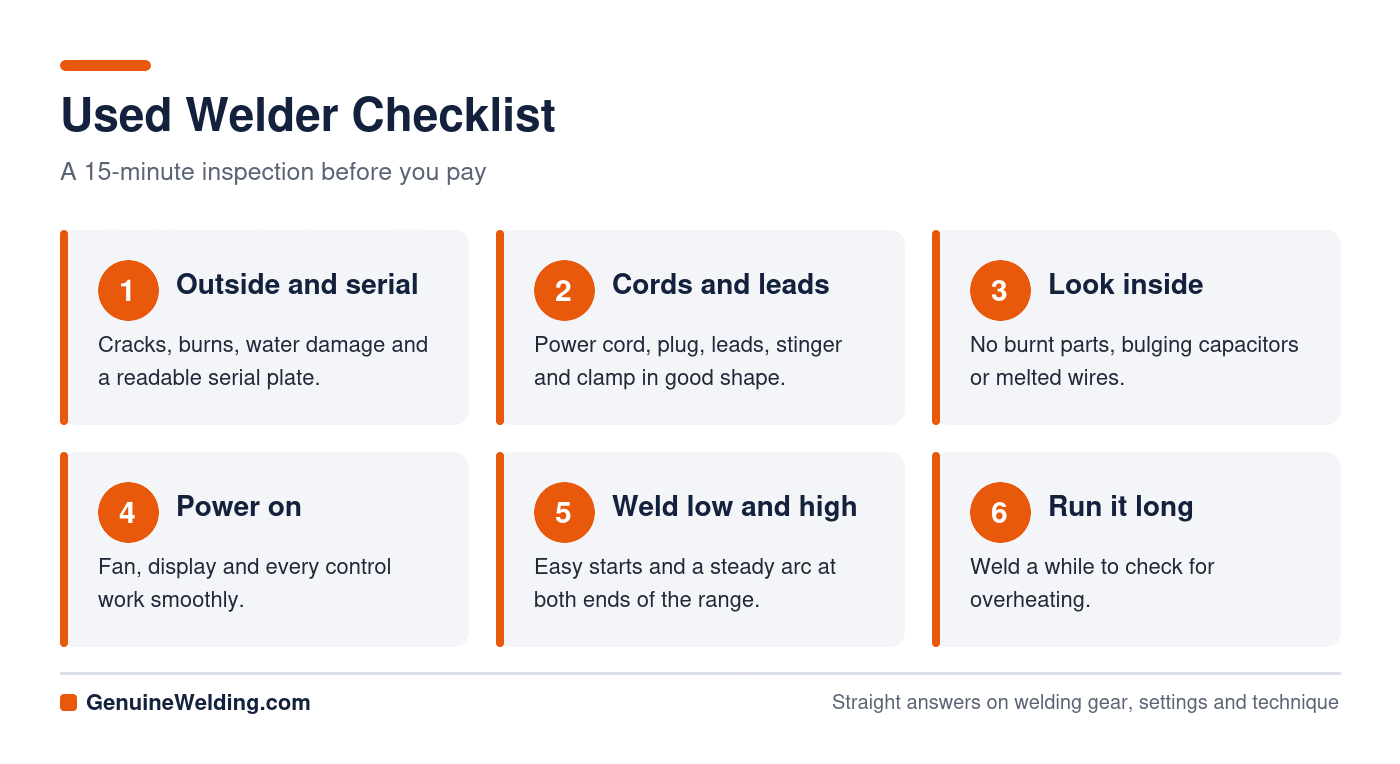
Used Welder Inspection Checklist
1. Check the outside
- Look for cracked cases, heavy dents, burn marks or melted plastic.
- Check the serial number plate. A missing or scratched-off plate can mean a stolen machine.
- Look for signs of water damage, heavy rust or rodent nests in the vents.
- Ask how and where it was stored. Machines kept in a dry shop age far better than ones left in a barn.
2. Inspect cords, leads and connections
- Check the power cord and plug for cuts, taped splices and burnt prongs. Confirm the plug matches your outlet; see welder plug types.
- Inspect welding leads for cracked insulation and bare copper. See welding leads explained.
- Check that the stinger, work clamp and Dinse connectors are tight and not burned.
3. Look inside (with the machine unplugged)
If the seller agrees, remove the side panel. Look for burnt or bulging components, blackened circuit boards, melted wires, a burnt smell or heavy dust packed into the fan and heat sinks. Heavy dust isn’t a deal-breaker by itself, but it suggests the machine ran hot and wasn’t maintained.
4. Power it up
- The fan should start (some newer machines run the fan only when needed).
- All displays, lights and knobs should work. Turn every control through its full range.
- Listen for loud buzzing, rattling or arcing sounds from inside the case.
5. Weld with it
This is the most important test. Bring your own scrap steel, gloves, helmet and, for a MIG, a small spool of wire and a gas bottle if needed. Weld at a low setting on thin metal and a high setting on thick metal. The arc should start easily, sound steady and produce a consistent bead. Run a longer weld to see if the machine overheats or the thermal light comes on too early.
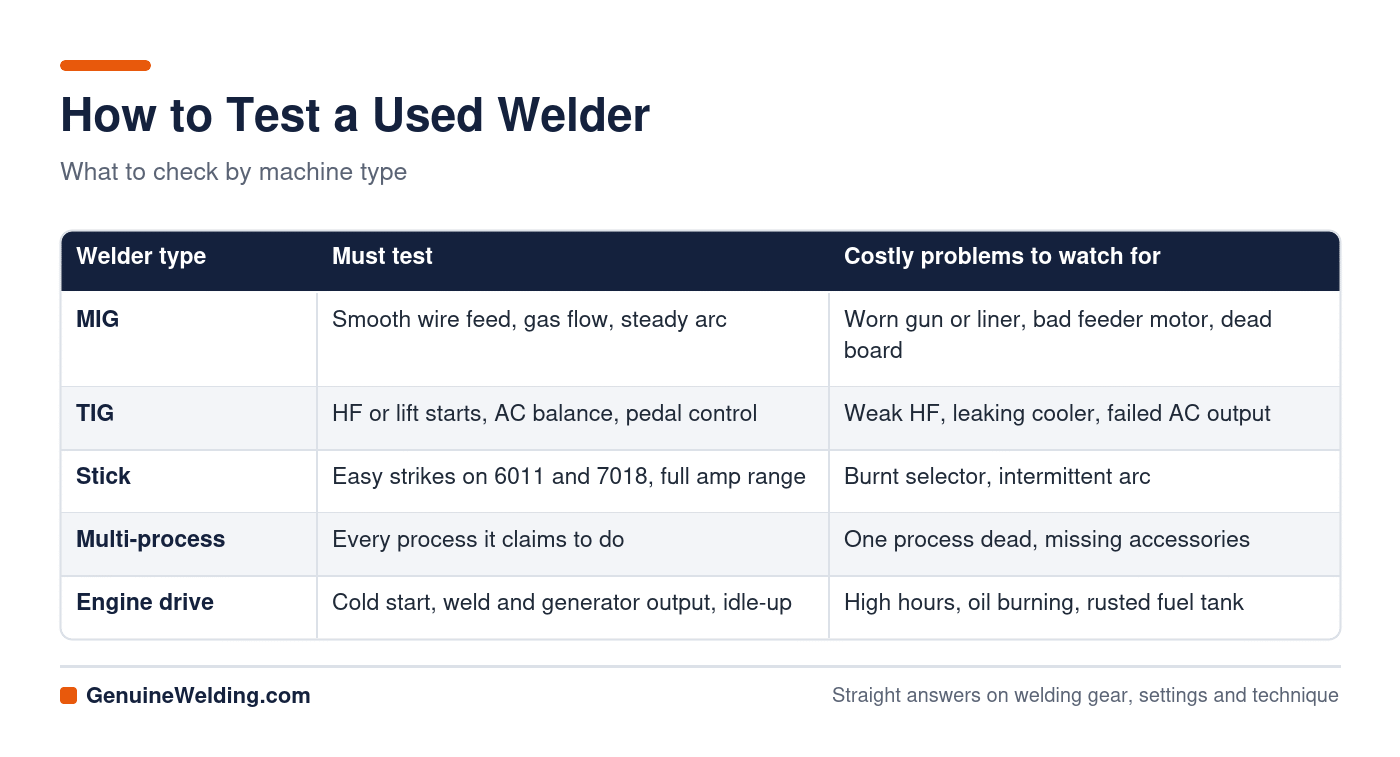
What to Check by Welder Type
Used MIG welder
- Wire feed: wire should feed smoothly with no jerking or slipping. Check drive rolls for wear and the tension arm for cracks.
- Gun and liner: a kinked cable, cracked handle or sticky trigger means you’ll need a new gun ($100 to $400+). Push wire through to feel for a worn liner. See MIG gun parts explained.
- Gas solenoid: pull the trigger and listen for gas flow at the nozzle.
- Consumables: check the nozzle, diffuser and contact tips.
Used TIG welder
- Arc starts: test high-frequency (HF) or lift starts; weak HF often means a worn spark gap or bad torch cable.
- AC function: if it’s an AC/DC machine, test it on aluminum and check AC balance and frequency controls.
- Foot pedal: amperage should rise smoothly with no dead spots or jumps.
- Torch and cooler: check the torch, collets and cups; on water-cooled setups, look for leaks and a working pump. See TIG torch parts.
Used stick welder
- Check that the amperage control is smooth and the arc doesn’t drop out.
- On transformer machines, check the selector or crank works through its full range.
- Make sure the machine strikes 1/8 in 7018 and 6011 rods easily.
Used engine-driven welder
- Check engine hours on the meter, oil condition, coolant and service records.
- Start it cold. Listen for knocking, check for blue or black smoke and test idle-up when you strike an arc.
- Test both welding output and generator outlets under load.
- Look for oil leaks, rust in the fuel tank and damaged control panels. See best welder generators for what new units cost.
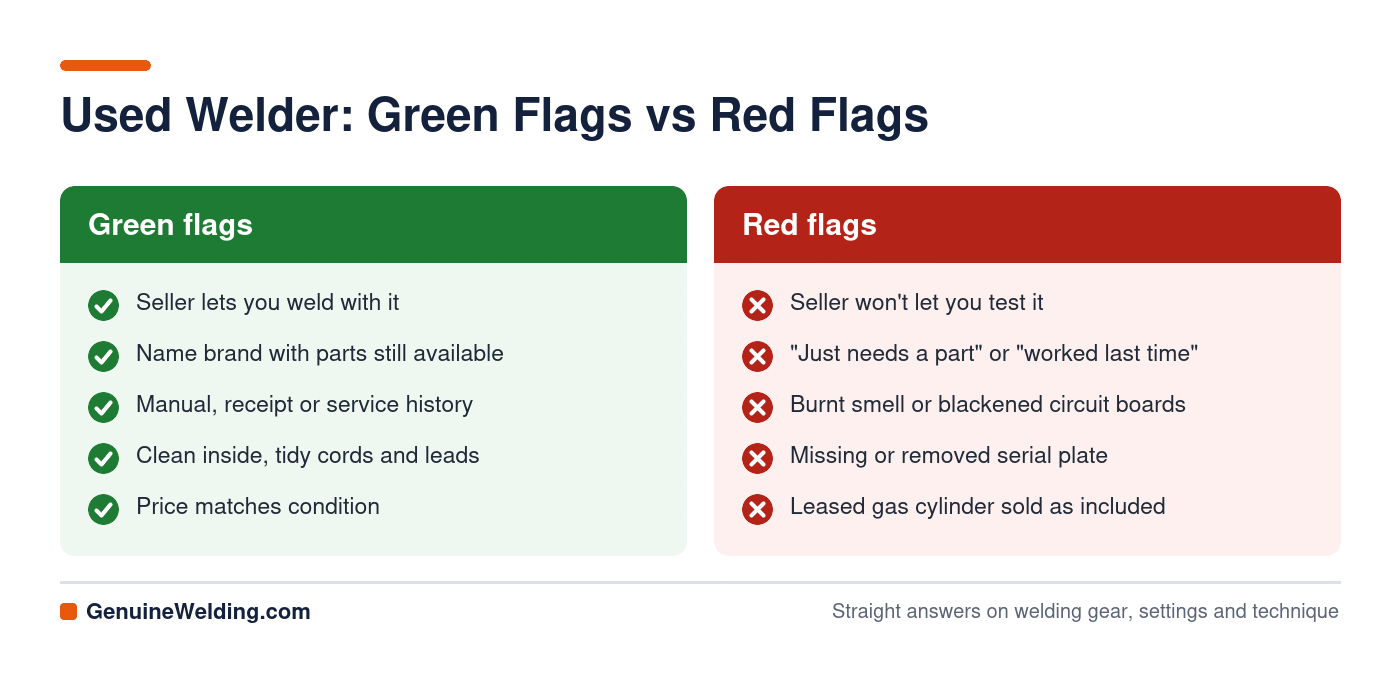
Red Flags When Buying a Used Welder
How Much Should You Pay for a Used Welder?
Prices vary by region, brand and condition, but a good rule is:
- Excellent, lightly used, current model: about 60 to 75% of the new price
- Good, older but supported model: about 40 to 60% of new
- Older transformer machines: priced by local demand; often a few hundred dollars
- Needs repair or untested: parts value only
Check the current new price first and factor in anything you’ll need to replace, such as a gun, leads, regulator or gas cylinder. A “cheap” MIG welder missing its gun and regulator can cost more than a new one by the time it’s ready to weld.
Questions to Ask the Seller
- Why are you selling it?
- How old is it, and has it been repaired?
- What was it used for, and how often?
- Do you have the manual, receipt or original accessories?
- Can I weld with it before buying?
- Does the gas cylinder belong to you, or is it leased from a supplier?
That last question matters: many welding cylinders are leased and can’t legally be sold by the person who has them. Learn more in welding gas cylinder sizes.
Used vs New Welder
| Used welder | New welder | |
|---|---|---|
| Price | Often 30–60% less | Full price, sometimes sales |
| Warranty | Usually none | Often 1–5 years (brand dependent) |
| Features | Older tech, fewer settings | Synergic, pulse, multi-process options |
| Risk | Hidden faults possible | Low |
| Best for | Buyers who can test and repair | Beginners who want support |
If you’re unsure what to buy, start with how to choose a welder and our list of best welders for beginners.
Buying a Used Welder: FAQs
What is the most reliable used welder to buy?
Transformer machines from major brands, such as the Lincoln AC-225, Miller Thunderbolt and older Miller and Hobart MIG welders, have a strong reputation for reliability and easy repairs.
How long do welders last?
Transformer welders can last for decades with basic care. Inverter welders are more efficient and portable, but their electronics are more sensitive to heat, dust and power surges.
Can I test a welder without power at the seller’s place?
You can inspect it, but you can’t verify it works. If you can’t test it, pay accordingly or walk away. Engine drives can always be tested on the spot.
Is it worth buying a used welder online?
It’s riskier because you can’t test it. Buy only from sellers with returns or strong buyer protection, and avoid listings with vague descriptions or stock photos.