Explosion welding is a solid-state process that uses a controlled detonation to slam one metal plate into another at very high speed, bonding them metallurgically without melting. It is mainly used to make clad plates, such as stainless steel, titanium or nickel alloys bonded to carbon steel, and transition joints between metals that can’t be fusion welded together, like aluminum to steel. The finished bond is often stronger than the weaker of the two metals.
Explosion welding (also called explosive welding, explosion bonding or explosion cladding) sounds dramatic, and it is. But it is also a precise industrial process behind many pressure vessels, heat exchangers, ships and aluminum smelters.
How Explosion Welding Works
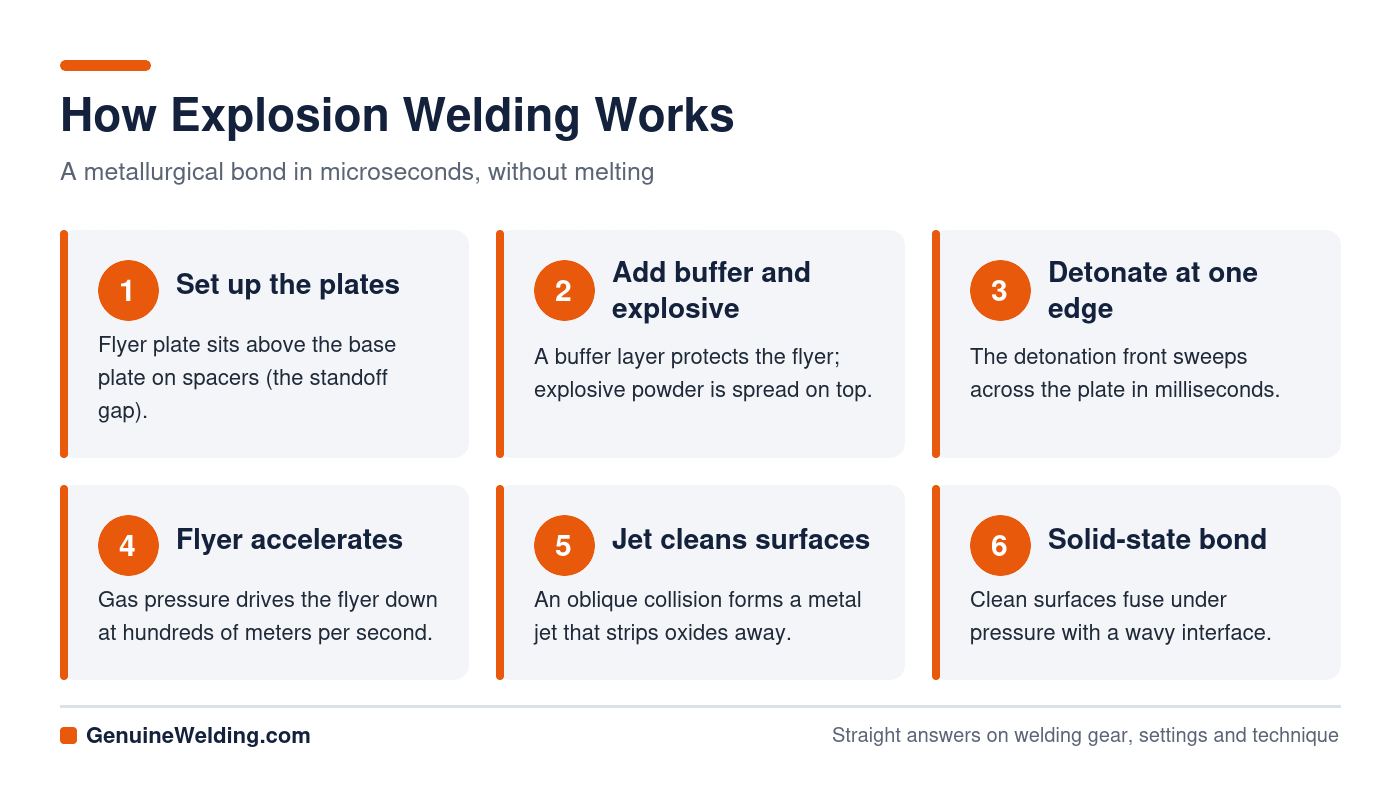
The key is what happens at the collision point. The flyer plate hits the base plate at a small angle and enormous pressure. That pressure makes the metal surfaces behave like a fluid for an instant, and a jet of metal sprays forward out of the collision point. The jet strips away oxides and contamination, leaving perfectly clean metal surfaces that are then pressed together and bond at the atomic level.
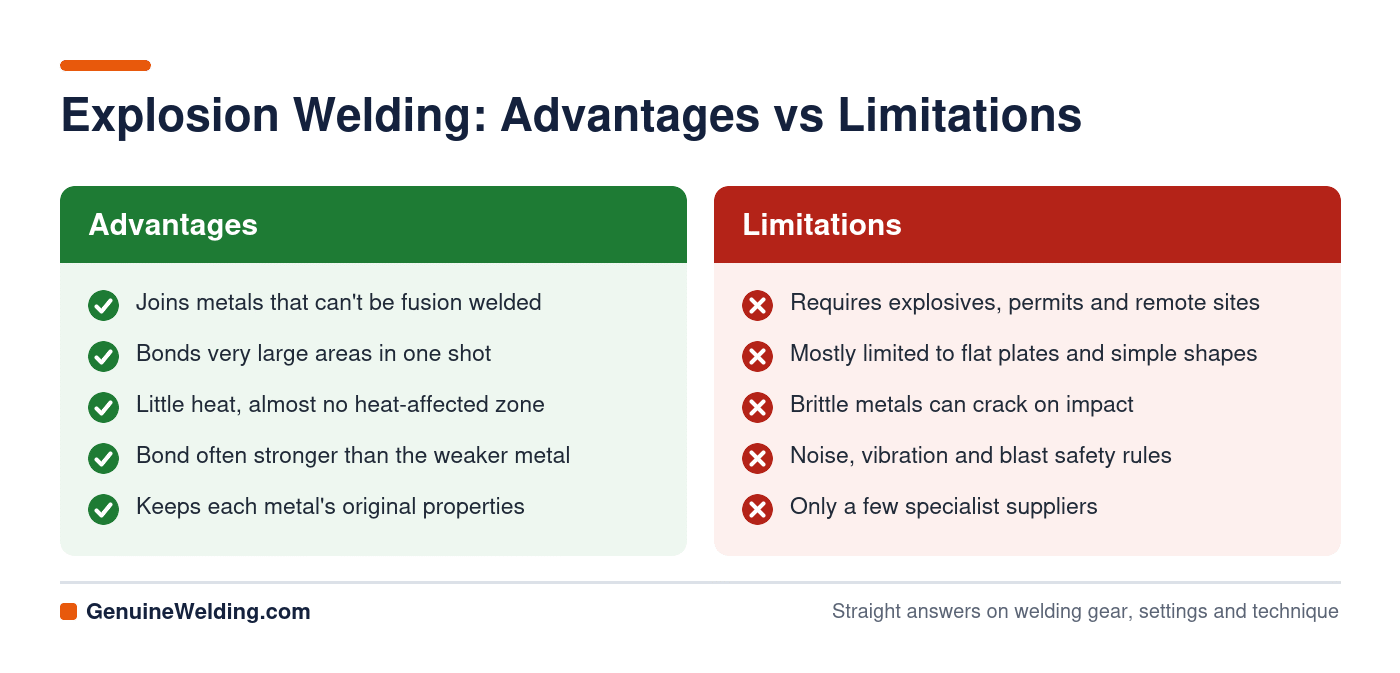
Because the process happens in microseconds, there is very little heat. Most of the metal never melts, so there is almost no heat-affected zone and the original properties of both metals are preserved. Under a microscope, a good explosion weld shows a characteristic wavy interface where the two metals interlock.
Key process variables
- Standoff distance: the gap between the plates, which lets the flyer accelerate before impact.
- Explosive type and load: usually ammonium-nitrate-based explosives chosen for a relatively low detonation velocity.
- Detonation velocity: typically kept in the range of roughly 1,500 to 3,000+ meters per second, below the speed of sound in the metals so a jet can form.
- Collision angle and flyer velocity: together they determine whether the bond forms and how wavy the interface is.
- Surface preparation: surfaces are ground or polished clean before bonding.
Because explosives are involved, explosion welding is done by specialist companies at remote sites, open-air ranges or underground facilities, under strict regulations.
A Brief History of Explosion Welding
Engineers noticed during World War I that shrapnel sometimes bonded to metal it struck. Researchers studied the effect in the 1940s and 1950s, and DuPont developed it into a commercial cladding process in the 1960s. Today a small number of specialist companies produce explosion-clad plate worldwide. For more welding history, see the history of welding.
What Is Explosion Welding Used For?
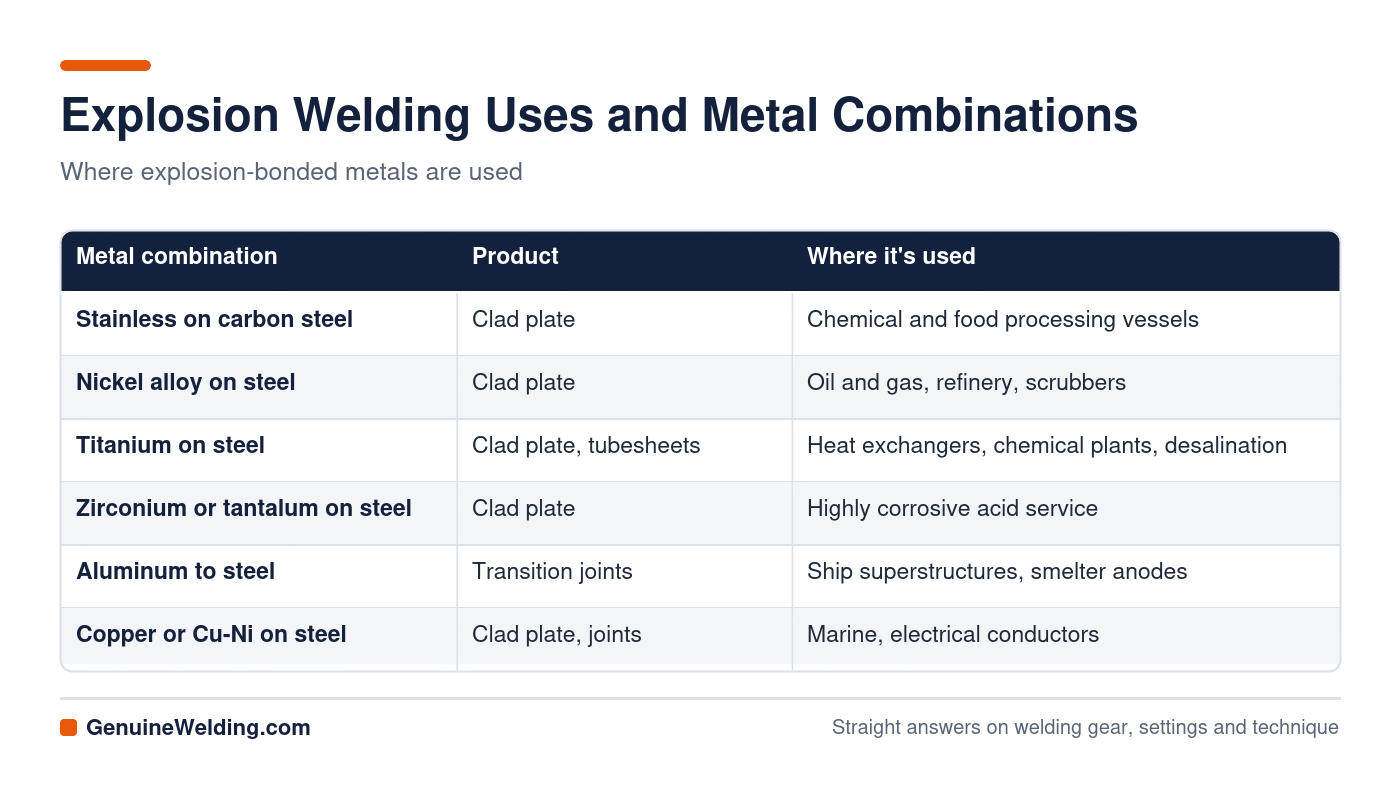
The biggest use by far is cladding: bonding a thin layer of an expensive corrosion-resistant metal onto a thick, cheaper carbon steel plate. The result costs much less than solid titanium or nickel alloy but resists corrosion on the process side. Clad plates are then formed and fusion welded into vessels using special procedures.
Transition joints are the other major use. Aluminum and steel can’t be fusion welded together because they form brittle intermetallics. An explosion-welded aluminum-steel strip lets shipbuilders weld an aluminum superstructure to a steel hull, with each side welded like-to-like. Learn more in can you weld aluminum to steel.
Which Metals Can Be Explosion Welded?
Almost any metal with enough ductility and impact toughness to survive the collision without cracking, including:
- Carbon and low-alloy steels
- Stainless steels and duplex stainless
- Nickel alloys (such as Alloy 625 and C-276)
- Titanium and zirconium
- Tantalum and niobium
- Aluminum and its alloys
- Copper, brass and copper-nickel
Very brittle materials, such as cast iron and some high-strength alloys, tend to crack. See nonferrous metals for more on these alloys.
Advantages and Limitations
How Explosion-Clad Plate Is Tested
- Ultrasonic testing maps the bond across the whole plate to find any unbonded areas.
- Shear testing pushes the cladding off a sample to measure bond strength. For example, ASTM A264 (stainless clad steel) sets a minimum shear strength of 20,000 psi.
- Bend and ram tensile tests check that the bond survives forming and pulling.
- Metallography examines the wavy interface under a microscope.
Common product standards include ASTM A263, A264 and A265 for chromium-steel, stainless and nickel-alloy clad plate, and ASTM B898 for reactive and refractory metal clad plate. Pressure vessel use also follows ASME code rules. See our guide to weld quality testing.
Explosion Welding vs Other Solid-State Processes
| Process | How it bonds | Typical use |
|---|---|---|
| Explosion welding | High-speed collision driven by explosives | Large clad plates, transition joints |
| Friction welding | Heat from rubbing plus forging pressure | Shafts, axles, bimetal joints |
| Cold welding | Pressure on very clean surfaces at room temperature | Wire, electronics, small parts |
| Roll bonding | Rolling metals together under heat and pressure | Clad sheet, coins, cookware |
Explosion Welding FAQs
Is explosion welding a fusion process?
No. It is a solid-state process. The metals bond without melting, apart from tiny localized zones at the wavy interface.
How strong is an explosion weld?
A good explosion bond is typically as strong as or stronger than the weaker of the two metals, which is why clad plates can be formed and welded after bonding.
Is explosion welding safe?
It uses commercial explosives, so it is done only by licensed specialists at controlled sites under strict safety rules. It is not a shop or DIY process.
Can you explosion weld aluminum to steel?
Yes. Aluminum-steel explosion-welded transition joints are widely used in shipbuilding and aluminum smelting.
How big can explosion-clad plates be?
Very large: plates covering many square meters are produced in a single shot, limited mainly by the site and handling equipment.
Sources
- ASTM A264: Stainless Chromium-Nickel Steel-Clad Plate
- American Welding Society: Welding Handbook and Standards