

You need a helmet that protects your eyes, keeps the weld puddle visible, and stays comfortable through a full project. In this best welding helmets under $200 roundup, two linked models still meet the target cleanly after a current model and availability check.
Hobart Inventor 770890 is the best overall pick because it pairs a 9.3-square-inch PureColor view with four arc sensors and direct analog controls. The ESAB Savage A40 is the value-focused alternative for welders who want True Color optics and low-amp TIG capability.
We checked the linked model identity, manufacturer specifications, current purchasing status, budget fit, safety information and repeated owner feedback before rebuilding the list.
Best Welding Helmets Under $200 Compared
| Product | Best for | Viewing area | Arc sensors | Shade range | Score |
|---|---|---|---|---|---|
|
Premium
|
Legacy large-view model; no longer recommended | 13.4 sq. in. | 4 | Cut 5-8; weld 8-13 | 94/100 |
|
Mid-range
|
Best overall | 9.3 sq. in. | 4 | 3; 9-13 | 90/100 |
|
Mid-range
|
Best value | 7.70 sq. in. | 4 | 4; 9-13 | 89/100 |
|
Premium
|
Digital-control option outside the current budget target | 9.3 sq. in. | 4 | 4; 9-13 | 86/100 |
Best Welding Helmets Under $200: Our Top Picks
1. Miller Digital Infinity 280045

Bottom line: The linked ASIN resolves to the Miller Digital Infinity 280045, not the Digital Performance helmet named in the original copy. That 280045 part is discontinued, so it stays here for transparency but is no longer a recommended pick.
- Viewing area: 13.4 sq. in., the largest window in this article
- Arc sensors: 4, for broader arc detection coverage
- Shade range: Cut 5-8; weld 8-13, for multiple processes
- Controls: Digital with Weld, Cut, Grind and X-Mode
The legacy Digital Infinity was built around a large viewing field and four operating modes. X-Mode uses electromagnetic arc sensing, which is useful when normal optical sensors are partly blocked or outdoor light interferes with detection.
The important correction is model identity. The affiliate link does not match the original Miller Performance copy, and Miller now lists a newer Digital Infinity Black ClearLight 4x generation under a different part number.
- 13.4-square-inch viewing area
- Four arc sensors
- Weld, Cut, Grind and X-Mode settings
- Digital sensitivity and delay controls
- Part 280045 is discontinued
- The linked ASIN does not match the original Performance model name
- Legacy 22-ounce listed weight is higher than the Hobart Inventor
2. Hobart Inventor 770890

Bottom line: The Hobart Inventor 770890 is the strongest verified all-around pick here. Its wide PureColor lens, four sensors and simple analog controls make it easy to set up for common shop welding and grinding work.
- Viewing area: 9.3 sq. in., wide enough for easier joint tracking
- Arc sensors: 4, for dependable arc detection coverage
- Shade range: 3 and 9-13, covering grind and welding settings
- Controls: Analog shade, sensitivity and delay adjustments
PureColor lens technology is designed to give you a more natural view than a traditional green-tinted lens. The 9.3-square-inch window also helps when you need to see more of the joint without turning your head as often.
Hobart keeps the controls simple: shade, sensitivity and delay are adjusted with analog controls, while a separate grind mode prevents the lens from darkening during cleanup. The helmet is also listed as low-amp TIG rated.
- 9.3-square-inch PureColor viewing area
- Four independent arc sensors
- Low-amp TIG rated by Hobart
- Direct analog shade, sensitivity and delay controls
- No digital memory presets
- Only Weld and Grind modes are listed
- Analog controls offer less setting feedback than a digital display
3. ESAB Savage A40
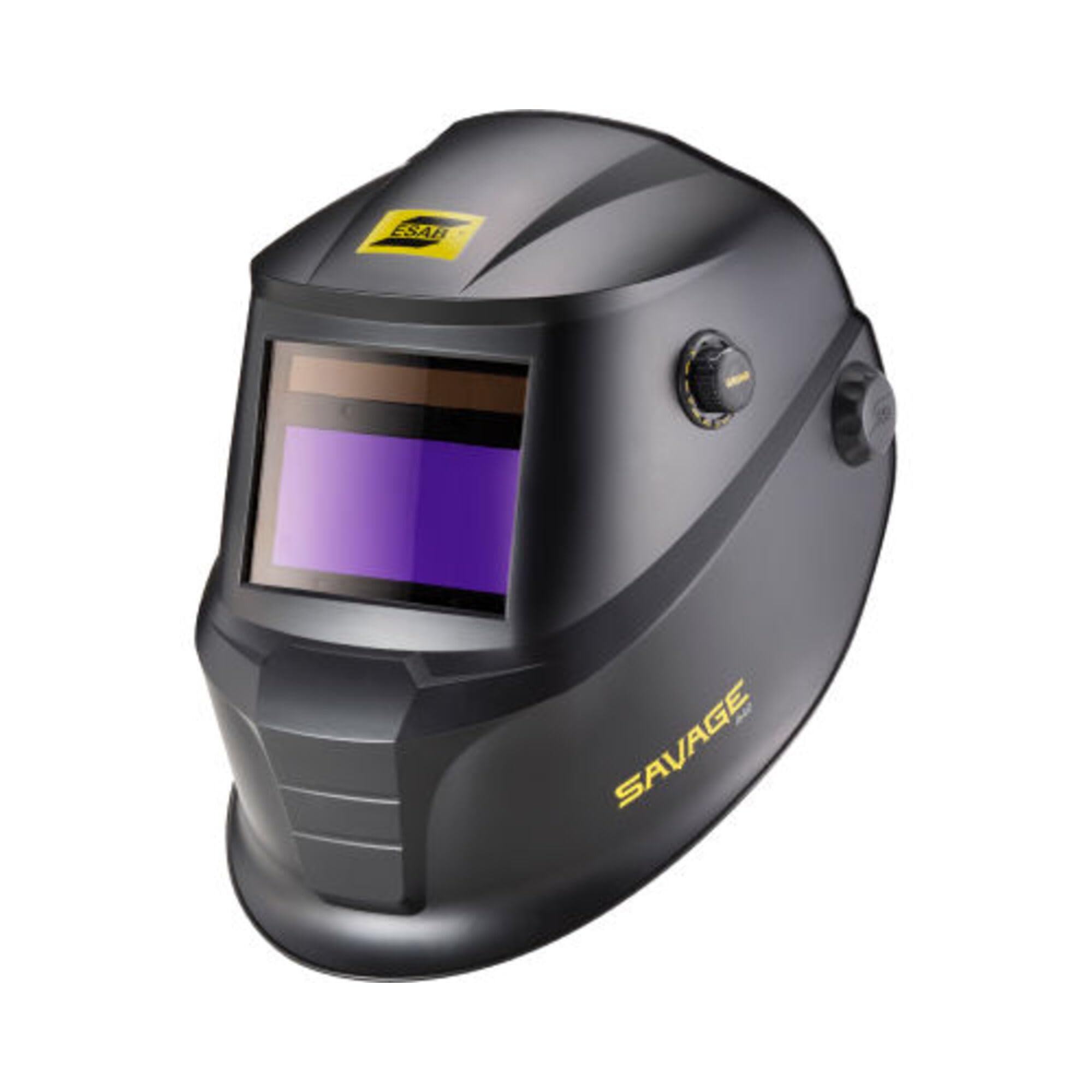
Bottom line: The ESAB Savage A40 remains a strong value-oriented option if you care more about True Color clarity, low-amp TIG and an external grind control than having the widest lens in the group.
- Viewing area: 7.70 sq. in., compact but still wide-format
- Arc sensors: 4, for consistent auto-darkening coverage
- Shade range: 4 and 9-13, for grind and welding work
- Controls: Adjustable shade, sensitivity and delay with external grind control
The A40 uses a True Color auto-darkening filter with optical class 1/1/1/2 and four arc sensors. Its low-amperage TIG rating reaches 5 amps, which makes it the more targeted choice here for light TIG work.
The tradeoff is viewing size. Its 7.70-square-inch window is smaller than the Hobart Inventor. ESAB has also introduced the newer Savage A41 with a digital interface and an extended active shade range, but the existing affiliate link still points to the A40.
- True Color auto-darkening filter
- Four arc sensors
- Low-amperage TIG capability down to 5 amps
- External grind control
- Smaller viewing area than the Hobart Inventor
- Welding shade range starts at 9 on the A40
- A newer Savage A41 generation is now available
4. Jackson Safety Insight 46131
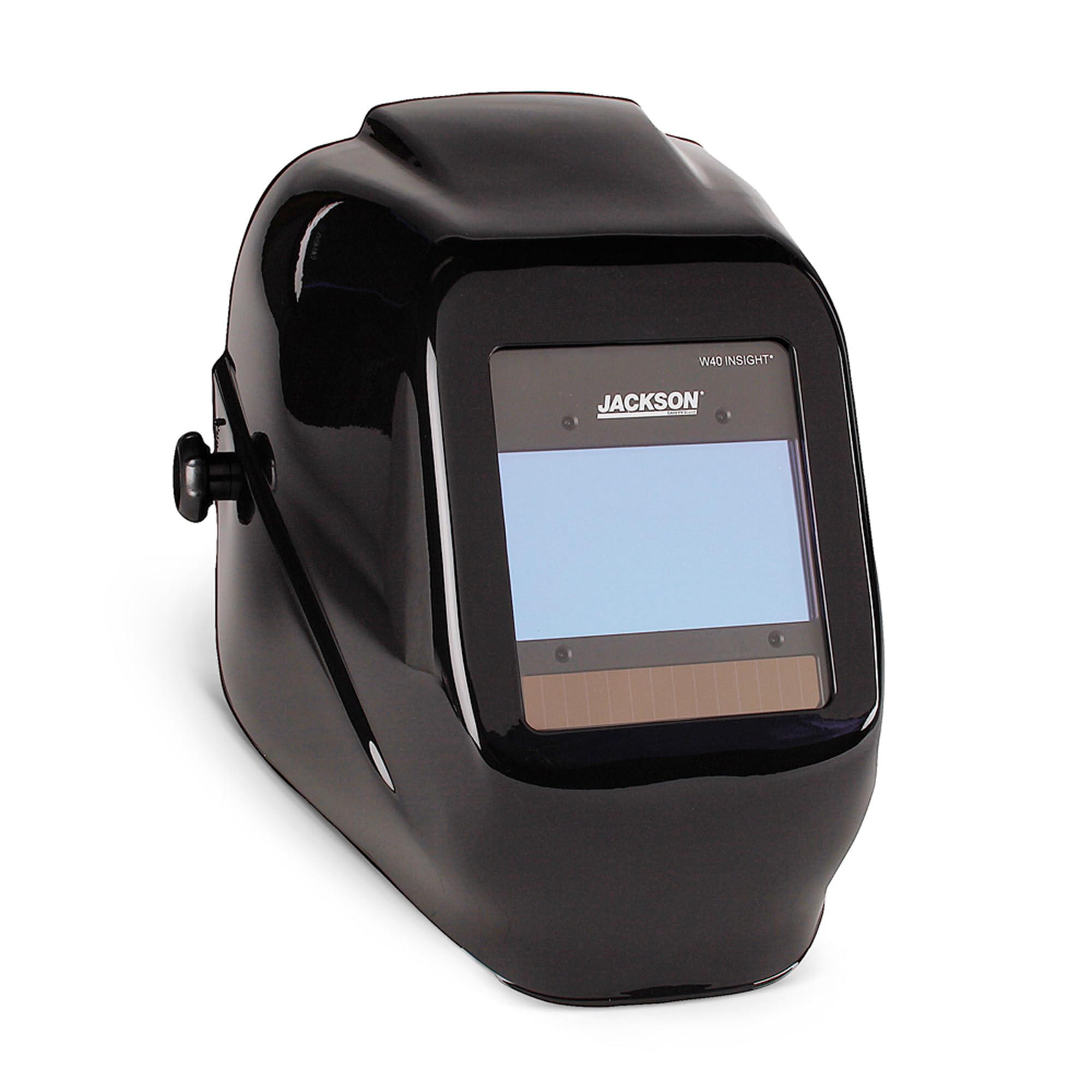
Bottom line: The Jackson Safety Insight 46131 has strong optical specifications, but current market pricing puts it outside this roundup’s budget target. It stays in the article because the original product and image must remain, but it is not a current recommendation.
- Viewing area: 9.3 sq. in., wide-format visibility
- Arc sensors: 4, for broad arc detection coverage
- Shade range: 4 and 9-13, for light state and welding
- Controls: Internal digital shade, sensitivity and delay settings
Jackson lists the 46131 with True Color optics, 1/1/1/1 optical clarity, four sensors and a 5-amp TIG rating. The HLX shell and 370 Speed Dial headgear are designed around a light, adjustable fit.
The catch is not the feature set; it is current budget fit. Multiple current retail listings place this exact 46131 above the roundup’s limit, so it should not be presented as one of the best current choices for this specific price-qualified list.
- 9.3-square-inch viewing area
- 1/1/1/1 optical clarity
- Four arc sensors and 5-amp TIG rating
- Digital shade, sensitivity and delay controls
- Current pricing misses this roundup’s budget target
- Internal controls require lifting the hood for adjustments
- No longer competitive here on budget fit
Hobart Inventor 770890 vs ESAB Savage A40: Is the Upgrade Worth It?
The core tradeoff is viewing area versus low-amp TIG emphasis. Hobart gives you the wider 9.3-square-inch window, while the ESAB A40 combines a smaller 7.70-square-inch view with a 5-amp TIG rating and external grind control.
- Viewing area: Hobart gives you more visible work area without moving your head as much.
- Controls: Hobart uses simple analog adjustment; ESAB adds an external grind control.
- TIG focus: ESAB explicitly rates the A40 down to 5 amps.
- Generation: ESAB now has an A41 successor, while the linked A40 remains the article’s existing product.
Which Welding Helmet Should You Buy?
- Want the widest verified view in this shortlist: get the Hobart Inventor 770890.
- Want simple controls without menus: get the Hobart Inventor 770890.
- Do low-amperage TIG: get the ESAB Savage A40.
- Want an external grind control: get the ESAB Savage A40.
- Need a current model under the roundup limit: choose between the two verified picks above and recheck Amazon before ordering.
How We Chose
- Exact model match: we checked the ASIN or part number against the linked product and manufacturer records.
- Optics and visibility: viewing area, color technology and optical classification received extra weight.
- Arc detection: sensor count, shade range, sensitivity controls and low-amp TIG support were compared.
- Workflow: grind mode, control layout and headgear features were considered for everyday use.
- Freshness and safety: current manufacturer pages, purchasing status, successor models and recall searches were checked. Owner comments were not used unless a repeatable trend could be supported across independent sources.
Welding Helmet Care and Maintenance
Clean the outer and inner cover lenses with a soft cloth and a cleaner approved for the helmet. Replace scratched or heat-damaged cover plates before they interfere with your view, and keep sensors clear of spatter, dust and stickers.
Inspect the headgear, shell, battery compartment and lens response before use. Store the helmet where the auto-darkening filter will not be crushed or exposed to harsh solvents. If the lens fails to darken consistently, stop welding and troubleshoot the helmet before using it again.
Customer Preferences
Most buyers should focus first on optical clarity, viewing area, sensor coverage and headgear fit. Low-amp TIG sensitivity, grind mode and control placement matter more when you switch processes often or work at low current.
How to Choose a Welding Helmet Under $200
Optical Clarity and Color
A clear lens helps you distinguish the puddle, joint and surrounding metal with less visual guesswork. True-color systems reduce the heavy green tint common to older auto-darkening filters. If a wide, natural-looking view is your priority, the Hobart Inventor 770890 is the best fit among the verified choices here.
Viewing Area
A larger viewing window is most useful in cramped positions, under vehicles or when you need to watch more of the joint without moving your head. Compare square-inch viewing area rather than only the outside lens dimensions. The Hobart Inventor 770890 has the wider verified viewing area of the two current recommendations.
Arc Sensors and Switching
More sensor coverage can help when part of the helmet faces away from the arc or your hand, torch or workpiece blocks one sensor. All four original products use four arc sensors, but sensor count is only part of the system. Sensitivity settings and correct positioning still matter, especially for TIG.
Low-Amp TIG Performance
For low-current TIG, check the manufacturer’s minimum TIG rating rather than assuming every auto-darkening helmet will catch a weak arc. The ESAB Savage A40 is rated down to 5 amps and gives you adjustable sensitivity for fine tuning.
Control Layout and Grind Mode
External controls are convenient when you switch from welding to grinding often, while internal controls are less likely to be bumped accidentally. Analog dials are fast to understand; digital controls provide clearer setting feedback. The ESAB Savage A40 is the better fit here if an external grind control is important.
Comfort and Headgear
Weight alone does not determine comfort. Balance, ratchet design, pad shape and how far the lens sits from your face all affect fatigue. If possible, try the helmet with your usual safety glasses and respirator so the headgear does not create pressure points or interfere with other PPE.
Safety Standards and Inspection
Use a helmet that meets the safety requirements for your work environment, and inspect the markings when it arrives. Auto-darkening convenience does not replace safety glasses, protective clothing, ventilation or respiratory protection required by the job. Replace a cracked shell or damaged filter instead of trying to work around it.
Mistakes to Avoid When Buying a Welding Helmet
- Buying by lens size alone: also compare clarity, sensors, controls and headgear.
- Ignoring low-amp TIG needs: verify the manufacturer’s TIG rating for your process.
- Assuming an old part number is current: check the exact model and generation before ordering.
- Forgetting other PPE: the helmet does not replace safety glasses or ventilation.
- Skipping a fit check: make sure the hood works with your respirator, glasses and work position.
FAQs
How do I choose the right welding helmet?
Start with optical clarity, viewing area, sensor coverage and headgear fit. Adjustable shade, sensitivity and delay help you tune an auto-darkening filter for MIG, TIG or stick work. A grind mode can save time between steps. Also confirm the helmet meets the safety requirements for your job, school or workplace before you rely on it.
Are auto-darkening sensors reliable for low-amp TIG work?
Yes, when the helmet is specifically rated for low-amperage TIG and its sensors have a clear view of the arc. Four-sensor designs can help when your torch, hand or workpiece blocks one sensor. Set sensitivity and delay for your process, then test the lens response on scrap before starting a critical weld.
Is a larger viewing area worth it?
A larger viewing area is useful when you work in tight positions or want more of the joint in sight without moving your head. It is not the only factor, though. Lens clarity, headgear balance and control layout can matter just as much. The Hobart Inventor combines a 9.3-square-inch view with four arc sensors.
What shade range should I look for?
Choose a shade range that covers the welding processes and amperage you actually use. The helmets here use variable welding shades rather than one fixed dark state, while grind mode uses a lighter setting. Follow the helmet manual and your welding procedure when selecting a shade; do not assume one setting is right for every arc process.
Are digital controls better than analog controls?
Neither control style is automatically better. Digital controls make exact settings easy to read and can support extra modes or memory on some helmets. Analog knobs are fast to adjust without working through menus. The better choice depends on whether you value repeatable settings or simple, direct changes while moving between jobs.
How should I care for an auto-darkening welding helmet?
Keep the outer and inner cover lenses clean and replace them when scratches reduce visibility. Inspect the shell, sensors, headgear and battery area before use, and store the helmet where the lens will not be crushed or exposed to harsh solvents. If the filter darkens inconsistently or the lens is damaged, stop using it until the problem is corrected.
Final Verdict
For the best welding helmets under $200 in this existing four-product roundup, the field narrows after current model and budget checks. The Hobart Inventor 770890 gives you the best overall balance of viewing area, sensor coverage and simple controls, while the ESAB Savage A40 remains the value-focused alternative.
If low-amp TIG and external grind control matter more, compare the ESAB Savage A40. The Miller 280045 and Jackson 46131 remain in the article for transparency but are not current recommendations for this qualified list.
| Product Name | Image | Rating | Viewing Area (sq. in.) | Weight | Key Highlights |
|---|---|---|---|---|---|
| Miller Digital Performance™ Welding Helmet |
|
4.7/5 (169 reviews) | 7.22 | 1.1 pounds |
|
| Hobart 770890 Auto-Darkening Welding Helmet |
|
4.7/5 (880 reviews) | 9.3 | 1.25 pounds |
|
| ESAB 0700000480 Black Savage A40 Welding Helmet |
|
4.6/5 (438 reviews) | 7.70 | 2.2 pounds |
|
| Jackson Safety Insight Auto Darkening Welding Helmet |
|
4.6/5 (682 reviews) | 9.3 | 0.375 pounds (6 ounces) |
|


[…] protection without sacrificing necessary visibility of the weld. Additionally, understanding sensor count and performance can greatly enhance your welding experience by ensuring optimal visibility and […]
[…] autonomy by enabling informed decisions before illness develops. Additionally, using high-quality welding helmets with clear optics can significantly reduce exposure to harmful […]
[…] optical clarity also makes it easier to see the joint and recognize whether the filter is switching […]
[…] solar-viewing safety. For ordinary welding use, you may separately compare welding jackets, welding helmets under $200, TIG welding gloves, Lincoln welding helmets, 3M Speedglas welding helmets, the ESAB Sentinel A50, […]
[…] also matters when you are trying to follow the joint and judge the puddle. The existing guide to optical clarity explains one helmet-related factor that affects […]