Choosing among oxygen cylinder sizes for welding is mainly a question of how much oxygen your torch consumes, how long you want to work between exchanges, and how portable the setup needs to be. For oxy-fuel welding, brazing, heating, and cutting, larger cylinders extend runtime but become heavier and less convenient to move. MIG and TIG need different shielding gases, so their cylinder choices should not be confused with oxy-fuel oxygen cylinders.
Quick Answer
For most U.S. oxy-fuel users, choose the smallest oxygen cylinder that meets your torch tip’s required flow without constant exchanges. Compact 20–40 cu ft cylinders favor portability, 80–125 cu ft sizes suit regular shop work, and roughly 150–300 cu ft cylinders reduce changeovers during sustained cutting or heating. These are not TIG shielding-gas sizes.
Last checked: September 28, 2026. Dates and figures were verified against official sources.
Key Takeaways
- Oxygen cylinders in welding shops are primarily used for oxy-fuel welding, cutting, brazing, and heating, not as the normal TIG shielding-gas supply.
- Calculate approximate runtime from cylinder capacity divided by the torch tip’s oxygen consumption in cubic feet per hour.
- Supplier size names are not perfectly universal, so compare actual cubic-foot capacity, cylinder dimensions, valve type, and stamped service pressure.
- Oxygen used for cutting can be consumed much faster than acetylene, so oxygen and acetylene cylinders should be matched to the torch’s actual gas demand rather than a fixed tank-size ratio.
- OSHA requires strict separation, securement, valve protection, ventilation, and oil-free oxygen equipment in covered workplaces.
How to Choose the Right Oxygen Cylinder Size
)
Choose an oxygen cylinder by starting with the oxygen flow required by your torch tip, then decide how much uninterrupted torch time you need. Portability, local exchange availability, storage space, and cylinder ownership rules come after that. There is no single cylinder size that fits every oxy-fuel job.
Start With the Torch Tip’s Oxygen Consumption
The torch manufacturer’s tip chart is the best sizing reference because oxygen consumption changes dramatically with the operation and tip size. Welding and brazing flames may use relatively modest flows, while cutting tips use an additional high-flow cutting-oxygen jet.
For example, official ESAB Type 101 oxy-acetylene cutting-tip data shows total oxygen consumption of about 30–35 cubic feet per hour for one 1/4-inch cutting setup and 55–60 cubic feet per hour for specified 3/8- to 1/2-inch setups. Larger cutting tips can demand substantially more.
Miller also publishes process-specific oxy-fuel tip and flow charts. Use the chart for your exact torch, tip, fuel gas, and material thickness rather than assuming one flow rate for every job.
Estimate Approximate Runtime
A simple planning estimate is:
Approximate torch time = cylinder capacity in cubic feet ÷ oxygen consumption in cubic feet per hour.
For example, if a specific tip consumes 40 cubic feet of oxygen per hour, an 80 cu ft cylinder represents about two hours of theoretical flow at that rate. Real working time may differ because pressure, regulator performance, pauses, setup practices, and how completely the supplier allows the cylinder to be drawn down affect usable gas.
Balance Runtime Against Portability
Small cylinders are easier to carry and fit on compact carts, but they require more frequent exchanges. Larger cylinders reduce interruptions and usually make more sense when cutting or heating is done regularly.
- Occasional mobile work: prioritize a compact cylinder you can secure and transport safely.
- Home or small fabrication shop: a mid-size cylinder often gives a useful balance of capacity and manageability.
- Frequent cutting or heating: choose a larger cylinder or discuss manifolded or higher-volume supply with a gas supplier.
Do not select a cylinder only by a letter such as M, Q, K, or another local designation. Those names can vary between gas companies. Compare the stated cubic-foot capacity and physical specifications instead.
Common Oxygen Cylinder Sizes Explained
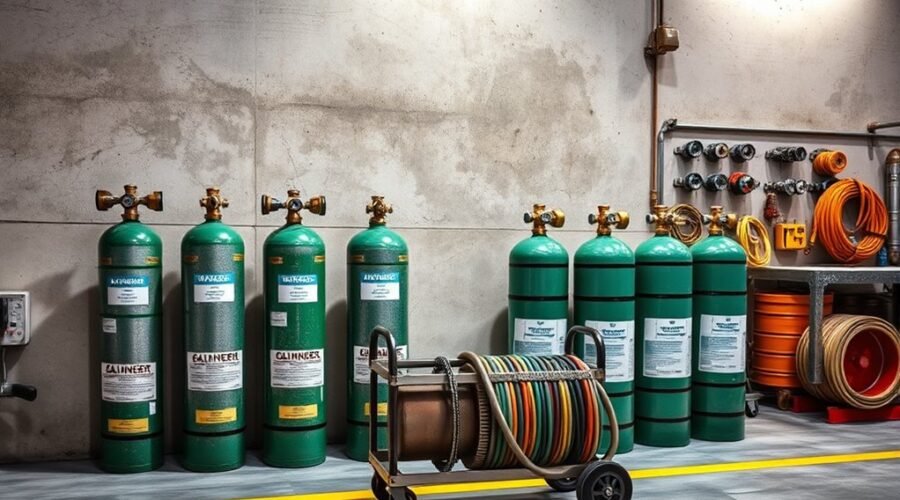
U.S. industrial oxygen cylinders are sold in several capacities rather than one universal set of standardized retail names. Common supplier offerings include roughly 20, 40, 80, 125, 150, 250, and 300 cubic feet. Availability and exact dimensions vary by supplier and cylinder specification.
Common Oxygen Sizes
A current U.S. supplier catalog includes 20, 40, 60, 80, 125, 150, and 300 cu ft steel oxygen cylinders, along with several aluminum sizes. The practical difference is mainly capacity versus weight and handling convenience.
The following ranges are useful for planning, but always confirm the exact cylinder your local supplier stocks:
- 15–20 cu ft: compact cylinders for light brazing, small repairs, backup supply, or highly portable torch kits.
- 40–60 cu ft: more working time while remaining easier to move than full-size shop cylinders.
- 80 cu ft: a practical mid-size option for intermittent fabrication, repair, brazing, and light cutting.
- 125–150 cu ft: better suited to regular shop use where frequent exchanges become inconvenient.
- 250–300+ cu ft: higher-capacity shop cylinders intended for longer operating periods and reduced changeover frequency.
Industrial oxygen cylinders commonly use a CGA-540 connection in the United States, but the correct regulator and valve configuration must always be confirmed before purchase or exchange.
Welding Use Cases
The best size depends more on the torch operation than on the word “welding.” Brazing and light welding can use far less oxygen than heavy cutting or heating, so two users with the same cylinder may get very different working times.
| Size | Use case | Benefit |
|---|---|---|
| 20 cuft | Light brazing, repair, portable work | High portability |
| 40 cuft | Occasional torch work | More runtime without a large cylinder |
| 80 cuft | Regular home-shop or repair work | Balanced capacity and mobility |
| 125 cuft | Frequent shop welding, brazing, or cutting | Fewer exchanges |
| 150–300+ cuft | Sustained cutting and heating | Longer operating periods |
| Any size | Storage and use | Must be secured and protected |
Do not assume a larger bottle automatically supports every torch. High-flow operations must stay within the cylinder, regulator, hose, flashback-arrestor, and equipment manufacturer’s rated flow limits.
Do MIG and TIG Use Oxygen Cylinders?
TIG welding does not normally use an oxygen cylinder for shielding. TIG relies on an inert shielding gas, most commonly argon, while helium or argon-helium blends may be used for some applications. Oxygen reaching the TIG weld pool causes oxidation rather than providing normal shielding.
Miller’s TIG welding guide identifies argon as the standard all-around TIG shielding gas and explains that helium or specialty blends may also be used.
MIG is different. Some GMAW procedures use a small percentage of oxygen blended with argon. Lincoln Electric’s GMAW shielding-gas selection guide lists mixtures such as 95–98% argon with 2–5% oxygen for certain carbon and low-alloy steels, and 98–99% argon with 1–2% oxygen for certain stainless-steel procedures.
That does not mean a normal MIG user should substitute a pure oxygen cylinder for the shielding-gas cylinder. These percentages are controlled shielding-gas mixtures selected for a specific wire, material, and welding procedure.
Warning: Never connect a pure oxygen cylinder to a TIG shielding-gas system or substitute oxygen for the specified MIG shielding gas. Use only the gas, regulator, fittings, and procedure specified for the welding process.
Matching Oxygen and Acetylene Cylinder Sizes
Oxygen and acetylene cylinders should be matched to actual torch consumption, not to a fixed cylinder-volume ratio. Oxy-acetylene welding can consume the two gases at comparatively similar rates, while oxy-acetylene cutting uses a separate cutting-oxygen stream and can consume oxygen much faster.
This is why an oxygen cylinder is often larger than the acetylene bottle in a portable cutting outfit. The right combination depends on your tip chart, intended material thickness, operating time, and the safe withdrawal limit of the acetylene cylinder.
The often-repeated “one-seventh rule” for acetylene withdrawal is based on older guidance and should not be used as a universal modern sizing rule. OSHA’s rulemaking record explains that later CGA guidance used different advisory rates for intermittent and continuous withdrawal. The practical approach is to follow the current cylinder supplier and torch manufacturer’s limits.
- Use the torch chart to determine oxygen and acetylene consumption separately.
- Size the oxygen bottle for the cutting-oxygen demand as well as the preheat flame.
- Choose an acetylene cylinder large enough to supply the required flow without exceeding the cylinder supplier’s withdrawal guidance.
- For high-flow heating or cutting, a larger fuel-gas cylinder or manifolded supply may be necessary.
A small 20 cu ft oxygen cylinder paired with a compact acetylene cylinder can suit brief brazing or repair work, but frequent cutting usually benefits from substantially more oxygen capacity.
Oxygen Cylinder Storage and Handling Rules
Oxygen is not a fuel, but it strongly supports combustion. A leaking oxygen system can make ordinary combustible materials burn far more aggressively, so cylinder storage, valve protection, oil-free equipment, and secure handling are essential.
For U.S. general-industry workplaces, OSHA 29 CFR 1910.253 requires protected, dry, ventilated cylinder storage and sets specific separation rules for stored oxygen cylinders. Construction work is covered by similar requirements in OSHA’s gas-welding standard.
Note: OSHA rules discussed here apply to covered U.S. workplaces. State plans, fire codes, transport rules, insurers, and gas suppliers can impose additional requirements, so commercial users should confirm the rules that apply to their facility and vehicle.
Safe Storage Distances
OSHA requires oxygen cylinders in storage to be separated from fuel-gas cylinders or combustible materials, especially oil and grease, by at least 20 feet. The alternative is a noncombustible barrier at least 5 feet high with a fire-resistance rating of at least one-half hour.
Inside buildings, cylinders must be kept in a well-protected, well-ventilated, dry location and at least 20 feet from highly combustible materials. OSHA also says cylinders should be stored in assigned locations where they are protected from being knocked over, struck by objects, or tampered with.
The 20-foot oxygen/fuel-gas rule is specifically a storage rule. OSHA has separate interpretations covering cylinders that are in use or connected and ready for use, so the rule should not be simplified to mean every working oxygen and fuel-gas cylinder must always be 20 feet apart.
Compressed-gas guidance also limits excessive heat exposure. Keep cylinders away from radiators and other heat sources, and do not store them where cylinder temperature can exceed 125°F.
Warning: Keep oxygen cylinders, valves, regulators, couplings, hoses, and fittings free from oil and grease. OSHA specifically prohibits handling oxygen equipment with oily hands or gloves because oxygen can greatly accelerate combustion.
Cap And Valve Care
Valve protection matters because a damaged high-pressure valve can release gas rapidly. OSHA requires the protective cap to remain installed and hand-tight when a cylinder designed for a cap is not in use or connected for use.
Close cylinder valves when work is finished. Do not repair, modify, or tamper with a cylinder valve or its safety devices yourself. If a valve is damaged, difficult to operate, leaking, or otherwise questionable, remove the cylinder from service and contact the supplier.
Protective caps are not lifting points. Do not lift a cylinder by its cap, intentionally drop it, strike it, or allow cylinders to collide violently.
Handling And Transport Rules
For U.S. construction workplaces, OSHA 29 CFR 1926.350 requires compressed-gas cylinders to be secured upright, with limited exceptions while they are actually being carried or hoisted. When transported by powered vehicles on covered construction sites, cylinders must be secured vertically.
Unless the cylinders are firmly secured on a special carrier intended for the purpose, regulators must be removed and valve-protection caps installed before cylinders are moved. A cylinder truck, chain, or other steadying device should keep the cylinder from being knocked over while in use.
- Confirm the cylinder label before connecting equipment.
- Inspect the shell, valve, cap, regulator, hose, and connections for visible damage.
- Close the valve before moving the cylinder.
- Use a suitable cylinder cart rather than dragging or dropping the bottle.
- Keep cylinders away from welding arcs, hot slag, flames, and electrical circuits.
Transport requirements can differ for private, commercial, and regulated hazardous-material shipments. Follow the gas supplier’s transport instructions and any DOT rules that apply to your load and vehicle.
What Oxygen Cylinders Cost
Oxygen-cylinder cost depends on capacity, steel versus aluminum construction, certification, valve configuration, supplier, and whether you are buying only the empty cylinder or also paying for gas, delivery, exchange, or rental. Prices can change quickly, so a current listing is more useful than a fixed historical range.
Buying the cylinder and buying the oxygen are separate costs; many new cylinders are sold empty.
As checked on September 28, 2026, the Gas Cylinder Source oxygen-cylinder catalog showed the following example prices for new empty cylinders:
| Example cylinder | Listed price |
|---|---|
| 15 cu ft aluminum, CGA-540 | $83.40 |
| 20 cu ft steel | $81.50 |
| 40 cu ft steel | $119.90 |
| 80 cu ft steel | $145.80 |
| 122 cu ft aluminum | $299.80 |
| 125 cu ft steel | $178.80 |
| 150 cu ft steel | $218.80 |
| 300 cu ft steel | $292.80 |
Those figures are examples from one U.S. seller, not nationwide market averages. Shipping, filling, local exchange charges, hydrostatic testing, taxes, and supplier policies can change the total cost.
Steel generally offers a lower purchase price at a given capacity, while aluminum can reduce cylinder weight and resist corrosion. Compare the full specification rather than choosing on material alone.
Should You Refill, Lease, or Buy Cylinders?
Buying usually gives you more control over a small cylinder you expect to keep for years, while rental or leasing can simplify high-use commercial supply. The deciding factors are refill availability, cylinder ownership policies, frequency of use, and how much responsibility you want for maintaining an owned cylinder.
Buying can make sense for hobbyists, mobile technicians, and small shops that use one or a few common sizes. Before buying, confirm that a nearby welding-gas supplier will fill or exchange that exact customer-owned cylinder and valve configuration.
Renting or leasing can suit businesses that need larger cylinders, multiple bottles, frequent deliveries, or cylinder tracking without owning every container. Airgas explains in its gas-ordering and cylinder-return guide that customers who do not refill a cylinder they own may rent or lease cylinders, with terms affected by gas type, consumption, and cylinder quantity.
Refill versus exchange is largely a supplier-policy question. Some suppliers refill a customer-owned bottle; others exchange eligible cylinders for another certified cylinder of the same service and size. Confirm ownership markings, test status, valve type, and local policy before purchasing an empty bottle online.
- Occasional user: ownership can avoid recurring rental charges if local filling is available.
- Frequent shop user: exchange or lease service can reduce downtime and cylinder-management work.
- High-volume operation: ask the supplier whether larger cylinders, manifolds, or bulk supply make more sense than repeated individual-cylinder changes.
Frequently Asked Questions
What Size Oxygen Bottle Do I Need for Welding?
Choose the smallest cylinder that can supply your torch’s required oxygen flow for the amount of work you plan to do. A 20–40 cu ft bottle favors portability, 80–125 cu ft suits regular shop use, and 150–300 cu ft reduces exchanges during sustained cutting or heating. Always confirm the tip’s flow requirement first.
What Are the Different Sizes of Oxygen Cylinders?
Industrial oxygen cylinders are sold in many capacities, with U.S. suppliers commonly offering sizes around 20, 40, 60, 80, 125, 150, 250, and 300 cubic feet. Exact dimensions, weights, pressures, and letter designations vary by cylinder and supplier, so compare the actual capacity and stamped specifications.
What Are the OSHA Storage Requirements for Oxygen Cylinders?
For covered U.S. workplaces, stored oxygen cylinders must be protected, dry, ventilated, secured as required, and separated from fuel-gas cylinders or combustible materials by 20 feet or an approved noncombustible barrier. Valve caps must be installed when applicable, and oxygen equipment must remain free of oil and grease.
What Are the Common Sizes of Welding Cylinders?
Common welding-gas cylinder capacities depend on the gas and process, so there is no single universal size list. For industrial oxygen, roughly 20–150 cu ft cylinders cover many portable and shop applications, while 250–300 cu ft cylinders serve higher-use work. MIG and TIG shielding-gas cylinders are a separate category.
Does TIG Welding Use an Oxygen Cylinder?
No, TIG welding normally uses argon, helium, or an argon-helium shielding-gas mixture rather than oxygen. The purpose of TIG shielding gas is to keep atmospheric oxygen away from the tungsten and molten weld pool, where oxygen would cause contamination and oxidation.
How Long Does an Oxygen Cylinder Last for Welding or Cutting?
Approximate runtime is the cylinder’s cubic-foot capacity divided by the torch tip’s oxygen consumption in cubic feet per hour. A cutting tip can consume much more oxygen than a small welding or brazing tip, so use the manufacturer’s chart for your exact torch and treat the calculation as a planning estimate.
Conclusion
The right oxygen cylinder is the one that safely supplies your specific oxy-fuel torch without creating unnecessary refill trips or handling problems. Start with the manufacturer’s oxygen-consumption figure, estimate the runtime you need, then compare locally available 20–300 cu ft cylinders by capacity, portability, ownership terms, and refill access. Keep storage and handling practices compliant with the rules that apply to your workplace.
Sources
- OSHA 29 CFR 1910.253: oxygen-fuel cylinder storage, separation, valve protection, and oil/grease requirements.
- OSHA 29 CFR 1926.350: cylinder securement, powered-vehicle transport, caps, regulators, and construction-site handling.
- Miller TIG Welding Guide: normal TIG shielding gases and the role of argon.
- Lincoln Electric GMAW Shielding Gas Selection Guide: oxygen percentages used in selected MIG shielding-gas blends.
- Miller Oxy-Fuel Technical Information: manufacturer tip, flow, and oxy-fuel reference data.
- ESAB Type 101 Cutting Tip Specifications: verified oxygen and acetylene consumption examples.
- Gas Cylinder Source Oxygen Cylinders: example U.S. cylinder capacities and prices checked September 28, 2026.
- Airgas Gas Ordering and Cylinder Return Guide: cylinder rental, leasing, ordering, and return practices.