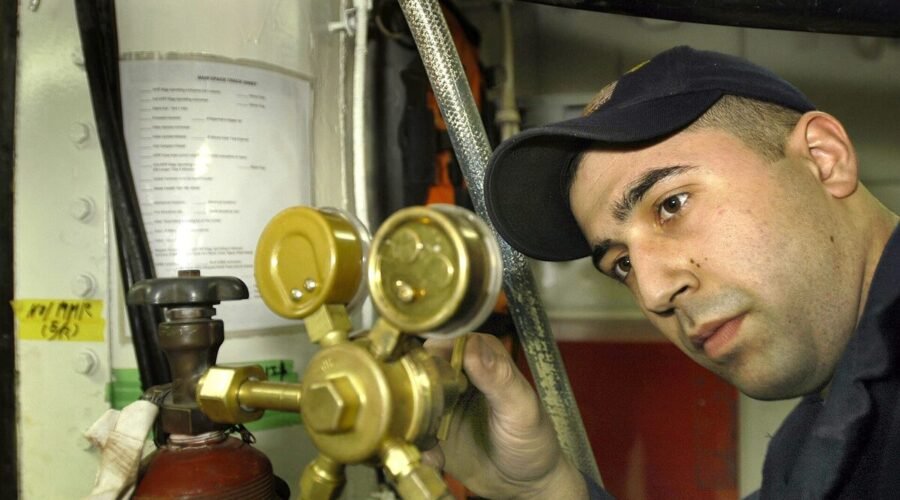
Pick an oxy-acetylene torch tip by metal thickness. For cutting with Victor-style 1-101 tips, use size 000 for 1/8 in steel, 00 for 1/4 in, 0 for 3/8 to 1/2 in, 1 for 3/4 in, 2 for 1 in, 3 for 2 in and 4 for 3 in. For welding, use small tips (000 to 1) on sheet metal up to about 3/32 in, sizes 2 to 4 on 1/16 to 1/4 in, and size 5 or larger above 1/4 in. Keep acetylene at or below 15 psig.
Tip numbers vary by brand, so always check the chart for your torch. The charts below use Victor’s published data, the most common reference in North America.
Oxy-Acetylene Cutting Tip Size Chart
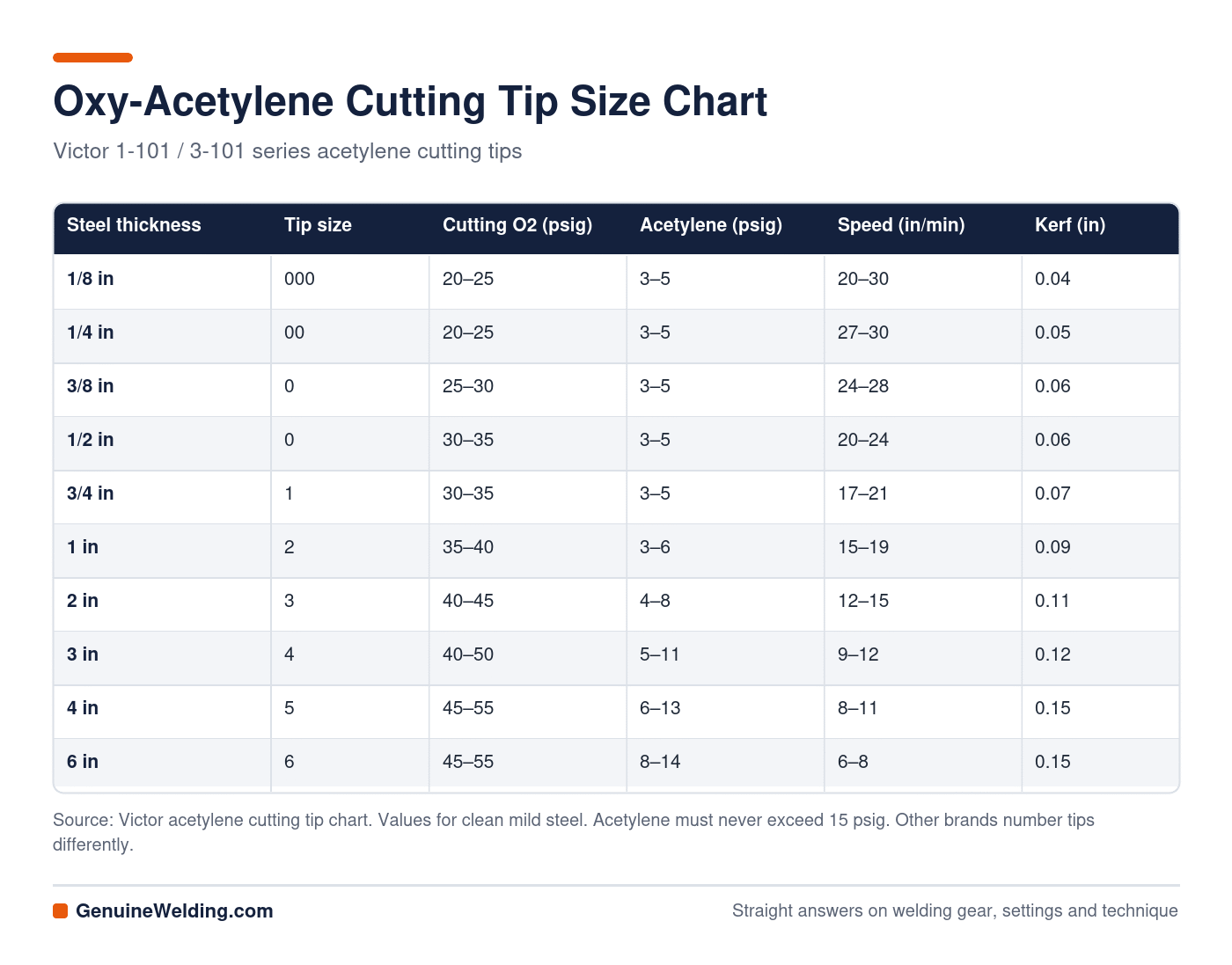
| Steel thickness | Tip size | Cutting oxygen (psig) | Preheat oxygen* (psig) | Acetylene (psig) | Speed (in/min) | Kerf (in) |
|---|---|---|---|---|---|---|
| 1/8 in | 000 | 20–25 | 3–5 | 3–5 | 20–30 | 0.04 |
| 1/4 in | 00 | 20–25 | 3–5 | 3–5 | 27–30 | 0.05 |
| 3/8 in | 0 | 25–30 | 3–5 | 3–5 | 24–28 | 0.06 |
| 1/2 in | 0 | 30–35 | 3–6 | 3–5 | 20–24 | 0.06 |
| 3/4 in | 1 | 30–35 | 4–7 | 3–5 | 17–21 | 0.07 |
| 1 in | 2 | 35–40 | 4–8 | 3–6 | 15–19 | 0.09 |
| 2 in | 3 | 40–45 | 5–10 | 4–8 | 12–15 | 0.11 |
| 3 in | 4 | 40–50 | 5–10 | 5–11 | 9–12 | 0.12 |
| 4 in | 5 | 45–55 | 6–12 | 6–13 | 8–11 | 0.15 |
| 6 in | 6 | 45–55 | 6–15 | 8–14 | 6–8 | 0.15 |
Use the lower end of each pressure range for clean, thin material and the higher end for rusty, scaled or thicker steel. Speeds are for clean mild steel with a skilled operator; hand cutting is usually a bit slower.
Oxy-Acetylene Welding Tip Size Chart
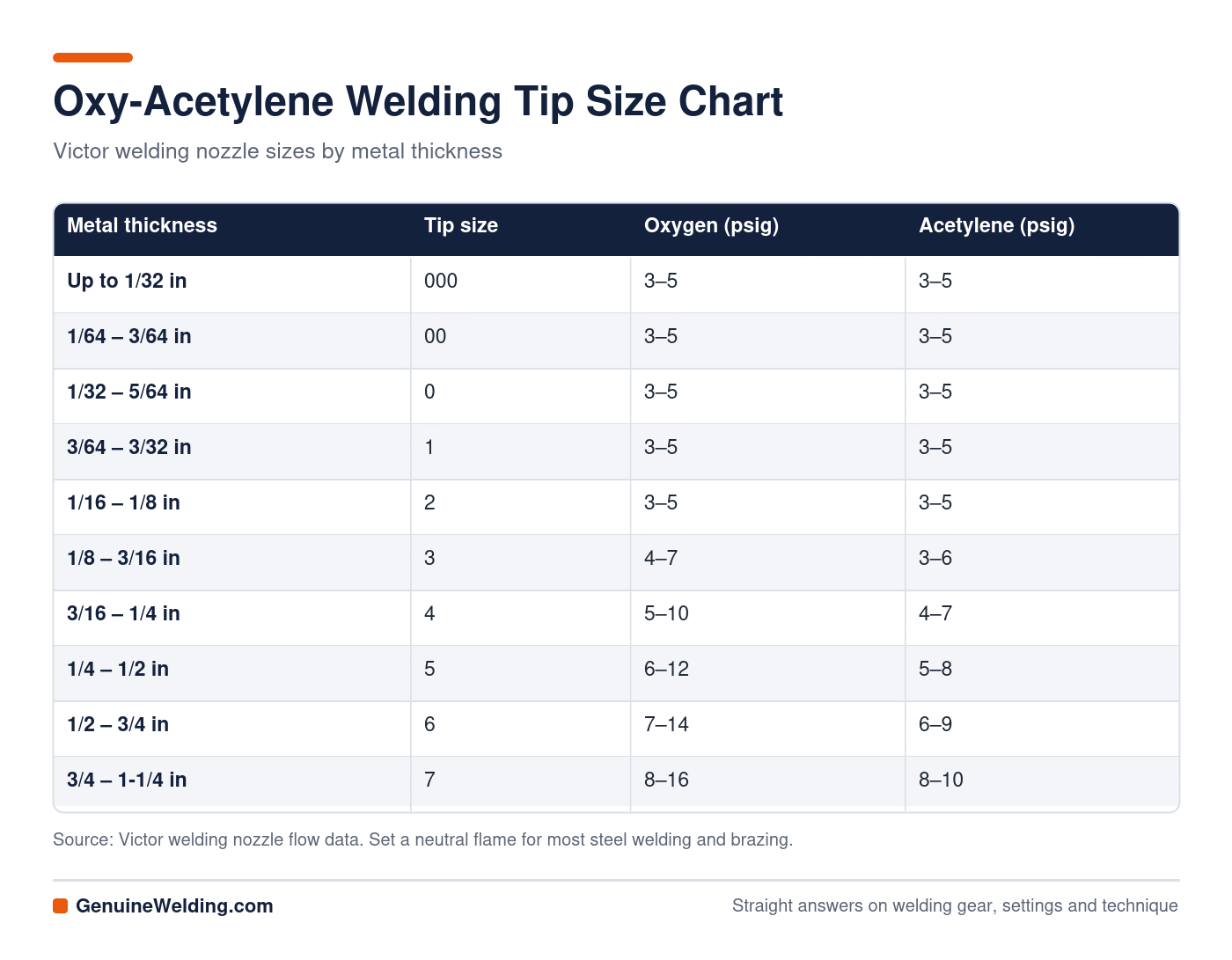
| Metal thickness | Tip size | Oxygen (psig) | Acetylene (psig) |
|---|---|---|---|
| Up to 1/32 in | 000 | 3–5 | 3–5 |
| 1/64–3/64 in | 00 | 3–5 | 3–5 |
| 1/32–5/64 in | 0 | 3–5 | 3–5 |
| 3/64–3/32 in | 1 | 3–5 | 3–5 |
| 1/16–1/8 in | 2 | 3–5 | 3–5 |
| 1/8–3/16 in | 3 | 4–7 | 3–6 |
| 3/16–1/4 in | 4 | 5–10 | 4–7 |
| 1/4–1/2 in | 5 | 6–12 | 5–8 |
| 1/2–3/4 in | 6 | 7–14 | 6–9 |
| 3/4–1-1/4 in | 7 | 8–16 | 8–10 |
| 1-1/4–2 in | 8 | 10–19 | 9–12 |
Welding (and brazing) tips have a single orifice and produce one concentrated flame. Use a neutral flame for most steel welding. Our guide to welding flame types shows how to set it, and oxy-fuel welding covers technique.
How Torch Tip Sizes Are Numbered
- Bigger number, bigger orifice. On Victor tips, 000 is the smallest and sizes run up through 0, 1, 2 and higher. A larger orifice passes more gas and heats or cuts thicker metal.
- Series must match the torch. Tip “series” or “type” (for example Victor 1-101 or 3-101) describes the seat and threads. A tip from the wrong series will not seal and can leak or backfire.
- Fuel must match the tip. Acetylene cutting tips are one-piece with small preheat holes. Propane and natural gas tips (such as two-piece GPN-style tips) have different preheat designs. Do not swap them.
- Brands are not interchangeable. Harris, Smith and other makers use their own numbering. A “size 1” from one brand may not match another. Use a cross-reference chart from the manufacturer.
How to Choose the Right Tip
- Measure the metal thickness you will cut or weld most often.
- Find that thickness on the chart and select the matching tip for your torch series.
- Set regulator pressures to the chart’s range. Set acetylene first, never above 15 psig.
- Light and adjust to a neutral flame, then fine-tune while watching the cut or puddle.
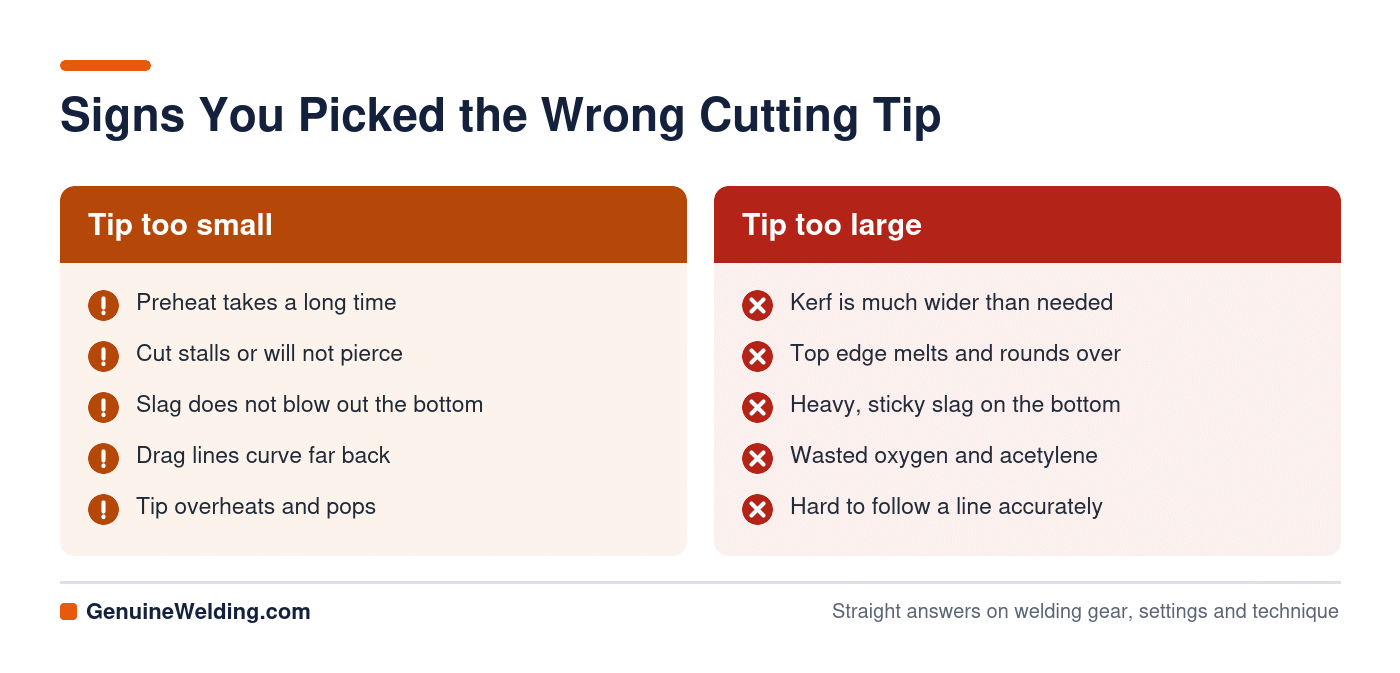
- Go up a size if preheating is slow or the cut won’t pierce; go down a size if the kerf is wide and the top edge melts.
Gas Consumption and Cylinder Size
Bigger tips use much more gas. Cutting oxygen use climbs quickly as tip size goes up, and acetylene use rises with the size of the preheat flames. An acetylene cylinder can only supply about 1/7 of its capacity per hour without drawing out acetone, so a small B tank cannot keep up with large cutting tips. Check our acetylene tank size chart to match your cylinder to your tip, and see oxygen cylinder sizes.
How to Care for Torch Tips
- Clean the orifices with a proper tip cleaner set, using the cleaner that matches the hole size. Don’t enlarge or bell-mouth the holes.
- Dress the face lightly with the file in the tip cleaner kit to keep it flat and square.
- Inspect the seat for nicks or dirt before installing. A damaged seat leaks.
- Tighten correctly: most tips seal with a wrench snug, but follow the maker’s torque guidance; never use pliers.
- Replace damaged tips. A tip that pops, backfires repeatedly or gives a distorted flame should be replaced.
Torch Safety Reminders
- Never set acetylene working pressure above 15 psig.
- Use flashback arrestors and check valves on both hoses.
- Purge each hose before lighting and use a striker, never a lighter.
- Cut over a clear area with no combustibles, and keep a fire extinguisher close.
- Wear shade 4 to 6 cutting goggles or a face shield with the right shade. See our welding lens shade chart.
Learn the full process in oxy-fuel cutting: setup and technique and how to set gauges in fuel gas regulators.
Oxy-Acetylene Tip Size FAQs
What size cutting tip for 1/4 inch steel?
A Victor-style size 00 tip, with about 20 to 25 psi cutting oxygen and 3 to 5 psi acetylene, is a good starting point for 1/4 in mild steel.
What size tip for 1/2 inch steel?
Use a size 0 tip with roughly 30 to 35 psi oxygen and 3 to 5 psi acetylene on Victor 1-101 series tips.
What tip size for brazing?
Small welding tips from 0 to 3 handle most brazing on thin to medium steel, copper and brass. Use a slightly larger tip for heavier parts that soak up heat.
Why does my cutting tip keep popping?
Popping usually means low gas flow for the tip size, a dirty or damaged tip, the tip too close to the work or overheating. Clean the tip, check pressures and keep a steady standoff.
Can I use an acetylene tip with propane?
No. Propane needs tips designed for its slower-burning flame. Using the wrong tip gives poor preheat and can be unsafe.
Sources
- Victor Tip Charts: Acetylene Cutting Tips and Welding Nozzles
- OSHA 1910.253: Oxygen-Fuel Gas Welding and Cutting