Welding copper is difficult because its high thermal conductivity pulls heat from the joint and its oxide layer blocks fusion. Pure copper typically uses AWS ERCu filler, while copper-silicon alloys often weld better with ERCuSi-A. Thicker sections generally need 100°C to 450°C preheat; thinner work may need less. TIG suits thin material, MIG suits heavier sections with argon-helium shielding. Clean, degrease, and remove oxides carefully. More detail clarifies parameter selection and defect control.
Key Takeaways
- Copper welds are difficult because high thermal conductivity, oxide layers, and thermal expansion quickly rob heat and cause distortion or cracking.
- Use AWS A5.7 ERCu for pure copper and ERCuSi-A for copper-silicon alloys, choosing filler to match base metal and service conditions.
- Preheat thicker copper sections, typically 100°C to 450°C, while thinner GMAW work may need only about 75°C.
- Clean copper thoroughly with degreasing and oxide removal before welding, and maintain a tight joint gap for better fusion and lower porosity.
- Choose GTAW for thinner joints and GMAW for thicker ones, using argon or argon-helium shielding and controlled parameters for penetration.
Why Copper Is Hard to Weld
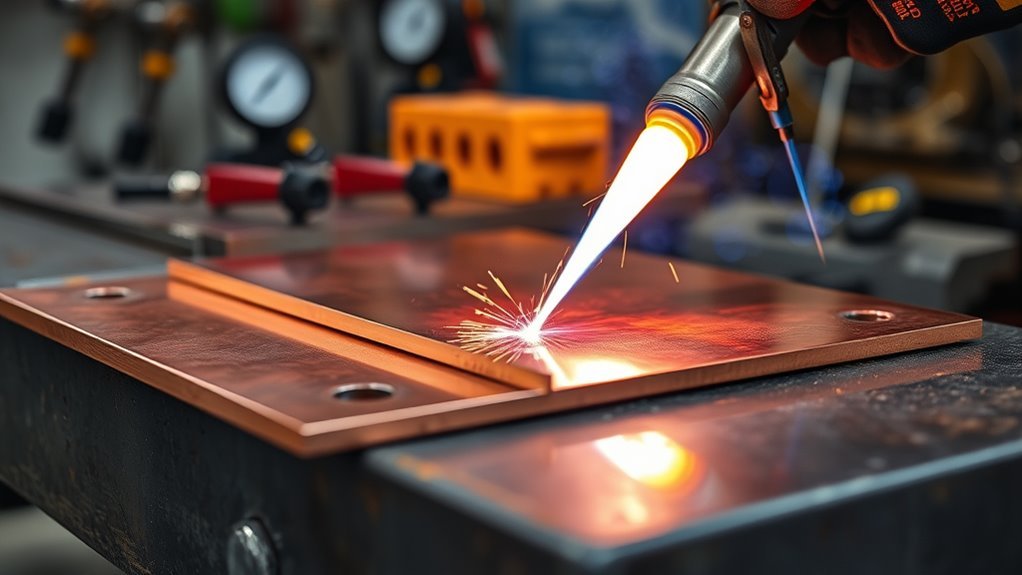
Copper is difficult to weld because its high thermal conductivity rapidly draws heat away from the weld zone, making it hard to maintain the energy needed for proper fusion.
In Copper welding, this thermal conductivity demands elevated input, yet the low melting point can cause localized collapse before adequate penetration is achieved.
The material’s high thermal expansion also promotes warping, so joint alignment must be controlled with disciplined fixturing and sequence.
Oxide layers further obstruct fusion by insulating the surface and reducing wetting, which makes thorough cleaning essential.
Oxide layers can block fusion by insulating the surface, making thorough cleaning essential for sound welds.
Some copper alloys are vulnerable to hot cracking during solidification, especially when cooling is uneven or restraint is excessive.
For this reason, preheat is often used to reduce thermal shock, improve heat distribution, and help stabilize the weld pool.
Successful welding of Copper consequently depends on managing heat, surface condition, and distortion with methodical precision.
Choose the Right Copper Welding Filler Metal
Selecting the correct filler metal begins with matching it to the base copper composition, since alloy compatibility governs fusion quality, distortion control, and final joint performance.
Effective filler metal selection prioritizes AWS A5.7 ERCu for pure copper and ERCuSi-A for copper-silicon alloys. These choices align thermal expansion properties closely enough to reduce warping and support leak-proof joints.
ERCuSi-A also contains deoxidants, such as manganese and silicon, which improve wetting, limit porosity, and strengthen weld quality.
In copper-nickel service, filler metals should exclude low-boiling-point elements that encourage hot cracking and weaken the seam.
Proper selection also preserves mechanical properties and corrosion resistance, both essential for demanding service conditions.
Engineers should evaluate chemistry, service environment, and required joint integrity before welding rather than relying on generic rods.
This disciplined approach supports cleaner fusion, stable arc behavior, and dependable results across fabrication and repair tasks.
How Much Preheat Does Copper Need?
Once the correct filler metal has been matched to the copper alloy, the next control variable is heat input, and preheating is often required to stabilize the weld zone.
For preheating copper, sections thicker than 2 mm generally benefit from elevated preheat temperatures to improve weld penetration and reduce cracking. Pure copper commonly falls between 100°C and 450°C, with thicker sections demanding the upper end to promote uniform heating and limit thermal stress.
In Gas Metal Arc Welding, or GMAW, thinner sections may only need about 75°C to improve weld quality and control distortion. The target is not maximum heat, but controlled thermal expansion that preserves joint integrity and supports freer, more predictable welding.
Clean before welding remains essential, yet it is separate from temperature control. By matching preheat to thickness and process, the welder creates a more stable arc, steadier fusion, and a stronger welded joint without unnecessary restraint or damage.
Prep Copper Surfaces for Clean Welds
Copper surfaces should be thoroughly degreased before welding, with oil, grease, moisture, and other contaminants removed to reduce porosity and weak joints.
Oxide layers must then be eliminated using wire brushes, grinding wheels, or dedicated cleaning tools, especially between passes to avoid cross-contamination.
Clean, active surfaces support consistent fusion and improve overall weld quality.
Surface Degreasing
Surface degreasing is a critical first step in preparing copper for welding, as even trace oil, grease, or dirt can promote porosity and weaken the finished joint. Effective surface degreasing removes contaminants before heat is applied, reducing weld defects and preserving bond quality.
Solvent-based cleaners or chemical pickling may be used, followed by dry wiping with clean cleaning tools to prevent redeposition. Copper should then be handled with disciplined restraint, since contaminated gloves or benches quickly undo progress.
A clean joint gap, ideally 0.04 to 0.20 mm for brazing, supports meticulous preparation and stable fit-up. Inspection of surfaces, tools, and equipment must be routine, because cross-contamination compromises integrity.
Consistent cleaning practices help secure sound fusion and a more liberated, reliable welding process.
Oxide Removal
With contaminants removed, attention must shift to the oxide film that forms naturally on copper and can obstruct fusion if left intact. Effective oxide removal is essential for clean welds, because oxides reduce wetting and promote poor weld quality.
Operators may use wire brushes, grinding wheels, or chemical cleaning agents, selecting tools that expose clean surfaces without embedding debris. On copper-aluminum alloys, thorough treatment is especially critical, since residual oxides quickly degrade joint integrity.
The weld area should be cleaned immediately before arc initiation, limiting rapid oxide reforming in air. A disciplined work environment, free of dust and loose scale, reinforces preparation and supports reliable fusion.
Proper technique grants control, reduces defects, and enables durable joints.
Pick the Best Copper Welding Process
Selection of a copper welding process depends on joint thickness, required precision, deposition rate, and filler metal compatibility.
GTAW, or TIG, is typically favored for thin to medium copper joints and controlled heat input, while GMAW, or MIG, is better suited to thicker sections where faster travel and higher deposition are needed.
Preheat requirements, polarity, and oxidation risk should also be evaluated before choosing the process.
Process Selection Criteria
Choosing the best copper welding process depends on thickness, joint precision, and heat control requirements. For sections up to 1.5 mm, MIG welding can deliver efficient deposition, while TIG welding suits thicker copper, up to 16 mm, where controlled penetration is essential.
The chosen welding technique should match joint design, thermal conductivity, and desired heat-affected zone width. Filler metal compatibility remains critical; ERCu serves pure copper, and ERCuSi-A suits copper-silicon alloys.
Preheating necessity increases above 2 mm, typically 100–450°C, to reduce thermal stress and improve fusion. Shielding gas selection also governs quality: argon supports thinner work, while argon-helium mixtures improve penetration in heavier joints.
This methodical selection restores control, reduces defects, and supports liberated, precise fabrication.
GMAW Vs GTAW
After the welding process has been matched to copper thickness, joint design, and heat control needs, the comparison between GMAW and GTAW becomes the next decision point.
In copper welding, GMAW suits base metals above 6 mm, where spray transfer, higher deposition, and stronger penetration offset copper’s high thermal conductivity. It commonly uses argon or argon-helium shielding gas with ERCu or ERCuSi-A filler.
GTAW is favored for thinner sections and precision work because it gives tighter heat input control, smaller distortion, and superior weld quality. Pure argon or helium shielding gas supports clean fusion, while added filler rods allow exact puddle control.
GMAW offers speed and production freedom; GTAW offers disciplined control and minimal oxidation, making both valid where process choice serves the joint.
Dial In TIG and MIG Settings
Dialing in copper welding parameters requires tight control of heat input and arc stability.
In TIG welding, a thoriated tungsten electrode with DCEN polarity gives focused control, while amperage should sit near 70–150 A for thin sections. Thicker parts benefit from preheat around 100–450°C to lift penetration without forcing excess current.
TIG welding with thoriated tungsten and DCEN delivers focused control, with 70–150 A suiting thinner sections.
In MIG welding, the filler metal should be ERCu or ERCuSi-A, with shielding gas blended from argon and helium to strengthen arc energy, especially beyond 6 mm. Wire feed speed should typically remain near 300–500 inches per minute, matched to section thickness for a stable arc and reduced burn-through.
Voltage settings must be monitored and adjusted between 18–30 volts as thickness changes. For both processes, travel speed of 10–20 inches per minute helps prevent heat buildup and preserves an even bead.
These settings let the welder work with discipline and freedom.
Fix Porosity, Cracking, and Weak Fusion
Porosity, cracking, and weak fusion are best corrected by controlling the weld environment and heat cycle from the start.
Surface cleaning must remove oil and oxides, because contamination traps gas and creates porosity. Preheat the copper workpieces to 100°C to 450°C, reducing thermal stress and limiting cracking during solidification.
Select compatible filler metals, such as ERCu or ERCuSi-A, so the deposit matches the base metal and supports strong bonding. Inadequate filler selection commonly produces weak fusion and brittle joints.
A disciplined welding technique also matters: stringer beads provide better penetration and heat control, especially in thicker sections where freedom from defects depends on consistent energy input.
During multi-pass work, keep interpass temperature below 100°C to avoid overheating and preserve layer-to-layer fusion.
When these variables are managed methodically, the weld becomes more reliable, the structure more durable, and the operator gains greater control over the result.
Remove Oxides and Check the Weld
Oxide removal is essential before welding copper, since surface oxides interfere with fusion and increase the risk of porosity in the joint. Effective surface cleaning should precede every pass: wire brushes, grinding wheels, or chemical pickling can remove oxides and other contaminants without leaving residue.
This discipline supports weld quality and stabilizes the weld joint, especially on copper alloys that react readily to atmospheric exposure. Proper shielding gases further reduce oxidation by protecting the molten pool from air, preserving clean fusion.
Between passes, the weld area should be cleaned again to prevent oxide buildup and limit contamination.
After welding, inspection must be systematic. Visible porosity, cracking, and incomplete fusion should be identified immediately, because each can weaken performance and reduce long-term reliability.
Accurate inspection confirms whether the process delivered a sound joint and whether additional repair is required before the component is released for service.
Frequently Asked Questions
Can Copper Be Welded Without Preheating?
Copper can be welded without preheating in limited cases, but only with careful welding techniques and small sections. High copper conductivity rapidly removes heat, so joint preparation, joint design, and welding speed become critical.
Preheat improves heat distribution, filler metal wetting, oxidation prevention, and reduces cracking risk. Many copper alloys still benefit from post weld treatment. For consistent liberation from defects, preheating is usually the methodical choice.
Which Safety Gear Is Best for Copper Welding?
Best copper-welding safety gear includes a welding helmet, protective goggles, face shield, safety gloves, flame resistant clothing, respirator mask, hearing protection, work boots, and a fume extractor.
Since 90% of weld injuries involve burns, eye damage, or inhalation exposure, disciplined protection is essential. A first aid kit should remain nearby.
This equipment reduces constraint, enabling controlled, precise work while preserving bodily autonomy and operational freedom.
Is Oxy-Fuel Welding Suitable for Copper?
Yes, oxy-fuel welding can suit copper when copper alloy characteristics are understood and welding equipment choices are matched carefully.
Oxy fuel efficiency depends on flame control techniques, welding speed factors, and distortion prevention methods.
Copper joint strength improves with thorough joint preparation tips and appropriate filler metal selection.
Post weld cleaning remains essential.
For an audience seeking liberation through mastery, the method is viable, yet demands disciplined handling and precise execution.
How Do I Store Copper Filler Rods Properly?
Copper filler rods should be stored in clean, sealed containers under stable storage conditions. Different copper rod types benefit from humidity control, contamination prevention, and packaging materials that resist dust and moisture.
Temperature effects should be minimized to protect rod longevity. Careful handling techniques and inventory management preserve traceability and usability.
Clear usage guidelines help guarantee rods remain ready for service, supporting liberated, efficient work without unnecessary waste or degradation.
Can Welded Copper Joints Be Heat Treated Afterward?
Yes—welded copper joints can sometimes be heat treated afterward, but only with careful control.
Suitable heat treatment methods may relieve post weld stress, yet copper alloy compatibility must be verified first.
Metallurgical changes and thermal cycling effects can alter copper joint durability, so joint integrity evaluation and microstructure analysis are essential.
In some cases, heat treatment may aid corrosion resistance improvement or welding defect remediation, but not restore all properties.
Conclusion
Copper, that famously cooperative metal, demands the usual trifles: correct filler, generous preheat, immaculate surfaces, and a process chosen with actual forethought. Ignore oxidation, thermal conductivity, and amperage balance, and the weld will reward the operator with porosity, cracking, and the general dignity of failure. Yet when the variables are controlled with discipline, copper can be joined reliably. In welding, as in bureaucracy, success often depends on respecting the paperwork before lighting the torch.