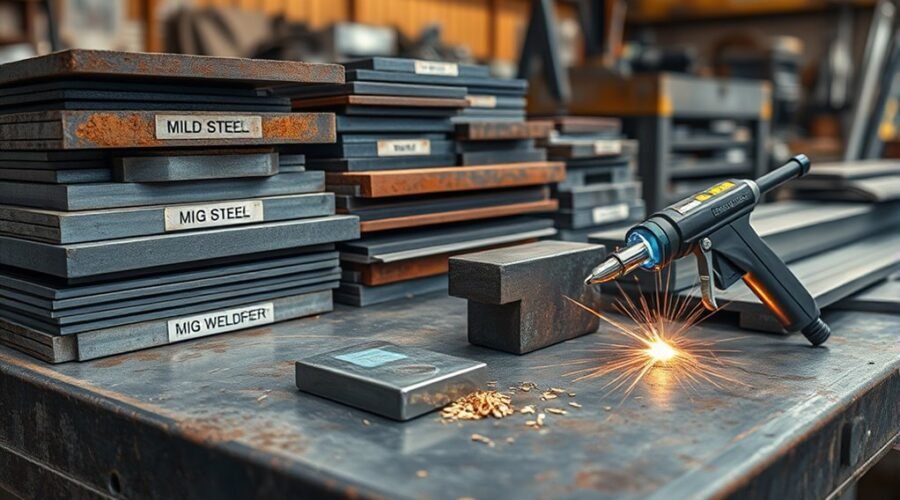
Ferrous metals are iron-based materials used throughout construction, manufacturing, repair, automotive work, machinery, and welding. Common examples include carbon steel, alloy steel, stainless steel, and cast iron. Their strength, hardness, corrosion behavior, and weldability depend on composition, heat treatment, microstructure, section thickness, and the way heat is applied during welding.
Quick Answer
Ferrous metals are metals in which iron is the principal metallic element. Carbon steel, alloy steel, stainless steel, and cast iron are the main examples. Most are strong and many are magnetic, but magnetism is not universal. Weldability varies widely and depends on carbon equivalent, alloy content, thickness, hydrogen, heat input, and cooling rate.
Key Takeaways
- Ferrous metals are iron-based materials that include carbon steel, alloy steel, stainless steel, and cast iron.
- Low-carbon steel is usually easier to weld than higher-carbon or highly hardenable steel, but carbon content is only one part of weldability.
- Carbon equivalent, material thickness, restraint, diffusible hydrogen, heat input, and cooling rate all affect cracking risk.
- Cast iron can be welded, but the correct filler metal, preparation, thermal control, and cooling method depend on the type of casting and repair.
- Many ferrous metals attract a magnet, but common austenitic stainless steels may show little magnetic response.
- GMAW, SMAW, GTAW, and FCAW are all useful on ferrous metals when matched to the material, thickness, joint, environment, and required procedure.
What Are Ferrous Metals?
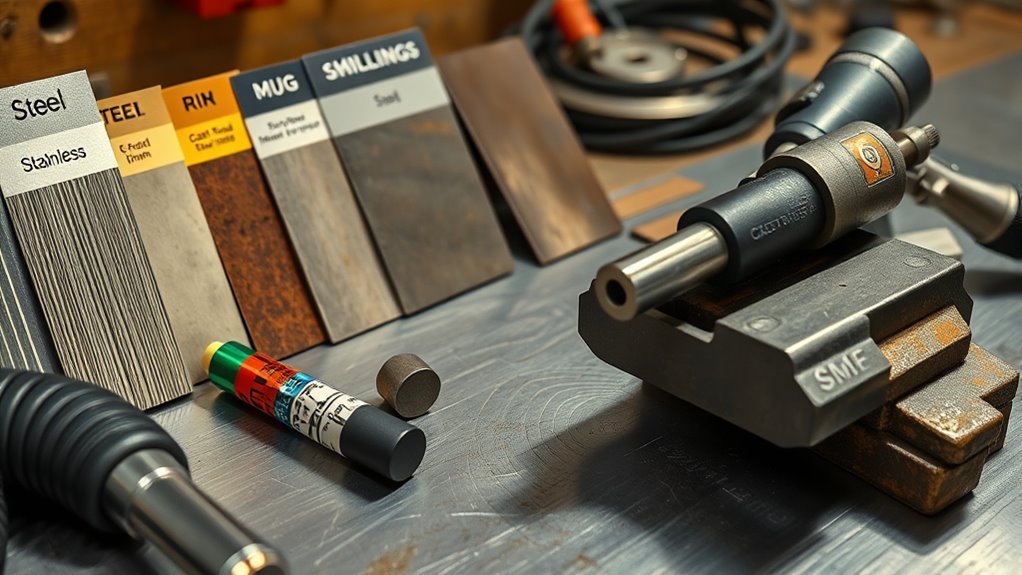
Ferrous metals are metals and alloys in which iron is the principal metallic element. They are widely used because they can provide high strength, toughness, wear resistance, machinability, formability, or corrosion resistance depending on the grade.
Carbon steel is one of the most common ferrous materials. Its properties change significantly as carbon content and heat treatment change. Low-carbon steels are normally easier to form and weld, while medium- and high-carbon steels can develop greater hardness and are generally more sensitive to rapid cooling during welding.
Stainless steel is also ferrous because iron remains its principal metallic element. Chromium and other alloying elements provide corrosion resistance and create different stainless families, including austenitic, ferritic, martensitic, and duplex grades.
Ferrous metals are also widely recycled. Scrap can be remelted and returned to useful production, although chemistry and contamination must still be controlled when a specific grade or mechanical property is required.
Note: “Ferrous” does not automatically mean “strongly magnetic.” Austenitic stainless steels commonly show little attraction to a hand-held magnet, while ferritic, martensitic, and duplex stainless steels normally show a much stronger magnetic response. British Stainless Steel Association guidance explains this distinction.
Common Types Of Ferrous Metals
The main ferrous-metal families used in fabrication include cast iron, carbon steel, alloy steel, stainless steel, and wrought iron. They share iron as the main metallic element but differ greatly in carbon content, alloying, microstructure, corrosion resistance, ductility, and weldability.
Cast Iron Varieties
Cast irons generally contain considerably more carbon than ordinary steels. Their graphite shape, carbide content, matrix structure, and prior service history have a major effect on weldability.
Gray cast iron contains graphite in flake form. It has good machinability, vibration damping, and castability and is widely used for machine bases, housings, brake components, and engine-related castings.
Ductile cast iron, also called nodular iron, contains graphite mainly as nodules rather than flakes. This produces better ductility and impact resistance than gray iron and makes it useful for pipes, hubs, housings, crankshafts, gears, and other loaded components.
White cast iron contains much of its carbon in hard iron carbides rather than free graphite. It offers high wear resistance but is hard, brittle, and particularly difficult to repair by conventional welding.
Malleable cast iron is produced by heat treating suitable white-iron castings. The treatment changes the carbon structure and improves ductility for applications such as fittings, brackets, and hardware.
Cast-iron welding requires careful identification and preparation. TWI notes that nickel-based fillers are among the common choices for manual metal arc or SMAW cast-iron repair, while heat input and dilution should be controlled. TWI’s cast-iron welding guidance provides additional technical detail.
Carbon And Alloy Steels
Carbon steels are often grouped as low-, medium-, and high-carbon grades. Exact boundaries vary somewhat by reference and specification, but a useful general guide is:
- Low-carbon steel: roughly up to 0.25-0.30% carbon. It is generally ductile, formable, economical, and comparatively easy to weld.
- Medium-carbon steel: roughly 0.25-0.60% carbon. It provides a balance of strength and ductility but normally needs more welding control than low-carbon steel.
- High-carbon steel: generally above about 0.60% carbon. It can develop high hardness and wear resistance but is more susceptible to hard, crack-sensitive microstructures after rapid weld cooling.
Alloy steels use elements such as chromium, nickel, manganese, molybdenum, and vanadium to obtain selected combinations of strength, toughness, hardenability, heat resistance, and wear resistance. Those additions can improve service properties while also changing weldability, which is why alloy content must be considered along with carbon.
Stainless Steel And Wrought Iron
Stainless steels are iron-based alloys designed primarily for corrosion resistance. Austenitic grades are generally readily weldable, while martensitic, ferritic, duplex, and precipitation-hardening grades can require more specific control of filler metal, heat input, interpass temperature, or heat treatment.
Wrought iron is a historic iron material containing very little carbon and characteristic slag inclusions. It is ductile and corrosion resistant in many environments, but true wrought iron is far less common in modern construction than mild steel. Older gates, railings, bridges, and architectural components may still require wrought-iron repair procedures.
Ferrous Vs. Non-Ferrous Metals
The practical difference is that ferrous metals are iron-based, while non-ferrous metals such as aluminum, copper, magnesium, and titanium are not principally iron-based.
- Ferrous examples: carbon steel, stainless steel, alloy steel, tool steel, cast iron, and wrought iron.
- Non-ferrous examples: aluminum alloys, copper alloys, magnesium alloys, nickel alloys, and titanium alloys.
- Corrosion: ordinary carbon steel readily rusts without protection, while stainless steels and many non-ferrous alloys can offer much greater corrosion resistance.
- Magnetism: many carbon and alloy steels are magnetic, but magnet response alone cannot reliably classify every metal.
- Welding behavior: thermal conductivity, expansion, oxide formation, melting range, alloy chemistry, and metallurgical transformations differ greatly between material families.
Key Properties That Affect Welding
Successful welding depends on more than whether a metal is ferrous. Composition, hardenability, thickness, joint restraint, hydrogen level, heat treatment, microstructure, filler metal, heat input, and cooling rate can all affect the final joint.
Carbon Content Effects
Carbon is one of the most important influences on the welding behavior of plain-carbon steel. As carbon increases, the steel can generally develop greater hardness and hardenability after rapid cooling. At the same time, ductility can decrease and the heat-affected zone can become more susceptible to cracking.
Low-carbon steels normally tolerate common arc-welding processes well when the joint is clean and the procedure is suitable. Medium- and high-carbon steels require progressively more attention to thermal control, filler choice, joint restraint, and cooling.
Alloying elements must also be considered. Manganese, chromium, molybdenum, nickel, vanadium, and other additions can improve useful mechanical or service properties, but some also increase hardenability. They therefore cannot be assumed to improve weldability simply because they improve toughness or strength.
Carbon Equivalent And Hardenability
For many carbon and low-alloy steels, weldability is assessed with a carbon equivalent rather than carbon percentage alone. Carbon-equivalent formulas combine the effects of carbon and selected alloying elements into an indicator related to hardenability and hydrogen-cracking susceptibility.
TWI explains that increasing carbon equivalent, section thickness, and other cracking factors can require additional controls such as preheat and low-hydrogen welding practice. Different carbon-equivalent formulas are intended for different steel families, so a single formula should not be applied blindly to every alloy. See TWI’s carbon-equivalent guidance.
Pro Tip: When the exact steel grade is known, use its material specification and an applicable welding procedure rather than judging weldability from appearance, spark testing, or carbon percentage alone.
Heat Treatment Changes
Heat treatment can change hardness, ductility, strength, toughness, residual stress, and weldability. Welding itself also produces a local thermal cycle that creates a heat-affected zone (HAZ) beside the fusion zone.
Annealing can soften certain steels and reduce residual stress. Quenched-and-tempered or martensitic steels require more caution because welding can locally alter the carefully controlled microstructure and mechanical properties.
Preheat can reduce cooling rate, reduce temperature gradients, and help limit hydrogen-assisted cracking in susceptible steels. Post-weld heat treatment may temper hard microstructures, relieve stress, or restore selected properties when the material specification and welding procedure require it.
PWHT is not a universal improvement. The correct temperature, holding time, heating rate, cooling rate, and need for treatment depend on the alloy and service. Incorrect treatment can reduce strength, toughness, or corrosion performance.
Grain Structure And Hardness
Welding changes the microstructure near the joint because different regions experience different peak temperatures and cooling rates. Excessive heat can cause grain growth in parts of the HAZ, while rapid cooling in a hardenable steel may form hard martensitic structures.
The resulting hardness and toughness depend on composition, prior heat treatment, heat input, thickness, and cooling conditions. A hard HAZ is particularly important when diffusible hydrogen and high residual or restraint stresses are also present.
Good procedures therefore control heat input and interpass temperature while matching filler metal and thermal treatment to the actual grade.
How Carbon Content Changes Weldability?
Carbon content strongly influences steel weldability because it affects hardenability and the microstructures that can form during cooling.
As steel hardenability rises, controlling hydrogen, cooling rate, restraint, and heat input becomes increasingly important for crack prevention.
Low-carbon steel is normally the most forgiving because the HAZ is less likely to form a highly hard, brittle microstructure under ordinary welding conditions. Medium-carbon steel may require preheat or controlled cooling depending on grade, thickness, restraint, and process.
High-carbon steel is considerably more sensitive. Rapid weld cooling can produce hard martensitic regions and increase cracking risk, particularly when hydrogen and high restraint are present.
However, carbon percentage must not be used as the only decision point. For many alloy steels, carbon equivalent provides a more useful picture because chromium, molybdenum, manganese, nickel, vanadium, and other elements can also affect hardenability.
- Lower carbon generally improves ordinary fabrication weldability.
- Greater hardenability increases the need for controlled welding procedures.
- Thick sections may cool differently and can require additional preheat.
- High restraint increases cracking stress.
- Low-hydrogen consumables and proper storage can reduce hydrogen-assisted cracking risk.
- Filler metal should be selected for required strength, toughness, chemistry, service conditions, and the qualified procedure rather than simply matching carbon percentage.
Best Welding Methods For Ferrous Metals
There is no single best process for every ferrous metal. The correct process depends on material grade, thickness, joint geometry, position, production rate, environment, quality requirements, and available procedure.
Gas Metal Arc Welding (GMAW/MIG) is widely used for carbon steel, low-alloy steel, and stainless steel. It offers good deposition rates and is well suited to shop fabrication and production work where shielding gas can be protected from wind.
Shielded Metal Arc Welding (SMAW/Stick) is portable and practical for field fabrication, repair, and outdoor work. Low-hydrogen electrodes are important for many crack-sensitive structural steels when required by the welding procedure.
Gas Tungsten Arc Welding (GTAW/TIG) provides precise heat and puddle control. It is commonly used for stainless steel, thin material, critical root passes, and applications where clean, controlled welds are more important than high deposition speed.
Flux-Cored Arc Welding (FCAW) provides high productivity on many carbon and low-alloy steel jobs. Depending on the wire type, FCAW can be used in shop fabrication or field conditions.
Cast iron is a special case. SMAW with cast-iron-specific nickel or nickel-iron electrodes is common for repairs, but successful work depends heavily on preparation, short controlled deposits, dilution, preheat strategy, and cooling practice.
When To Preheat Or Post-Weld Heat Treat
Preheat is used when a welding procedure requires slower cooling, lower HAZ hardness, reduced thermal gradients, or more time for hydrogen to diffuse from a crack-sensitive weld region.
The required temperature cannot be selected from carbon percentage alone. Important factors include:
- Base-metal composition and carbon equivalent.
- Material thickness and heat-sink effect.
- Joint restraint and residual stress.
- Welding-process hydrogen level.
- Heat input and interpass temperature.
- Ambient and base-metal temperature.
- Applicable code, specification, and qualified WPS.
TWI’s guidance on preventing hydrogen cracking in steels shows why preheat must be chosen from material and procedure conditions rather than a universal temperature chart.
Cast iron also requires material-specific practice. Some repair procedures use substantial whole-casting preheat and slow cooling, while other nickel-filler repair methods deliberately limit total heat input. The casting type, size, restraint, contamination, repair geometry, and filler all matter.
Post-weld heat treatment is similarly application-specific. It may be required to temper a hardened HAZ, relieve residual stress, or restore properties in certain alloy steels. Stainless steel should not receive an arbitrary PWHT because unsuitable thermal exposure can damage its intended microstructure or corrosion performance.
Warning: Do not use a generic preheat or PWHT temperature for a critical structural, pressure-containing, lifting, vehicle, or safety-related component. Identify the alloy and follow the applicable code, manufacturer requirement, or qualified welding procedure specification.
Common Weld Defects In Ferrous Metals
Ferrous-metal welds can develop several different defects, and each has a different cause.
- Porosity: gas pockets caused by contamination, moisture, shielding problems, or unsuitable technique.
- Lack of fusion: weld metal fails to fuse properly with the base metal or a previous weld bead.
- Incomplete penetration: the joint root is not fully fused where complete joint penetration is required.
- Undercut: a groove is melted along the weld toe and left insufficiently filled.
- Burn-through or excessive penetration: excessive heat input or poor joint control melts through thin material or produces an unsuitable root profile.
- Hydrogen-assisted cracking: cracking that can occur when a susceptible hard microstructure, hydrogen, and sufficient stress are present together.
- Solidification or hot cracking: cracking that develops while the weld metal is solidifying and is influenced by composition, joint design, restraint, and welding conditions.
Clean joint surfaces, correct fit-up, suitable consumables, dry low-hydrogen electrodes when specified, stable shielding, controlled heat input, and the correct procedure reduce defect risk.
How To Choose The Right Ferrous Metal
The right material is selected by matching its properties to the component’s real service conditions. Important factors include strength, toughness, corrosion resistance, wear resistance, operating temperature, fabrication method, weldability, machinability, cost, and availability.
- Low-carbon steel is a strong general-purpose choice for welded and formed fabrication.
- Medium-carbon steel suits parts such as shafts, gears, and axles when greater strength and wear resistance are needed.
- High-carbon steel is useful for springs, cutting edges, high-strength wire, and wear-related applications but is less forgiving to weld.
- Stainless steel is appropriate where corrosion resistance, cleanliness, temperature resistance, or appearance is important.
- Alloy steel is chosen when a specific combination of strength, toughness, heat resistance, or hardenability is required.
- Cast iron works well for cast shapes, wear surfaces, damping, housings, machine bases, and other applications where its casting and compression properties are useful.
- Wrought iron is mainly encountered in historic components and restoration work rather than new structural fabrication.
For a welded component, material selection should also consider whether the grade can be welded using the available process and whether preheat, special filler metals, controlled heat input, inspection, or PWHT will be required.
Welding Safety For Ferrous Metals
Ferrous-metal welding creates hazards beyond the metallurgy of the joint. Arc radiation can damage eyes and skin, hot metal can cause burns or fires, electrical equipment can create shock hazards, and welding produces airborne fumes and gases.
OSHA’s welding safety guidance identifies metal fumes, ultraviolet radiation, burns, electrical shock, and other hazards that must be controlled with proper work practices and personal protective equipment.
Ventilation is particularly important. The exact fume composition depends on the base metal, filler, coating, process, and contaminants. Stainless and alloy welding can produce fumes containing chromium, nickel, manganese, and other constituents. NIOSH maintains current information on welding fumes and manganese exposure.
- Wear an appropriate welding helmet, protective clothing, gloves, and eye protection.
- Provide effective general or local exhaust ventilation as required.
- Remove paint, oil, plating, and other contaminants using a safe procedure before welding.
- Keep flammable materials away from sparks and hot work.
- Use additional controls for confined spaces and coated or toxic-metal work.
- Follow the applicable hot-work, respiratory-protection, and welding procedures for the workplace.
Frequently Asked Questions
What Are 10 Ferrous Metals?
Ten common examples or categories are mild steel, medium-carbon steel, high-carbon steel, alloy steel, tool steel, stainless steel, gray cast iron, ductile cast iron, malleable cast iron, and wrought iron. Some entries are families rather than single chemical compositions, but all are iron-based.
What Two Metals Cannot Be Welded Together?
Few useful metal combinations can be described simply as impossible to join. Aluminum and steel are a good example of metals that are difficult to fusion-weld directly because heating can form brittle iron-aluminum intermetallic compounds. Specialized methods such as bimetallic transition inserts, coatings, brazing-type processes, friction welding, and other controlled joining processes can still produce usable aluminum-to-steel joints. TWI explains the available approaches.
What Metal Is Hardest to Weld?
There is no single universally “hardest” metal to weld. Cast iron is difficult because of its high carbon content, low ductility in many grades, contamination risk, and sensitivity to thermal stress. High-carbon steels, some tool steels, martensitic stainless steels, and certain dissimilar-metal combinations can also be challenging and may require specialized procedures.
Will a Magnet Stick to Ferrous Metal?
Often, but not always. Carbon steel, ferritic stainless steel, martensitic stainless steel, duplex stainless steel, and many cast irons show noticeable magnetic attraction. Austenitic stainless steels such as common 304 and 316 grades can show little magnetic attraction in the annealed condition, although cold working or welding can change their response.
Is Stainless Steel a Ferrous Metal?
Yes. Stainless steel is ferrous because iron is its principal metallic element. Chromium and other alloying elements give stainless steel its corrosion resistance and determine whether the grade is austenitic, ferritic, martensitic, duplex, or precipitation hardening.
Can Cast Iron Be Welded Successfully?
Yes, many cast-iron components can be repair welded successfully. Results depend on identifying the cast iron, removing contamination and cracks, selecting a suitable filler, controlling heat input and dilution, and using the correct preheat or low-heat repair strategy. White cast iron and highly restrained or contaminated castings can be especially difficult.
Conclusion
Ferrous metals range from easily welded low-carbon steel to crack-sensitive cast irons and highly hardenable alloy steels. Carbon content is important, but it is only part of the welding picture. Carbon equivalent, microstructure, thickness, hydrogen, restraint, filler metal, heat input, and cooling rate can all determine whether a joint remains tough or becomes hard and crack-sensitive.
For routine fabrication, matching the welding process to the actual grade and service conditions produces better results than relying on broad rules. For critical components, use an approved welding procedure and material-specific requirements for preheat, filler metal, inspection, and any post-weld heat treatment.
Sources
- TWI — Hydrogen Cracks in Steels: Prevention and Best Practice — supports carbon-equivalent, preheat, hydrogen and cracking guidance.
- TWI — Manual Metal Arc Welding of Cast Iron — supports cast-iron filler, heat-input and repair guidance.
- British Stainless Steel Association — Magnetic Properties of Austenitic Stainless Steels — supports the magnetism and stainless-steel discussion.
- TWI — Welding Aluminium to Steel — supports the discussion of dissimilar aluminum-to-steel joining.
- OSHA — Welding, Cutting and Brazing: Hazards and Solutions — supports welding safety, PPE and hazard guidance.
- NIOSH — Welding Fumes and Manganese — supports welding-fume and ventilation guidance.